This Day in Coast Guard History, June 22

Based on the Coast Guard Historian’s timeline, https://www.history.uscg.mil/research/chronology/
With inspiration from Mike Kelso

June 22

1818  Boarding parties from the Revenue cutter Dallas seized the privateer Young Spartan, her crew, and the privateer’s prize, the Pastora, off Savannah, Georgia.  The crew of the Pastora had been set adrift and their fate remained unknown.  The New York Evening Post noted that the crew of the privateer had committed offenses “that can only be expiated by making their exits on the gallows.” (July 3, 1818 issue).

1936  Congress passed an act to define jurisdiction of Coast Guard.  In one of the most sweeping grants of police authority ever written into U.S. law, Congress designated the Coast Guard as the federal agency for “enforcement of laws generally on the high seas and navigable waters of the United States.”

World War II-era Temporary Reserve Recruiting Poster. Photo by Capt. Bob Desh, U.S. Coast Guard retired

1940  Port Security responsibilities were undertaken again for the first time since World War I when President Franklin Roosevelt invoked the Espionage Act of 1917.  The Coast Guard was to govern anchorage and movement of all vessels in U.S. waters and to protect vessels, harbors, and inland or coastal waterways of the U.S.  The Dangerous Cargo Act gave the Coast Guard jurisdiction over ships with high explosives and dangerous cargoes.

1948  Congress enacted Public Law 738, which authorized the operation of floating ocean stations for the purpose of providing search and rescue communication and air-navigation facilities, and meteorological services in such ocean areas as are regularly traversed by aircraft of the United States.

Commandant’s inspection and where 82-footers tie up at Da Nang, Vietnam. (ADM E. J. Roland, USCG, and Assistant Sec. Reed) 24 July 1965. USCG photo by PH1 Nichols

1965  Coast Guard forces in Vietnam fired their first shot of the war when LT John M. Cece, commanding CGC Point Orient, gave the order to “commence fire” while patrolling the 17th Parallel.  The cutter was assigned to Coast Guard Squadron One.

“Point Orient was assigned to Division 12 of Squadron One to be based at Da Nang, along with USCGC Point Arden, USCGC Point Caution, USCGC Point Dume, USCGC Point Ellis, USCGC Point Gammon and USCGC Point Welcome. After sea trials, the Division left Subic Bay for Da Nang on 16 July 1965 in the company of USS Snohomish County, their temporary support ship. After almost two weeks at sea, they arrived at their new duty station on 20 July and began patrolling the coastal waters near Da Nang. Duty consisted of boarding Vietnamese junks to search for contraband weapons and ammunition and check the identification papers of persons on board. Permanent engineering and logistic support of Division 12 was provided by a U.S. Navy non-self-propelled floating workshop, YR-71. Point Orient became the first Coast Guard unit in Vietnam to engage the enemy on 24 July 1965 after being fired on from the shore by machine guns and mortars while attempting to board a junk. She returned fire but the results were unknown. During this time, the WPB’s were directed to paint the hulls and superstructures formula 20 deck gray to cover the stateside white paint. This increased the effectiveness of night patrols.”

Lt. (j.g.) Beverly Kelley, first woman to command a U.S. military vessel, on the bridge of the 95-foot cutter Cape Newagen. (U.S. Coast Guard photo)

1977  Secretary of Transportation Brock Adams introduced Ensign Beverly G. Kelley and Boatswain’s Mate 3/c Debra Lee Wilson during a press conference as two of 12 women who had been assigned to sea duty.  “This is the first time in Coast Guard history that women have been sent to sea.”   Both women had orders to report to the Morgenthau later that year.

The Coast Guard Cutter Alert (WMEC 630) conducts an engagement coincidental to operations with members of the Guatemalan Navy August 23, 2022, five miles south of Puerto Quetzal, Guatemala. The engagement to strengthen law enforcement and search and rescue capabilities with our partners in Guatemala included joint pursuit training with two Guatemalan small boats, and a search-and-rescue exercise with the Guatemalan vessels Kukulkan and the Kaibil Balam. U.S. Coast Guard courtesy photo.

1982  The first successful hostage rescue at sea occurred when a combined Coast Guard/FBI boarding party deployed from CGC Alert took control of the 890-foot Liberian-flagged motor tanker Ypapanti.  The incident began on May 16, 1982 when the Ypapanti anchored off the entrance to Delaware Bay after it was denied entrance to U.S. waters by COTP Philadelphia, due to the lack of required safety equipment aboard.  Initially the CGCs Hornbeam, Active, and Point Franklin responded.  After the situation stabilized, Active and Point Franklin departed while Hornbeam stood by the tanker to monitor the situation and to act as on scene commander; she was relieved on May 29 by Alert.  During the next few days the tanker’s crew mutinied and seized control of the tanker from the master in a wage dispute.  After a prolonged period of unsuccessful negotiations and threats by the crew to kill various officers and to set fire to the vessel, the Alert went alongside the tanker on June 22, 1982.  A senior Coast Guard negotiating team went aboard to present one last wage/repatriation offer to the crew.  When this offer was rejected a combined Coast Guard/FBI boarding team went aboard from the Alert and took control of the Ypapanti without injury.  The vessel was then returned to the control of the master and 12 loyal crewmen.  Twenty-four mutineers were detained on board the Alert and were transferred to the custody of the INS in Cape May.

The Reliance Class Cutter USCGC Valiant (WMEC-621) underway on a routine fisheries patrol in the Gulf of Mexico.

2020  The crew of Coast Guard Cutter Valiant (WMEC 621) returned home to Naval Station Mayport, Florida, Monday after completing a 9-week patrol conducting operations in the Windward Passage between Haiti and Cuba in support of Coast Guard 7th District and Operation Southeast Watch.  Valiant patrolled over 11,000 nautical miles in the Caribbean, working closely with the Navy and Coast Guard Cutters Diligence (WMEC-616), Resolute (WMEC-620), Kathleen Moore (WPC 1109), William Trump (WPC 1111), and Raymond Evans (WPC 1110). Valiant increased Coast Guard presence along the northern coasts of Haiti, Dominican Republic, Cuba, and the Windward Passage, working to prevent an anticipated surge of illegal immigration and human smuggling amidst the COVID-19 global pandemic. Throughout this patrol, Valiant served as the Cutter Tasking Unit, directing all Coast Guard assets supporting Operation Southeast Watch in the Windward Passage. In order to deter an illegal exodus from Haiti, Valiant maintained an overt presence by frequently transiting the Canal de la Tortue, a heavily trafficked, deep-water passage between the Tortuga Island and the Northern Haitian coastline.

The USCGC Bear (WMEC 901) approaches the pier in Portsmouth, Virginia, Monday. Bear returned home following a 74-day deployment to the northern Atlantic Ocean where crew members conducted living marine resources enforcement to ensure federal regulations compliance in U.S. waters, and the crew also took part in the Canadian Armed Forces-led, multinational naval exercise Operation Nanook. (U.S. Coast Guard photo by Petty Officer 2nd Class Brandon Hillard)

2023  CGC Bear (WMEC 910) returned home to Coast Guard Base Portsmouth, VA, on 22 June 2023, following a 65-day Caribbean Sea patrol. While underway in the Seventh Coast Guard District’s area of responsibility and in support of Joint Interagency Task Force–South, Bear conducted six counterdrug interdictions and seized a total of 8,558 pounds of cocaine worth an estimated $97 million. Bear conducted counterdrug operations as part of a multi-faceted approach to combatting illicit narcotics trafficking across maritime borders. Part of this effort included other Coast Guard assets, a Helicopter Interdiction Tactical Squadron aircrew from Jacksonville, Florida, and a deployable specialized forces unit from the Pacific Tactical Law Enforcement Team. Bear also conducted vertical replenishment with the U.S. Navy vessel Little Rock (LCS-9). Little Rock deployed its SH-60 Seahawk helicopter and crew to successfully deliver 5,566 pounds of seized cocaine to Bear’s flight deck. Bear moored in Miami, last Friday, 16 June 2023, and offloaded the combined 14,153 pounds of cocaine worth an estimated $186 million.

This Day in Coast Guard History, June 21

Based on the Coast Guard Historian’s timeline, https://www.history.uscg.mil/research/chronology/
With inspiration from Mike Kelso

June 21

Coast Guard Cutter 16, an 83-foot wooden patrol boat assigned to Coast Guard Rescue Flotilla One, sits out of the water in Poole, England, in 1944. On D-Day, the crew of CGC-16 saved the lives of 126 Allied troops, more lives than any other vessel present that day. (U.S. Coast Guard photo)

1944  Cutters 83415 and 83477 assigned to Rescue Flotilla One wrecked off coast of Normandy, France during a storm – no lives were lost.  This is the storm that wrecked the artificial harbor constructed by the Allies off the coast of Normandy.

US Coast Guard 83-foot rescue boat CGC-16 transferring wounded troops to USS Joseph T. Dickman APA-13 off of Normandy France at 0930 local time on D-Day – June 6, 1944
One account; “The relatively small cutter could only hold about 20 wounded men at a time, and double that number were often taken aboard. But in one instance, 140 men shared 1,000 square feet. Casualties and unwounded survivors crammed the forecastle, pilot house, and engine room, and those incapable of going below lined the deck topside, side by side. Walking wounded were jammed into the tiny crew’s quarters and piled into bunks in three tiers of four.”
LIFE Magazine Archives – Ralph Morse Photographer

SN Ina J. Toavs

1979  SN Ina J. Toavs was awarded the Coast Guard Medal, the first woman to receive the award.

ector North Bend (AOR) encompasses 220 miles of shoreline extending from Pacific City, Oregon, south to the California border, west to the 50nm offshore, and east to the I-5 corridor.

2013  Coast Guard Group/Air Station North Bend, located out of North Bend, Oregon, was officially renamed Sector North Bend, “to match the Coast Guard standards of mission support and execution.”  Group/Air Station North Bend was the final “legacy group in the Coast Guard to be transitioned under the multi-year sector modernization effort.”

This Day in Coast Guard History, June 20

Based on the Coast Guard Historian’s timeline, https://www.history.uscg.mil/research/chronology/
With inspiration from Mike Kelso

June 20

1874  An Act of Congress provided for lifesaving stations on the coasts of Delaware, Maryland, Virginia, and Florida, as well as on the Great Lakes and the Pacific Coast.

1874  The first Life Saving Medal enactment was passed, which was updated in 1878 and 1882.  Ship masters were also required to report accidents and death in order to gather data to aid in evaluating sites for search and rescue stations.

1906  Congress passed the Sponge Fishing Act and directed that the Revenue Cutter Service enforce it.

1918  An Act of Congress (40 Stat. L., 607, 608) changed the designation of Lighthouse Inspectors, who were in charge of the 19 lighthouse districts, to that of Superintendents of Lighthouses.

25 May 1963 — The first of the new class of 210-foot cutters, USCGC Reliance (WPC-615, later WMEC-615), was christened at Todd Shipyard, Houston, Texas. The wife of the Commandant at the time, Mrs. Edwin J. Roland, was the sponsor for the cutter. A news report published at the time noted: “The CGC RELIANCE, to be stationed at Corpus Christi, Texas, marks a significant milestone in the building program of the Coast Guard as it is the first cruising cutter of any size built for Coast Guard service in almost twenty years.”

1964  CGC Reliance, the first of the Coast Guard’s new 210-foot medium endurance cutter class, was commissioned.

North Vietnamese 100′ Trawler burns on a South Vietnamese beach after being forced ashore by USCGC POINT LEAGUE, on 20 June 1966. It was carrying an estimated 250 tons of supplies for the Viet Cong. USN 1116663

1966  CGC Point League attacked and crippled a North Vietnamese junk attempting to run the Navy’s Market Time blockade.  The action continued into the next day as the junk stranded itself on the shore and its crew fired a demolition charge, destroying their ship.

USCGC Point League (WPB-823304) forces North Vietnamese trawler aground near Ba Song, RVN, 20 June 1966.

German Navy Adopting 30x173mm Air Burst Weapons / So Should the Coast Guard

The new Mark 38 Mod 4 30mm naval gun system on display on MSI Defence stand at Sea Air Space 2022. Photo: Naval News

Army Recognition’s Navy News reports,

“…on 11 June 2025 … a public tender released via the official German e-procurement platform marks the beginning of a strategic modernization effort in the German Navy’s close-range defense capabilities. In a context where drones and asymmetric threats are playing an increasingly prominent role in contemporary conflicts, the Bundeswehr is initiating a structural transformation of its naval weapons systems.

“At the core of this reform is the introduction of a new 30×173 mm caliber, intended to progressively replace the currently deployed 27 mm light naval guns. This development aims to improve effectiveness against light aerial targets, especially drones, but also surface and land-based threats, by using programmable airburst munitions. The doctrinal shift reflects operational requirements and signals a lasting change in the defensive posture of German naval vessels.”

The gun that is being replaced is in some respects a better weapon than the 25mm the Coast Guard currently uses. It fires a heavier projectile, over a greater distance and has a much higher rate of fire, but apparently they have decided that an airburst projectile is necessary to deal with the drone threat.

The Coast Guard should probably come to the same conclusion. It now appears that an attack by unmanned air or surface craft is the most likely form of terrorist attack. Air burst projectiles are the best available, reasonably priced, hard kill systems for both self-defense and close in force protection.

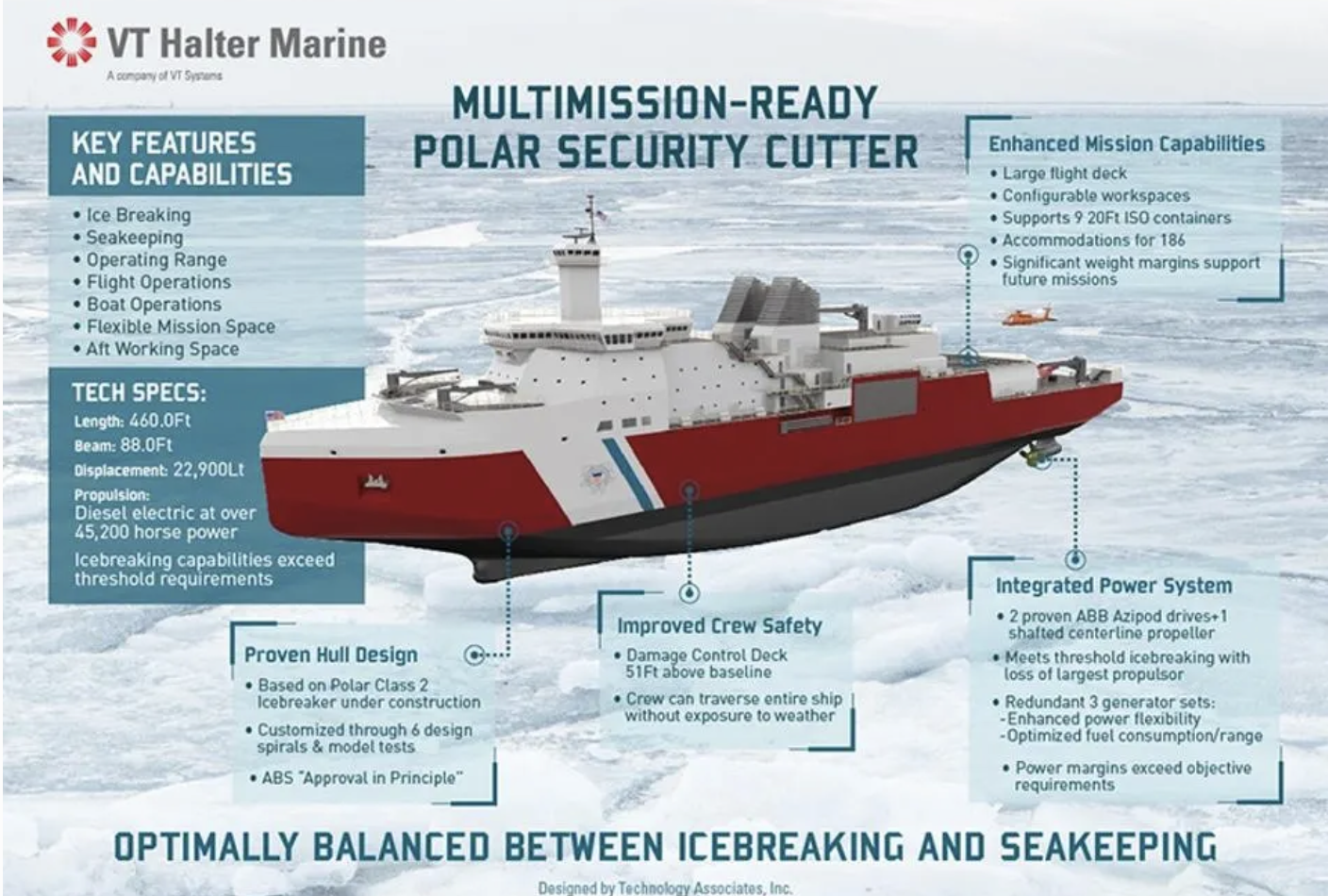
Unlike the German Navy, the 30x173mm round is already in service with the US Navy and is expected to arm the Polar Security Cutter.

The new large cutters are getting 57mm guns which should be effective, but the FRCs are the units most likely to encounter this threat. The 30 mm would also be more effective against larger threats. We have been told that it is possible to replace a few parts and upgrade existing 25mm mounts to 30mm mounts. If so, we should be doing this.

Austal Launches First Steel Ship / Good News for OPC Program?

Future USNS Billy Frank Jr. (T-ATS 11), June 2025

Below is an Austal USA news release,

Hopefully, this success suggests the Austal portion of the Offshore Patrol Cutter program will move along faster than the Eastern portion.

This ship, the future USNS Billy Frank, Jr. is the first in the second phase of procurement of a planned class of ten. The first five were contracted to Gulf Island Fabrication. The shipyard and the contract passed to Bollinger, 19 April 2021.

Austal got their contract for up to five in October 2021 (FY2022).

These are simpler ships than the OPCs, costing less than $80M each, but their full load displacement is actually more than that of the OPCs. The rate of progress seems to bode well for the OPCs. Billy Frank was laid down 14 November 2023 and launched 14 June 2025, 17 months later.

Certainly the Independence class trimaran Littoral Combat Ships that Austal has been building for 20 years are at least as complex as the OPC, and the last one, USS Pierre (LCS-38) went from keel laying to launch in only 14 months. We can’t expect construction of the first OPC to go that quickly, but for later ships it might be possible.

Two of the Bollinger ships are reportedly completed, but I have seen no indication they are  in service yet. The first took 41 months from laid down to launch, the second took 52 months to reach the same milestones. The third and fourth Bollinger built ships had keels laid in 2022 but have yet to be launched.

But were they late?:

It appears that the Austal contract actually anticipated faster delivery than we are seeing.

“The projected delivery for T-ATS 11 is in early FY 2025, with one more ship delivering in FY 2025, and two ships delivering in FY 2026.”

The Bollinger contract anticipated a slower delivery,

“The projected delivery for T-ATS 6 is in FY 2026, with follow-on Bollinger ships delivering each subsequent FY.”

Offshore Patrol Cutters: 

Austal got the Phase II contract for up to eleven OPCs in June 2022 and began building their first OPC in late August 2024. With Austal completing their last LCS, I hope to see rapid progress on OPCs #5-15.


JUNE 18, 2025

AUSTAL USA LAUNCHES FIRST STEEL SHIP FUTURE USNS BILLY FRANK JR. (T-ATS 11)

MOBILE, Ala. – Austal USA successfully launched the company’s first steel ship, the future USNS Billy Frank Jr. (T-ATS 11), on June 14.  Named after a native American Korean War veteran who, as an activist, fought for justice and environmental preservation in the Northwest United States, Billy Frank Jr. is a Navy Towing, Salvage and Rescue Ship – one of 3 under construction at Austal USA and the first steel product of the company’s state-of-the-art automated steel panel line.

“It was amazing to see the flawless rollout of our first steel ship,” said Harley Combs, vice president of surface ship programs. “The completion of this milestone is the result of the hard work and dedication of our talented workforce.  I am so proud of all they have accomplished.”

At 3,100 metric tons, T-ATS 11 is the heaviest ship Austal USA has launched to date. The launch was executed using the proven process used to launch most of the 32 Navy ships the company has built and delivered to the Navy over the last 15 years.

T-ATS will provide ocean-going towing, salvage and rescue capabilities to support fleet operations. T-ATS will be a multi-mission common hull platform capable of towing U.S. Navy ships and will have 6,000 square feet of deck space for embarked systems. The large, unobstructed deck allows for the embarkation of a variety of stand-alone and interchangeable systems. The T-ATS platform will combine the capabilities of the retiring Rescue and Salvage Ship (T-ARS 50) and Fleet Ocean Tug (T-ATF 166) platforms. T-ATS will be able to support current missions including towing, salvage, rescue, oil spill response, humanitarian assistance, and wide-area search and surveillance. The platform also enables future rapid capability initiatives such as supporting modular payloads with hotel services and appropriate interfaces.

With the ship over 85 percent complete at the time of launch, the future USNS Billy Frank Jr. will now prepare for her next major milestone, engine light off, as she gets ready for sea trials and delivery.

This Day in Coast Guard History, June 19

Based on the Coast Guard Historian’s timeline, https://www.history.uscg.mil/research/chronology/
With inspiration from Mike Kelso

June 19

1845  The Secretary of the Treasury had Lieutenants Thornton A. Jenkins and Richard Bache detailed from the Navy and sent abroad to procure information that might tend to the improvement of the lighthouse system of the United States.  Subsequently, when the Secretary submitted the report of these two naval officers and asked that a board be appointed to consider thoroughly the matter of lighthouse improvements.  No legislative action resulted.

1876  The first Gold Life Saving Medals ever awarded were presented to private citizens Lucien M. Clemens and his brothers Hubbard M. Clemons and Al J. Clemons.  On May 1, 1875 the Clemens’ brothers “displayed the most signal gallantry in saving two men from the wreck of the schooner Consuelo” in an open rowboat.  Five others on board the schooner perished when the schooner capsized in the heavy seas “with the wind blowing a gale from the northeast” before the brothers arrived on scene.  The medals were awarded by the Treasury Department.

1992  In a joint operation with INS, the Coast Guard assisted in the seizure of the 167-foot Belize-registered freighter Lucky No. 1, her 15-man crew, and 117 illegal Chinese migrants that were aboard.  The seizure took place off Oahu.

2008  The U.S. Coast Guard announced the launch of an ORBCOMM concept demonstration satellite, equipped with Automatic Identification System (AIS) capability, from Kapustin Yar, Russia. The satellite attained a proper orbit was expected to start transmitting operational data within the next three months. The U.S. Coast Guard Nationwide Automatic Identification System (NAIS) Project sponsored equipment on the satellite to test the feasibility and effectiveness of AIS message reception and reporting from space for ship tracking and other navigational activities. The NAIS project improved maritime domain awareness for the U.S. Coast Guard and Department of Homeland Security by using the integrated network of AIS equipment and user interface services that display and exchange AIS-equipped vessel information for maritime safety and security.  Data collected by the NAIS supports the nation’s maritime interests by promoting vessel and port safety through collision avoidance, and through detection, traffic identification, and classification of vessels out to 2,000 nautical miles from shore.

October 4, 2022, Rochelle Park, NJ – ORBCOMM Inc., a global provider of Internet of Things (IoT) solutions, today announced that it has been awarded a multi-year contract by a U.S. Government Agency for a competitive renewal of its global Automatic Identification System (AIS) data services used for ship tracking and other maritime navigational and safety efforts. In addition, ORBCOMM was awarded a separate competitive contract to deliver AIS services to multiple other U.S. Government users.

USCGC TAHOMA

2014  CGC Tahoma returned to its homeport in Portsmouth, New Hampshire after a 64-day deployment in the Caribbean Sea.  During the deployment, the 100-member crew of Tahoma worked under tactical control of Coast Guard Sector San Juan, Puerto Rico, conducted flight operations, patrolled drug and migration, conducted sea boarding, and assisted in the transfer or repatriation of 26 Haitian migrants.  The crew also participated in training and law enforcement operations, migrant interdiction and counterdrug operations in support of Operation Unified Resolve, and conducted Tailored Ship’s Training Availability (TSTA).  The crewmembers completed a total of 148 drills and exercises, earning the prestigious Battle “E” for excellence in five areas of professional expertise.

USCGC Valiant / Another WMEC210 Bits the Dust

Coast Guard Cutter Valiant (WMEC 621) is moored to the pier at Naval Station Mayport in Jacksonville, Florida, June 17, 2024. The cutter was honored after more than 57 years of service during a heritage recognition ceremony held in front of Coast Guard and cutter leadership, the assembled crew and former crew members, family and friends. (U.S. Coast Guard photo by Petty Officer 2nd Class Brandon Hillard)

Below is a Coast Guard news release.

If my count is right, we are now down to 21 WMECs: 7 WMEC 210s, 13 WMEC 270s, and USCGC Alex Haley. Along with the ten Bertholf class national security cutters, that only 31  large patrol cutters (over 1,000 tons). This is the lowest number we have had since before WWII. In addition, at any time two of the WMEC270s will be out of operation for SLEP.

To some extent the FRCs are filling the gaps left in our larger cutter fleet. The Coast Guard  currently has 58 delivered and serviceable. Looks like we are headed toward a total of 70.

The nation certainly got their money’s worth out of USCGC Valiant and the other 210s, These little ships were originally expected to operate within 50 miles off shore and to provide a lily pad for helicopters. Turns out they were a lot more capable than expected.

Certainly we need the larger ships like the NSCs to operate in the most challenging environments, but for other missions I think its a fair question to ask, where the 210s’ seakeeping was adequate, how much more effective were the larger cutters compared to this class?

With growing demand for Coast Guard assets, we need more larger platforms, but I don’t think they all need to be 4,500 tons or larger.


June 17, 2025

Coast Guard Cutter Valiant celebrated for over 57 years of service during heritage recognition ceremony

To view b-roll of the ceremony, click here.

NAVAL STATION MAYPORT, Fla. — The Coast Guard held a heritage recognition ceremony, Tuesday, in Jacksonville to honor the U.S. Coast Guard Cutter Valiant (WMEC 621) and recognize its more than 57 years of exemplary service.

The ceremony was presided over by Rear Adm. Adam Chamie, assistant commandant for operations integration and response policy, Coast Guard Headquarters in Washington, D.C., and served to celebrate Valiant’s contributions to the Coast Guard and nation in the presence of cutter leadership, current and former crew members, families and friends.

In addition to Chamie, a former commanding officer of Valiant, 2014-2016, the official party included: Cmdr. Matthew Press, commanding officer of Valiant, retired Capt. Timothy Cronin, former commanding officer of Valiant, 2016-2018, Senior Chief Petty Officer Clark Lauer, command senior enlisted leader of Valiant, Lt. Cmdr. Merrill Gutowski, executive officer of Valiant and master of ceremonies, and Chaplain Duke Leon Ann’El, Fraternal Order of Police, former Valiant crew member, 2006-2007.

The event also marked the ship’s exit from active-duty service for an indeterminate time, placing it in commission, special status. The 210-foot Valiant operated as a Coast Guard Atlantic Area Command asset, based in Portsmouth, Virginia, and was most recently homeported in Mayport.

Valiant, a multi-mission cutter, was built in Lorain, Ohio by the American Shipbuilding Company and was commissioned, Nov. 3, 1967. The cutter is the 7th of 16 vessels built in the Reliance-class of medium endurance cutters that have operated in the Coast Guard’s fleet. These cutters were designed for search and rescue, law enforcement missions such as counter-drug and alien interdiction, as well as national defense and international engagement.

Valiant was named after the inspirational trait, which means to act with courage and determination. It is the first Coast Guard cutter to bear its name.

The cutter has been helmed by several notable commanding officers to include, Adm. James Loy, former commandant of the Coast Guard, 1998-2002, and Capt. John G. Witherspoon, the first African American officer to command a medium endurance cutter and for whom the annual John G. Witherspoon Inspirational Leadership Award, which recognizes the Coast Guard officer, active duty and reserve, who best exemplifies the Coast Guard’s Core Values of Honor, Respect and Devotion to Duty, is named.

Valiant spent its first 24 years in the Coast Guard Eighth District area of responsibility while being homeported in Galveston, Texas. While there, it earned its nickname, “Guardian of the Gulf,” after crews assisted in several high-profile search and rescue cases.

In 1971, Valiant provided assistance after two Venezuelan freighters collided.

In 1972, the crew of Valiant supported the International Ice Patrol and identified icebergs off the coast of Newfoundland, Canada, locating hazards to navigation in the North Atlantic Ocean.

Later in the decade, the cutter responded to a collision between a tanker and a freighter in 1979.

Valiant played a crucial role in the mass Cuban exodus of 1980 known as the Mariel Boatlift, while working alongside numerous Coast Guard cutters, small boats, aircraft, and U.S. Navy vessels.

In June of 1990, Valiant and other Coast Guard cutters responded to the 853-foot Norwegian tanker Mega Borg after a deadly explosion in the engine room led to the release of oil approximately 60 miles off the coast of Texas. Valiant’s crew persevered through complex logistical problems, mounting an effective firefighting, salvage and pollution cleanup campaign.

Between 1991 and 1994, the cutter was decommissioned for the purpose of undergoing a major maintenance availability at the Coast Guad Yard in Baltimore, Maryland, extending its service operational life through modifications and modernizations.

After Valiant was recommissioned in January of 1994, it was transferred to the Seventh Coast Guard District area of responsibility and relocated to its second home port of Miami Beach for the next 18 years.

During Operations Able Manner and Able Vigil in 1994, the crew of Valiant interdicted over 500 Haitian and Cuban migrants. And the cutter repatriated over 1,900 Haitian migrants from Guantánamo Bay, Cuba to Port-au-Prince, Haiti over the course of 11 passages during this time.

Valiant served as patrol commander during the 1996 Summer Olympics sailing events in Savannah, Georgia, where the cutter directed over 29 Coast Guard assets to help ensure security for 800 athletes representing 98 different countries.

In 1997, the cutter’s crew helped train over 500 Caribbean Coast Guard members during Operation Tradewinds. Valiant taught personnel from 12 countries in fields such as damage control, engineering and seamanship fundamentals.

In January 1999, a Valiant and Coast Guard law enforcement detachment (LEDET) 406 boarding team interdicted over 10,000 pounds of cocaine from the merchant ship Cannes.

On Nov. 7, 1999, the crew of Valiant discovered a person in the water and another on the sinking hull of a partially submerged vessel. The two were enroute to Antigua and spent over 30 hours before they were rescued.

A few days later, Valiant’s crew rendezvoused with the HMS Northumberland and an embarked U.S. Coast Guard LEDET aboard the British naval vessel to intercept over 2.5 tons of cocaine aboard the the motor vessel Adriatik. After three days of lifting 110-pound bags of sugar, the crew of Valiant uncovered the illicit narcotics.

Later in the same month, Valiant served as on-scene commander while attempting to locate two missing sailing vessels near Saba Island, Netherlands Antilles in the wake of Hurricane Lenny. Their efforts located several capsized vessels adrift in the region, but unfortunately only one survivor was found.

In 2003, the first official Department of Homeland Security secretary’s speech was given by Secretary Thomas Ridge aboard Valiant at the Port of Miami.

In 2004, Valiant conducted alien migration interdiction operations during the Haiti rebellion, repatriating 531 Haitians intercepted on boats as they fled growing violence and turmoil fueled by rebel forces.

While deployed in 2006 to the Caribbean Basin and Florida Straits, Valiant’s crew interdicted 270 aliens attempting to enter the U.S. illegally and assisted the government of the Bahamas, seizing a Dominic Republic-flagged vessel illegally fishing in Bahamian territorial seas. The 65 crew members aboard the fishing vessel Barlovento were later transferred to Bahamain officials. During the same patrol, the crew made a port of call in Miami to host a presidential visit by President George W. Bush.

The cutter interdicted nearly five tons of cocaine from four separate smuggling vessels during a 2009 patrol. The narcotics, worth over $125 million, were seized as a result of coordinated efforts between Valiant’s crew, other Coast Guard assets and U.S. Customs and Border Patrol aircraft.

The crew of Valiant responded to the Haiti Earthquake of 2010, both supporting relief efforts while countering mass migration at sea. Valiant crew members assisted the Haitian Coast Guard to repair their damaged assets and coordinated with the Haitian government and the United Nations to open Cap-Haitien as a resupply and repatriation port during the earthquake’s aftermath.

On Aug. 8, 2012, Valiant transferred to its current home port of Mayport.

In 2017, Valiant conducted a counter-drug patrol in support of Joint Interagency Task Force – South. While deployed to the coast of Central and South America, the crew seized $47 million worth of cocaine and rescued several seas turtles entangled in garbage.

In October 2019, during an Eastern Pacific patrol, the cutter interdicted a self-propelled semi-submersible, a fishing vessel and a go-fast vessel. These actions resulted in Valiant seizing 16,000 pounds of cocaine worth over $218 million.

In September 2023, Valiant’s crew encountered a man in a giant hamster wheel, known as a hydro-pod, well off the Georgia coast. The man was warned about the approaching hurricanes and urged to abandon his unsafe vessel. Despite threats of self-harm and violence, the case was eventually handed over to another Coast Guard vessel, and after three days, he was arrested.

Most recently, Valiant completed a 33-day patrol in the Caribbean Sea earlier this year where the crew conducted counter-drug operations and seized 10,000 pounds of cocaine. The crew was transferred additional contraband from interdictions made by foreign naval partners with embarked Coast Guard law enforcement detachments on board. On June 6, the crew offloaded a combined total of 17,450 pounds of cocaine and 2,585 pounds of marijuana worth $132 million at Port Everglades.

The Valiant now transitions into an inactive shipyard status as part of the Coast Guard’s efforts to modernize its cutter fleet to combat the evolving security threats in the maritime domain. Force Design 2028 is an accelerated effort to transform the Coast Guard into a more agile, capable, and responsive fighting force. By optimizing resources, enhancing workforce readiness and integrating advanced technology to ensure mission readiness, Force Design 2028 provides a bold blueprint to renew the service to be better prepared to meet the mission readiness demanded by the American public.

Once back at the Coast Guard Yard, Valiant’s current crew will transition to different units both ashore and afloat, a step taken to help ensure the Coast Guard’s ability to prioritize lifesaving missions, national security, and protection of the Maritime Transportation System with no degradation to these critical services.

“I am grateful and thankful for our team. The crew makes the cutter, and I am honored to be part of this extraordinary team,” said Cmdr. Matthew Press, commanding officer of Valiant. “I am honored to be part of Valiant’s prestigious legacy.”

Valiant is a 210-foot, Reliance-class medium endurance cutter with a crew of 64 and 12 officers. Since commissioning in 1967, Valiant has conducted search and rescue missions, counter-drug and alien interdiction operations, supported national defense, marine environmental protection and homeland security missions and participated in the International Ice Patrol.

For information on how to join the U.S. Coast Guard, visit GoCoastGuard.com to learn about active duty, reserve, officer and enlisted opportunities.

Information on how to apply to the U.S. Coast Guard Academy can be found here.

This Day in Coast Guard History, June 18

Based on the Coast Guard Historian’s timeline, https://www.history.uscg.mil/research/chronology/
With inspiration from Mike Kelso

June 18

Crew of the Coast Guard Cutter James Rankin readies to set the Francis Scott Key buoy, June 2, 2017, where a ship carrying the author of “The Star-Spangled Banner” was anchored during the Fort McHenry bombardment in the War of 1812.

1812  The United States declared war against Great Britain.

An illustration of the Steamship Pulaski disaster, an 1838 boiler explosion. From page 170 of the 1848 book The tragedy of the seas; or, Sorrow on the ocean, lake, and river, from shipwreck, plague, fire and famine. Photo credit: Charles Ellms

1838  The steamboat Pulaski, a passenger vessel traveling between Baltimore and Charleston, suffered a boiler explosion while at sea, killing over 100 passengers and crew.  This was one of three fatal steamboat boiler explosions within as many months that forced the Federal Government to begin regulating merchant steam vessels.

1878  Congress established the U.S. Life-Saving Service as a separate agency under the control of the Treasury Department (20 Stat. L., 163).

1878  The 45th Congress enacted a rider on an Army appropriations bill that became known as the Posse Comitatus Act [Chapter 263, Section 15, U.S. Statutes, Vol. 20.]  This act limited military involvement in civil law enforcement leaving the Revenue Cutter Service as the only military force consistently charged with federal law enforcement on the high seas and in U.S. waters.  The rider prohibited the use of the Army in domestic civilian law enforcement without Constitutional or Congressional authority.  The use of the Navy was prohibited by regulation and the rider was amended in 1976 outlawing the use of the Air Force.  In 1981, however, new legislation allowed the Secretary of Defense to bring Army, Navy, Air Force, and Marine Corps support to civilian authorities in intelligence, equipment, base and research facilities, and related training.

The original 1903 Scotch Cap Light, located on the SW corner of Unimak Is., Alaska . US Coast Guard photos

1903  Alaska’s first coastal lighthouse, Scotch Cap Lighthouse, was first lit.  It was located near the west end of Unimak Island on the Pacific side of Unimak Pass, the main passage through the Aleutian Islands into the Bering Sea.

1930  An Act of Congress provided “for the transfer of the old lighthouse at Cape Henry, Virginia, to the Association for the Preservation of Virginia Antiquities.”

1938  The first low power, unattended “secondary” radio aid to navigation was established at St. Ignace, Michigan.

Former Coast Guard member Walter Scobie visited Stannard Rock Lighthouse in Lake Superior with family members on June 17, 2015. Scobie was stationed at the lighthouse in 1961 when an explosion killed a Coast Guardsman, damaged the inside and caused him and two others to be stranded for three days before being rescued. (Courtesy photos | U.S. Coast Guard Senior Chief Alan Haraf).

1961  An explosion in the power room of the Stannard Rock Lighthouse killed PO1c William Maxwell, one of the four Coast Guardsmen at the station at that time.


Courtesy photos | U.S. Coast Guard Senior Chief Alan Haraf

U.S. Coast Guard Cutter Forward (WMEC 911) approaches the pier, Sept. 26, in Portsmouth, Virginia. Forward completed a two-and-a-half month-long patrol in the North Atlantic Ocean to support the Coast Guard Arctic Strategy and participate in the Canadian Armed Forces-led Operation Nanook 2023, an annual military exercise conducted to strengthen shared maritime objectives in the high northern latitudes. (U.S. Coast Guard photo by Petty Officer 2nd Class Brandon Hillard)

1995  The 736-foot cruise ship Celebration suffered an engine-room fire and lost power while off the coast of San Salvador, Bahamas.  CGC Forward responded and was designated as the on-scene commander.  CGC Vigorous was also diverted to lend assistance.  The cruise ship’s Halon system put out the fire but she was drifting dangerously close to shore.  The Forward then towed her throughout the night away from shore until the arrival of commercial tugs the next day.  A Coast Guard helicopter medevaced one passenger– a 25-year-old quadriplegic from Israel who relied on electrically powered medical equipment .  On June 20 the crew of the Forward and MSO Miami team members stood by while the 1,735 passengers still aboard were transferred from the Celebration to the cruise ship Ecstasy, which had arrived in the area.  The Ecstasy then sailed for Miami and the Celebration, with one engine then on-line, sailed to Freeport for repairs.

1999  CGC Midgett departed its homeport of Seattle for a six-month deployment to the Persian Gulf.  Midgett was attached to a Navy carrier battle group and its crew brought the Coast Guard’s expertise in boarding ships to the group.  Once in the Gulf, the cutter’s primary mission was to enforce United Nations’ sanctions against illegal Iraq petroleum shipments and conduct SAR operations.

This Day in Coast Guard History, June 17

Based on the Coast Guard Historian’s timeline, https://www.history.uscg.mil/research/chronology/
With inspiration from Mike Kelso

June 17

1832  The practice of utilizing “surplus” naval officers as officers of the Revenue Marine was discontinued.  Revenue officer vacancies were henceforth filled by promotion from within the service.

1910  An Act of Congress (36 Stat. L., 534) abolished the Lighthouse Board and created the Bureau of Lighthouses to have complete charge of the Lighthouse Service.  This law constituted the organic act under which the Lighthouse Service operated thereafter.

1942  The Commander-in-Chief, U.S. Fleet ordered the organization of coastal pickets to combat the “submarine menace” off the Atlantic Coast.  The hodge-podge fleet of primarily small private recreational craft taken into government service under Coast Guard direction became known as the “Corsair Fleet.” This was in the response to U-boat attacks along the East and Gulf coast that began after the US entered WWII. This period was referred to by the German Navy as the “Second Happy Time.”

The Second Happy Time lasted from January 1942 to about August of that year and involved several German naval operations, including Operation Neuland. German submariners named it the “Happy Time” or the “Golden Time,” as defense measures were weak and disorganized, and the U-boats were able to inflict massive damage with little risk. During this period, Axis submarines sank 609 ships totaling 3.1 million tons, against a loss of only 22 U-boats. This led to the loss of thousands of lives, mainly those of merchant mariners. Although fewer than the losses during the 1917 campaign of the First World War, those of this period equaled roughly one quarter of all ships sunk by U-boats during the entire Second World War.

The Second Happy Time ended primarily because a coastal convoy system was instituted, but there was a rationale for the formation of the Corsair Fleet using sailing vessels. U-boats would stay submerged during the day but surface at night to hunt and recharge their batteries. Because boats under sail would make very little noise, they might escape detection by the U-boat before they surfaced. The Corsair fleet was armed with depth charges and machine guns but they were primarily expected to report sightings.

1983  National Narcotics Border Interdiction System (NNBIS) began operations under the direction of Vice President George Bush and the executive board consisting of Secretaries of State, Transportation and Defense, the Attorney General, the Counselor to the President, the Director of Central Intelligence, and the Director of the White House Drug Abuse Policy Office.  “U.S. Army, Air Force, Navy, and Marine Corps airborne and seaborne craft, intelligence, technology, surveillance, and manpower now are used to augment operations by the U.S. Coast Guard, Customs Service, the Drug Enforcement Agency, Federal Bureau of Investigation, Immigration and Naturalization Service, Border Patrol, and the U.S. Attorney’s Office.  The system provides a coordinated national and international interagency network for prioritizing interdiction targets, identifying resources, recommending the most effective action, and coordinating joint special actions.

2013  The Coast Guard 13th District and the Royal Canadian Mounted Police “E” Division signed a finalized agreement for the Pacific region Integrated Cross-border Maritime Law Enforcement program, known as “Shiprider,” during a ceremony at the Peace Arch Provincial Park in British Columbia, Canada.  Shiprider was a program that enabled specially-trained officials from both nations to pursue or interdict suspected criminals transiting across the shared maritime border.  The concept of Shiprider was first introduced in 2005.  A version of the agreement proved successful during the Winter Olympic Games in Vancouver, British Columbia, in 2010.

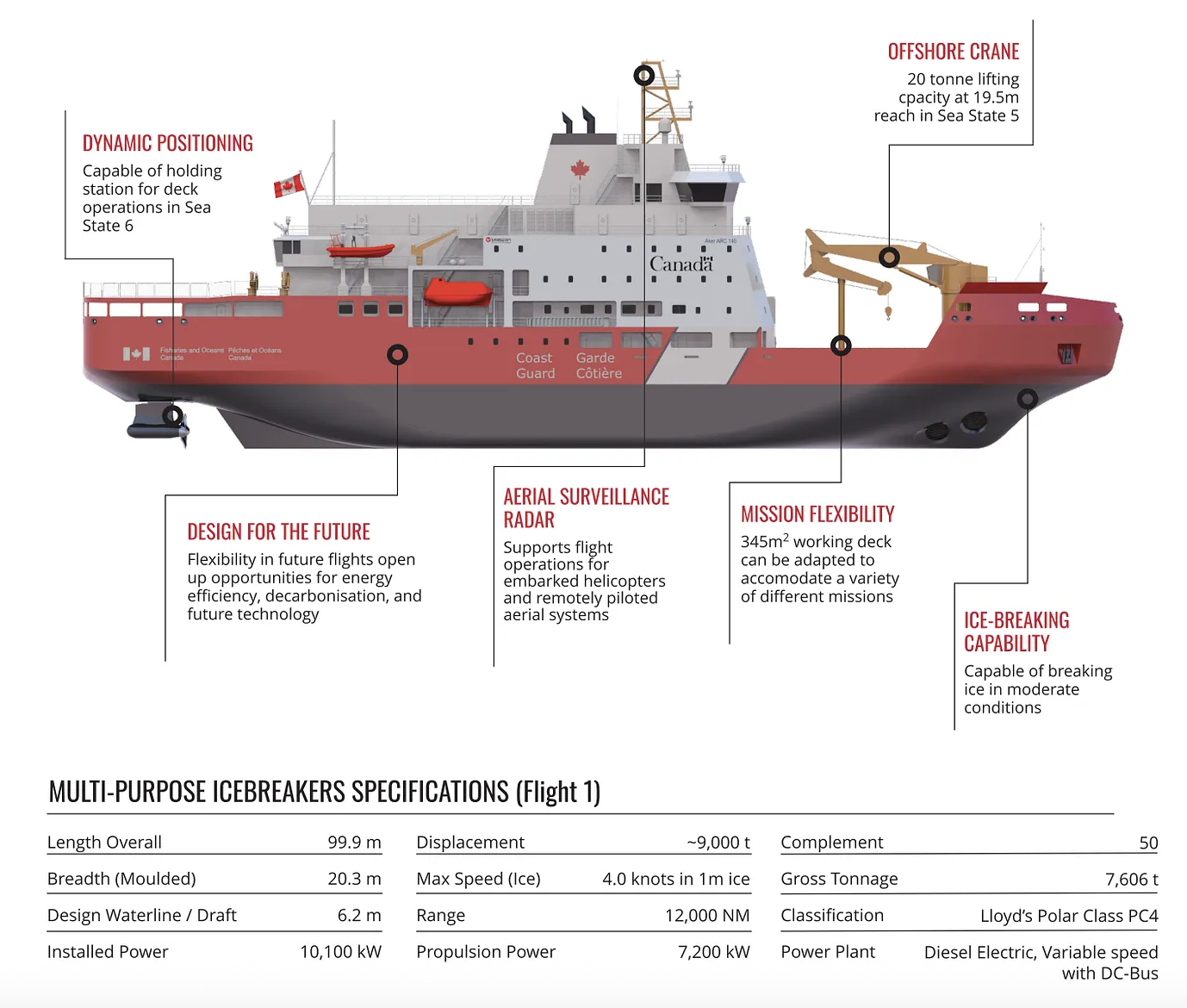
“Analyzing the Arctic Security Cutter Request for Information” –Sixty Degrees North

Canadian CG MPV. Credit Aker Arctic.

An excellent article here from Sixty Degrees North.

Minor difference with the analysis above, authors states,

“Note that it is about 3,000 nautical miles from Seattle to northern Alaska, so the 6,000 nm range in the RFI is likely insufficient for meaningful operations in the Arctic.”

The 6500 nautical mile range listed in the RFI is probably adequate given the possibility of refueling in Alaska, although longer range is always a desirable attribute.

Note there has been considerable news lately that Canadian Shipbuilder Davie has announced an intention to acquire Gulf Copper & Manufacturing Corporation with facilities in Port Arthur and Galveston. It is always going to be difficult to sell the idea that US military vessels should be built outside the US.