“USCGC Katmai Bay making a path through the ice for Algonova going to the Soo on Jan 31st, 2025” –Video

A regular reader wanted to share this video. This was his comment.

I did not know where to put this, so I found one of the stories about the 140′ Ice Breaking Tugs in the Great Lakes

Below is a YouTube link of the USCGC Katmai Bay breaking ice up in Sault Ste. Marie as it was escorting a tanker.

Beautiful close up shots of her after the 20min mark, and you can clearly see her bubbler system working as she slices through the ice.

Just wanted to share this, as these 140’s are a unique asset in the Great Lakes – Very well made ships that still look strong (where’s the 140′ Replacement Program Congress!!).

Are we not allowed to post YouTube Links?? In not, please go search on YouTube for: “USCGC Katmai Bay making a path through the ice for Algonova going to the Soo on Jan 31st, 2025”

So I am passing it along.

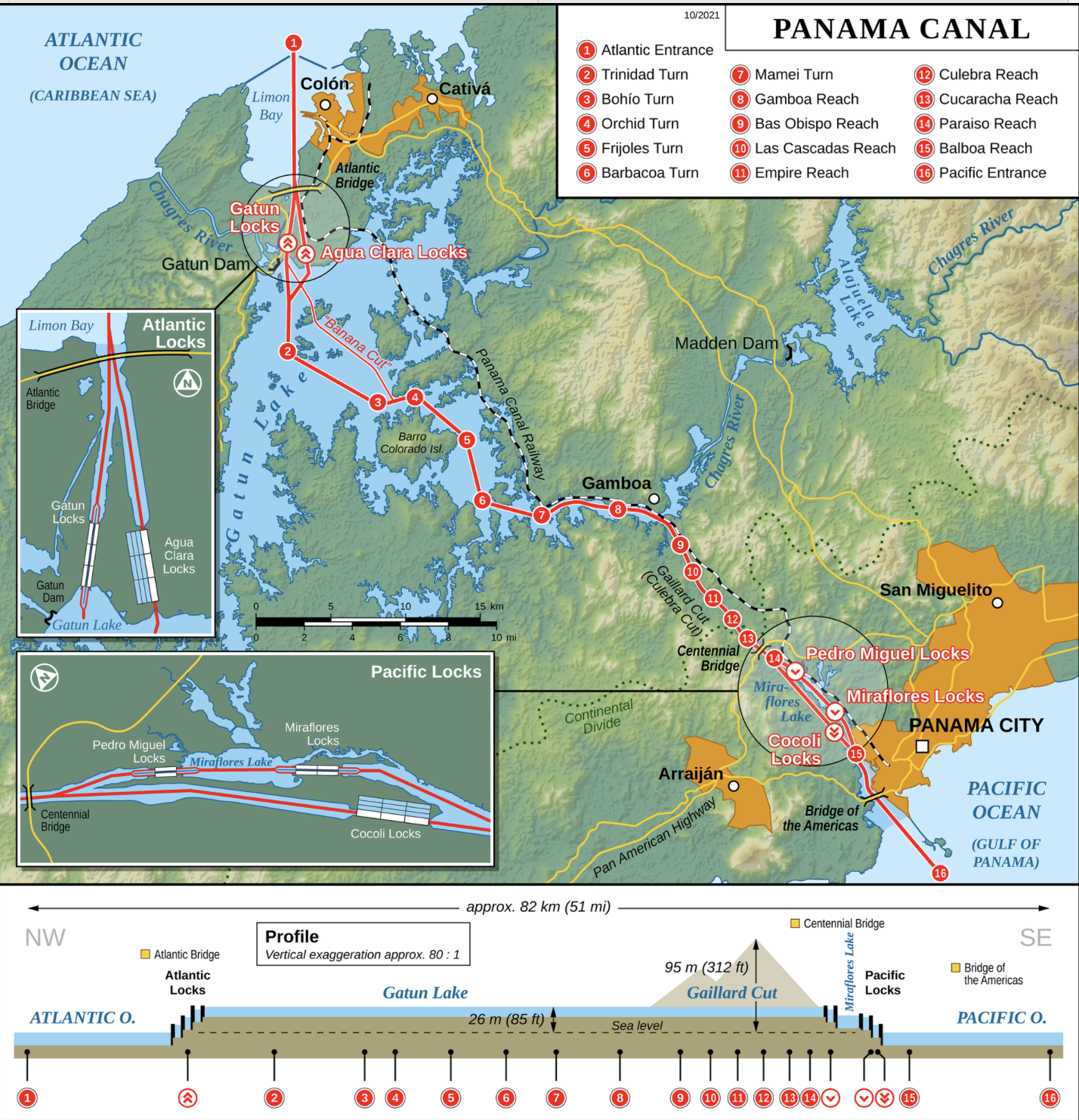
What About Panama?

My previous post included a discussion about the US interests in the Panama Canal and the President’s stated aim of retaking the canal. The discussion suggested that talk of a complete takeover might be a negotiating tactic. In any case it suggests that US forces may make a return to the Canal Zone.

This could be significant for the Coast Guard. The Coast Guard might replicate PATFORSWA with a squadron of Webber Class WPCs that would be very useful in interdicting drug traffic in the Eastern Pacific Transit Zone–PATFORCENTAM.

A Coast Guard base and support center, hosting perhaps a reinforced company of Marines, tasked with doing training in Central America, might be enough to satisfy US concerns about the security of the canal.

A Coast Guard base would also probably be more welcomed by Panama than a DOD base that would look like an occupying force. After all, both the US and Panama share an interest in maritime law enforcement and the security of the canal.

“What the Ship (Ep116) | Maritime Leaders | Tariffs & Review | Panama Canal | Wind Leases | Red Sea”

“What the Ship” is usually interesting, but this episode is more Coast Guard centric than most.

I would say the Coast Guard needs to stop talking about how small it is. The US Coast Guard does not have aircraft carriers or submarines but has more uniformed personnel, more vessels, and more aircraft than either the British or French Navies. The Coast Guard could make a significant contribution to national security if the country made relatively inexpensive additional investments in it.

“The Propulsion Disabler Will Be a Strategic Weapon” –USNI

A Navy briefing slide showing the internal components and describing the various features of the PSU_ARL Common Very Light Weight Torpedo (CVLWT) design

The January 2025 US Naval Institute Proceedings includes an article suggesting the development of “Propulsion Disablers.”

A propulsion disabler (PD) is a small, passive, torpedo-like device that serves as a cheap, non-lethal mine and torpedo warhead. The proposed munition’s purpose is to destroy a ship’s external propulsion or direction-control mechanisms, leaving the vessel stationary. Production of PDs is possible with today’s emerging robotics technologies. Future PD devices could be used in an autonomous swarm that combines the smallest explosive charge with the greatest disabling effect by attacking a ship at its most vulnerable point.

I have been advocating for a propulsion disabler (ship stopper) since at least 2011, since Coast Guard missions imply a requirement to be able to forcibly stop any ship, regardless of size. This article is the first I have seen that suggests the Navy may see a need for a similar weapon.

The Very Light Weight Torpedo pictured above appears to be a likely basis for a propulsion disabler.

One potential scenario where this capability might be required is in the case of an effort to impose a blockade. The linked post discusses this in relationship to a blockade of China.

The propulsion disabler concept first emerged in the search to make a Western blockade strategy affordable and sustainable, and to solve the moral, political, and legal problems involved in a blockade

Another US Naval Institute article explains the problems that might be encountered in the imposition of a blockade,

Legally, deliberately targeting neutral merchants and civilians would be an excellent way to get hauled before the International Court of Justice at the Hague while alienating not only the neutral state but also the home nations of the crew. Ethically, it constitutes a direct attack on civilians. Tactically, attacking and sinking merchantmen would involve the expenditure of an unacceptable number of heavyweight torpedoes or advanced antiship cruise missiles (ASCM) better employed against high-end enemy combatants or troop transports. The economic damage to fisheries caused by the sinking of a single supertanker would devastate coastal nations. Strategically, it could turn neutral-friendly nations into neutral-hostile nations.

The second USNI article makes no mention of Coast Guard assets in the execution of a blockade of China, but that does seem like a likely mission for Coast Guard units and special teams.

This Day in Coast Guard History, February 1

Based on the Coast Guard Historian’s timeline, https://www.history.uscg.mil/research/chronology/
With inspiration from Mike Kelso

February 1

1871  Using his administrative authority, Secretary of the Treasury George S. Boutwell re-established a Revenue Marine Bureau within the Department and assigned Sumner I.  Kimball as the civilian Chief.  (He was 36 at the time.) Kimball’s duties included administering both the revenue cutters, which were then under the control of the local Collectors, and the life-saving stations.

Sumner Increase Kimball, organizer of the United States Life-Saving Service and the General Superintendent of the Life-Saving Service from 1878–1915.1913, American magazine, Volume 150

1938  The Lighthouse Service Radio Laboratory was moved from the shops of the lighthouse depot in Detroit, Michigan, “to the Lazaretto Lighthouse Depot in Baltimore, Md., where a building had been constructed providing more adequately for this important branch of the work of the Service.”

1942  Enlistees after this date were restricted to enlistment in the Coast Guard Reserve. This was done to prevent having too many regulars in the service at the end of World War II.

1944  Coast Guardsmen participated in the invasion of Namur Island, Kwajalein Atoll.

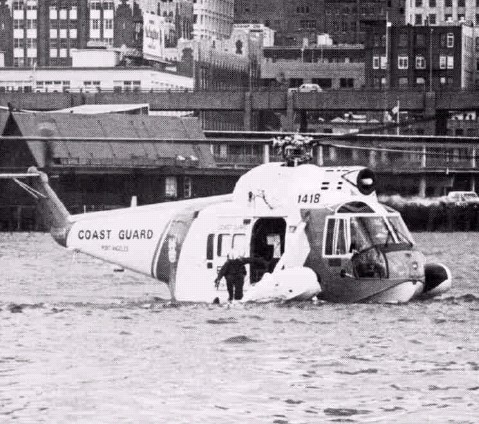
File:HH-52A PortAngelesWA NAN6-79.jpg

U.S. Coast Guard HH-52A floating in Seattle in 1979

1963  The Coast Guard’s “newest” helicopter, the Sikorsky HH-52, performed its first rescue.  On February1, 1963, the F/V Enterprize sank after colliding with ice off Hyannis, Massachusetts.  The two crewman of the vessel abandoned and sought safety on the ice.  After a 63-mile flight, 56 of which were over water at night, the aircraft commander, LT R. A. Johannsen, landed the HH-52A (CG-1352) on the ice and made the rescue.

“Operation Southern Spear: Latest Development in Operationalizing Robotic and Autonomous Systems” –4th Fleet

Commercial operators deploy Saildrone Voyager Unmanned Surface Vessels (USVs) out to sea in the initial steps of U.S. 4th Fleet’s Operation Windward Stack during a launch from Naval Air Station Key West’s Mole Pier and Truman Harbor, Sept. 13, 2023. (U.S. Navy photo by Danette Baso Silvers/Released)

Below is a news release from U.S. Naval Forces Southern Command/U.S. Fourth Fleet.

This involves the Coast Guard and the opposing forces are drug smugglers.


Jan. 27, 2025

By U.S. Naval Forces Southern Command/U.S. 4th Fleet Public Affairs

U.S. Naval Forces Southern Command/U.S. 4th Fleet is advancing the Navy’s Hybrid Fleet Campaign through Operation Southern Spear, which will start later this month in U.S. Southern Command Area of Responsibility (USSOUTHCOM AOR) and at U.S. 4th Fleet Headquarters at Naval Station Mayport.

“Southern Spear will operationalize a heterogeneous mix of Robotic and Autonomous Systems (RAS) to support the detection and monitoring of illicit trafficking while learning lessons for other theaters,” said Cmdr. Foster Edwards, 4th Fleet’s Hybrid Fleet Director. “Southern Spear will continue our (4th Fleet’s) move away from short-duration experimentation into long-duration operations that will help develop critical techniques and procedures in integrating RAS into the maritime environment.”

Specifically, Operation Southern Spear will deploy long-dwell robotic surface vessels, small robotic interceptor boats, and vertical take-off and landing robotic air vessels to the USSOUTHCOM AOR. 4th Fleet will operationalize these unmanned systems through integration with U.S. Coast Guard cutters at sea and operations centers at 4th Fleet and Joint Interagency Task Force South. Southern Spear’s results will help determine combinations of unmanned vehicles and manned forces needed to provide coordinated maritime domain awareness and conduct counternarcotics operations.

U.S. 4th Fleet is conducting Operation Southern Spear in support of our Navy’s Project 33 targets to operationalize RAS. Using RAS to increase presence in, and awareness of, strategically and economically important maritime regions will help decision-making, strengthen sovereignty, and facilitate regional cooperation.

“Operation Southern Spear is the next step in our Hybrid Fleet Campaign,” said Rear Adm. Carlos Sardiello, Commander, U.S. Naval Forces Southern Command/U.S. Fourth Fleet. “We look forward to the results of Southern Spear. Hybrid Fleet operations increase our collaboration with partners in the region while furthering the Navy’s tactics, techniques, procedures, and processes.”

U.S. Naval Forces Southern Command/U.S. 4th Fleet is the trusted maritime partner for Caribbean, Central and South America maritime forces leading to improved unity, security and stability.

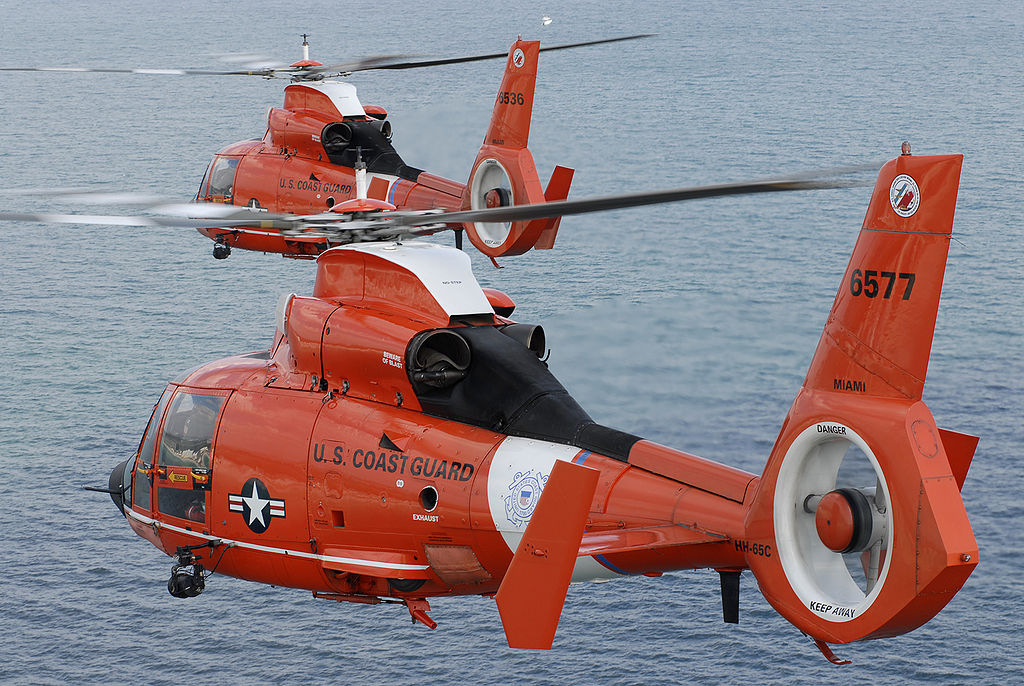
Airbus and U.S. Coast Guard sign support agreement for MH-65 fleet” –AIRBUS News Release

US Coast Guard photo, by PAC Dana Warr

Below is a news release from AIRBUS.

Looks like we expect the H-65 to continue serving in the Coast Guard until at least 2037. Cutters with flight decks but incapable of operating larger helicopters should all be gone by then.


Grand Prairie, Texas  – Airbus Helicopters has signed a Memorandum of Understanding (MOU) with the United States Coast Guard (USCG) to continue providing support for the service’s fleet of MH-65 Dolphin helicopters through 2037. The agreement reaffirms Airbus Helicopters’ commitment to ensuring the mission readiness of the USCG’s fleet as it performs critical search and rescue, law enforcement, and disaster response missions.

Under the terms of the MOU, Airbus Helicopters will deliver enhanced maintenance, spare parts, and technical support to optimize the performance and availability of the MH-65 fleet. The agreement also includes provisions for fleet modernization and engineering services to extend the operational life of the aircraft.

“The U.S. Coast Guard’s MH-65 helicopters are at the forefront of safeguarding our nation’s coastlines and saving lives,” said Bart Reijnen, President of Airbus Helicopters in the U.S. and Head of the North America region. “We are honored to continue working with the Coast Guard to ensure their fleet remains mission-ready for years to come. This agreement demonstrates our shared commitment to safety, reliability, and operational excellence.”

The MH-65 Dolphin has been the backbone of the Coast Guard’s aviation fleet for more than four decades. With this new MOU, Airbus Helicopters and the USCG aim to maintain the fleet’s high level of operational capability, enabling continued support for critical missions across the country.

Airbus Helicopters has a long-standing partnership with the USCG, providing tailored solutions to meet the service’s dynamic operational demands. The extended collaboration will build on this history, leveraging Airbus’ global support network and industry-leading expertise.

@AirbusHeli #MH65

This Day in Coast Guard History, January 31

Based on the Coast Guard Historian’s timeline, https://www.history.uscg.mil/research/chronology/
With inspiration from Mike Kelso

January 31

USCGC Itasca as HMS Gorlsston, a sister ship of HMS Culver (former USCGC Mendota), one of ten Lake Class cutters transferred to the Royal Navy under Lend Lease.

1942 HMS Culver (ex-CGC Mendota – one of the “Lake” Class cutters transferred to the Royal Navy in 1941 under the Lend-Lease program) was torpedoed and sunk with only 13 survivors.

An older woman polishes the mirror, known as a Fresnel lens, behind a light bulb

Salter polishes the Fresnel lens at Turkey Point Light, 1945

1948 Mrs. Fannie M. Salter, keeper of the Turkey Point Lighthouse in upper Chesapeake Bay since 1925 and the last woman keeper of a lighthouse in the United States, retired from active service.  The first woman had been hired as a lighthouse keeper 150 years before.  Salter’s retirement temporarily closed the tradition of women serving as keepers at lighthouses.

1968 Coast Guard SPAR Chief Storekeeper Mary Ashley Rose retired “after a career of more than 20 years of service in the Coast Guard.  Chief Rose is the first enlisted woman to retire from active duty in the Coast Guard.”

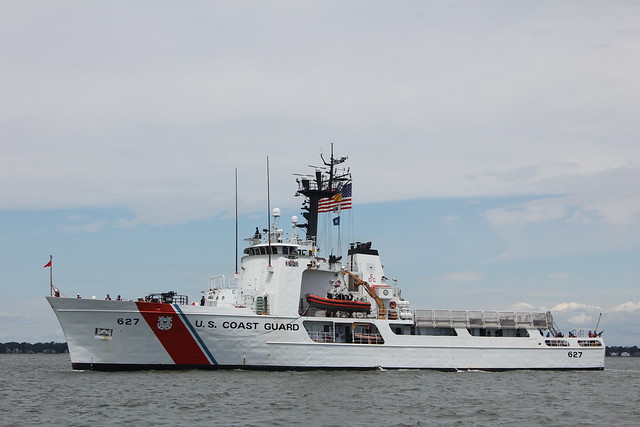
USCGC Vigorous

1975 CGC Vigorous (WMEC-627) became the first cutter to make a seizure of a foreign-flag fishing vessel on the high seas when she seized the Italian fishing vessel Tontini Pesca Cuarto for illegally taking lobster.  All of the other fishery seizures prior to this were of vessels that had violated territorial seas (TS) or Contiguous Fishing Zone (CFZ).  At the time, Vigorous was under the command of CDR Paul Welling, USCG.  The arresting officer was ENS S.T. Fuger, Jr., USCG.

2000 Alaska Airlines Flight 261 crashed off the coast of California near the Channel Islands, killing all 88 on board.  Coast Guard Channel Island Station crewmen responded to the tragedy.

2004 The crews of a 47-foot MLB from Station Chincoteague and a rescue helicopter from Air Station Elizabeth City combined to rescue five men after their vessel began taking on water 25 miles east of Chincoteague.

“First of 3 new Coast Guard cutters arrives to homeport in Kodiak, Alaska” –Coast Guard News

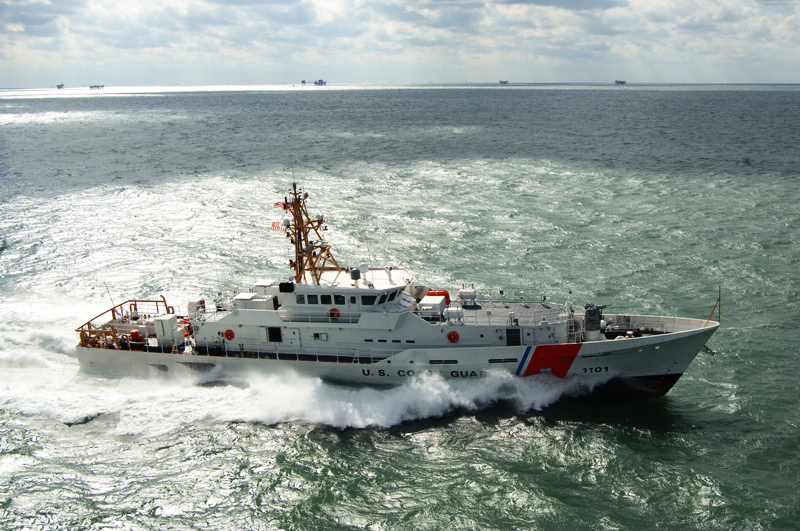
One of the U.S. Coast Guard’s modern Fast Response Cutters underway. (U.S. Coast Guard) Below is a news release from CG News. We knew this was coming. There are only three WPB110s left in the USCG, all in Alaska. Presumably, this will be their last year.

What I found most interesting here was this statement, “… they will operate throughout the 17th Coast Guard District to include the U.S. Arctic, Gulf of Alaska, and Bering Sea.”

We have already seen Alaska based FRCs operating in the Aleutians. The US considers the Bering Sea as part of the Arctic, though it is below the Arctic Circle, so it may not mean they will operate North of the Bering Strait, but that’s what it sounds like.

Earlier story about Captain Witherspoon here.

The crew of U.S. Coast Guard Cutter John Witherspoon (WPC 1158) arrives to their homeport in Kodiak, Alaska, aboard their cutter for the first time, Jan. 28, 2025. (U.S. Coast Guard photo by Petty Officer 1st Class Shannon Kearney)


 Jan. 29, 2025

First of 3 new Coast Guard cutters arrives to homeport in Kodiak, Alaska

D17 Public Affairs

KODIAK, Alaska — The crew of Coast Guard Cutter John Witherspoon (WPC 1158) arrived at the cutter’s new homeport in Kodiak, Tuesday.

The cutter is scheduled to be commissioned during a ceremony in April.

The Witherspoon is the first of three Fast Response Cutters (FRCs) scheduled to be homeported at Coast Guard Base Kodiak and is now the fourth FRC currently based in Alaska. While these ships will be homeported in Kodiak, they will operate throughout the 17th Coast Guard District to include the U.S. Arctic, Gulf of Alaska, and Bering Sea.

The crew of the Witherspoon will carry out integral Coast Guard missions such as maritime law enforcement and security, living marine resources, and search and rescue. They will provide security for Alaskan coastal communities as they continue to utilize the ocean for their livelihoods while preserving Alaska’s living marine resources in conjunction with our partner agencies.

“The crew is humbled to be associated to a namesake honoring Capt. John G. Witherspoon, a trailblazer who found enjoyment and purpose in leading and mentoring others,” said Lt. Cmdr. Adam Young, commanding officer of the Witherspoon. “It is fitting that the cutter’s first sail was no tall order, stretching more than 7,000 nautical miles from Key West to Kodiak. Throughout the last five months, the crew displayed remarkable teamwork and resilience, a true testament to the core values Capt. Witherspoon epitomized throughout his illustrious career. I couldn’t be prouder of the team we have onboard, and I look forward to experiencing the beauty of Alaska once again.”

The new FRCs arriving in Alaska are designed to replace the service’s fleet of 110-foot cutters that are projected to be decommissioned this year. The Coast Guard is currently scheduled to have six FRCs operating throughout Alaska by the end of 2025 to reinforce our maritime boundaries and shorten on-scene response times to support search and rescue efforts and better serve the people of Alaska.

FRCs feature advanced command, control, communications, computers, intelligence, surveillance and reconnaissance equipment as well as over-the-horizon response boat deployment capability and improved habitability for the crew. The ships can reach speeds of 28 knots and are equipped to coordinate operations with partner agencies and long-range Coast Guard assets such as the Coast Guard’s National Security Cutters.

FRCs are 154-foot multi-mission ships designed to conduct drug and migrant interdictions; ports, waterways and coastal security operations; fisheries and environmental protection patrols; national defense missions; and search and rescue. Each cutter is designed for a crew of 24, has a range of 2,500 miles and is equipped for patrols up to five days. The FRCs are part of the Coast Guard’s overall fleet modernization initiative.

Coast Guard, multiple partner agencies, responding to plane crash in Potomac River

Jan. 30, 2025

Coast Guard, multiple partner agencies, responding to plane crash in Potomac River

WASHINGTON — The Coast Guard is coordinating with local, state and federal agencies in response to the aircraft collision which occurred Wednesday evening over the Potomac River in Washington.

Coast Guard Sector Maryland – National Capital Region command center watchstanders received a report at approximately 8:55 p.m. reporting a helicopter and a commercial passenger aircraft collided in the vicinity of Ronald Reagan Airport.

Response boat crews from Coast Guard stations Washington, Curtis Bay, Annapolis, St. Inigoes, Oxford and Crisfield have deployed to the incident to conduct searches in coordination with local partners and enforce a safety zone. Cutters Sailfish, Bruckenthal, Kennebec and Frank Drew are enroute to assist.

An Urgent Marine Information Broadcast was issued regarding the incident and a safety zone has been established, securing all vessel traffic from the Woodrow Willson Bridge heading north along the Potomac River. Mariners are urged to avoid the area.

Coast Guard pollution crews have mobilized and are pre-staged to respond to any pollution caused by the incident.

The Coast Guard is working with the Army Corps of Engineers and Navy’s Supervisor of Salvage and Diving to coordinate removing the wreckage and restoring the waterways once able to do so.