USCGC Alexander Hamilton (WPG-34) Lost January 30, 1942

Today is the 83rd anniversary of the sinking of USCGC Alexander Hamilton (WPG-34), January 30, 1942. She was the Coast Guard’s first loss of World War II and the first US warship sunk in the Atlantic after the US entered the War.

USCGC Hamilton (WMSL-753)’s web site has the story of her sinking which I have reproduced below.

There is a “Booklet of General Plans” as originally built here, and contract plans here.

U-132, which torpedoed Alexander Hamilton, also sank ten other ships but was “Sunk on 4 November 1942 in the North Atlantic south-east of Cape Farewell, in approx. position 55.38N, 39.52W, when the British ammunition ship Hatimura blew up in a huge explosion. U-132 had torpedoed this ship earlier and was probably waiting nearby for her to sink when caught in the lethal radius of the explosion. 47 dead (all hands lost). (FDS/NHB, January 1985).”

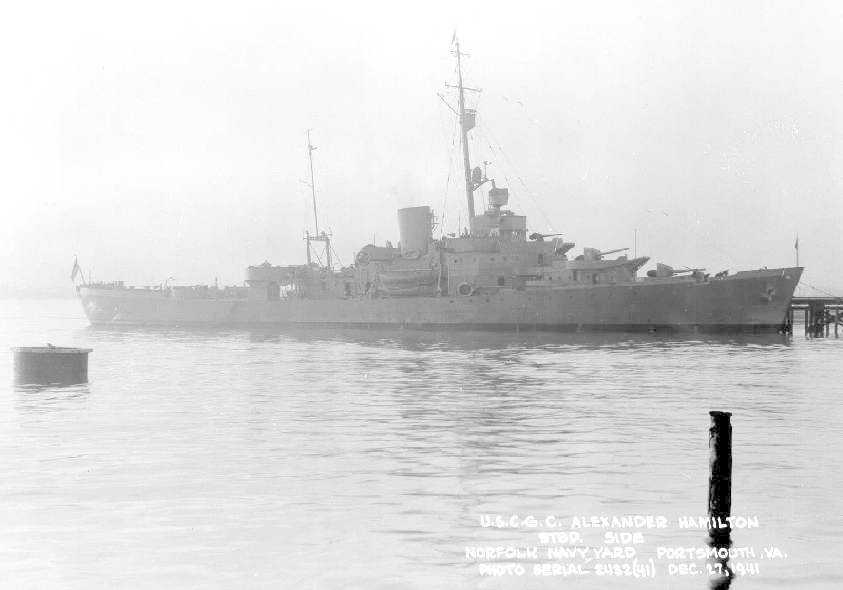
Found some photos of Cutter Alexander Hamilton on Facebook that were taken only five weeks before she was sunk. She is much better armed then when she was built, with three 5″/51s and three 3″/50s, but does not have some of the equipment seen on other ships of her class in pictures taken in 1942/43, no radar, no High Frequency Direction Finder (HF/DF), a Y-gun in the photo immediately but no K-Gun depth charge launchers.
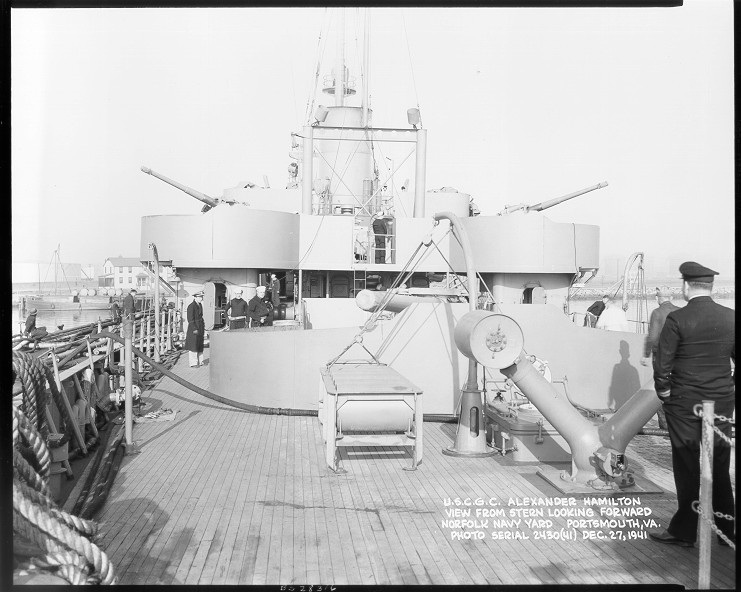
U.S.C.G.C. Alexander Hamilton view from stern looking forward, Norfolk Navy Yard Portsmouth, VA. Photo Serial 2430(41) Dec. 27, 1941.

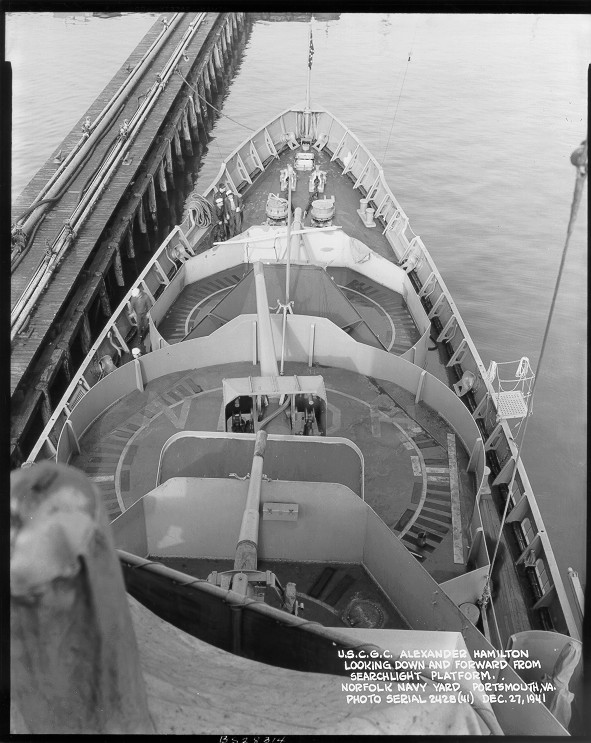
U.S.C.G.C Alexander Hamilton STBD. Side Norfolk Navy Yard Portsmouth, VA Photo Serial 8482(41) Dec 27, 1941″


THE FIRST LOSS; THE SINKING OF THE ALEXANDER HAMILTON
by Dr. Robert M. Browning Jr.

When the United States entered World War II, the Coast Guard had already demonstrated its value in this country’s national defense.  For over a year the Coast Guard, with its large cutters and experienced seamen, had protected American interest in the North Atlantic.  They had maintained patrols in Greenland and took a prominent role in the protection of America’s seaborne commerce in this area.  The 327 foot cutters in particular were well-suited for convoy duty in the North Atlantic. Because of their long-range and good sea-keeping qualities along with their speed and armament, the Navy Department put the entire class into naval service before the war began.  The Alexander Hamilton, participating with the ocean escorts in the icy North Atlantic, became the Coast Guard’s first loss of the war.

The Alexander Hamilton was one of the newest ships in the service.  Built at the New York Navy Yard, this twin-screw, geared-steam-turbine-propelled cutter was commissioned in March 1937.  The Alexander Hamilton was initially stationed in Oakland, California and performed patrols to the Bering Sea. All the vessels in the class carried their full names when commissioned, but these were shortened in 1937 to their surnames only.  The Navy requested that the Hamilton use its full name so as not to be confused with the Navy’s U.S.S. Hamilton.  In January 1942, the cutter resumed its full name once again.

When war began in Europe the cutter was ordered to Norfolk Virginia to perform Neutrality Patrol duties. The Alexander Hamilton also operated with the Grand Banks Patrol and made ten cruises on weather observation patrol. On 27 December, just three weeks after Pearl Harbor, the Alexander Hamilton reported for special naval duty in the North Atlantic. Mixed groups of U.S. Navy, Coast Guard and Royal Canadian Navy escorts had begun to escort fast and slow convoys between rendezvous points off the coast of Newfoundland and mid-ocean meeting points (MOMP). At this point British escort groups protected the merchantmen eastward. The 327 foot Campbell was the first cutter to perform this duty, followed by the Ingham and on January 15th 1942, the Alexander Hamilton.

After helping to screen convoy HX 170 to the MOMP, the Alexander Hamilton was tasked to tow the disabled storeship Yukon to Iceland. A destroyer, USS Gwinn, steamed ahead to act as an escort. The British rescue tug Frisky arrived later to take over the tow. At about 1:00 pm, the Alexander Hamilton handed off the tow to Frisky and steamed ahead to screen the other ships.

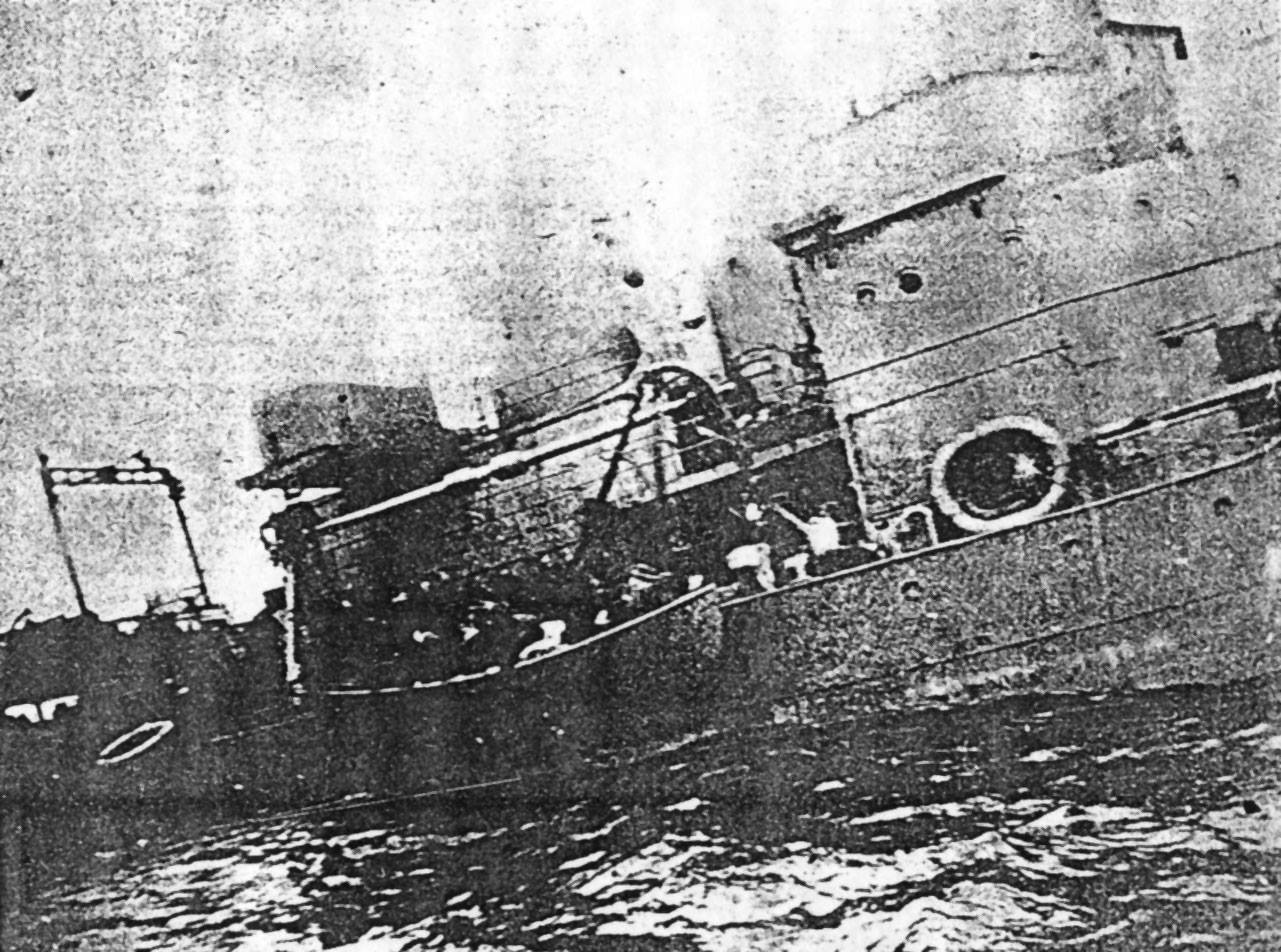
Unknown to all the allied ships, the German submarine U-132 had detected these ships at a vulnerable moment and maneuvered to a favorable position to attack.  Instead of singling out the crippled and near motionless 12,546 ton storeship Yukon, the U-132 fired a spread of torpedoes at the Alexander Hamilton.  The cutter had meanwhile worked up to 15 knots and passed the Yukon as the torpedoes sped past the storeship.  One torpedo passed ahead of the Yukon and struck the Alexander Hamilton on the starboard side between the fireroom and the engine room.(Right: crew of the Alexander Hamilton abandons ship after being torpedoed.)
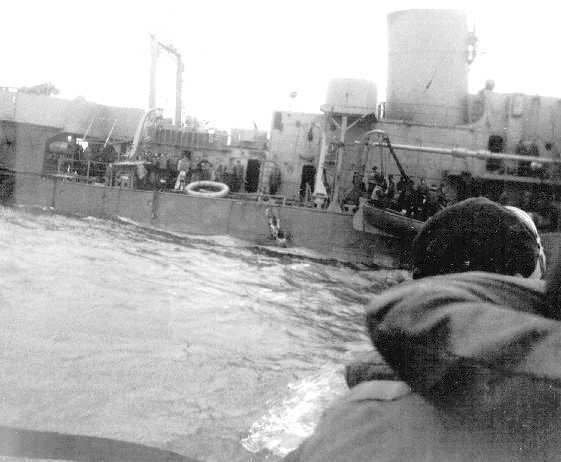
Crew of the Alexander Hamilton abandons ship after being torpedoed.

The Alexander Hamilton was fatally wounded.  The explosion wrecked both the engine room and the fire room, initially killing seven men and burning and injuring many others.  The cutter immediately lost way and settled 4 feet in the water but was counter-flooded to trim the vessel. Afraid that the submarine might fire another torpedo, the crew began to abandon ship.  Thirty minutes after the attack, four boats began transferring the injured and some of the crew to the Gwin.  Three Icelandic fishing trawlers, responding to the distress signals, also came to help remove the “Hamiltons”.  The torpedo claimed 26 lives, including 6 who later died of burns. While attempting to rescue the damaged cutter, as many as 14 destroyers from the nearby base at Hvalfjordur searched unsuccessfully for the U-132.

The cutter remained afloat.  That evening the British tug Restive tried for two hours to take the Alexander Hamilton in tow.  The Frisky returned from Reykjavik after towing the Yukon and joined the ex-Coast Guard tug Redwing and the Restive in the attempt to save the cutter.

Darkness and rough seas, however, prevented salvage throughout the night.  Just after 10:00 am on the morning of 30 January, the weather moderated enough for the Frisky to take the Alexander Hamilton in tow. The cutter’s list had increased to nearly 20 degrees as seas broke over the starboard side aft while the bow rode out of the water.  The Frisky towed the Alexander Hamilton about 18 miles when the cutter suddenly capsized and floated bottom up.  The life of the gallant cutter ended at 7:57 pm when gunfire from the U.S.S. Ericksson sent it to its final resting place in forty fathoms of water, 28 miles off the coast of Iceland.

This Day in Coast Guard History, January 30

Based on the Coast Guard Historian’s timeline, https://www.history.uscg.mil/research/chronology/
With inspiration from Mike Kelso

January 30

Model of the revenue cutter Jefferson Davis. On display at Coast Guard Museum/Northwest, Seattle, Washington. Sister ship of McClelland.

1861 Treasury Secretary John A. Dix ordered LT S. B. Caldwell, the second in command of the cutter McClelland, “to arrest Capt. Breshwood [the cutter’s commanding officer and a Confederate sympathizer] assume command of cutter and if anyone attempts to haul down the flag, shoot him on the spot.”  The message was not delivered by the telegraph office.  Breshwood turned McClelland over to the State of Louisiana, where the cutter ended up in Confederate service.  The northern papers reported the story though and the Secretary’s order became a rallying cry in support of the Union’s war effort.

1942 The capsized wreck of CGC Alexander Hamilton was sunk by the Navy after U-132 torpedoed the cutter off the coast of Iceland the previous day.  She was the first cutter sunk by enemy action during World War II.  Twenty-six of her crew perished in the attack.

“Convoy WS-12: A Vought SB2U Vindicator scout bomber from USS Ranger (CV-4) flies anti-submarine patrol over the convoy, while it was en route to Cape Town, South Africa, 27 November 1941. The convoy appears to be making a formation turn from column to line abreast. Two-stack transports in the first row are USS West Point (AP-23) — left –; USS Mount Vernon (AP-22) and Coast Guard manned USS Wakefield (AP-21). Heavy cruisers, on the right side of the first row and middle of the second, are USS Vincennes (CA-44) and USS Quincy (CA-39). Single-stack transports in the second row are Coast Guard manned transports USS Leonard Wood (AP-25) and USS Joseph T. Dickman (AP-26).”

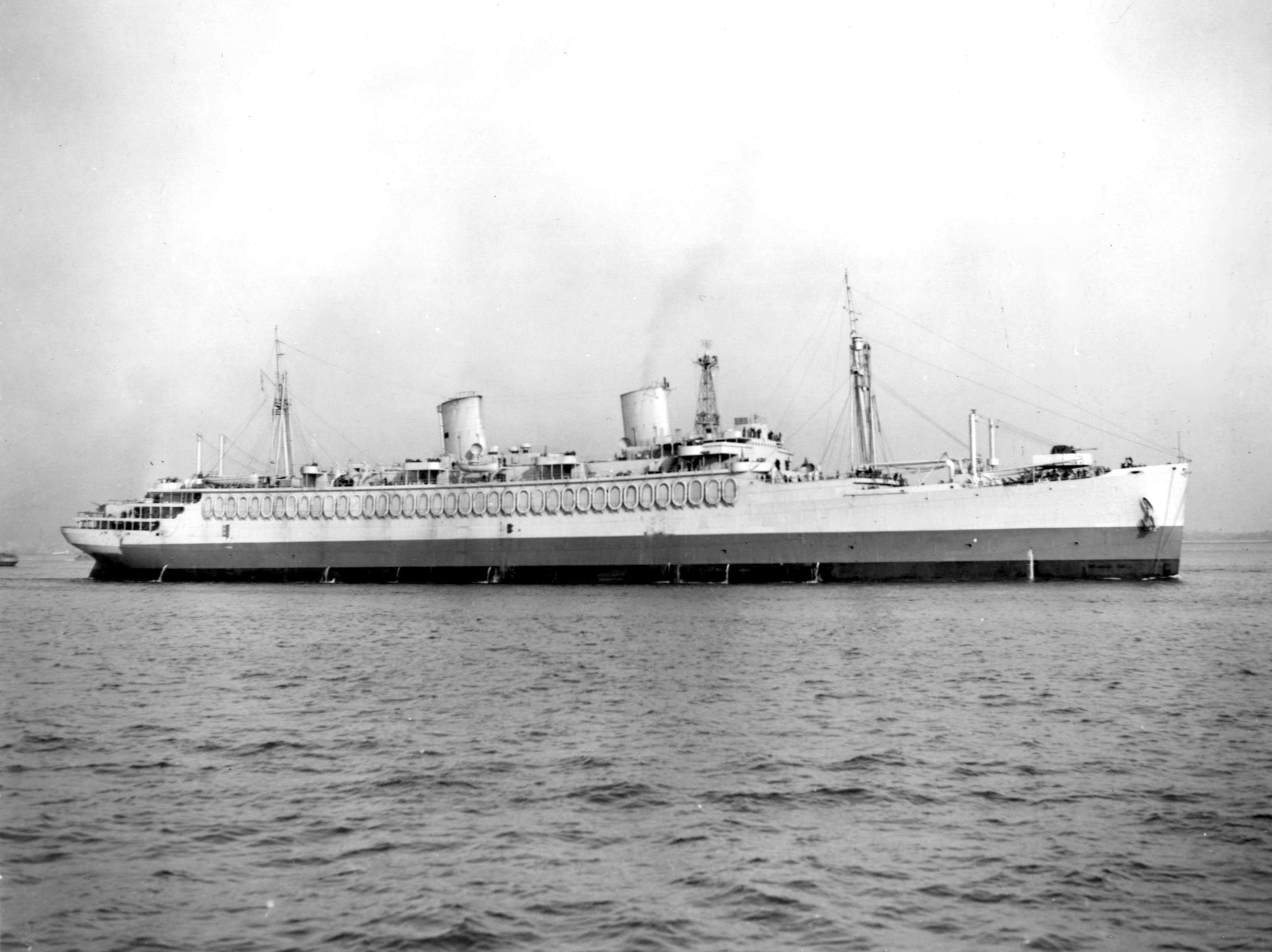
1942 USS Wakefield, the former passenger liner SS Manhattan converted to a troop transport and manned by a Coast Guard crew, transported British troops to Singapore.  Having disembarked the troops, she was bombed by Japanese aircraft while still tied up.  Five of her Coast Guard crew were killed and nine were wounded.  After temporary repairs, Wakefield evacuated 500 women and children to Bombay before the port fell to the Japanese

The U.S. Navy troop transport USS Wakefield (AP-21) off the Boston Naval Shipyard, Massachusetts (USA), in March 1944. Wakefield had been completely rebuilt at Boston after a large onboard fire in September 1942.

1979 There was an explosion at the Coast Guard Marine Safety Detachment office at Ponce Playa, Port Ponce, Puerto Rico.  The OVPR (Organizacion De Voluntarios Por La Revelucion Puerto Riquena) claimed responsibility.  The terrorist attack caused no casualties and little damage to the facility.

1982 Coast Guard 8th District units responded to the flooding of the Calcasieu River near Lake Charles, Louisiana.  Up river Coast Guard boats searched daily for stranded people and domestic animals.  Downriver COTP Port Arthur and Marine Safety Detachment Lake Charles wrestled with the problem of strong currents and four run-away barges that destroyed one bridge and threatened two others.

“Teledyne FLIR Defense Awarded $74 Million IDIQ Contract to Modernize U.S. Coast Guard Surveillance Systems” –Teledyne News Release

#USCG members of Maritime Security Response Team West, Maritime Safety and Security Team 91101, Port Security Unit 313, and a Sector Columbia River MH-60 Jayhawk helicopter crew conducted a maritime security exercise near Fox Island, WA recently. Photo by PA3 Michael Clark

Below is a Teledyne news release:

Sounds like all operational H-60s and H-65s will receive this system.


BOSTON, Mass., January 13, 2025 ― Teledyne FLIR Defense, part of Teledyne Technologies Incorporated (NYSE:TDY), announced it has been awarded a five-year Indefinite Delivery Indefinite Quantity (IDIQ) contract worth up to $74.2 million to provide modernized imaging surveillance systems to the United States Coast Guard (USCG).

FLIR Defense will deliver more than 125 Electro-Optic Sensor System-Modernized (ESS-M) systems for use on USCG rotary wing aircraft, specifically the MH-60 and MH-65. The advanced ESS-M platform features a full-HD sensor suite and updated user interfaces, as well as advanced processing capabilities and software enhancements that will support future growth.

The ESS-M systems provide operators with high-definition daylight, low light, and infrared imagery and will be used in support of all Coast Guard missions, with an emphasis on search and rescue, living marine resources, and law enforcement. The new technology also will augment coastal security, drug and migrant interdiction, ports and waterways protection, and other Coast Guard rapid response needs.

Teledyne FLIR Defense has been delivering and supporting legacy ESS systems for USCG medium- and short-range recovery aircraft since 2005.

“The significant updates through ESS-M will enable the U.S. Coast Guard to stay on technology’s cutting edge while conducting its wide range of key maritime operations,” said Dr. JihFen Lei, president of Teledyne FLIR Defense. “We’re proud to extend our history of support and look forward to building our relationship across all missions areas.”

Deliveries will begin in Q4-2025. For more on Teledyne FLIR’s maritime surveillance solutions, visit us online.

“Coast Guard conducts alien expulsion flight operations between California and Texas” –News Release

People on a Coast Guard flight being transported to Texas and California. U.S. Coast Guard photo.

Below is a news release. More on this operation here.

I have to wonder if we are using Minitour equipped aircraft for this? If so, is this the best use for aircraft that have been modified at great expense in time and money for maritime patrol, including supporting Alien Migrant interdiction?

I think we still have some unmodified HC-130Hs at Clearwater. Are they the ones doing this? “Inquiring Minds Want to Know?”


 Jan. 28, 2025

Coast Guard conducts alien expulsion flight operations between California and Texas

SAN DIEGO – Jan. 28, 2025, the Coast Guard conducted Alien Expulsion Flight Operations between California and Texas, in coordination with U.S. Customs and Border Protection.

In accordance with the President’s Executive Orders, these flights continue the Coast Guard’s actions to enforce the immigration laws of our country. Through these ongoing operations, and in close cooperation with our Department of Homeland Security and Department of Defense teammates, the Coast Guard is detecting, deterring, and interdicting aliens, drug smugglers, and individuals intent on terrorism or other hostile activity before they reach our border.

Led by the Eleventh Coast Guard District in California, the Coast Guard is coordinating the actions of multiple units in support of this operation. The Coast Guard is surging assets and personnel from around the nation – including Air Stations Elizabeth City, Kodiak, Sacramento, San Diego, and Hawaii – to support this Department of Homeland Security-led operation.

The Coast Guard’s current role is to assist with the national transport of aliens to designated locations in Texas and California, where the Department of Defense will transport the aliens internationally.

For more information about the Coast Guard, visit www.uscg.mil.

This Day in Coast Guard History, January 29

Based on the Coast Guard Historian’s timeline, https://www.history.uscg.mil/research/chronology/
With inspiration from Mike Kelso

January 29

1919 Ratification of the 18th Amendment to the U.S. Constitution occurred on this date.  The amendment prohibited the manufacture, sale, and transportation of alcoholic beverages.  Its enforcement was authorized by the National Prohibition Enforcement Act, otherwise known as the Volstead Act that was passed on October 28, 1919.  The Coast Guard was tasked with the prevention of the maritime importation of illegal alcohol.  This led to the largest increase in the size and responsibilities of the service to date.

USCGC Bibb

1938 CGC Bibb reported for duty in connection with the U.S. Navy exercises held off Culebra, Puerto Rico.

The U.S.S. Serpens Monument is dedicated to those who lost their lives when the U.S.S. Serpens was destroyed. The 14,250-ton ammunition ship exploded off Lunga Baech, Guadacanal, British Solomon Islands on the night of Jan. 29, 1945 and was the largest single disaster suffered by the U.S. Coast Guard in World War II. (U.S. Army photo by Rachel Larue/released)

1945 The Coast Guard-manned attack cargo vessel USS Serpens exploded off Guadalcanal due to unknown causes.  Only two men aboard survived.  This was the single greatest Coast Guard loss of life in history.

USCGC CASCO 1961

1963 CGC Casco inaugurated the expanded Ocean Station Vessel Oceanographic Program when it departed for Ocean Station Echo on this date.  Casco was outfitted for oceanographic research by the addition of a laboratory space, hydrographic winch, and other instruments.  As the first Coast Guard Ocean Station Vessel to be so outfitted, Casco’s mission represented “a significant step on the Coast Guard’s participation in the National Oceanographic effort.”

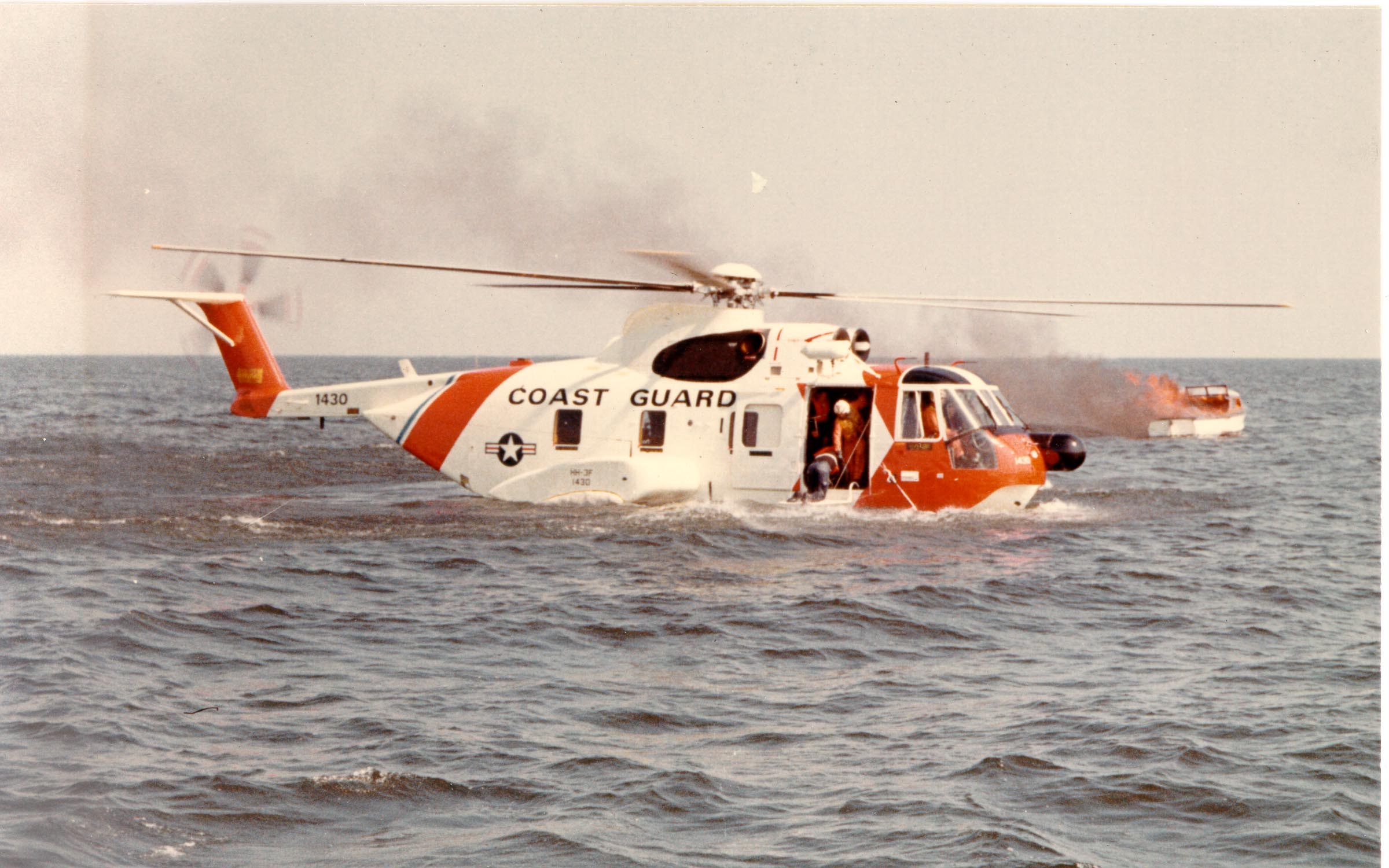
USCG HH-3F Pelican on the water, demonstrating its amphibious capability. This was also the first HH-3F delivered to the Coast Guard.

1980 Local authorities in the Tijuana, Mexico area requested Coast Guard assistance in evacuating flood victims stranded by the rising waters of the San Miguel River.  Two HH-3F helicopters from Air Station San Diego transported 180 persons to safety during the two-day operation.

This Day in Coast Guard History, January 28

Based on the Coast Guard Historian’s timeline, https://www.history.uscg.mil/research/chronology/
With inspiration from Mike Kelso

1885 Keeper Marcus Hanna of the Cape Elizabeth Light Station saved two men from the wrecked schooner Australia.  For this rescue Hanna was awarded the Gold Lifesaving Medal.  He was also awarded the Medal of Honor for his actions at Port Hudson in 1863.  He is the only person to have ever received both awards.

1915 President Woodrow Wilson signed into law the “Act to Create the Coast Guard,” an act passed by Congress on January 20, 1915 that combined the Life-Saving Service and Revenue Cutter Service to form the Coast Guard (38 Stat. L., 800).  The Coast Guard, however, still considers the date of the founding of the Revenue Cutter Service, August 4, 1790, as its official birthday, even though the Lighthouse Service, absorbed in 1939, is even older than that, dating to August 7, 1789.  Under the new law the Coast Guard officially became “part of the regular military establishment of the United States.”

The U.S. Coast Guard buoy tender USCGC Blackthorn (WLB-391), in the 1972. US Coast Guard photo.

1980 CGC Blackthorn sank in Tampa Bay after colliding with the tanker Capricorn.   Twenty-three Coast Guard personnel were killed in the tragedy.

The STS-51L crewmembers are: in the back row from left to right: Mission Specialist, Ellison S. Onizuka, Teacher in Space Participant Sharon Christa McAuliffe, Payload Specialist, Greg Jarvis and Mission Specialist, Judy Resnik. In the front row from left to right: Pilot Mike Smith, Commander, Dick Scobee and Mission Specialist, Ron McNair. 15 November 1985

1986 NASA’s space shuttle Challenger exploded after lift-off, killing the entire crew. Coast Guard units, including the cutters Dallas, Dauntless, Harriet Lane, Bear, Tampa, Cherokee, Sweetgum, and Point Roberts conducted the initial search and rescue operations and later assisted in the recovery of much of the shuttle’s wreckage.  Other units included personnel from Station Port Canaveral, air stations Miami, Clearwater, and Savannah, as well as Coast Guard reservists and Auxiliarists. Dallas served as the on-scene commander for what was a joint Coast Guard, NASA, Navy, and Air Force search and recovery operation.

2003 DOD submitted a request for Coast Guard forces in support of Operation Enduring Freedom.  The Commandant, ADM Thomas Collins, approved that request and ordered the deployment of eight 110-foot patrol boats, crews, and support units.  The cutters were CGCs: WrangellAdakAquidneckBaranofGrand IsleBainbridge IslandPea Island, and Knight Island.


This Day in Coast Guard History, January 27

Based on the Coast Guard Historian’s timeline, https://www.history.uscg.mil/research/chronology/
With inspiration from Mike Kelso

January 27

1909 The schooner Nelson Y. McFarland issued a distress call after dropping anchor near the White Head, Maine, Life-Saving Service station.  Although anchored against the tide, she was becalmed, yet her stern swung so close to the ledge that “a change of wind or tide would have thrown the vessel upon the rocks.  A pulling boat and crew from the station responded to the call and the men rowed to the ship’s aid.  After a 3-hour, pull the surfmen succeeded in towing the schooner to a safe anchorage in Seal Harbor.”

USCGC Rush

1993 Communications Station Guam received a mayday broadcast from the M/V East Wood.  The ship’s radio operator claimed that the vessel had been taken over by hijackers and that there were 400 people in the vessel’s two main cargo holds.  Another transmission claimed that 10 persons were going to be thrown overboard.  The Coast Guard dispatched an HC-130 from AIRSTA Barbers Point and ordered CGC Rush to intercept.  A boarding team from the Rush seized the vessel and escorted it to an Army installation on the Marshall Islands.  There were 527 Chinese nationals and 10 crewmembers aboard.  The Chinese nationals were repatriated to China and nine of the crewmen were sent to Indonesia.  The 10th crewman was taken to Honolulu to investigate whether prosecution was possible under U.S. law.


APKWS Takes Down Cruise Missile

Vampire Surface to Air/Surface guided 70mm Guided Rocket System using Fletcher launcher and APKWS guided Hydra Rockets.

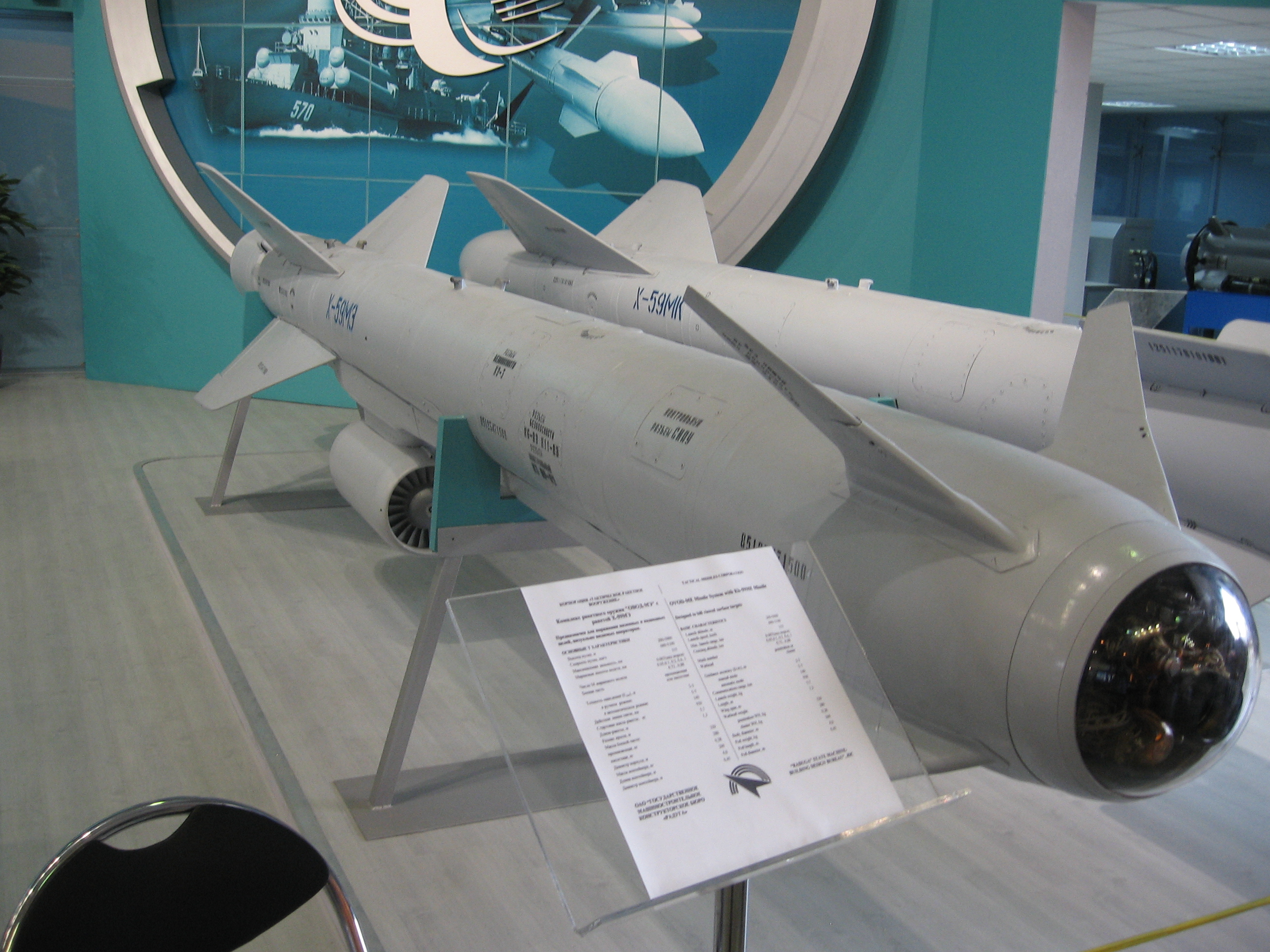
We have reports that the Ukrainian Navy has shot down a Russian KH-59 cruise missile using an APKWS guided 70mm guided Hydra Rocket.

Russian made Kh-59 air to surface cruise missile. Photo from Wikipedia

I have an intense interest in the system because I believe it meets many of the US Coast Guard’s needs for increased capability against drones, aircraft, small fast highly maneuverable surface craft, and larger vessels, while being small and light enough to equip WPBs. I have been talking about APKWS since 20217. 

And it is cheap. For comparison, an all-up APKWS round cost about the same as a single 57mm Mk110 round, the probability of hit is higher, the effective range–about 5,000 meters–may be shorter, but each round can be more destructive.

The weapon is already in the USN supply system. The Navy would be paying for them, but we have to ask for them, not just for wartime, but for peacetime counter-terrorism as well.

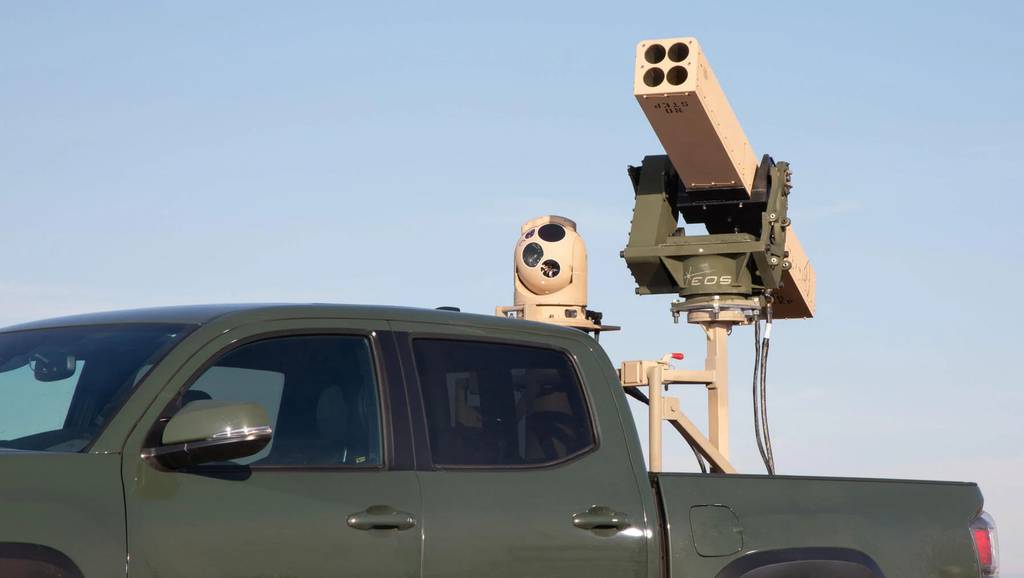
The VAMPIRE system can fit in almost any pickup or vehicle with a cargo bed. (Courtesy of L3Harris)

The complete system was developed by L3Harris.

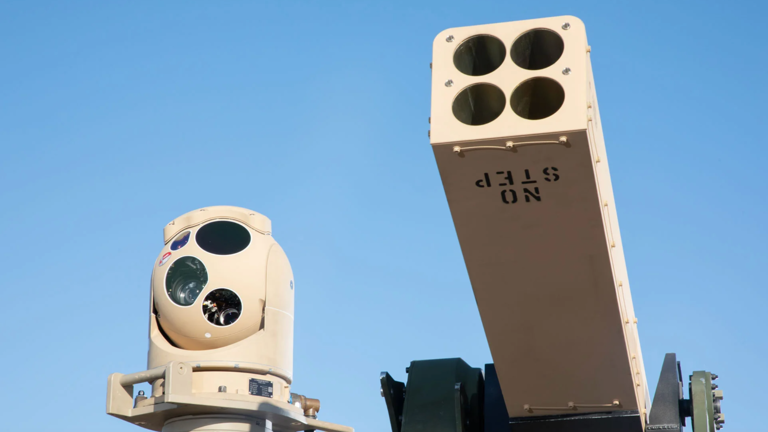
“Proximity fuzes are used to engage fast-moving targets like drones, aircraft or missiles. L3Harris’ Vehicle-Agnostic Modular Palletized ISR Rocket Equipment (VAMPIRE™), equipped with the WESCAM MX™-10D RSTA sensor system, uses proximity fuzes in order to significantly increase the probability of hitting the target.”

In addition, Vampire includes the four round Fletcher Launcher from Arnold Defense and the APKWS guidance system for 70mm Hydra Rockets.

I believe the Fletcher launcher can be mounted on the mounts we use for the .50 caliber machine gun.

Installed on a cutter, we could have the Electro-optic device on the mast and a Fletcher launcher on either side.

An alternative c-UAS system with radar here.

There is no indication what type of patrol boat the Vampire system was mounted on, but I hope it was one of the former US Coast Guard patrol boats transferred to the Ukraine Navy. Three of the four largest vessels in the Ukrainian Navy are former USCG Island class WPBs. A fourth was lost in combat.

Ukrainian Navy Island-class patrol boats, formerly of the U.S. Coast Guard, conduct maritime security operations in the Black Sea off the coast of Odesa, Ukraine.
UKRAINIAN NAVY

This Day in Coast Guard History, January 26

Based on the Coast Guard Historian’s timeline, https://www.history.uscg.mil/research/chronology/
With inspiration from Mike Kelso

January 26

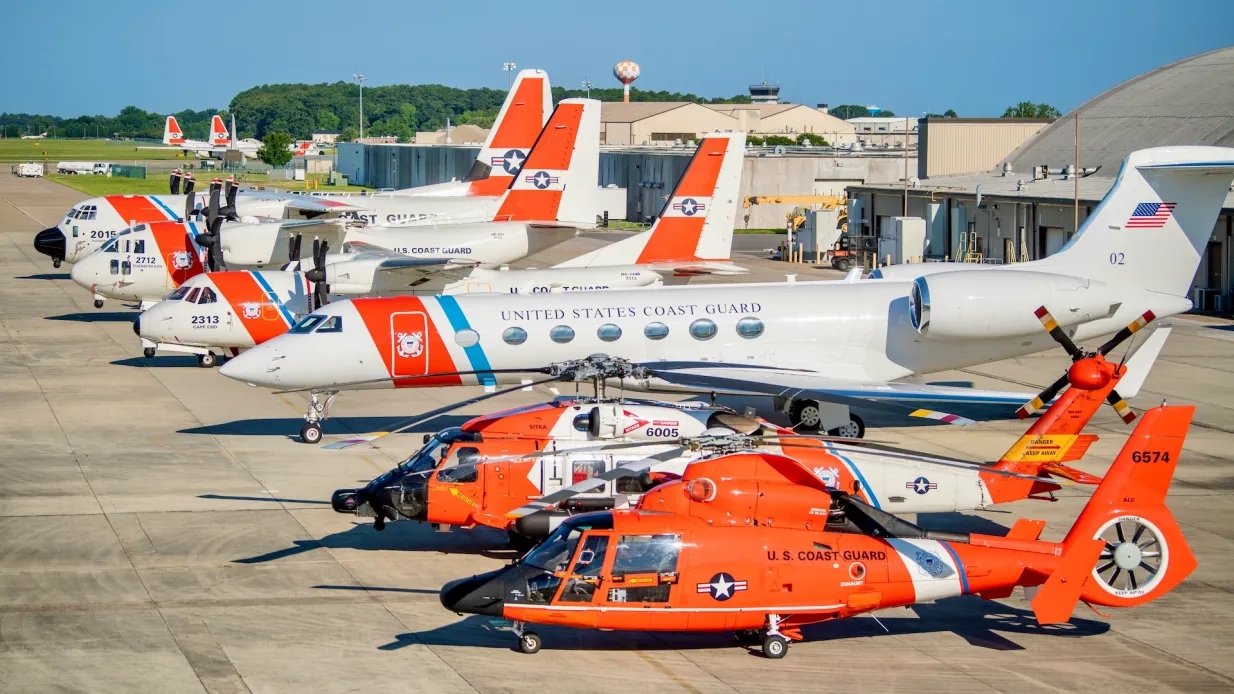
Every Coast Guard Aircraft Type Pictured Together In Rare ‘Family Photo’. Pictured: HC-130J, C-27J, HC-144, C-37B, MH-60T, MH-65E.

1939 Ground was broken for the construction of an air station at Elizabeth City, North Carolina.  With the support of Congressman Lindsay Warren and a favorable vote by local county and city officials regarding a bond issue, the land was secured for the new facility which was constructed by the WPA.

1953 Coast Guard forces assisted civilian authorities in evacuating 191 persons from the Coxuille Valley, Oregon flood area.

Coast Guard Cutter Healy (WAGB 20) and crew conduct formation steaming exercises with Candian Coast Guard Ship Sir Wilfrid Laurier and crew in the Beaufort Sea, July 28, 2023. The crew conducted a passenger exchange with the Sir Wilfrid Laurier off the coast of Utqiagvik, Alaska. (U.S. Coast Guard photo by Petty Officer 1st Class Michael Underwood)

1963 The modern Canadian Coast Guard was founded on this date.  Their official motto is Saluti Primum, Auxilio Semper (Safety First, Service Always).

1991 Upon receiving a request from the Saudi government, the Bush Administration determined that the Coast Guard would head an interagency team to assist the Saudi government in an oil spill assessment and plan for a clean-up operation after an intentional Iraqi oil spill.

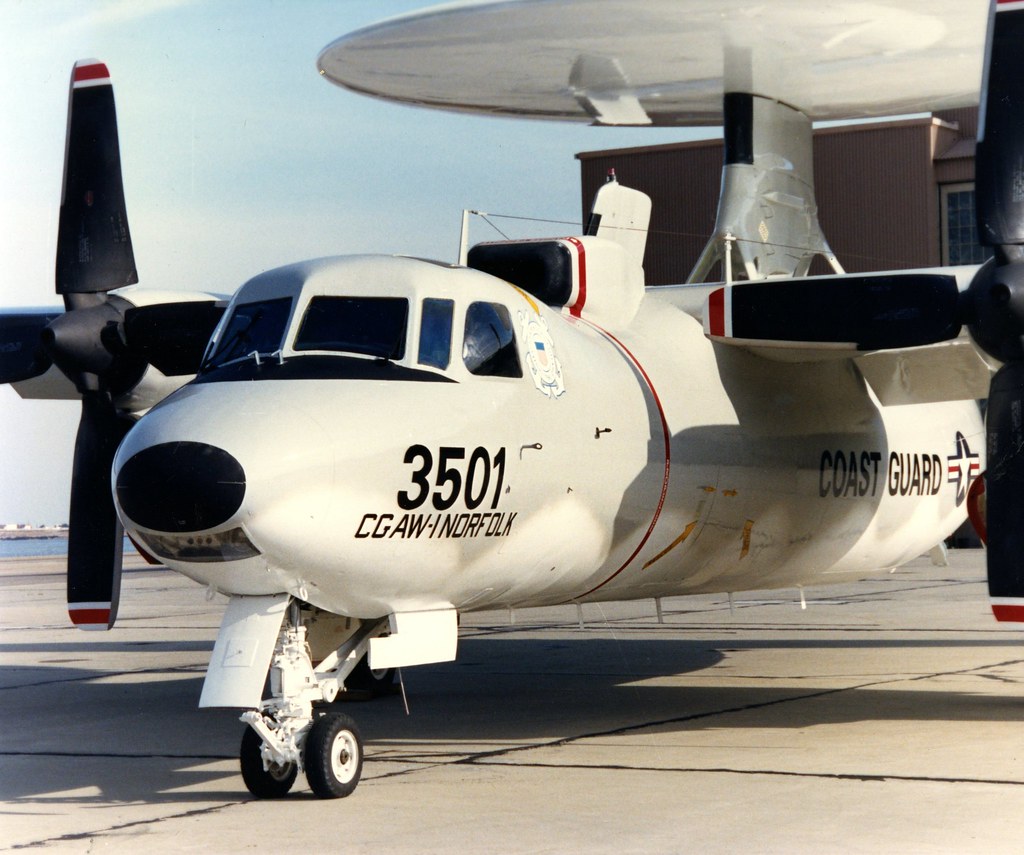
1990 Coast Guard Air Station St. Augustine, home of CGAW-1, was formally commissioned.  The Navy loaned E2Cs to the Coast Guard for use in the efforts by CGAW-1 to track drug shipments by radar.  One E2C, #3501, crashed during a landing at Roosevelt Roads, Puerto Rico, on August 24, 1990 and all four crewmen on board were killed.  CGAW-1 was disbanded soon thereafter and the remaining E2Cs were returned to the Navy.

“This Icebreaker Has Design Problems and a History of Failure. It’s America’s Latest Military Vessel” –Military.Com / Was Halter Marine Ever Really Qualified to Build the PSC?

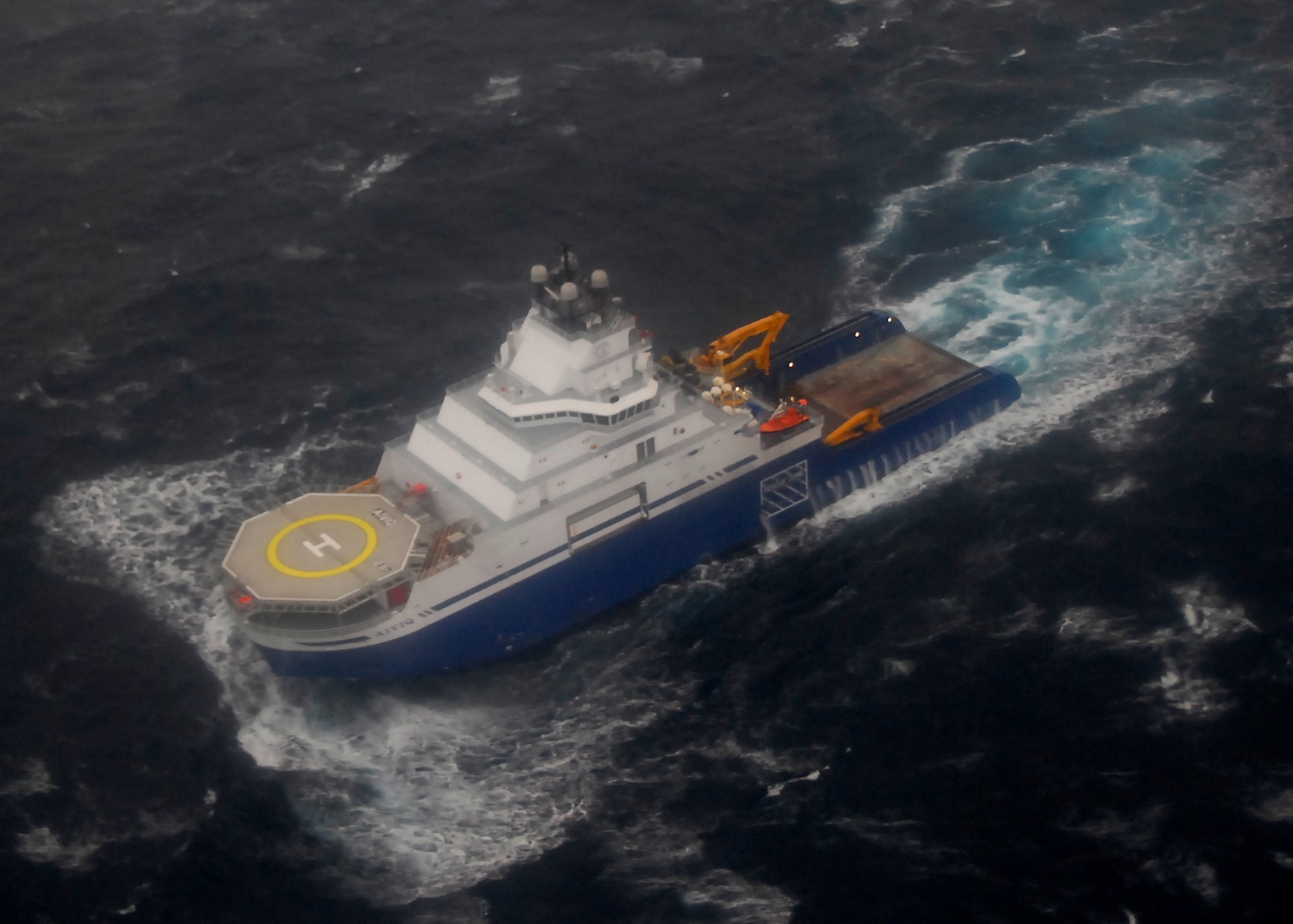
The tug Aiviq traveling with the mobile drilling unit Kulluk in tow 116 miles southwest of Kodiak City, Alaska, in 2012. Credit: U.S. Coast Guard | Petty Officer 2nd Class Chris Usher

Military.com provides an article, originally published by ProPublica, that questions the acquisition of the new USCGC Storis, formerly M/V Aiviq., suggesting undue influence in the decisions to procure the vessel and to homeport it in Anchorage.

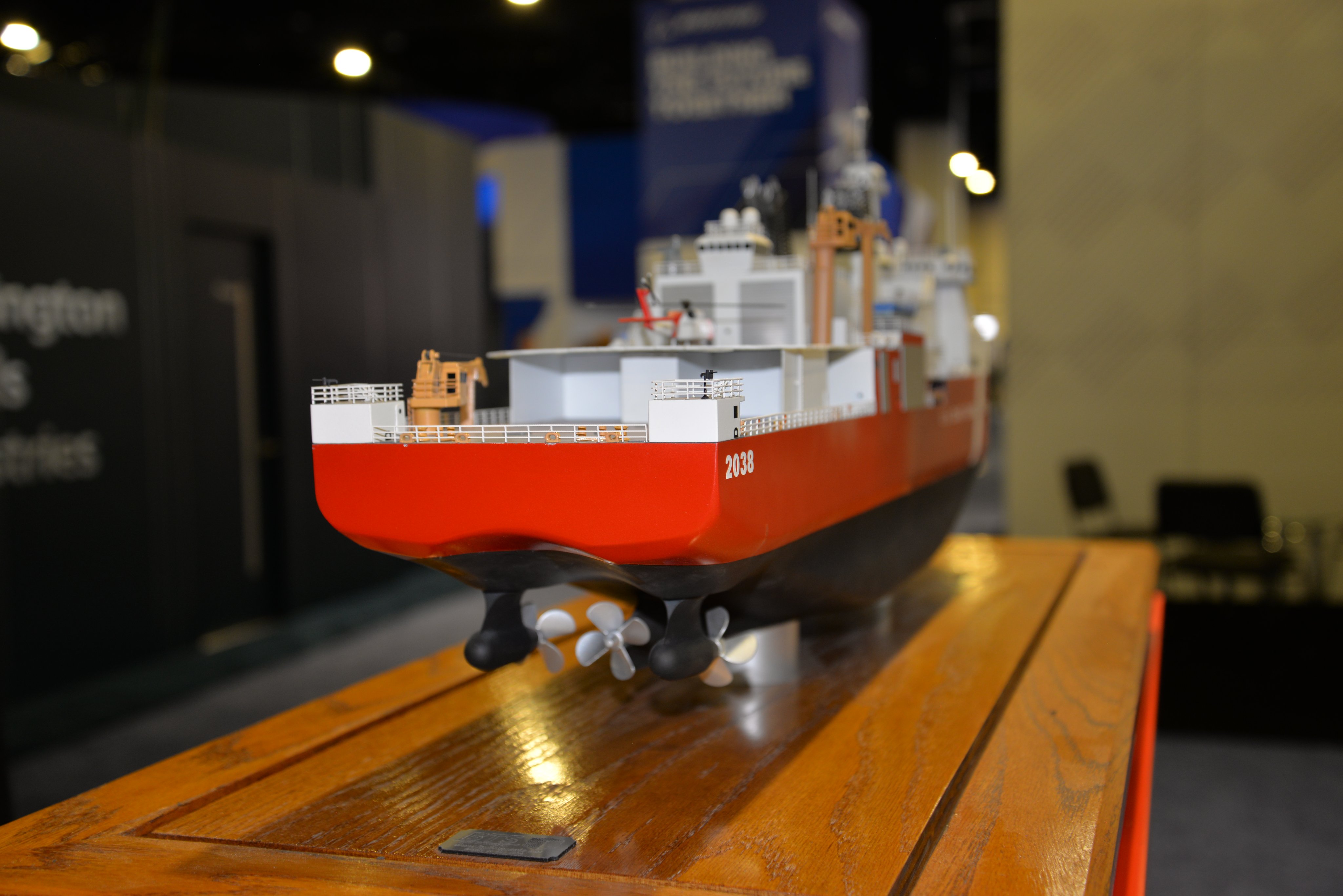
Photo of a model of Halter Marine’s Polar Security Cutter seen at Navy League’s Sea-Air-Space Exhibition have surfaced. Photo credit Chris Cavas.

We would like to think that the Coast Guard has free reign in its award of contracts, but that is, of course, not entirely true.

With this and with the long history of difficulties with the Polar Security Cutter (PSC) program, I have to wonder about the decision to award the contract to award the decision to relatively inexperienced Halter Marine for a design that did not meet the RFP requirement that the design be based on a proven design.

In February 2017, the USCG awarded five fixed-price contracts for heavy polar icebreaker design studies to Bollinger ShipyardsItaly’s Fincantieri Marine GroupNational Steel and Shipbuilding CompanyHuntington Ingalls Industries, and Singapore’s Halter Marine Inc .

On 23 April 2019 Halter Marine was awarded a $745.9M contract for detailed design and construction of the lead ship. This was probably the low bid, but it has proven an unrealistically low bid.

Of the five contenders, Halter Marine was the least experienced and the least familiar to the Navy and Coast Guard.

Halter Marine had changed hands in 1983, 1996, 1999, 2003, and 2022, not a picture of stable management, and it was not partnered in this offer with any experienced builder of icebreakers.

At the time of the award, Halter Marine had built two ships for the US Navy, none for the Coast Guard. The two ships for the Navy were USNS Howard O. Lorenzen (T-AGM-25), 12,642 tons, a Missile Range Instrumentation Ship and USNS Maury (T-AGS-66), 5000 tons, an oceanographic survey ship.

The Navy’s experience with the construction of USNS Howard O. Lorenzen might have raised red flags. Defense News’ Chris Cavas reported,

“The new ship, built under an initial $199 million contract awarded in 2006, has been under construction at VT Halter’s yard since August 2008, when delivery was scheduled for June 2010. The design is based on a pair of Navy survey ships built in the mid-1980s.
“The Navy’s Board of Inspection and Survey, known as INSURV, conducted the Lorenzen’s acceptance trials in the Gulf of Mexico during the week of May 9, …”
“The trial “was reported as unsatisfactory” by INSURV…The failed grade was due to three major discrepancies – thrust bearing temperature, and steering and anchor demonstrations. Three of 15 graded areas – electrical, damage control and aviation – were also graded unsatisfactory.
“INSURV recommended that acceptance not take place until the systems “can be fully re-demonstrated.”
“…In recent years, problems have emerged with several ships under construction at the Moss Point yard for U.S. government customers.
“Last fall, the National Oceanographic and Atmospheric Administration (NOAA), for which VT Halter built a number of fisheries research ships, abruptly canceled completion of a new research ship when it was nearly finished, claiming it was overweight and unable to carry out its coastal mapping mission. The ship was seized by NOAA and moved elsewhere for completion and modifications.
“In 2005, contract disputes led the U.S. Army to cancel completion of a logistics vessel and delay delivery of two others.

The Coast Guard might also have looked at their safety record.

 “…in 2009, unsafe working conditions led to an explosion that killed two employees and injured five others. The company was fined $1.32 million by the United States Department of Labor for 17 willful and 11 serious violations, including willfully exposing workers to toxic fumes in a confined space. According to Secretary of Labor Hilda L. Solis, the explosion “was a horrific and preventable situation. VT Halter Marine was aware of the hazards and knowingly and willfully sent workers into a confined space with an explosive and toxic atmosphere.”

The use of a never completed design should have disqualified Halter Marine. With this as background, could the Coast Guard have missed the warning signs, or might they have been overruled in the selection of the yard? Could this have been a case of undue influence? Who made the final decision, the Coast Guard/Navy acquisition team, the Commandant, the Department of Homeland Security, or someone else? and why?