The Last 76mm Gun Shoot?

Coast Guard Cutter Mohawk’s (WMEC 613) Mk 75 weapon system fires, Aug. 16, 2024, during a gunnery exercise in the Florida Straits. Mohawk was the last Famous-class medium endurance cutter to fire the onboard Mk 75 mm gun weapon system as large caliber weapon systems onboard these cutters are being modernized for the service life extension program. (U.S. Coast Guard photo by Ensign Brian Morel)

Below is a Coast Guard news release. It is otherwise a pretty typical patrol report, but I wanted to call your attention to one paragraph,

“Of note, this patrol marked a significant historical event for the Coast Guard’s Famous-class medium endurance cutter fleet. Mohawk was the last in its class to fire the onboard Mk 75 mm gun weapon system. The largest caliber weapon in the Coast Guard inventory, it has been utilized by Famous-class cutters like Mohawk since they were first commissioned in the 1980’s. Now, large caliber weapon systems onboard Famous-class cutters are being modernized for a service life extension program.”

Does this really mean the Coast Guard is stopping support for all 76mm gun and Mk92 fire control systems even though only six WMEC270s are expected to receive the full life extension program? USCGC Harriet Lane which went through a partial SLEP, has also swapped out her 76mm for a 25mm Mk38, but that still leaves six WMEC270s that will not go through the service life extension program. Will they also lose their 76mm guns?

The 25mm Mk38 is a poor substitute for the 76mm gun that is upgradable and still in service with about 40 countries.


Oct. 23, 2024

Coast Guard Cutter Mohawk returns home from 62-day migrant interdiction operations patrol

KEY WEST, Fla. — The crew of Coast Guard Cutter Mohawk (WMEC 913) returned to their homeport of Key West, Oct. 11, following a 62-day migrant interdiction operations patrol in the Florida Straits.

Mohawk’s crew deployed in support of Homeland Security Task Force – Southeast (HSTF-SE) and Operation Vigilant Sentry (OVS) while underway in the Seventh Coast Guard District’s area of responsibility. While on patrol, crew members worked alongside additional Coast Guard units and partner agency crews to detect, deter and intercept unsafe and illegal migrant ventures bound for the United States.

While at sea, Mohawk crew members interdicted and rescued 41 migrants from unseaworthy vessels. Of these, Mohawk’s crew rescued 25 migrants aboard a single disabled vessel found taking on water in the Florida Straits on Aug. 20. Throughout the deployment, Mohawk cared for a total of 53 migrants, providing shelter, sustenance, hydration and medical care before conducting safe repatriation back to their country of origin.

On Oct. 3, Mohawk’s crew conducted a rescue of four personnel stranded on the remote island of Cay Sal, Bahamas after their seaplane was disabled. Mohawk coordinated with a U.S. Navy P-8 Poseidon airplane and a Coast Guard Air Station Miami HC-144 Ocean Sentry airplane to vector in Mohawk’s small boat crew for the rescue.

Most recently, the crew of Mohawk extended their deployment in response to the approach of Hurricane Milton. Mohawk sortied alongside other Key West-based Coast Guard cutters to avoid potential storm damage and ensure response readiness after the hurricane. Mohawk’s crew also conducted a tow of the Isaac Mayo during the sortie for several days of rough seas as the cutter was disabled due to scheduled maintenance.

Of note, this patrol marked a significant historical event for the Coast Guard’s Famous-class medium endurance cutter fleet. Mohawk was the last in its class to fire the onboard Mk 75 mm gun weapon system. The largest caliber weapon in the Coast Guard inventory, it has been utilized by Famous-class cutters like Mohawk since they were first commissioned in the 1980’s. Now, large caliber weapon systems onboard Famous-class cutters are being modernized for a service life extension program.

To successfully conduct the migrant interdiction mission, Mohawk partnered with U.S. Customs and Border Protection – Air and Marine Operations air and boat crews as well as additional Coast Guard units to include Coast Guard Cutters Charles Sexton (WPC 1108), Raymond Evans (WPC 1110), Isaac Mayo (WPC 1112), Maple (WLB 297), Coast Guard Station Key West, Coast Guard Sector Key West and Coast Guard Air Station Miami.

“Outstanding work by the Mohawk crew. I am very proud of our ability to secure our nation’s maritime borders while maintaining the safety of life at sea,” said Cmdr. David Ratner, commanding officer of Mohawk. “We understand the importance of deterring unlawful and dangerous maritime migration attempts on often overloaded and unseaworthy vessels. One such vessel with 25 migrants on board was disabled with insufficient fuel to make it to land and was taking on water.”

Mohawk is a 270-foot, Famous-class medium endurance cutter with a crew of 100. The cutter’s primary missions are counter-drug and migrant interdiction operations, enforcement of federal fishery laws as well as search and rescue in support of Coast Guard operations throughout the Western Hemisphere. Mohawk falls under the command of U.S. Coast Guard Atlantic Area, which is based in Portsmouth, Virginia. U.S. Coast Guard Atlantic Area oversees all Coast Guard operations east of the Rocky Mountains to the Arabian Gulf.

For information on how to join the U.S. Coast Guard, visit GoCoastGuard.com to learn about active duty and reserve, officer and enlisted opportunities. Information on how to apply to the U.S. Coast Guard Academy can be found here.

“Chinese Ship Expelled From Neighbor’s Waters” –MSN

On Monday (21/10/2024) Indonesian Coast Guard and Navy expelled CCG 5402 (left center) from North Natuna Sea after it was reported to have disrupted seismic survey activities. In the photo, the Indonesian CG vessel, KN Tj data (lower right) is supported by the Indonesian Navy vessel KRI Sutedi Senoputra,  (upper right) Source: X

MSN reports,

“Indonesia on Monday expelled a Chinese coast guard ship from its maritime zone after it allegedly interfered with a seismic survey operation.”

“An Indonesian coast guard cutter approached the Chinese ship, coming within around 8 miles of it and issuing a radio warning. However, the Chinese vessel insisted it was operating within Chinese waters.”

The Indonesian Navy sent reinforcements to support the cutter in the form of a patrol aircraft and a corvette.

“The Indonesian vessels shadowed the Chinese counterpart until it was ultimately expelled from Indonesia’s EEZ, per the statement.”

How long that took is not clear.

The same China Coast Guard ship (bearing an earlier hull number) and a Philippine supply boat engage in a standoff as the Philippine boat attempts to reach the Second Thomas Shoal, a South China Sea reef inside the Philippine EEZ, on March 29, 2014, Jay Directo—AFP

Correlation of Forces:

Correlation of forces is a term the Soviets used, and the Chinese would understand. It means if there were conflict what would be the likely outcome, and in any tense situation, the thought has to be at least in the back of the mind of the players, and will influence decision makers. 

China CGC 5402 is reportedly a Zhaolai class, formerly hull number 3401. The Zhaolai-class China Coast Guard cutters are reported to have a displacement of 4,896 tons and are 99 meters in length. It is a relatively big cutter, but closer to an Offshore Support Vessel than a warship. They go back to at least 2014, and were built before the China Coast Guard began building cutters armed with medium caliber guns. It is not clear if China CGC 5402 is now armed with heavy weapons. In the photo above, a foundation for what would probably be a 76mm gun is visible, but I have seen no photos of this class so armed.

The Indonesian cutter, KN Tanjung Datu, is the largest cutter in the Indonesian CG. It is reportedly 2400 tons, but I suspect the full load displacement is greater considering it is 110 meters (360′) in length with a beam of 15.5 m (51′), making it almost as large as the USCG’s new 4,500 ton Offshore Patrol Cutters. The USCG has exercised with her (photo below). She is armed with a 30mm Mk44 chain gun in a Aselsan SMASH remote weapon station, but the Indonesians did not assume that would be enough. They called in reinforcements in case things went South.

Indonesian Maritime Security Agency vessel KN Tanjung Datu, left, sails alongside U.S. Coast Guard Cutter Stratton during joint exercises in the Singapore Strait in August 2019. IMAGE CREDIT: PO1 LEVI READ/USCG

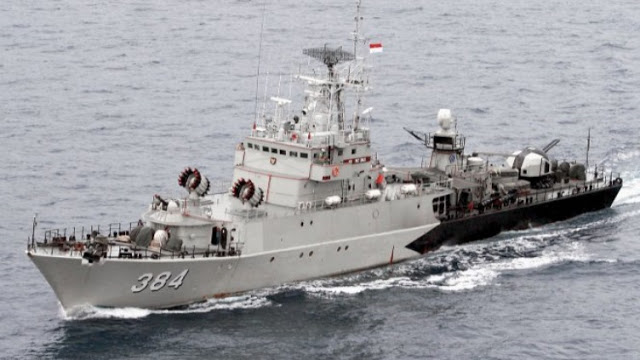
The smallest vessel in the photo at the head of the post (KRI Sutedi Senoputra) was also, by far the most heavily armed. It is only 935 tons, full load, lighter than a WMEC210, and 43 years old, but it is faster than either of the cutters at 24 knots and armed with a twin 57mm, a twin 30mm, and two 20mm. It also has RBU-6000 ASW rocket launchers which may have some anti-surface capability. (see photo below)

The Indonesian Corvette, KRI Sutedi Senoputra, is a former East German Parchim class corvette like this one.

The incident happened within 200 nautical miles of Indonesian territory so attack aircraft would not be too far away.

The Indonesians have been acting aggressively against Chinese fishing vessels in their EEZ. They don’t seem to be unwilling to insist on their rights.

The Chinese probably don’t want to risk an armed conflict before they are ready to attack Taiwan with all the logistical preparation that would require. They seem to have been losing influence in Indonesia, and don’t want further alienate Indonesia and to push them closer to the US.

This Day in Coast Guard History, October 24

Based on the Coast Guard Historian’s timeline, https://www.history.uscg.mil/research/chronology/
With inspiration from Mike Kelso

Cutter Sherman returns home after a 52 day deployment

2014  CGC Sherman returned to its homeport of San Diego after completing a 52-day deployment to the Eastern Pacific Ocean participating in UNITAS 2014 and conducting counter maritime drug interdiction operations.  At the beginning of their deployment, Sherman represented the United States, one of 14 partner nations that participated in UNITAS 2014 from September 12-26.  Toward the conclusion of its deployment, Sherman interdicted two suspected smuggling boats that resulted in the seizure of approximately 120 pounds of cocaine with a wholesale value of nearly $2 million.

This Day in Coast Guard History, October 23

Based on the Coast Guard Historian’s timeline, https://www.history.uscg.mil/research/chronology/
With inspiration from Mike Kelso

1818  USRC Monroe captured the armed brig Columbia inside the Virginia Capes.  Columbia had been “cut out” of a Venezuelan fleet by pirates.

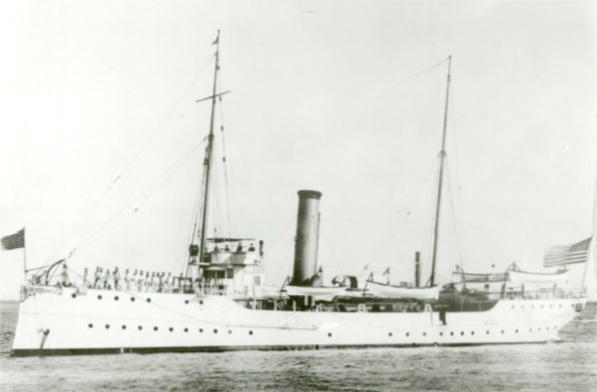
Algonquin, no caption/date; Neg. No. 148-2; Marine Photo Shop-Joe D. Williamson photo.

1907  The first wireless operator joined the Revenue Cutter Service, H. I. Logan, enlisted on the USRC Manhattan, a harbor tug based in New York City, as an “Electrician (acting).”  He was assigned to the cruising cutter USRC Algonquin where he reported on board on October 30, 1907.  Logan remained in the service until 22 December 1923 when he retired after serving on board the USCGC Bear.  He crossed the bar in 1936.

SOUTHCOM to host change-of-command ceremony Nov. 07 –News Release

VADM Alvin Holsey

Below is a SOUTHCOM news release. Thought this might be of interest since just about all the ships in his fleet as well as much of his staff will be Coast Guard.


Oct. 15, 2024, MIAMI – U.S. Navy Vice Adm. Alvin Holsey is scheduled to assume duties as commander of U.S. Southern Command (SOUTHCOM) from U.S. Army Gen. Laura J. Richardson during a change-of command ceremony 1 p.m. Nov. 7, 2024, at the command’s headquarters.
Holsey, who previously served as the Military Deputy commander at SOUTHCOM, will be promoted to the rank of admiral before the ceremony.

Richardson will retire after more than four decades of military service as a decorated Army officer and distinguished aviator that included leadership roles in various assignments from the Company to the Theater level, as well as deployments to Iraq in support of Operation Iraqi Freedom and Afghanistan in support of Operation Enduring Freedom. Richardson’s career also included assignments as Military Aide to the Vice President at the White House, Chief of Army Legislative Liaison to the U.S. Congress in Washington, D.C., and as a U.S. Army campaign planner at the Pentagon.

Richardson assumed command of SOUTHCOM Oct. 29, 2021, during a history-making ceremony in which she became the first woman general to lead the U.S. combatant command. Under her leadership, SOUTHCOM conducted numerous operations directly supporting regional security, increased security cooperation with regional defense and security partners, and optimized its multinational exercise program to strengthen the region’s collective security capacity and bolster interoperability.

Richardson also led the command’s critical support to partner nation efforts aimed at disrupting the activities of transnational criminal organizations and malign state actors; including illicit trafficking; human smuggling; illegal, unregulated, and underreported fishing; and cyberattacks. SOUTHCOM is currently supporting the Multinational Security Support mission assisting Haitian-led efforts in and near Port-au-Prince to restore security in communities impacted by widespread gang violence.

Holsey will also make history when he assumes command duties November 7, becoming the first African American to lead SOUTHCOM since the organization assumed its mission more than six decades ago. The U.S. Senate confirmed Holsey’s presidential nomination September 24.

A Georgia native, Holsey was commissioned through the Naval Reserve Officers Training Corps (NROTC) program at Morehouse College in 1988, where he received a degree in Computer Science.  In 1995, he earned a Master of Science in management from Troy State University, and in 2010, he attended the Joint Forces Staff college.

Holsey’s career includes numerous deployments aboard U.S. Navy frigates and cruisers, as well as missions flying the SH-2F Seasprite and SH-60B Seahawk helicopters. He commanded a helicopter anti-submarine squadron; the U.S. Navy’s first hybrid electric propulsion warship, USS Makin Island (LHD 8); and Carrier Strike Group One aboard the aircraft carrier USS Carl Vinson, (CVN 70).

Holsey previously made history as the inaugural commander of the International Maritime Security Construct / Coalition Task Force Sentinel, tasked with ensuring freedom of navigation, adherence to international law, free flow of commerce, and the stability of maritime commons in the Middle East. His career assignments include tours as deputy director for operations at the National Military Command Center for the Joint Chiefs of Staff, and deputy chief of naval personnel at Navy Personnel Command.

SOUTHCOM is one of the nation’s six geographically focused unified commands.  The command is responsible for U.S. defense and security cooperation with partner nations in the Caribbean, Central America and South America, as well as U.S. military operations sin the region.

German Corvette Brings Down Drone

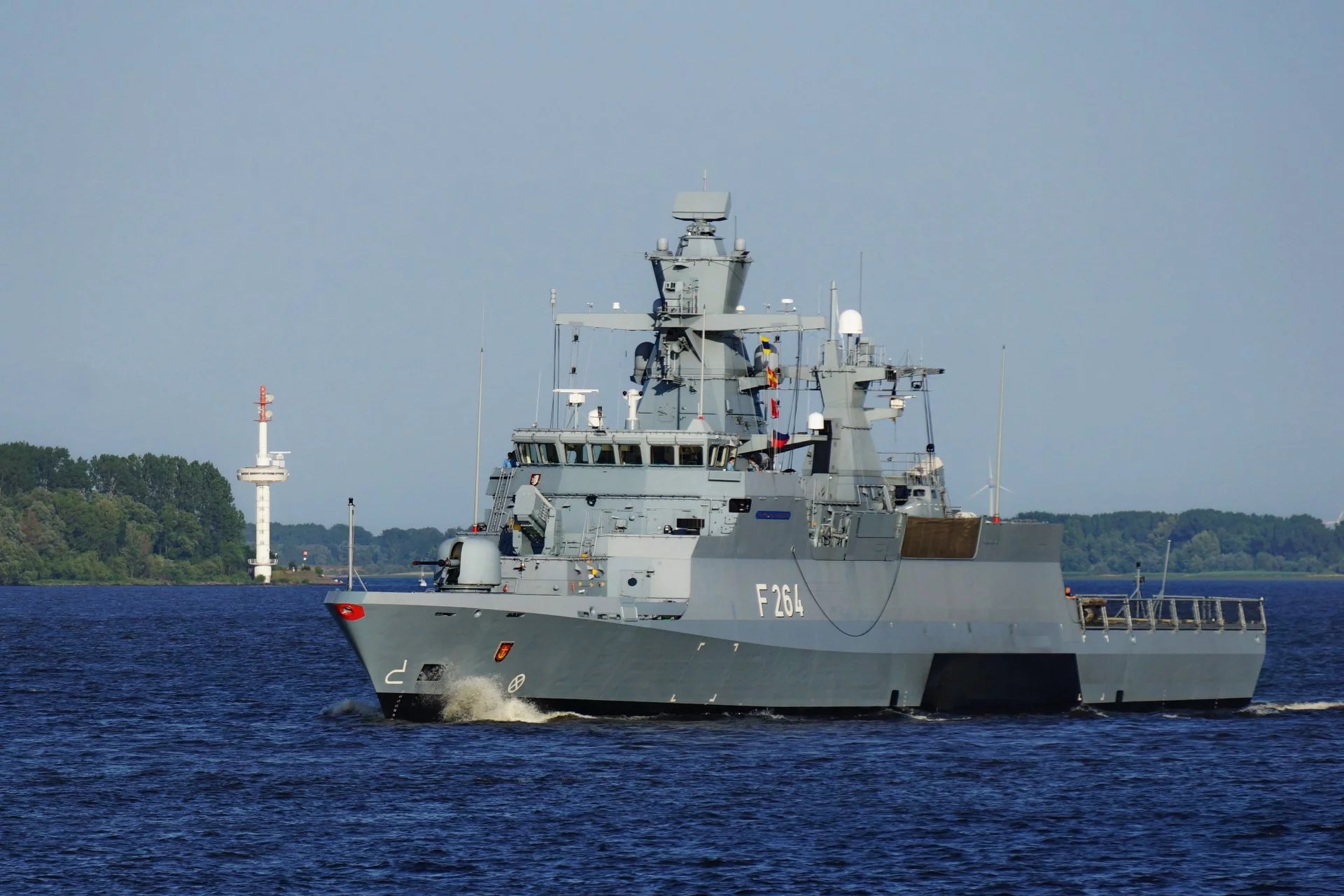
German Navy Braunschweig-class corvette Ludwigshafen am Rhein. (Picture source: German MoD)

ArmyRecognition’s Navy News reports,

According to information published Die Zeit on October 17, 2024, the German Navy corvette Ludwigshafen am Rhein, deployed as part of the United Nations Interim Force in Lebanon (UNIFIL), successfully intercepted and neutralized an approaching drone near the Lebanese coast.

Unfortunately, the report does not specify which defensive system brought down the drone, but the corvette is relatively small, only a little larger than a WMEC270, and compared to the American DDGs that have been operating against kamikaze drones in the Red Sea, their options were limited.  It has two 21 cell RAM (rolling airframe missile) launcher, a 76 mm gun similar to that found on the WMEC270s, two 27mm guns, and an Electronic Countermeasures System.

Most US successes against drones have involved air to air intercepts or the use of very expensive standard missiles, with some attributed to medium range ESSMs (Evolved Sea Sparrow Missiles). In one case a drone was brought down by a Phalanx CIWS (Close in Weapon System) like that mounted on the National Security Cutters, but that was a last ditch effort not a weapon of choice.

The Italian Navy, showing great confidence in their 76mm Strales system, shot down a kamikaze drone after forgoing an opportunity to engage it with surface to air missiles.

Hopefully we will learn more about this incident.

This Day in Coast Guard History, October 22

Based on the Coast Guard Historian’s timeline, https://www.history.uscg.mil/research/chronology/
With inspiration from Mike Kelso

1853  The English ship Western World grounded off Spring Lake, New Jersey, during a gale with about 600 persons on board. Everyone was rescued using equipment at the nearby station.

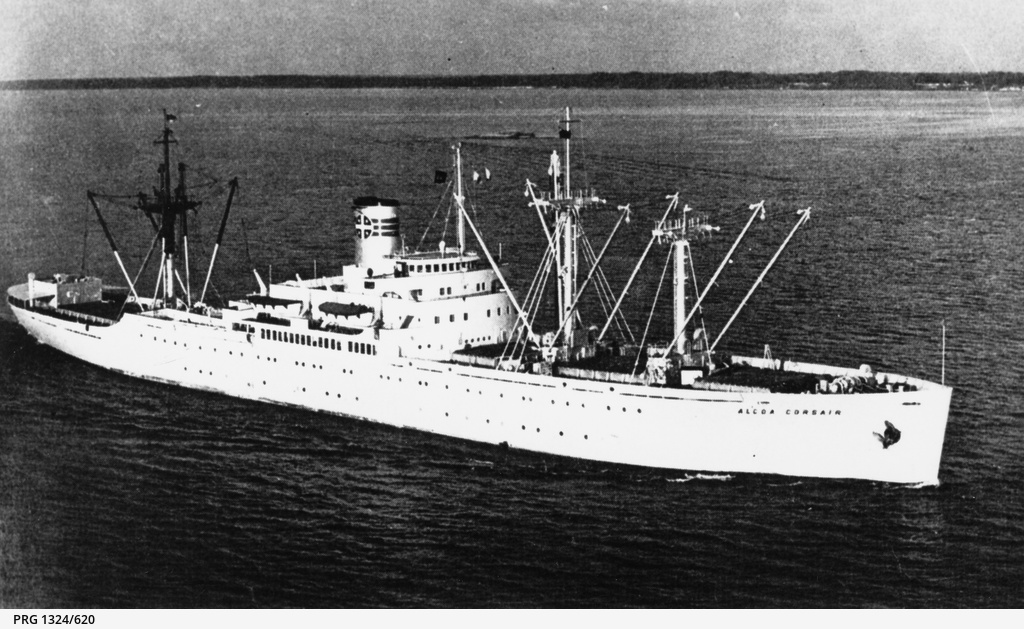
SS Alcoa Corsair

1960  Early in the morning on October 22, 1960, SS Alcoa Corsair and SS Lorenzo Marcello collided near the mouth of the Mississippi River.  Although the Lorenzo Marcello suffered no casualties and proceeded to New Orleans, Alcoa Corsair had eight fatalities, nine injured, and one missing, besides being forced to beach because of severe damages.  A Coast Guard helicopter removed four of the critically injured crewmen while Coast Guard boats and other craft ferried the remaining ones ashore to waiting ambulances.

Northwest Airlines DC-7

1962  Shortly after a Northwest Airlines DC-7 with 102 occupants ditched in the waters of Sitka Sound, Alaska, a Coast Guard amphibian sighted five life rafts.  All on board survived, although three suffered minor injuries.  A Federal Aviation Administration supply boat picked up the survivors, later transferring them to CGC Sorrel, which took them to Sitka, Alaska.

USCGC Charles Sexton (WPC-1108). US Coast Guard photo.

2014  The crew of CGC Charles David Jr. repatriated 43 Cuban migrants to Bahia de Cabañas, Cuba. These repatriations were a result of three separate interdictions of people attempting to illegally migrate to the United States. On October 18, 2014, the crew of CGC Charles Sexton interdicted 22 Cuban migrants from two separate interdictions in the Florida Straits. The next day, October 19, Sexton interdicted another 21 Cuban migrants. All of the migrants were safely removed from their makeshift vessels and were transferred to the Charles David Jr. for repatriation.

This Day in Coast Guard History, October 21

Based on the Coast Guard Historian’s timeline, https://www.history.uscg.mil/research/chronology/
With inspiration from Mike Kelso

Throughout the 1970s, Confidence’s crews seized international vessels originating from the Soviet Union, South Korea, Panama, and other nations for violating U.S. fishery laws.

1971  Alaska Senator Mike Gravel criticized the punishment of 18 crewmen of CGC Confidence for showing support for Greenpeace and asked the Commandant, Admiral Chester Bender, to investigate.

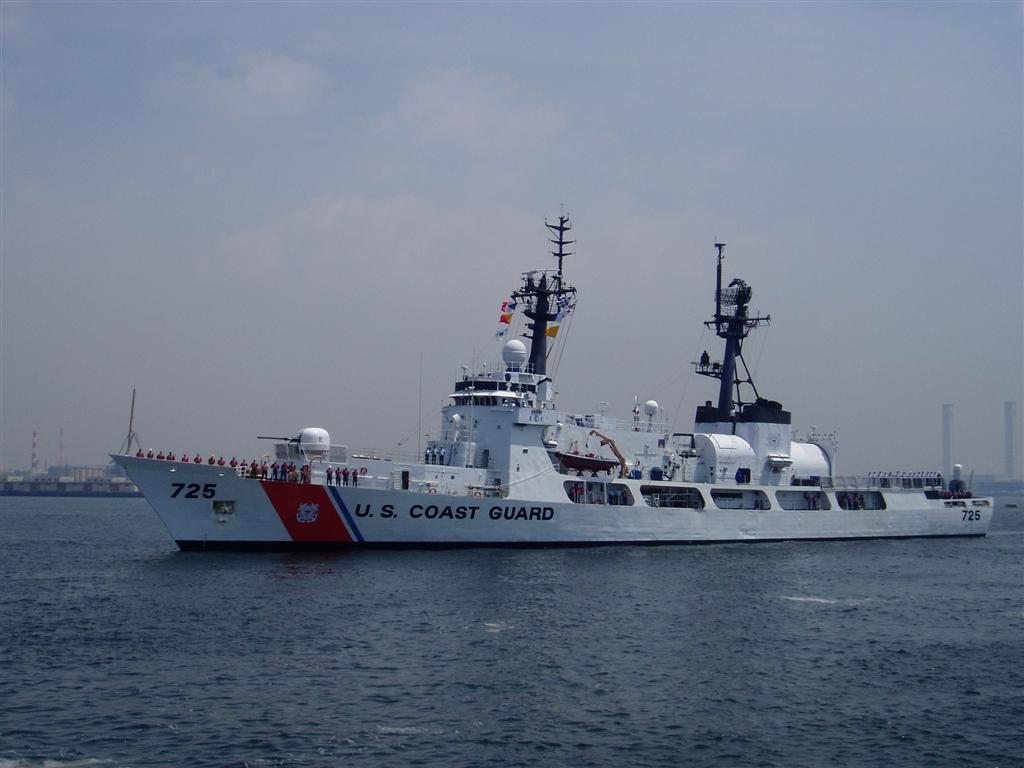
USCGC Jarvis (WHEC-725) participating in RIMPAC 2005.

2009  While on a law enforcement patrol in the Eastern Pacific off the coast of Central America, CGC Jarvis intercepted and captured a self-propelled semi-submersible (SPSS) first located by a U.S. Customs and Border Protection patrol aircraft.  Jarvis’s boarding team discovered 4,500 kilos of narcotics aboard the craft and arrested the SPSS’s four crewman.

This Day in Coast Guard History, October 20

Based on the Coast Guard Historian’s timeline, https://www.history.uscg.mil/research/chronology/
With inspiration from Mike Kelso

1892  After ten years of difficult and costly construction, the St. George Reef Lighthouse, built on a rock lying six miles off the northern coast of California, midway between Capes Mendocino and Bianco, was first lit. “St. George Reef Light marks a hazardous line of rock outcrops that extend northwest from Crescent City to form Saint George Reef. The light was abandoned in 1975 and replaced with a navigational buoy to the west of its current location.”

1920  The Superintendent of the 5th Lighthouse District inspected the aids to navigation “in New River Inlet and Bogue Sound, North Carolina by hydroplane in two hours, which would have required at least four days by other means of travel, owning to the inaccessibility of the aids inspected.”

1944  Allied landings on Leyte, Philippine Islands commenced.  Many Coast Guard units participated in the landings, which marked the fulfillment of General Douglas MacArthur’s promise to the Filipino people that he would return to liberate them from the Japanese.

1950  President Harry S. Truman issued an executive order “activating” the Magnuson Act, which had been passed by Congress earlier that month.  This act, authorizing the president to invoke the Espionage Act of 1917, tasked the Coast Guard once again with the port security mission.

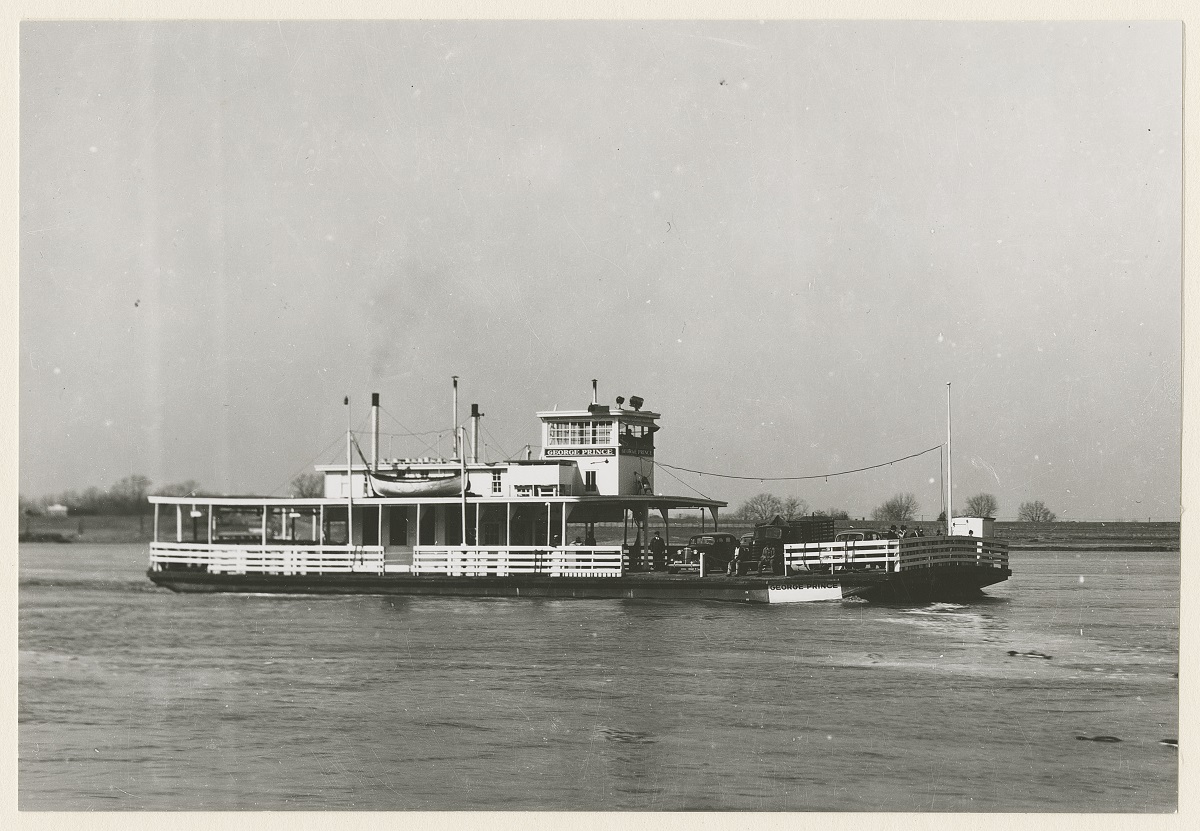
Ferry George Prince

1976  The 120-foot ferry vessel George Prince, carrying 96 passengers and crew along with approximately 30 vehicles, collided with the Norwegian tank vessel Frosta in the Mississippi River about 20 miles above New Orleans.  George Prince was underway from Destrehan to Luling, Louisiana and was loaded to capacity.  Frosta struck  George Prince on the port side aft and the ferry quickly capsized and drifted upside down until it grounded on the right descending bank approximately one mile downstream from the point of collision.  “Ninety-six passengers and crew were aboard the ferry when it was struck, and seventy-eight perished. This accident is the deadliest ferry disaster in United States history.”

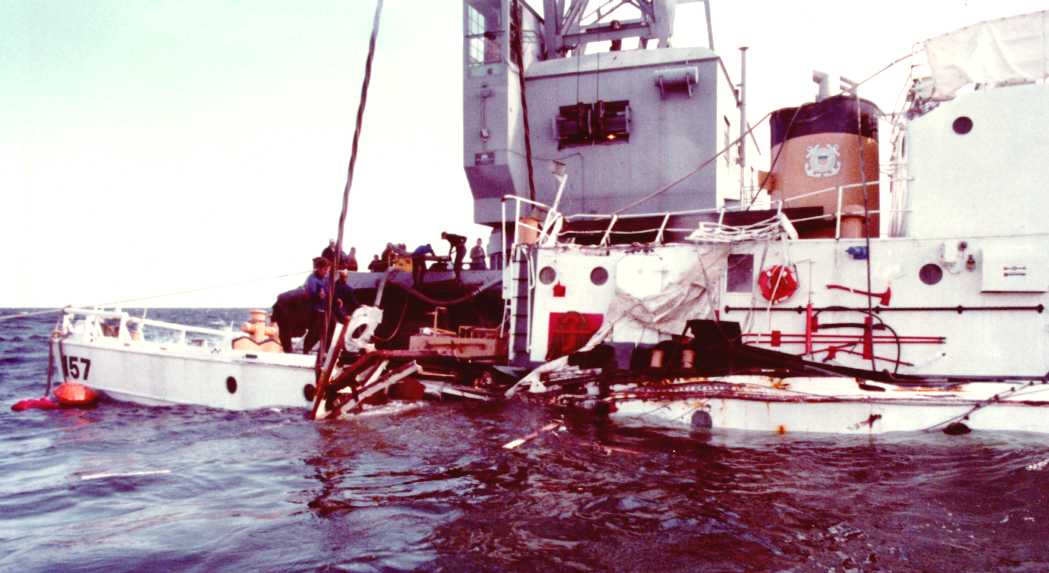
USCGC Cuyahoga (WIX-157) after being raised. USCG photo.

1978  CGC Cuyahoga sank after colliding with M/V Santa Cruz II near the mouth of the Potomac River.  Eleven Coast Guard crewmen were killed.

USCGC MUNRO

2021  CGC Munro (WMSL 755) and crew returned to their Alameda, California homeport after a 102-day, 22,000 nautical mile deployment to the Western Pacific. Munro departed Alameda in July and operated under the tactical control of the U.S. Navy’s 7th Fleet to promote a “free and open Indo-Pacific.” Munro’s crew executed numerous cooperative engagements, professional exchanges and capacity building efforts with naval allies and partners, including the Japan Coast Guard, Japan Maritime Self Defense Force, Philippine Coast Guard and Bureau of Fisheries and Aquatic Resources, Royal Australian Navy, and Indonesia Maritime Security Agency.

This Day in Coast Guard History, October 19

Based on the Coast Guard Historian’s timeline, https://www.history.uscg.mil/research/chronology/
With inspiration from Mike Kelso

1881  The sloop Zulu Chief with four passengers and a crew of two men struck the bar off Hog Island Inlet, Virginia at a point about half a mile from the beach. The accident occurred at 11 o’clock am in plain view of the crew of Station No. 9, Fifth District, on Hog Island.  They launched the surfboat and went to the sloop’s assistance.  She was pounding heavily and lay in a very dangerous position.  The life-saving crew went to work without delay and carried out her anchors and succeeded in saving the vessel.