Closer Coast Guard Ties with Vietnam

The Vietnamese have not had a coast guard very long, just two years, but it looks like after a recent visit by our Commandant, the US Coast Guard will be working more closely with them. The US had already committed to financing the purchase of US made patrol boats for the Vietnamese Coast Guard to the tune of $18M. We discussed this earlier here and here.

As you probably know, the Vietnamese and Chinese have an ongoing dispute over a large area of the South China Sea. A recent change has authorized the their Coast Guard to use force as necessary to expel those who violate law from Vietnamese waters.


Document Alert: U.S. Department of Defense’s Asia-Pacific Maritime Security Strategy

The US Naval Institute News Service has made available the U.S. Department of Defense’s Asia-Pacific Maritime Security Strategy.

I have only scanned it, but it does mention the Coast Guard in the context of freedom of navigation exercises and capacity building for our allies.


China CG gets Surplus PLAN Frigates

Recent spotter pictures from China show that the four Type 053H2G Frigates (NATO designation Jiangwei I) belonging to the People's Liberation Army Navy (PLAN or Chinese Navy) have been transfered to the China Coast Guard (CCG) and are being converted into patrol vessels.

Navy recognition is reporting that all four type 053H2G frigates (NATO designation Jiangwei I) have been transferred to the Chinese Coast Guard, contributing to the already feverish build up of this service. These 115 meter (376 foot),  2,200 ton, 27 knot, helo deck and hangar equipped, diesel powered ships entered service with the Chinese Navy (PLAN) between 1991 and 1994, so while far from new, by USCC standards, they should have considerable life remaining. The design seems quite appropriate for a cutter.

The fact that the PLAN is willing to give up these ships suggest both the pace of modernization of the PLAN and the priority given to bulking up their Coast Guard.

The conversion apparently results in the removal of all the primary weapons including a twin 100mm gun, anti-air and anti-surface missiles, and anti-submarine weapons.

But the ships will not be unarmed, and how they are armed may suggest how Chinese Coast Guard vessels, which were essentially unarmed in the past, may be armed in the future.

The guns that remain are four twin 37mm type 76A mounts. Positioned as they are, this will allow at least two twin mounts to be pointed at any direction, and in perhaps most cases three twin mounts. The projectile weight is about 1.6 pounds; rate of fire is 375 rounds/minute/barrel. They have a range of 9,400 meters and an effective range of 3,500 meters, with a 1600 round ready service capacity at each twin mount.

While these weapons are obviously limited in range, at close quarters they would be extremely dangerous.

In an earlier post I used the weight of projectiles a ship could shoot per minute as one measure of the possible effectiveness of a weapon system. By that measure four 37mm firing 375 one-point-six pound projectiles per minute would mean the capability of firing 2400 pounds of projectiles per minute. This is more than a single 57mm Mk110 (1160 pounds), a 76mm Mk75 (1120 pounds), or even a 5″/62 Mk45 mod4 (1400 pounds).

Why did they retain all four mounts? It would not have been hard to remove two of the four mounts and still retain, what many would see as more than adequate law enforcement firepower, but we probably should not read too much into the retention of all four mounts; it was the easier option, and they may be seen as nothing more than on board spares. They certainly have retained a fierce capability to engage at anything less than 4,000 yards. I would not mind seeing similar redundancy on USCG cutters for our peacetime missions..

The deletion of the ASW equipment certainly suggest the new, more militarized, Chinese Coast Guard does not see itself as ASW capable, and the removal of the 100mm guns suggest they don’t expect to be used as a Naval Gun Fire Support asset.

Changing EEZs

PacificEEZ

Pacific Exclusive Economic Zones. David Butler/Globe staff, click on the chart to enlarge

An interesting discussion in the Boston Globe about how to deal with potential changes in the world’s Exclusive Economic Zones as rising sea levels change the shape of land areas, perhaps resulting in the complete disappearance of some sovereign nations.

One of the possibilities is that the EEZs may be frozen in their current configuration and become an asset of the population, even after the land becomes uninhabitable or disappears completely, and that this asset may be sold, traded, or leased away. We know territorial sovereignty can be sold, after all, the US benefited from the Louisiana Purchase and Seward’s Folly (Alaska).

A Chinese Corporation has been attempting to build a new port complex on “reclaimed” land in Sri Lanka. “Located next to the Colombo Port, the US$1.4 billion project will add about 233 hectares of reclaimed land to the capital and house luxury office buildings, apartment blocks, a golf course, a water sport area, medical facilities, education institutions, hotels, a theme park and marinas.” The project is on hold right now, but if it goes forward, the Chinese firm would be granted  20 hectares (49.4 acres) on an outright basis and 88 hectares (244.6 acres) on a 99-year lease.

This is not a transfer of sovereignty, and  Sri Lanka is not in any danger of disappearing, but it does indicate the scope of China’s interest in the area and, located right off the Southern tip of India,  it is sure to feed into India’s fears of being surrounded by a Chinese “string of pearls.”

Potentially more serious is the decision of the government of the Maldives, “The law passed by the Parliament will now allow absolute foreign ownership of land in Maldives if the investment is above USD 1 billion. The caveat to the law is that 70% of the land has to be reclaimed from the sea.”

The Maldives, with an average elevation of 1.6 meters,  is one of those island nations that are in danger of being adversely effected by rising see levels. If anyone takes the Maldives up on their offer, it will probably be the Chinese, who have already shown a lot of interest in the Indian Ocean island nation. Again this is not a transfer of sovereignty, but it may be a harbinger of things to come

(Beside it really wanted everyone to see the chart of Pacific EEZs. A lot of that is US EEZ.)

China’s Naval Militia–A Coast Guard Auxiliary and Much More

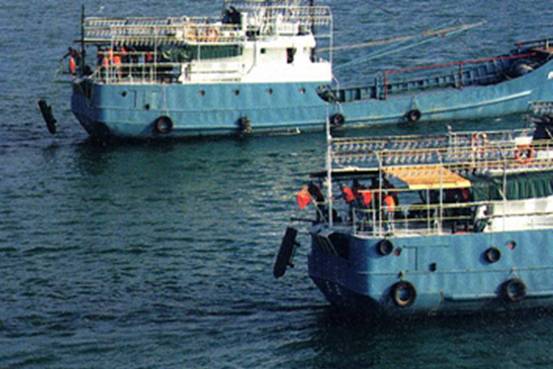
A photo published in a report on Chinese mine warfare by the U.S. Naval War College shows Chinese civilian fishing vessels practicing deploying sea mines at a naval base in Sanya in 2004. —Courtesy of U.S. government

A photo published in a report on Chinese mine warfare by the U.S. Naval War College shows Chinese civilian fishing vessels practicing deploying sea mines at a naval base in Sanya in 2004. —Courtesy of U.S. government

The Wall Street Journal has an interesting story about China’s Naval Militia. It employs not only the crews of their fishing industry, but also their vessels, to support China’s Navy and Coast Guard. It certainly blurs the line between government and non-government vessels.

Presumably this organization also extends to include their ocean going vessels and their crews as well. This is all the more interesting because of China’s recent announcement that they would require the incorporation of military characteristics in newly constructed container, roll-on/roll-off, multipurpose, bulk carrier and break bulk civilian vessels.

New Info on China’s Navy and coast guards–ONI

File:Logo of the China Coast Guard.png

China Coast Guard Crest

The Office of Naval Intelligence (ONI) has issued incredibly detailed information on China’s Navy and para-military naval organizations in an unclassified form.

Perhaps most impressive is the PLA Navy Identification Guide which includes their coast guards. The sheer number of vessels in their coast guard type organizations is staggering.

The Diplomat offers their take on these new intelligence products. The author, “Andrew S. Erickson is an Associate Professor in the Strategic Research Department at the U.S. Naval War College and a core founding member of the department’s China Maritime Studies Institute (CMSI). He serves on the Naval War College Review’s Editorial Board.”

You can access all of these products here.