
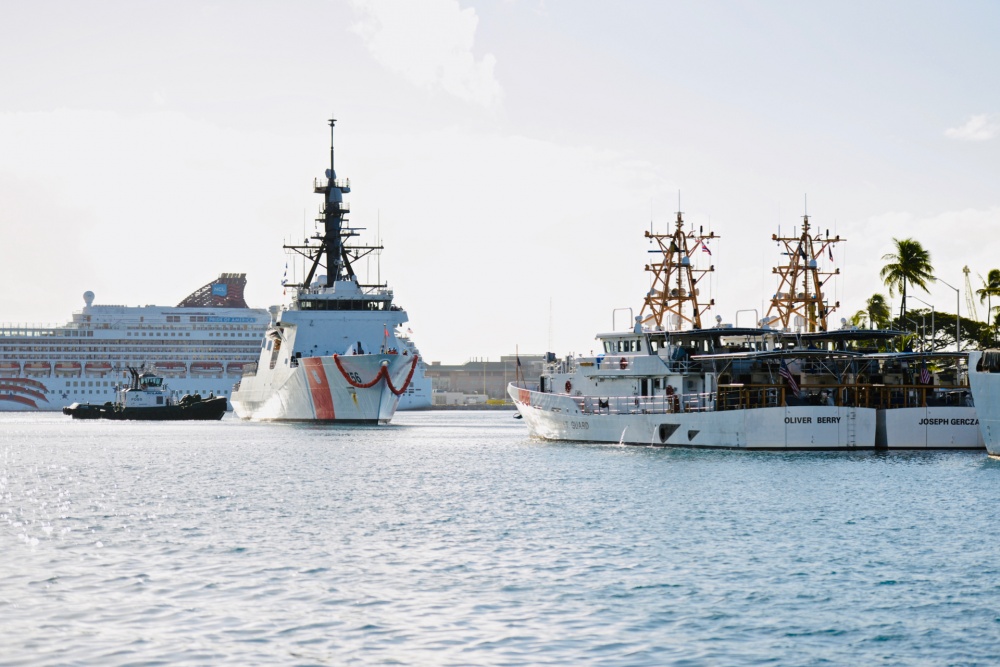
The crew of USCGC Kimball (WMSL 756) arrive in Honolulu for the first time Dec. 22, 2018. Known as the Legend-class, NSCs are designed to be the flagships of the Coast Guard’s fleet, capable of executing the most challenging national security missions, including support to U.S. combatant commanders. (U.S. Coast Guard photo by Chief Petty Officer Sara Muir/Released)
The US Naval Institute Proceedings’ December issue includes an article by LCdr. Karen Love Kutkiewicz, USCG, discussing the problems of motivating people toward sea duty, both now and in the future, when sea duty billets are expected to constitute a higher percentage of Coast Guard personnel.
The article has a couple charts that are particularly interesting. The first shows the growth in cutter billets and associated direct support.

The fleet has had some ups and downs and while we may be seeing a percentage rise currently, I suspect that there were periods in the past, when the Coast Guard was even smaller, when seagoing billets were at a higher percentage than currently projected for 2037 (really more like 2039 now). When I reported to the Academy in 1965, we had 36 WHECs and several icebreakers.
Still looking at the recent past, since we are adding both afloat billets and direct support billets, which will be in large part billets that require seagoing experience, while the rest of the service remains essentially stable, this does look like a substantial change in the overall percentage of coasties going to sea.
The second showing the assignment year 2021 command slots to be filled and number of applicants.
 I would not think it surprising that there is more competition for Command Ashore positions because, while only officers with an afloat background compete for Command Afloat, those same officers, as well as essentially the rest of the officer corps, compete for command ashore billets, and at the O3/O4 level there are very few command ashore billets. Looking at the O3/O4 Afloat Command line, are 91 applicants for 53 positions adequately competitive? Could be.
The post seems to be most concerned about O3/O4 command billets, but really, I see more of a problem in motivating personnel to fill department head and XO billets in the O3-O5 level. Will they ever get a shot at command afloat when up against those who were given early command?
This is not the first article bemoaning the loss of sea going experience.
Apparently one thing we have done, is open O3 command billets to Warrant Officers. Maybe, if we are not doing so already, we should consider opening O3 department head billets to Warrants as well.
Something else we might do, is reorganize at least some support functions into squadron commands, staffed by experienced seagoing personnel, including post-command squadron commanders. These commands (Area commands for the largest ships and District commands for WPC and WPBs) could mentor the ships’ COs and crews. In addition, they would be in an excellent position, to make fair evaluations of their performance. Additionally, they could be the source to fill short term shortages in essential billets.
To keep things in perspective. I would note that, while the Coast Guard has only about an eighth of the number of active-duty military personnel as the Navy, the Coast Guard has almost as many military command afloat billets (excluding Military Sealift vessels commanded by civilians), and far more at a junior level.


 Chuck Hill's CG Blog