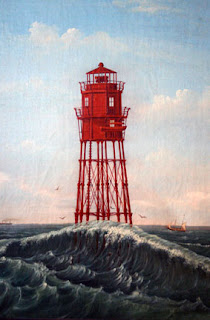
A painting of the original Minot’s Ledge Lighthouse built in 1850
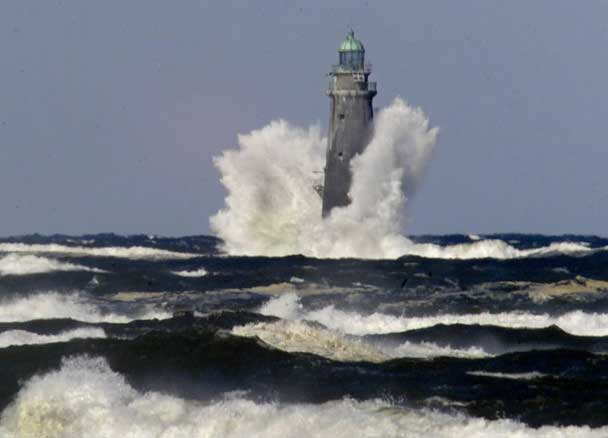
The modern Minot’s Ledge lighthouse built of granite replace the steel lighthouse that was destroyed in 1851
1850 The light in the Minot’s Ledge Lighthouse was first shown. This lighthouse was the first one built in the U.S. in a position directly exposed to the sweep of the open sea. It was destroyed and two keepers were killed in a great gale in April 1851.
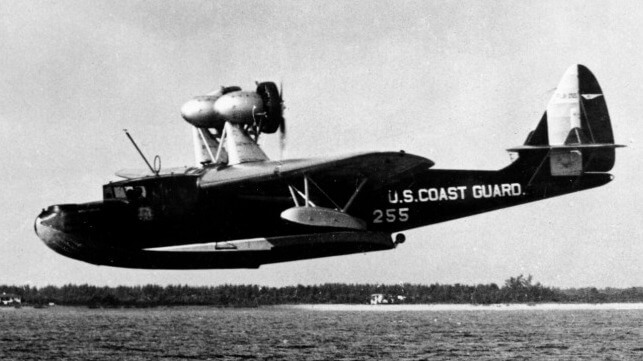
The U.S. Coast Guard SAR aircraft Arcturus (USCG)
1933 Carl C. von Paulsen, a pioneering Coast Guard aviator, and his crew of four rescued a man during a gale off the coast of Florida while flying in the Coast Guard seaplane Arcturus from Air Station Miami. He and his crew were awarded a Gold Lifesaving Medal, the first Coast Guard aviators to earn the prestigious award.
1937 Effective this date, the dividing point between the 6th and 7th Lighthouse Districts on the east coast of Florida was moved northward from Hillsboro Inlet to St. Lucie Inlet to place the new trans-Florida waterway (through Lake Okeechobee) under one jurisdiction.
1946 The Coast Guard, which had operated as a service under the Navy since November 1, 1941, was returned to the Treasury Department, pursuant to Executive Order 9666, dated December 28, 1945.
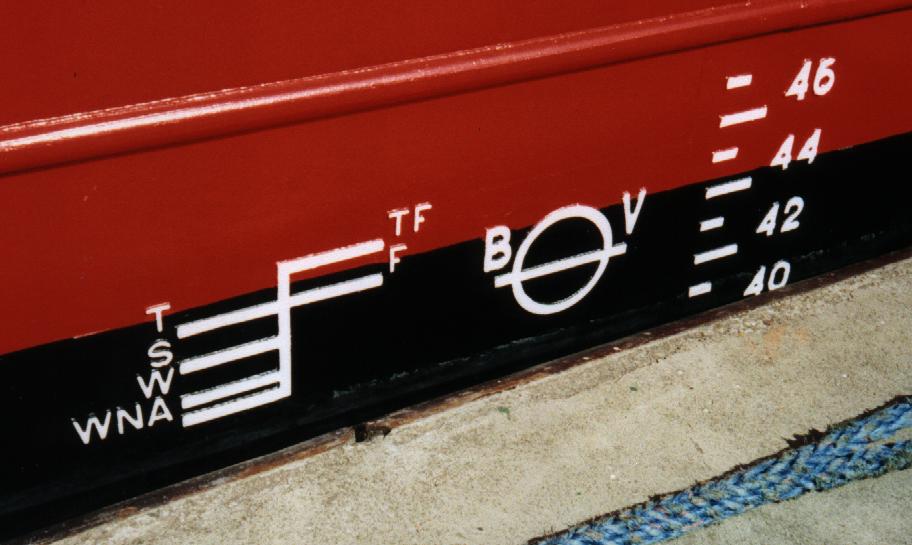
Freeboard mark (Plimsoll mark). Load line markings on a cereal carrier, certified by Bureau Veritas. Photo credit: Wualex
1946 The International Load Lines Convention, which had been suspended since August 9, 1941, was restored to full effectiveness by a Presidential proclamation dated December 21, 1945. The Coast Guard assumed the enforcement of the convention’s requirements in the interest of safe loading.

Oct. 11, 2020, collision between the offshore supply vessel Cheramie Bo-Truc No. 33 and the Coast Guard cutter Harry Claiborne. NTSB Photo
1954 The “Regulations for Preventing Collisions at Sea, 1948”, commonly known as the “Revised International Rules of the Road”, became law. These were a result of the International Conference on the Safety of Life at Sea, 1948.
1958 The Coast Guard ceased listening continuously for distress calls on 2670 kilocycles. Although the countries of the world had agreed at the Atlantic City Convention of the International Telecommunication Union in 1947 to use 2182 kilocycles for international maritime mobile radiotelephone calling and distress, the Coast Guard had continued listening on the old frequency until the public had had sufficient time to change to the new one.

USCGC Point Gammon gets a camouflage coat of dark grey paint at Da Nang, October 1965. Photo credit Lt. Cdr. Richard J. Knapp, USCG
1967 CGC Point Gammon destroyed an enemy trawler in Vietnam.
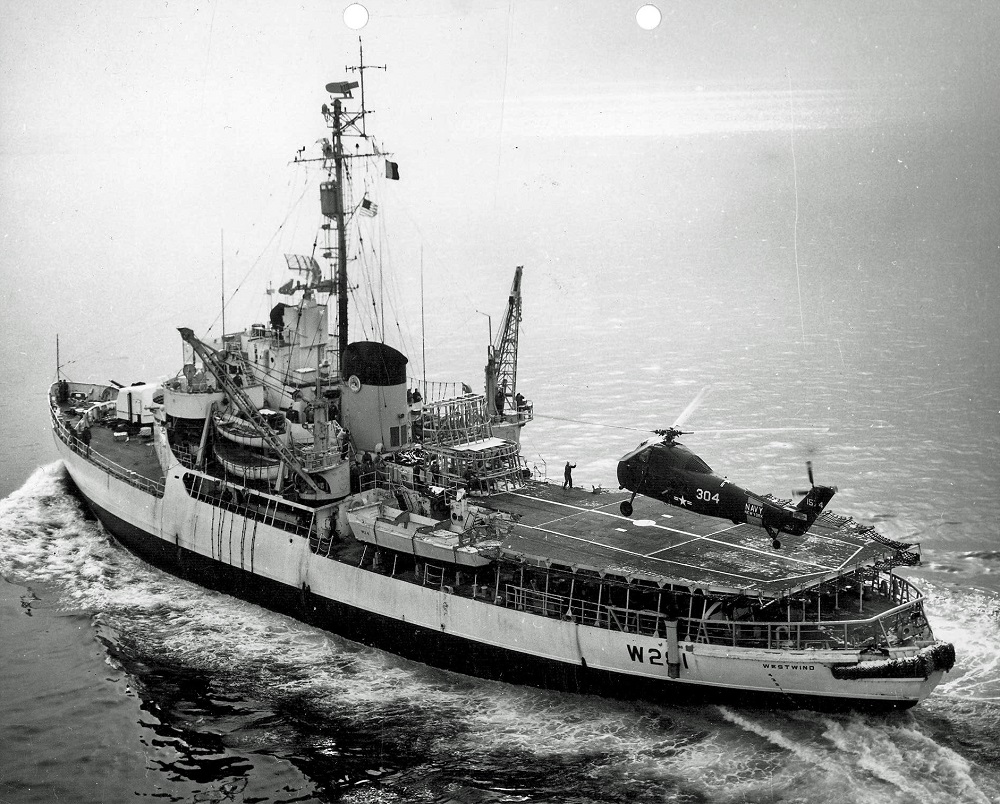
USCGC Westwind
1984 CGC Westwind was heavily damaged by ice in Antarctic’s Weddell Sea. About 120 feet of the port-side hull was gashed when brash ice forced the ship against a 100-foot sheer ice shelf. The gash was two to three feet wide and was six feet above the water line. The crew made temporary repairs. There were no injuries.
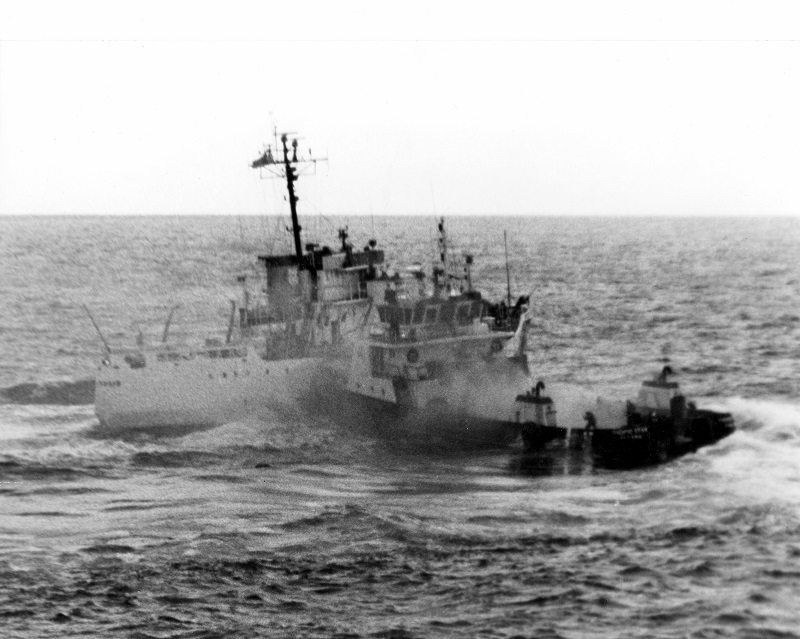
When the boarding team attempted to board the vessel, the master set the Pacific Star on fire and commenced to scuttle the vessel. In a final act of deterrence, the master turned his vessel and rammed Citrus on the starboard side. The boarding team did get on board and located a large quantity of Thai marijuana in the vessel’s forward hold. As the vessel sank, more than 3,800 pound of marijuana was recovered as it floated to the surface and the seven-man crew was arrested.
1985 CGC Citrus was rammed by the M/V Pacific Star during a boarding incident. The Pacific Star then sank after being scuttled by her crew. There were no casualties. The seven crewmen were arrested on drug charges.
1999 The Aviation Machinist ratings merged with the Aviation Structural Mechanic ratings to form the Aviation Maintenance Technician rating with the designator AMT. The Aviation Electronics Technician rating became the Avionics Technician rating with the designator AVT. The Aviation Survivalman rating was renamed Aviation Survival Technician.








 Chuck Hill's CG Blog