
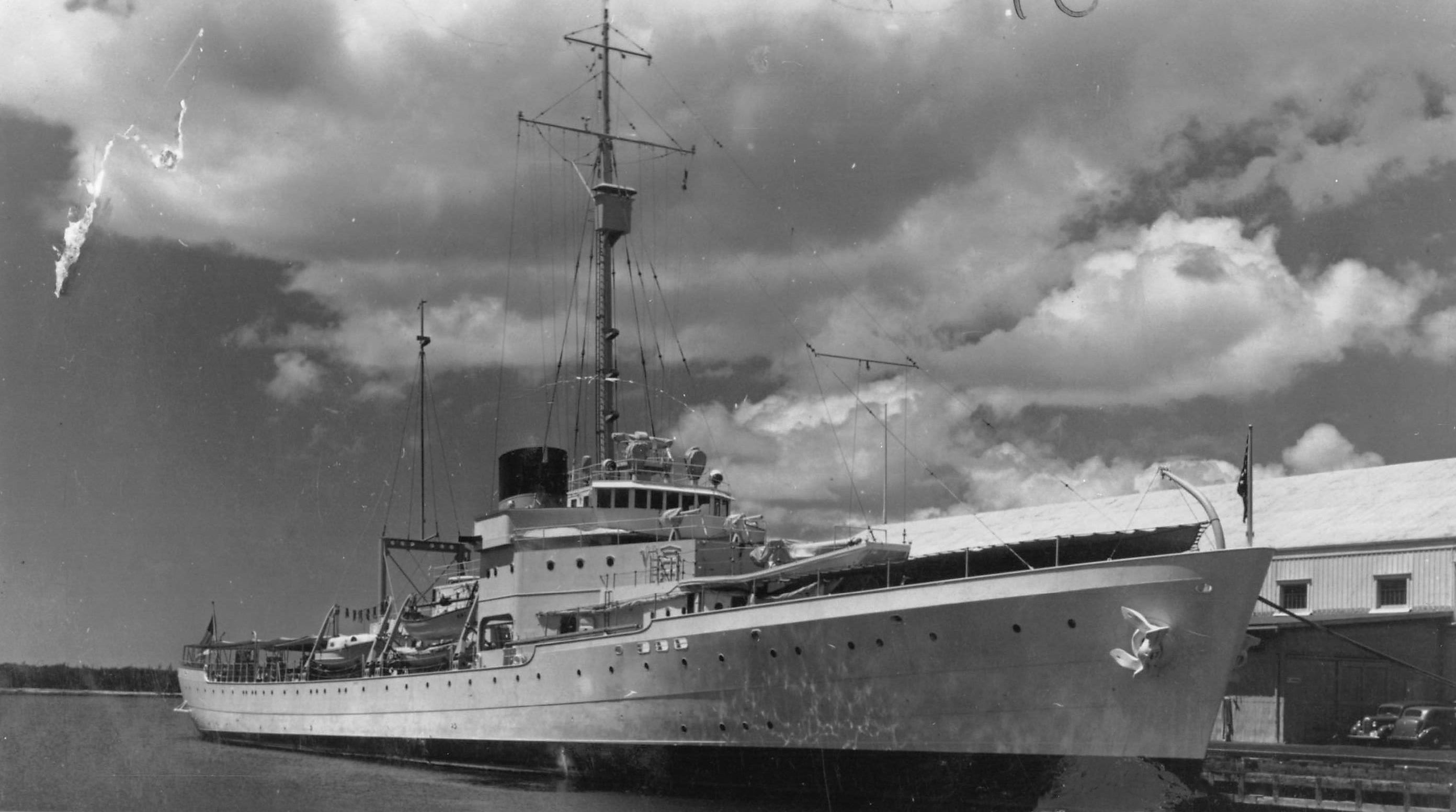
327 foot Secretary class cutter USCGC Taney tied up at Pier 4 in Honolulu Harbor, Hawaii, circa 1940. VIRIN: 220509-G-G0000-002.JPG Photo credit: USCG Historian’s Office
I began this as a comment in answer to a comment by Bill Smith, to the effect that it is harder to prepare for war now than it was in preparation for WWII, but thought it might be of general interest.
Admiral Waesche served in the Navy Department’s War Plans shop as an O-5 before assuming the role of Commandant in June 1936 at the age of 50 (after ten years as a Commander) skipping the rank of Captain altogether.
He had five years as commandant, to get the Coast Guard ready to fight WWII, but even then, we had serious problems. Many of the smaller cutters used as escort vessels had no sonar and/or no trained sonar operators. Even the 327s didn’t get decent anti-air fire control systems until 1943. That the 327s had only a single engine and boiler room was a serious flaw as a warship and the while the 327s and 165 foot 165B class WPCs proved excellent ASW ships, the last 327s were commissioned in March 1937 and the last of the WPC165s in 1934. The Coast Guard laid down no credible surface combatants in preparation for the coming war from October 1933 until USCGC Storis was laid down in July 1941, almost eight years. The only large cutters constructed during the war were the 255s and they were assigned a low priority and only one was complete before the end of the conflict.

240 foot Tampa class cutter USCGC Haida in the Bering Sea sometime in 1945. Note her wartime appearance and armament. Photo credit: naval-history.net
The large cutter fleet in the immediate pre-war period consisted of 30 ships:
- seven 327 foot Treasury class (2,350 tons full load, 19.5 knots, commissioned 1936/37),
- ten 250 foot Lake class (2,075 tons, 17 knots,1928-32),
- four 240 foot Tampa class (1,955 tons, 16 knots, 1921/22),
- six 165 foot Algonquin 165A class (1000 tons 1932-34),
- USCGC Northland (1,785 tons, 11.7 knots, 1927),
- USCGC Tallaposa (964 tons, 12 knots, 1915), and
- USCGC Unala (1,180 tons, 12.5 knots, 1912). (humorous stories here)

USCGC Unalga at San Juan, PR, circa 1943, with two 3″/50 guns fore and aft. In 1941 the two 3″/50s were mounted abreast on the forecastle. The decks could not support a centerline gun, so in 1944 the forecastle was strengthened
Photo “U.S. Coast Guard Cutters & Craft of World War II” by Robert L. Scheina
All ten of the 250s were transferred to Great Britain in April and May of 1941. These were to be replaced by what became the 255s, the first of which was not commissioned until May 1945.

250 foot Lake class cutter USCGC Itasca as HMS Gorlsston
No patrol boats over 40 feet were completed after 1937 until the 83 foot WPB program was initiated in 1941.
The US began pre-war naval expansion in 1934 with the relatively modest Vinson–Trammell Navy Act followed by additional expansion concluding with the Two Ocean Navy Act of 1940, but the Coast Guard was not a beneficiary of this increased spending.
Perhaps it was not surprising the money went to the Navy. When war did come, the Coast Guard expanded exponentially. Large numbers of vessels were taken up in an emergency expansion and ultimately the Coast Guard would man 351 Navy and 288 Army vessels.
While the concentration on Navy vessels was understandable, the total effort would have improved with only a small investment in equipment and training for the Coast Guard.
Ironically, after WWII, the Coast Guard was fleshed out with ships built for the US Navy.
 Chuck Hill's CG Blog