
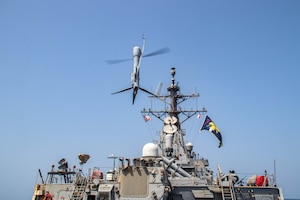
GULF OF OMAN, An Aerovel Flexrotor unmanned aerial vehicle launches from the deck of the Arleigh Burke-class guided-missile destroyer USS McFaul (DDG 74) in the Gulf of Oman, in an image released Oct. 6. US Navy photo.
Below is a 6 October news release from U.S. Naval Forces Central Command Public Affairs. It notes Coast Guardsmen were involved, presumably PATFORSWA, but no details of how. All the photo here accompanied the release.
MANAMA, Bahrain —
Last month, naval forces in the Middle East region successfully integrated unmanned platforms with traditionally crewed ships and aircraft to conduct enhanced maritime security operations in the waters surrounding the Arabian Peninsula.
Seven task forces falling under U.S. 5th Fleet integrated 12 different unmanned platforms with manned ships for “manned-unmanned teaming” operations, tracking Iranian Navy and Islamic Revolutionary Guard Corps Navy (IRGCN) ships and small boats over several days during routine patrols in and around the Strait of Hormuz.
This operation bolstered presence in and around a critical chokepoint that in recent months has seen Iran unlawfully seize internationally flagged merchant ships.
Unmanned underwater vehicles (UUVs), unmanned surface vehicles (USVs) and unmanned aerial vehicles (UAVs) were involved in the operation.
“We have been operating UAVs and UUVs in the region for years,” said Capt. Joe Baggett, Director of Maritime Operations for U.S. Naval Forces Central Command and U.S. 5th Fleet. “Adding our new USVs, and then integrating all of these platforms into fleet operations, is how we expect to fly and sail well into the future.”
Sailors, Marines, Coast Guardsmen, ships and aircraft from Task Force 51/5 (Amphibious/Marine), Task Force 52 (Mine Countermeasures), Task Force 53 (Logistics), Task Force 55 (Surface Warfare), Task Force 56 (Expeditionary), Task Force 57 (Patrol/Reconnaissance) and Task Force 59 (Unmanned/Artificial Intelligence) conducted the operations.
“The integration of new, multidomain unmanned platforms into routine fleet operations provides more ‘eyes on the water,’ enhancing maritime domain awareness and increasing deterrence in the region,” said Vice Adm. Brad Cooper, Commander, U.S. Naval Forces Central Command and U.S. 5th Fleet.
Cooper added that collectively, these platforms support the safe navigation and free flow of commerce through vital regional chokepoints, particularly around the Strait of Hormuz.
“This enhanced maritime security serves as a deterrent against malign activity and strengthens regional stability, which is good for everybody,” he said.
U.S. Naval Forces Central Command/U.S. 5th Fleet’s area of operations encompasses about 2.5 million square miles of water area and includes the Arabian Gulf, Red Sea, Gulf of Oman, Gulf of Aden, Arabian Sea and parts of the Indian Ocean. This expanse, comprising 21 nations, includes three critical choke points at the Strait of Hormuz, the Suez Canal and the Strait of Bab al Mandeb.
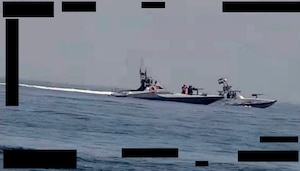
STRAIT OF HORMUZ (Oct. 6, 2023) An undated still image released on Oct. 6 from video taken by an Arabian Fox MAST-13 unmanned surface vessel of two Islamic Revolutionary Guard Corps Navy patrol speedboats in the Strait of Hormuz.
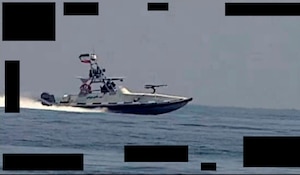
STRAIT OF HORMUZ (Oct. 6, 2023) An undated still image released on Oct. 6 from video taken by an Arabian Fox MAST-13 of an Islamic Revolutionary Guard Corps Navy patrol speedboat in the Strait of Hormuz.
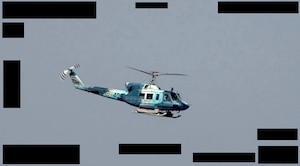
STRAIT OF HORMUZ (Oct. 6, 2023) An undated still image released on Oct. 6 from video taken by an Arabian Fox MAST-13 unmanned surface vessel of an Iranian Navy AB-212 helicopter in the Strait of Hormuz.
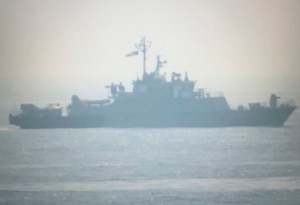
STRAIT OF HORMUZ (Oct. 6, 2023) A undated still image released on Oct. 6 from video taken by a MARTAC T-38 Devil Ray unmanned surface vessel of an Islamic Revolutionary Guard Corps Navy warship in the Strait of Hormuz.
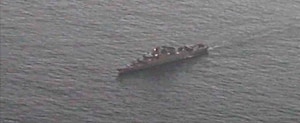
STRAIT OF HORMUZ (Oct. 6, 2023) An undated still image released on Oct. 6 from video of an Iranian Navy frigate taken by an Aerovel Flexrotor unmanned aerial vehicle (AAV) in the Strait of Hormuz.(U.S. Navy photo)
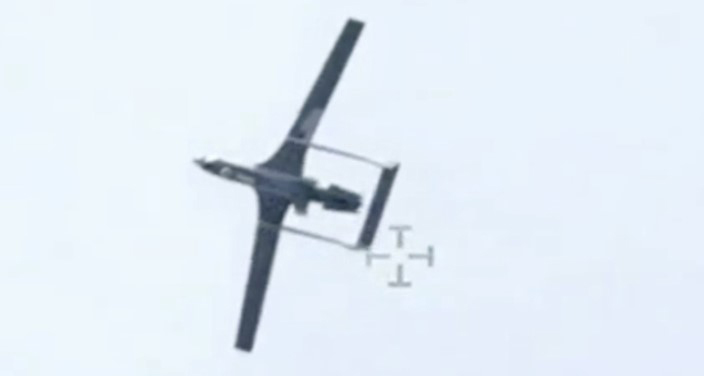
STRAIT OF HORMUZ (Oct. 6, 2023) An undated still image released on Oct. 6 from video taken by an Arabian Fox MAST-13 unmanned surface vessel of an Iranian unmanned aerial vehicle in the Strait of Hormuz.

 Chuck Hill's CG Blog