Liberator, Containerized Launcher for Torpedoes and Maybe More

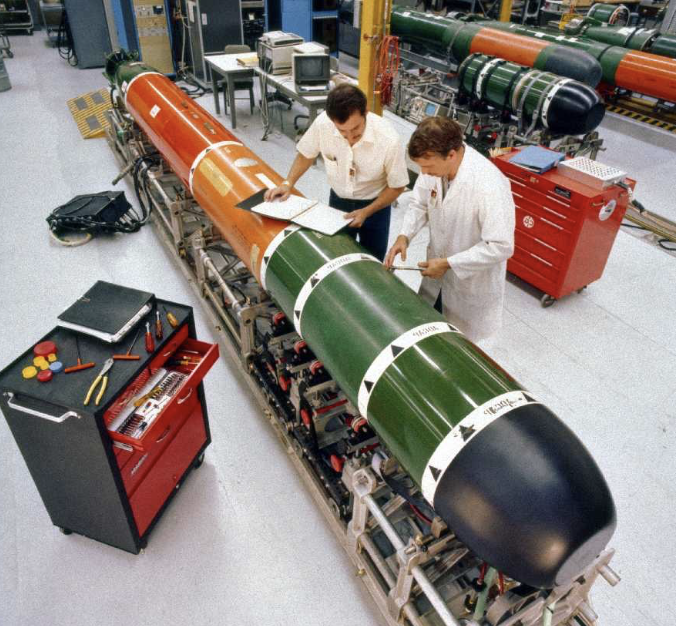
Keyport Technicians working on a Mark 48 in early 1982. U.S. Navy Photograph No. DN-SC-86-00553.

Naval News reports,

A new line item in the U.S. Navy Fiscal Year 2026 budget is supporting a containerized Mark 48 Advanced Capability (ADCAP) torpedo launcher for use on unmanned surface vessels (USV) and small combatants.

But looks like there may be more to it than the very expensive Mk48 torpedo.

“Program Executive Office, Unmanned and Small Combatants (PEO USC) is leading the effort and will deliver a 3.5 hour presentation about Liberator and a related unmanned undersea vehicle (UUV) payload…The Liberator provides for the development of alternative methods for launching torpedoes or similar devices…”

The Mk48 is intended to be used against the most demanding (nuclear submarines) in the most hostile environment. They have to be fast and they need to be capable of surviving great pressure. For this reason they are extremely expensive. The basic design goes back to 1972 but there have been many improvements.

Torpedo tubes are already being used to launch and recover Uncrewed Underwater Vehicles (UUVs). Plus we have begun seeing new cheaper torpedoes.

I find this exciting because it looks like we might have a relative inexpensive anti-surface torpedo. It would allow a Patrol Boat to stop even a large ship.

Heavy Weight Torpedoes on Surface Ships

The Mk 48 torpedo was intended for use in both submarines and surface ships, in the latter for the ASW role. Twin Mk 25 tubes for Mk 48 torpedoes were fitted in guided missile frigates (DLG/DLGN) in their after deckhouse and in escort ships (DE/DEG) in their stern counters. This photo shows a Mk 48 being launched from the USS Talbot (DEG-4). Lockheed Shipbuilding; US Navy

Looking back a couple of years, The War Zone had a post that argued that Heavy Weight Torpedoes (HWT) should be installed as anti-submarine weapons on surface ships.

Cold War U.S. Navy Nearly Armed Its Frigates With Mk 48 Heavyweight Torpedoes

The argument is based on misgivings about the effectiveness of the Mk54 light weight torpedo (LWT)) and about reliance on only one weapon in general.

He specifically talks about problems with the Mk54 and the possibility of mounting at least one torpedo tube with reloads on the Constellation class guided missile frigates.
He also advocates adding a bow mounted active sonar to provide targeting for the HWT. From what I hear, the CAPTAS 4 sonar really does make the bow mounted sonar unnecessary.
His argument seems sound, but there are perhaps additional reasons for putting one or two heavy weight torpedo tubes on large Cutters, even if they don’t come with the very expensive Mk48 torpedoes.
There are indications the Navy may be producing an alternative heavy weight torpedo tentatively named the RAPTOR (Rapid Acquisition Procurable Torpedo) and we have Anduril offering an unmanned underwater vehicle that serve as a heavy weight torpedo.
Given the implicit requirement in the Coast Guard mission set that cutters should be able to forcibly stop any vessel regardless of size, a heavy weight torpedo could be a very effective ship stopper with relatively long range.
For Mobilization:
In case of a major conflict I would anticipate large cutters would be used to enforce blockades and/or escort logistics support ships.
The new generation of large cutters are armed adequately to enforce a blockade against clandestine shipments in small vessels for operations like Market Time, but to forcibly stop larger vessels we need something more than the 57mm. Since in most cases the desire would be to stop rather than to sink vessels like large tankers, we need something that can reliably disable propulsion, most probably a smart torpedo.
To escort logistics ships against either China or Russia, the minimum requirement would be a towed array like CAPTAS 4 (selected to equip FFG-62 class) or one of that family, an ASW helicopter, space for torpedoes and sonobuoys, and additional personnel (probably Navy Reserves) to operate and maintain them.
It would not be too difficult to add light weight torpedoes to large cutters, but unless there is major surgery, cutters will not have the vertical launch systems that allow Navy escort vessels to also have an organic longer ranged ASW weapon in the form of vertical launched ASROC for times when an ASW helicopter is not available. A heavy weight ASW torpedo could provide such a long range capability.