Coast Guard Strategic Plan, 2018-2022

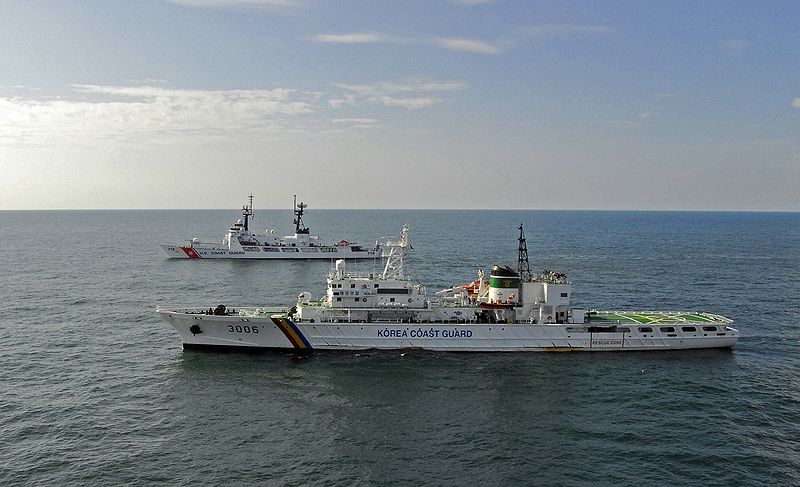
Republic of Korea Coast Guard vessel #3006 in company with U.S. Coast Guard cutter USCGC Boutwell (WHEC-719) during the North Pacific Coast Guard Forum in August 2007. This forum was created to increase international maritime safety and security in the Northern Pacific Ocean and its borders. The Boutwell worked with the Korean coast guard while on their way to Yokosuka, Japan. The Japanese coast guard is one of the six nations involved in the forum.

The Coast Guard has issued a new Strategic Plan for the next five years. It is an amplification of the new Commandants mantra “Ready, Relevant, Responsive.” I’m always a little dubious about these sorts of document since, frequently they look more like public relations documents than real plans, but this may have some actual clues that point to changes of emphasis and direction.

The plan continues the previous Commandant’s intention to counter Transnational Criminal organizations, but there seems to be an increasing emphasis on the Coast Guard’s role in emerging great power competition.

Another shift in the strategic environment is the return to great-power competition. Rival powers, such as China and Russia, are challenging rules-based international order through inter-state aggression, economic coercion, maritime hybrid warfare, gray zone activities, and overreaching territorial claims. Through their actions, they are attempting to diminish American and partner-nation influence abroad. By exploiting pockets of weak governance, these near-peer competitors could undermine democratic institutions, escalate conflict, poach maritime resources, jeopardize access to critical sea lanes, and ultimately disrupt peaceful regions

There is again emphasis on cyber.

The security environment is also affected by the rising importance of the cyber domain – where adversarial nation states, non-state actors, and individuals are attacking our digital infrastructure and eroding the protections historically provided by our geographic borders. At the stroke of a key, rivals in remote regions of the world can attack, disable, and alter our critical infrastructure and financial networks. These bad actors can unleash volatile malware that could have devastating consequences worldwide. While improved interconnectivity expands our capabilities, we must be wary of the corresponding increase in risk

There is recognition that our disaster response role has now become increasingly routine.

The increasing severity and scale of catastrophic incidents is another reality. Coastal regions are densely populated, and ports have become heavily developed. Catastrophic events, whether man-made or natural, can have enormous consequences to our coastal communities and disrupt regional and global commerce. Recent hurricanes, floods, and other maritime disasters have reinforced the Nation’s need to prepare for the size and impact of such incidents.

This is reflected in an objective on page 24:

3.1.1. Lead in Crisis
Whether a maritime disaster or catastrophic event, the Coast Guard is a leader of the integrated response. Drawing on our vast organizational experience, we will:

• Cultivate crisis leadership as a core competency;

• Be the Nation’s premier incident management experts for complex maritime disasters; and

• Enhance the management of surge capabilities and the mobilization of adaptive force packages

There is recognition of increasingly global deployment of Coast Guard assets.

The Coast Guard is deployed globally to promote peace, fortify alliances, attract new partners, and challenge threats far from U.S. soil. For example, we provide United States Southern Command (USSOUTHCOM) detection, monitoring, and response capability in the Western Hemisphere to combat transnational crime in the Transit Zone while building the interdiction and crisis response capabilities of our partner nations. In United States Northern Command (USNORTHCOM), our Rotary Wing Air Intercept assets and Maritime Security Response Teams rapidly deploy as singular elements or as a supplement to joint- force packages in support of Homeland Defense missions. As the Federal surface presence in the Arctic, we advance safe, secure, and environmentally-responsible maritime activity by improving awareness, modernizing governance, and broadening partnerships. In the Indo-Pacific, we are actively building partner capacity and theater security cooperation throughout the region to enhance maritime governance and bolster stability in collaboration with United States Indo-Pacific Command (USINDOPACOM). In United States Central Command (USCENTCOM), our patrol boats and advanced interdiction teams conduct maritime security operations in the Arabian Gulf. Along the West African coast, we support United States Africa Command (USAFRICOM) to strengthen partner-nation capability for self-policing in order to thwart transnational threats such as piracy, illegal fishing, and contraband trafficking.

Among the many bulleted action items there are a few that might indicate change of direction.

• Preserve maritime norms and influence acceptable behavior to facilitate the unimpeded flow of lawful maritime commerce;

• Create opportunities and build avenues for regional information sharing;

Are these looking perhaps at the South China Sea or the West Africa’s Gulf of Guinea?

There were a couple of items that emphasized improved working relations with DHS and DOD:

2.2.1. Strengthen Integration with DHS The Coast Guard employs both distinct and complementary capabilities to help DHS and its components meet their strategic objectives. To maximize our value to the Department, we will:
• Enhance integration with DHS at the strategic, operational, and tactical levels;

• Implement DHS best practices across the Service including joint requirements management, acquisition processes, research and development, and IT solutions; and

• Connect our capabilities with other DHS components to further DHS strategic priorities.

2.2.2. Leverage Joint Capabilities and Authorities to Complement DOD Our unique authorities, specialized capabilities, and established relationships will complement DOD to provide an agile response to contingencies, address sources of maritime discord, and deter threats to our national interests. To better integrate capabilities for national defense, we will:
• Employ our authorities to support National Defense Strategy (NDS) objectives;

• Synchronize engagement, operations, and capacity-building efforts to strengthen maritime governance around the world;

• Leverage DOD to field interoperable equipment and reduce redundancies in the acquisition of new capabilities; and

• Target interoperability with the U.S. Navy and other maritime services to include the National Oceanic and Atmospheric Administration (NOAA) and the U.S. Maritime Administration (MARAD)

Looks like generally, continuity with long established priorities, and recognition of some new unfortunate realities.

What is missing is the hard decision to reinstate the Coast Guard’s ASW mission.


The Salty Millennial–USNI

Would like to recommend a series of posts that appeared in the US Naval Institute Blog. They are written specifically for a Navy audience, but there is probably a lot here that also applies to the Coast Guard. They are written by LCdr Jimmy Drennan, a surface warfare officer and Vice President of the Center for International Maritime Security (CIMSEC), though all but the last were written under the pseudonym, the Salty Millennial.

They are funny, irreverent, and revealing. I have listed them below in the order they appeared, but If you are pressed for time, particularly read the last one. Even if the first few piss you off, read the last one. It is a voice we don’t often hear, but we need to.

I Can’t Even

Happy Anniversary NAVFIT98

The DOD’s Policy on Marijuana Finally Makes Sense Because I am Way High

Orders to the Helm

Never Read the Comments


“Build a Corvette with a Hornet’s Sting” –USNI

Coast Guard Cutter John F. McCormick (WPC 1121) crew transits through the San Francisco Bay, Saturday, March 4, 2017, during their voyage to homeport in Ketchikan, Alaska. Coast Guard photo by Petty Officer 2nd Class Loumania Stewart

The US Naval Institute has a short post that proposes a new type of combatant, and it could potentially be based on the Webber class Fast Response Cutter, or as it is referred to in the post, the Sentinel class.

The author suggests some relatively straight forward upgrades for dealing with low-end (swarming) threats, but the heart of the proposal is to think about arming and equipping them much like the FA-18 Hornet including link 16, cooperative engagement capability, and electronic warfare equipment.

“To create the best system, get past the question of the hull; start with weapons and sensors and ask what they can do. A good starting place might be, “Can we accomplish anti-surface warfare (ASuW) if we put Super Hornet capabilities onto a patrol boat?” … the boat should employ a small unmanned aerial vehicle (UAV) such as the Boeing RQ-21 Blackjack to give it extended sensing for independent operations. “

All the basic weapons upgrades suggested and a UAS are probably feasible without making serious changes to the Webber class’s basic configuration. The next step up is going to require some compromises.

The author suggests a four-cell Mk-57 vertical-launch system (VLS) which would weigh about 20 tons. This would likely replace the 8 meter over the horizon boat on the stern. That is a lot of weight to be positioned that far aft, but there are alternatives. Inclined deck launchers using the MK41 VLS system have been proposed and would be lighter. Dedicated launchers for Harpoon and particularly NSM would be a lot lighter. All these missiles are shorter than the over the horizon boat.

The Naval Strike Missile certainly seems the most likely since in has been chosen for the Navy’s small combatants, including all LCSs. Because of its smaller size it might be possible to carry more missiles than would be possible with the larger weapons.


Keep in mind that the Navy is going to have to replace it Cyclone class patrol craft. the oldest of the thirteen is now over 25 years old.

It the Navy chose to replace the Cyclone class with modified Webber class, while the over the horizon boat is certainly useful, they could find a lot of potential alternative uses for the stern ramp other than a place for missile launchers including:

  • Support for unmanned surface and sub-surface system that might conduct Mine  Counter Measures (MCM) and possibly other missions.
  • Transporting and deploying a Swimmer Delivery Vehicle for SEAL Team operations
  • Sonar systems for coastal Anti-Submarine Warfare in conjunction with installation of torpedo tubes as suggested earlier.

In reading over the comments on the USNI post there was a good question, forgive me for paraphrasing,

Since the price is about the same why not just buy strike aircraft? The aircraft can get there, release its weapons, return, rearm and strike again.

All true, but total costs are not the same. The aircraft operating and support cost are much higher, including the aircraft carrier, big deck amphib, or airfield it operates from.

A patrol craft has can remain on station much longer than an aircraft.

A group of patrol craft can be spread out in ways a group of aircraft tied to its base afloat or ashore cannot.

Yes, these patrol craft would be easy to kill, but they can only be killed one at a time, and may not be that easy to find. On the other hand, if an anti-ship cruise missile hits a carrier, it may still kill more people than the crew of a patrol craft and when it leaves the theater for months to have the damage repaired, she also takes those 70 or so $100M airplanes with her. If the carrier is sunk, we may lose not only a 7-12 billion dollar carrier, but also the 70 or so $100M aircraft aboard are likely to go down with it. The actual survivability of small warships is usually understated, not because they can take a hit, but because they are usually never hit at all, while the survivability of large warships is overstated, because there is always a huge effort to find, fix, and destroy them. Also the opportunity costs when large ships are taken out of the fight for repairs is often over looked.

Patrol craft are the Naval equivalent of boots on the ground. They see things those flying at 25,000 feet cannot. You don’t try to fight a land war without infantry. You can’t fight a naval war without the small boys.

The Sharrow Propeller


Photo: Sharrow Engineering

MarineLink has a report on a new propeller design claimed to be “9-15 percent more efficient than the industry standard Wageningen B-series design” It is also claimed that new design can be “manufactured to meet a comparable price point to standard propellers.”

“Sharrow’s propeller product provides a wider peak efficiency curve for greater utility over a wide scope of operational ranges, and a 17 percent reduction in torque while accelerating. “

Fuel is a major part of Coast Guard operating costs. That degree of increased efficiency would make a huge difference in fuel economy. .

Looks like each blade consist of two parts connected at root and tip, with a gap in between. Visualizing the fluid flow over the blades is quite intriguing.  I presume the gap allows accelerated flow over the forward face of the following blade half and that the joined tip prevents some loss of efficiency by decreasing span wise flow on the underside of the leading blade half and on the upper surface of the following blade half.

Could these be applied to the same effect to Variable Pitch propellers?

Makes me wonder if a similar design might not work on an airplane as well, both as a propeller and perhaps as a wing.

“YOU MIGHT BE A COASTIE, IF…”

Misappropriated this from Fred’s Place Tribute Group on Facebook. Feel free to add more in the comments. 

Image may contain: text

1. You know instantly that “work smarter, not harder” means billet cuts.
2. People ask you what you’re doing beyond the three mile limit.
3. You get married to move out of the barracks.
4. You precede every public speech with, “I was going to tell a sea story, but seeing the lack of Cutterman’s pins out there, you all just wouldn’t understand.”
5. An Alaskan cruise is not an option for your honeymoon.
6. You are still trying to figure out what TQM was all about.
7. You’ve ever laughed when watching the CG commercial at 0300 and wondered why all they show is helo’s and small boats.
8. You’ve successfully avoided at least one inspection, Change of Command, or urinalysis.
9. After boot camp, you’ve never fired a rifle.
10. You hear a HH-65 and DON’T look up.
11. Your port calls have more bars in them than people.
12. You consider the door falling off your aircraft natural air conditioning.
13. While underway, a life raft comes loose, hits you on the head and you’re counseled for “loss of situational awareness.”
14. Members of other branches of the service visit your workspace and they shout “Wow, I haven’t seen one of these in 20 years.”
15. Your idea of aroma therapy is Simple Green and JP5.
16. Any time you set out on a trip you expect to hear, “make
preparations for getting underway.”
17. When you come home with armloads of groceries you shout, “All hands lay to the driveway for stores.”
18. You catch yourself speaking to your children in the same tone of voice you use with your non-rates …. or is it the other way around?
19. It seems every time you watch a movie it says on the bottom of the screen “Property of the US Navy.”
20. If you had people say to you “The Coast Guard is military?”
21. If getting to sleep after the mid-watch was ever difficult due to the ever-present sun above throwing your system off.
22. If your ship is handed a list of businesses, your crew is not welcome at during their port call.
23. You’ve left a port with more than one sign from the naval base.
24. You’ve woken up in the “red zone” in Panama.
25. WMEC mean ‘We Must Eat Chicken’ to you.
26. If your 40 year old cutter is getting underway on Monday for a 6-week patrol, you still make plans for the weekend because you know there will be CASREP within 2-3 days.
27. You know you’re a Coastie when your ship sends an emergency CASREP for the broken coffee maker.
27. You might be a Coastie if the Marines get upset when they see you use real bullets in your weapon.
28. If your child refers to the boat or station as “where Daddy lives”
29. You claim to have a woman in every port, yet you are on your fourth tour at a shore station.
30. Your wife and/or girlfriend are active duty Coast Guard women.
31 You run from the kitchen, trip over the dog, fall and hit your head on the coffee table just to see a 15 second blip on TV when you hear the words “Coast Guard”.
32. You PANIC when you have to wear nice civilian clothes because you can’t color coordinate, for you know no other color than blue.
33. Your wife looks at you strange and spouts out, “You’re not my Chief, and I sure as hell ain’t one of your deck-apes.”
34. You tell your children that Fridays are “field days”.
35. You can get in an alcohol incident and get a rate advance in the same week.

ALCOAST 366/18 – OCT 2018 U.S. NAVAL INSTITUTE’S GENERAL PRIZE ESSAY CONTEST

Just passing this along. the ALCOAST is repeated below. Note the contest is open to anyone. 

R 181223 OCT 18
FM COMDT COGARD WASHINGTON DC//CG-09//
TO ALCOAST
UNCLAS//N05700//
ALCOAST 366/18
COMDTNOTE 5700
SUBJ: U.S. NAVAL INSTITUTE’S GENERAL PRIZE ESSAY CONTEST
A. Coast Guard External Affairs Manual, COMDTINST M5700.13 (series)
1. This ALCOAST announces the U.S. Naval Institute’s annual General Prize Essay Contest.
2. Overview. Located at the U.S. Naval Academy in Annapolis, MD, the U.S. Naval Institute (USNI), a private, non-profit, non-partisan organization, has provided an open forum for honest debate, informed discussion, and professional development for members of the Naval Services since 1873. The vision and mission of USNI is to give a voice to those who seek the finest Navy, Marine Corps, and Coast Guard by providing an independent forum for those who dare to read, think, speak, and write to advance the professional, literary, and scientific understanding of sea power and other issues critical to global security. USNI is noted for its flagship magazine Proceedings, and a variety of historical and professional books.
3. General Prize Contest. This year’s annual General Prize Essay Contest challenges authors to dare to write to advance the professional, literary, and scientific understanding of sea power and other issues critical to national defense. Authors are encouraged to discuss the most compelling issues, ideas, and solutions. There is no restriction on topic. Those authors who choose to write about the Coast Guard are encouraged to advance new thinking about the Coast Guard’s critical role in the 21st century, including constructively analyzing and challenging conventional wisdom and current practices. In fact, USNI encourages authors to push the “dare” factor, and Coast Guard senior leaders encourage diversity of thought and respectful deliberation of difficult issues facing our Service.
a. Eligibility: Open to all contributors – active duty military, reservists, veterans,
and civilians – who are eligible for USNI membership. The essay must be original and not
published or under consideration for publication elsewhere.
b. Length: 3,000 words maximum, excluding footnotes, endnotes and sources.
c. Prizes: First prize – $6,000. Second prize – $3,000. Third prize – $2,000. Some
entrants will be awarded a one year USNI membership. All winning essays will be announced and published in the May 2019 issue of Proceedings. Essays not earning prizes will be considered for publication in future issues of Proceedings.
d. Submission Deadline: 31 December 2018. Note: Essays are submitted directly to USNI and the Coast Guard plays no role in selecting the winning essays. Applicants shall ensure entries conform to Chapter 6, sections (A) through (C) of REF (A).
e. Additional details: https://www.usni.org/essay-contest/general-prize-essay-contest/.

4. Other Essay Contests and Writing Opportunities.
a. Essay Contests. In addition to its flagship General Prize Essay Contest, the Naval
Institute sponsors other essay contests throughout the year including the Coast Guard, Cyber, Emerging and Disruptive Technology, Enlisted, Leadership, Marine Corps, Naval History, Naval Intelligence, Naval Mine Warfare, and Midshipman and Cadet essay contests. For details see: https://www.usni.org/essay-contests/.
b. Other Writing Opportunities. Authors can also submit articles year round for
publication in Proceedings or Naval History magazines, Proceedings Today (online), and the Naval Institute Blog (online). For details see: https://www.usni.org/magazines/submissions.
5. POCs.
a. For additional information on USNI, contact RDML Jack Vogt (Anthony.J.Vogt@uscg.mil), the Coast Guard’s representative to the U.S. Naval Institute.
b. For additional information on professional writing for USNI, including essay contests, contact CAPT Greg Stump (Gregory.G.Stump@uscg.mil), CAPT Holly Harrison
(Holly.Harrison@uscg.mil), CDR Brian Smicklas (Brian.A.Smicklas@uscg.mil) or CDR Grant Thomas (Joseph.G.Thomas@uscg.mil) who currently serve or have served as elected members of the Naval Institute’s editorial board.
6. ADM Charles W. Ray, Vice Commandant, sends.
7. Internet release is authorized.

Coast Guard Seeks Information to Support Waterways Commerce Cutter Program

USCGC Smilax (WLIC-315)The Coast Guard has issued a Request for Information “seeking information regarding various ship mounted, marine cranes for the Waterways Commerce Cutter (WCC) program.”

The interesting thing here is that it gives us a good idea of what is expected of these ships which hope to combine both buoy tending and construction in a single ship.

  • A. River Buoy Tending
  • B. Pile Driving and Extraction
  • C. Tower Construction
  • D. Large Buoy Operations

The RFI calls out specifics of weight, number, height, etc.

I’m hoping we will not try to use WCC as a ships designation. Even then it would probably have to be WWCC. Considering what WC means, we probably don’t want to go there. WLI at least has precedence, but in the standardized typing conventions “L” refers to “Landing” or amphibious warfare and “I” stands for intelligence. If we wanted to more closely follow the standard typing convention we might go with WNR,” W” the prefix for Coast Guard, “N” as primary type designation for Navigation since “N” is not currently used as a primary designation but only as a modifier for Nuclear power where it always comes at the end of the designation, and “R” for River.

Homeland Security Today (HSToday) Seeks Input for Critical Infrastructure Protection Month!

I received the following from Homeland Security Today and have received permission to pass along the request.

Dear HSToday Readers,

I’ve been an advocate and supporter of critical infrastructure protection since well before serving as Assistant Secretary for Infrastructure Protection at the U.S. Department of Homeland Security.  For all of us, securing and enhancing the resilience of our nation’s critical infrastructure assets is job one.
Since joining HSToday as a Visiting Editor, I have focused on issues related to resilience and critical infrastructure. I am thrilled to chair HSToday’s National Critical Infrastructure Protection & Resilience Month (NCISRM) coverage.  NCISRM began in earnest while I was at the Department with the simple objective of building awareness and appreciation of the importance of critical infrastructure and reaffirming the nationwide commitment to keep our critical infrastructure secure and resilient.
I know that for many of you – a “month” isn’t really necessary. You are on the front-lines protecting our critical infrastructure every day, 24/7.  You also know that awareness, vigilance, evolution and innovation in our security posture and resiliency practices is needed now more than ever.
That is why I’m reaching out to you today.
I invite you to share your advice and expertise here at HSToday for our focus on critical infrastructure in November.  

I hope you have noticed that since Government Technology & Services Coalition acquired HSToday, its editorial content has been enhanced by contributions from experts in our field.  Former government officials, practitioners, subject matter experts with the experience and understanding of the complexities faced by the professionals protecting our homeland in the various disciplines across the vast enterprise – are engaged with us.

I encourage you to reach out if you’d like to contribute a piece. We are looking for you  to share your thoughts about the evolving threat landscape and/or a security solution that helped a company or agency save money, better secure assets or improve its resilience posture. We are looking for “lessons learned” from your experience – OR just your opinion about something going right, or wrong. We do not accept marketing pieces, but if you have an idea we are interested in hearing it. If you would preferred to be interviewed, we can make that happen as well.
Thank you for your service and your commitment to advancing the security and resilience of our nation’s critical infrastructure – AND thank you for being a loyal reader of HSToday. Please do not hesitate to reach out to us with ideas or suggestions.
Respectfully,
Caitlin Durkovich
Chair, HSToday National Critical Infrastructure Security & Resilience Month
Director, Toffler Associates
Former Assistant Secretary for Infrastructure Protection, U.S. Department of Homeland Security

New Swedish Ice Breaking Tug

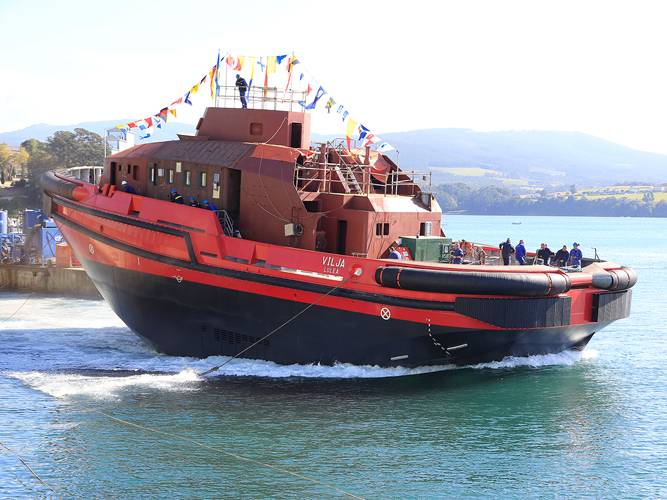
36 meter hybrid-electric icebreaking escort tug Vilja for Sweden’s Port of Luleå launched Oct 8, 2018 at GONDAN Shipyard in Figueras, Spain.

MarineLink reports the launch of a new icebreaking tug built in Spain for a Swedish port. At 36 meters (118 feet) they are a bit smaller than our nine Katmai Bay class 140 foot icebreaking tugs, but substantially larger than the eleven 65 foot tugs.

They claim an ability to break up to a meter of ice at three knots. That is more than the claim for the Katmai Bay class, but that does refer to fresh water which might be harder.

Reported missions are ice management, escort, ship assist, coastal towing, firefighting and navigation aids service duties.

The new tug is equipped with a hybrid propulsion system that will include two diesel main engines, shaft generators/motors and batteries for energy storage claimed to provide operational flexibility that will produce significant fuel, emissions and maintenance savings.

In addition, with an expected bollard pull of about 100 metric tons in diesel-mechanical mode when including battery boost capacity, this tug will be the most powerful icebreaking escort tug of this size in the world with hybrid/electrical propulsion.

Perhaps Tups can provide us more information.