Polar Fleets Update

NavalTechnology.com gives us a quick overview of the status of Naval fleets operating in the Arctic.

The improvements in the Russian icebreaker fleets are very impressive. The Russians have by far the strongest motivation for developing their Arctic coast. Presumably the Russians will be replacing their six remaining long serving Ivan Susanin armed icebreakers (3,400 tons). There is also a new class of smaller ice-stregthened patrol vessels the, Purga class (1066 tons).

I also noted there were some significant omissions.

There was no mention of the Danish fleet who, because Greeenland is a part of the Kingdom of Denmark, are an Arctic power and maintain four ice strengthened frigates of the Thetis class (3,500 tons) and two ice strengthened patrol vessels of the the Knud Rasmussen Class (2,050 tons). These ships perform coast guard functions in the Waters off Greenland.

There was no mention of the fact that the 25 Offshore Patrol Cutters are to be ice strengthened. This will give the Coast Guard an ability to surge a relatively large patrol force into Arctic (or Antarctic) waters.

Counter Piracy in the Gulf of Guinea

As Somali piracy seems to have quieted down Indian Ocean, the problem has gotten worse in the Gulf of Guinea, along the Atlantic Coast of West Aftrica. gCaptain is reporting the European Union is making an effort to help navies and coast guards in the area.

Not long ago a cutter was in the area as part of the US Navy administered Partnership program. The Deployable Operations Group trains their personnel, and Nigeria was the recipient of the former USCGC Chase, one of our retiring 378s.

Maritime Futures Project

Center for International Maritime Security

The Center for International Maritime Security is running a series they have titled the “Maritime Futures Project” or MEP. They sent out a list of nine questions and asked for comment. I was one of those poled. They are posting the answers to each of the questions separately. Here are the first three:

All my answers are below:

1.      If your Navy/Coast Guard (please specify) is facing fiscal hard times, what areas of the budget should be targeted first? What should be targeted last? Why?

The funding structure of the Coast Guard needs an overhaul. It has never been a good fit in any of the Departments it has been assigned to. A multi-purpose agency does not seem to integrate well in a government that seems able to deal with only one objective at a time.
The Coast Guard is overseen by too many Congressional committees with divergent interest, most of whom see only small parts of the Coast Guard. Most significantly, as an armed force, it is part of the nations maritime security apparatus, but because it is not funded under DOD, relatively little attention is given to its wartime role or funding it.

The Coast Guard is already fallen on hard times. Congress is attempting to cut spending at a time when, because of the cyclical nature of its ship building, Coast Guard funding needs to be increased rather than cut. Many ships will be over 50 years old before they are replaced. Unfortunately It appears the Coast Guard needs to cut current operations to fund investment in future capabillities.

2.      What should your Navy/Coast Guard invest in more that it is not investing enough in today?

The Coast Guard needs to cut its manpower requirement because that is where most of the money is spent. It needs to look for opportunities to replace manpower with technology.

3.      If you are a current Sailor or member of the Coast Guard (I know, I could call them Coasties, but wasn’t sure if you’d take that in the derogatory sense), what are some of the biggest impediments to getting your job done? What promised development or technology would most aid you in the accomplishment of your assignment?

The US has the largest Exclusive Economic Zone in the world. Its area exceeds that of the total land area of the US and most of it is in the Pacific. Most of the assets are in the Eastern US where most of the population (and political clout) resides.

Improved Maritime domain Awareness (MDA) has the potential to assist in SAR, fisheries enforcement, drug interdiction, coast defense, and protections of ports.

The Coast Guard cannot afford a comprehensive MDA system solely for its own purposes, but if it can share information with DOD agencies also interested in monitoring the maritime approaches to the US, including perhaps cruise missile defense, it could make the employment of assets much more efficient.

4.      What emerging technology is going to most profoundly change the way naval warfare is conducted, and why?

For the Coast Guard’s operations, in both peace and war, the most important aspect is likely to be processed vessel track information. Given the ability to track every vessel in the EEZ, identify it, and correlate it to its past history including the cargoes it has received, would be the ultimate goal. OTH radar/Satelite/AIS derived information may eliminate the search in search and rescue, allow us to know where all the fishing vessels are, and allow us to recognize anomalous voyages that might be smugglers. To do this effectively we need to be able to track small vessels as well as the large. 

In wartime this will also make blockade enforcement more effective, and permit prompt response when vessels are attacked.

5.      How would you design the next naval vessel for your fleet?

Better information will not totally eliminate the need to board and search vessels. In fact it might raise many questions that can only be resolved on scene. The Coast Guard will continue to need vessels to do boardings, as will the Navy in wartime. A significant unmet requirement for the Coast Guard and possibly for some elements of the Navy is an ability to forcibly stop even the largest merchant ships. With merchant ships now up to 100 times as large as their WWII counterparts, gunfire and even ASCMs may not be effective. Torpedoes, even small ones, targeting ships propellers might satisfy this need. 

To maximize their utility in war, I would like to see new cutters designed for wartime roles, but equipped for peacetime to keep down the cost of operation, with the ability to be upgraded within a few months. https://chuckhillscgblog.net/2012/06/27/opc-design-for-wartime-build-for-peacetime/

6.      What will your Navy/Coast Guard look like in 5/10/25/50 years, and how is it different from today?

Unfortunately the Coast Guard will not look different enough, if the relatively low level of capital investment continue. Ships being planned now, will not be built for five to ten years. The last of the Offshore Patrol Cutters expected to replace our medium endurance cutters will not be fully operational until approximately 2029, and all will likely  still be in the fleet in 50 years. The oldest of them will only be 44 years old, younger than ships we are replacing now.

I do believe we will see less distinction between search aircraft and rescue aircraft. Other systems are likely to replace the pure search functions of our fixed wing aircraft, while rescue aircraft will gain greater speed and range as they employ newer technology. Hopefully in 25 years we will see a new generation of rescue aircraft that have sufficient range and speed to eliminate the separate requirement for long range search aircraft.

There will also, hopefully be more information sharing with other agencies, including comprehensive vessel tracking. 

7.      What maritime dispute is most likely to lead to armed conflict in the next 5/10/20 years?

China and Iran are the most obvious candidates. Today’s Navy seems geared to those threats.

Looking elsewhere, we are likely to see some asymmetric conflicts where insurgents attempt to exploit the seas.

China will continue to push its claims in the South and East China Seas by unconventional means, or perhaps we may wake up some morning and find that every tiny islet that remains above water at high tide has been occupied. They are building enough non-navy government vessels to do that. They may also sponsor surrogates to destabilize the Philippines, Indonesia, and other Asian Nations that don’t willingly accept Chinese leadership.

We may also see conflicts
–in Latin America, e.g. Venezuela vs Colombia;
–between the countries surrounding the Caspian Sea over oil and gas drilling rights;
–over water resources on the great rivers of Asia.

There are always wars in Africa. They may become more general. Where ever there is both oil and weak governments, there may be conflict. Nigeria and Sudan come to mind, The entire Maghreb is at risk with Libya unstable, an ongoing arms race between Morocco and Algeria, and a growing Al-Qaeda franchise.

8.      What advice would you give to a smaller nation on the maritime investments it should pursue, and why?

Not every coastal nation needs a navy, but they all need a coast guard–see Costa Rica for example. It is their only armed force.

9.      Any final predictions?

In the most likely conflicts, large numbers of vessels will be needed to perform blockade and marine policing, to prevent use of the use of the seas for transportation of weapons, supplies, and personnel. We will never have “enough.” The Coast Guard will be needed to supply some of them.

Biometrics, the ability to positively identify individuals, already in use in counter-piracy operations, may become important in tracking down terrorists and agents in unconventional asymmetric conflicts.

States led by China will attempt to reinterpret UNCLOS to apply the restrictions and requirements of innocent passage to the EEZ as well as the Territorial Sea. They will use Article 58 section 3 of UNCLOS, “In exercising their rights and performing their duties under this Convention in the exclusive economic zone, States shall have due regard to the rights and duties of the coastal State and shall comply with the laws and regulations adopted by the coastal State in accordance with the provisions of this Convention and other rules of international law in so far as they are not incompatible with this Part.” They will interpret this to mean that anything other than expeditious transit including “spying,” “hovering,” flight ops, and submerged operations might be considered illegal. 

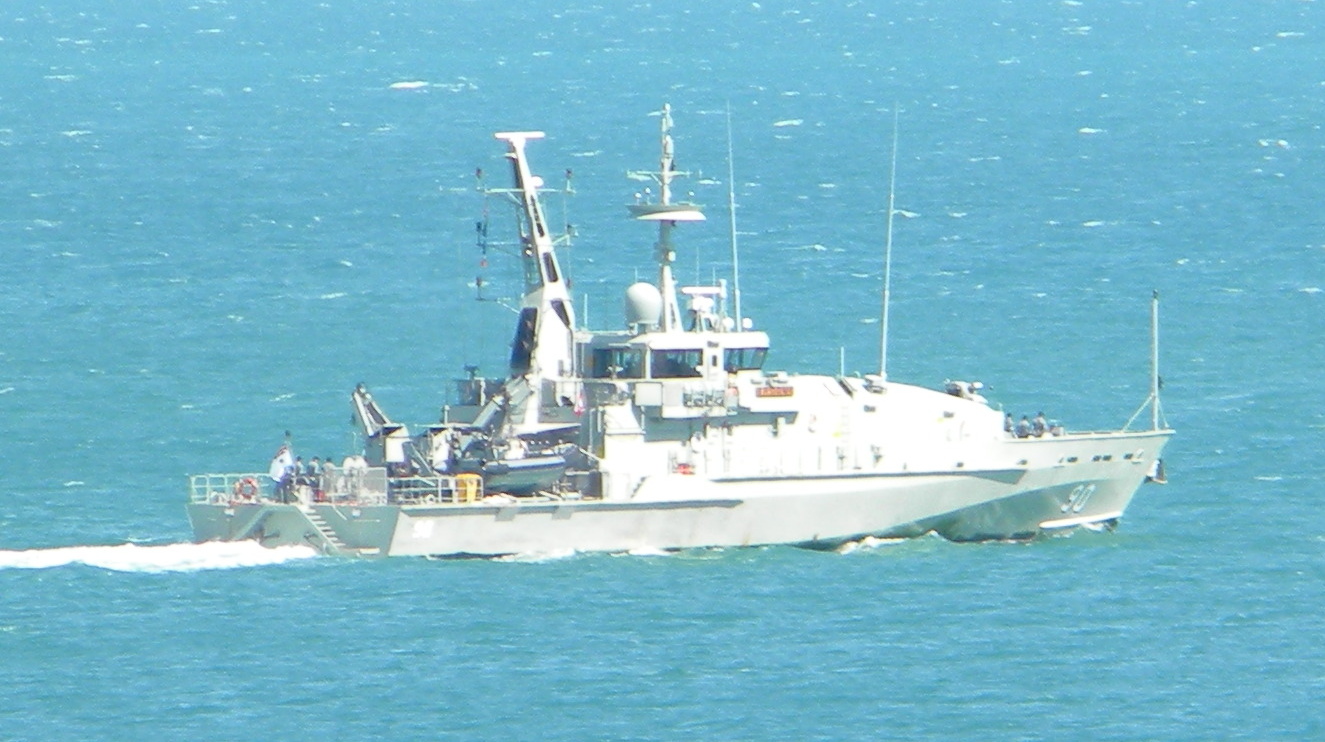
Premature Problems with Australia’s Patrol Boats–Multi-Crewed, Over-worked, Under-spec’d?


File:HMAS Broome (ACPB 90) Darwin Harbour.JPG

Photo Credit: HMAS Broome (ACPB 90) in Darwin Harbor, 12 May, 2010, by “Radagast3”

The Coast Guard is planning on multi-crewing the new large cutters, both NSCs and OPCs. In fact the latest authorization requires the Coast Guard to show that it can get 220 op-days out of each of the National Security Cutters, as the Coast Guard (and Integrated Coast Guard Systems) has said the they would. Neither the Coast Guard or the Navy has a lot of experience with this, although the Navy has had some sucess multi-crewing mine warfare ships. The Australians have been doing it for several years. Still their results are anything but clear.

Like the US, Australia has a problem with Illegal immigration. Their primary asset for Migrant Interdiction Operations (MIO) are a class of 14 patrol boats similar in size to our own Fast Response Cutters (FRC). They are a bit longer and beamer, but are built of aluminum and substantially lighter at 270 vs 353 tons. The armament and crew size are also similar. Rather than a single boat on a stern ramp they have two RHIBs on davits aft.

The vessels and their crews are organized into four division, three of four vessels and six crews and one of two vessels and three crews.

These little ships of the Armidale class are relatively new, with the first entering service in 2005 and the newest in 2008. (Their specifications are here.) Even so they have developed problems in service that has been blamed on both the heavy usage they have gotten as the illegal immigration problem has gotten much worse than anticipated and on their essentially commercial specifications.

Apparently the demanding usage has resulted in cracks in several of the vessels including restricting the first of class to less demanding training missions.

This problem came to the public’s attention in August. Since then it has apparently gotten worse.

Some speculate that the defects have been due to the use of commercial specifications. That the specification would have been alright for a vessel that could choose to avoid bad weather, but were not sufficient for a vessel that’s mission would entail going into bad weather to conduct search and rescue operations.

The other explanation is that because of the high tempo of operations, there has not been sufficient time for maintenance.

The Australian Navy has minimized the impact and significance of the cracking.


Top Coast Guard Stories of 2012

Hopefully we will soon see the annual summary of Coast Guard Operations for the previous year–lives saved, persons assisted, illegal immigrants repatriated, drugs seized–all the statistics that demonstrate that the Coast Guard has been a good investment. But until then, here are some of the stories that we might remember from 2012.

There were the losses.

28 Feb., CG 6535 an MH-65C crashed in Mobile Bay. All four crewmen were lost.

Dec. 2, BMC Terrell Horne III, 34, was killed in the line of duty when his boat was rammed and run over by suspected smugglers of Southern California.

There was the recrimination.

Negligent homicide charges against Lt. Lance Leone, the co-pilot and lone survivor of the crash of an MH-60 Jayhawk off La Push in 20110 were dismissed, but it is likely that his career is irretrievable damaged.

There were the acquisitions.

The first four of a projected class of 58 new, more capable cutters, the 154 foot, 353 ton, Webber Class Fast Response Cutters Bernard C. Webber (WPC 1101), Richard Etheridge (WPC 1102), William Flores (WPC 1103), and Robert Yered (WPC 1104) were delivered. Fourteen additional vessels are either under construction, or contracted.  There are options for an additional twelve under the existing contract.

A Request for Proposal has been issued and the first phase of the design process funded for the Offshore Patrol Cutters, a new class intended to replace the existing medium endurance cutters. The first of these planned 25 ships will not be delivered until at least 2019, at which time the oldest 210s will 55 years old. Because the deliver rate for this new class is expected to be slower than the originally delivery rate for the 210s, if 210s are retained until replaced one for one, the last of the fourteen 210s will not be replaced until 2028 at which time, the last 210 will be at least 59 years old.

The third National Security Cutter, Stratton WMSL 752, was accepted. Units four (Hamilton, WMSL 753) and five (Joshua James, WMSL 754) are under construction and unit six is funded. Units 7 and 8 were deleted from future budget projections, but the Coast Guard hopes to see them reinstated. Meanwhile two more 378s were decommissioned for a total of four of the twelve.

The Polar Star (WAGB 10) completed a long overhaul and is expected to return to service after testing. The intention was to discard Polar Sea, but her status is still in limbo. The first contract for design of a new icebreaker has been funded. Delivery of the new icebreaker is expected “within a decade.”

Contracts have been issued to MetalCraft Marine USA for up to ten 36-foot “Mark II Long-Range Interceptors” over the next five years, and to SAFE Boats for up to 101 “Over-the-Horizon, IV” 26 foot cutter boats over the next seven years.

111 of 166 Response Boat Mediums ordered have been delivered. These 45 foot 42.5 knot boats are being Delivered at a rate of 30 boats per year.

Contract for the first 38 of up to 470 Response Boat Small replacements has been issued. The remainder are options under the existing contract plus up to 30 boats for Customs and the Navy.

Three additional C-130Js have been ordered. This will bring the total number of this newer model to nine.

The Coast Guard took delivery of its 13th and 14th HC-144 search aircraft and exercised an option for numbers 16 and 17. The 15th unit was ordered in 2011. A total of 36 aircraft are planned.

A Scan Eagle Unmanned Air System (UAS) was demonstrated aboard a National Security Cutter, and the Coast Guard is now pursuing procurement of a small UAS as an interim system.

The Coast Guard has implemented Rescue 21 coverage over the entire Atlantic, Gulf, and Pacific coasts of the contiguous 48 states. Additional coverage is being extended to the Great Lakes, Puerto Rico, Hawaii, and Guam. Modified systems that will not include direction finding capabilities will cover the Western Rivers and Alaska. These systems have features that will help to take the “search” out of “search and rescue” and help to identify and locate hoax calls.

And there were the operations.

There was the effort to supply fuel to Nome after unusually severe conditions made it impossible for the barge that normally supplied their fuel to reach the isolated community.

During Operation Arctic Shield the Coast Guard moved non-icebreaker assets including the National Security Cutter Bertholf,  into the Arctic to test their operational capabilities in anticipation of increased human activity as the a result of global warming.

While perhaps not as demanding as Katrina, Hurricane Sandy again demonstrated the Coast Guard’s flexibility and resilience in spite of its damage to many of the Coast Guard’s own facilities and trashing the homes of many of its members. Like the residents of the effected communities the Coast Guard came back strong. Before the Hurricane made landfall, there was also the high profile rescue of 14 members of the crew of the HMS Bounty which gained national attention.

HAPPY NEW YEAR

Coming Unmanned Surface Vessels

Dangerroom reports on a new technology being developed for the Navy, the Anti-Submarine Warfare Continuous Trail Unmanned Vehicle, or ACTUV,. This unmanned surface vessel is intended to dog potentially hostile subs during that awkward period when tensions are high, but before the first shots are fired. The idea is that once the sub is located, one of these unmanned (and at least for now, unarmed) surface vessels will be assigned to trail it using active sonar and other sensors. This should cost less than maintaining a continuous track using Maritime Patrol Aircraft, and would allow manned vessels to avoid coming within range of the sub. If shots are fired, presumably the ACTUV would be the first to go, but it would be a minor loss, and allow the manned vessels to avoid being surprised.

The technology may also have some implications for the Coast Guard. We might see a smaller version of this launched from a cutter to augment the cutter’s radar picture. The technology for this requires developing an artificial intelligence capable of applying the  rules of the road–essentially a computer OOD. Some day the Coast Guard may be asked to approve fully autonomous merchant vessels plying the trade routes with no one aboard.