“Congress Looks to Continue Coast Guard’s Pacific Expansion” –Another WMEC Going to the Pacific?

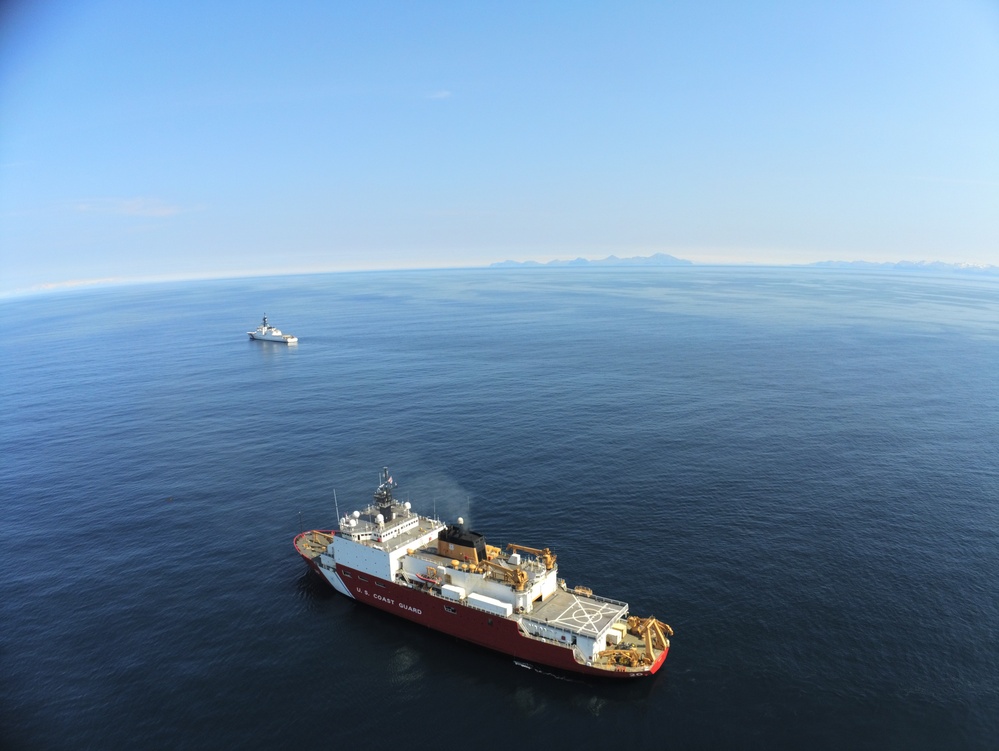
U.S. Coast Guard Cutter Harriet Lane returns to home port after 79-day patrol, April 9, 2024. (U.S. Coast Guard photo by Senior Chief Petty Officer Charly Tautfest)

Military.com passed along a Honolulu Star-Advertiser report that another Medium Endurance Cutter is expected to join Harriet Lane in the 14th District in FY 2025. (I suspect, ultimately there will be a third.)

This along with additional improvements in Coast Guard funding and infrastructure are still at the draft legislation phase, so we can’t assume too much, but it at least points to the intention.

There are other items,

The current draft of the spending legislation also includes $3 million to increase the presence of regional Coast Guard advisers as well as $1.2 million for the Coast Guard’s Indo-Pacific Workforce Support Project, which includes funds to increase housing, medical and child care access and capacity in Hawaii and Guam to support the service’s Pacific operations. It also calls for the service to acquire a new pier at its Sand Island base, expand facilities and come up with a report on infrastructure at Coast Guard Air Station Barbers Point.

It does appear from the report that politics regarding unrelated issues are getting in the way, but we have learned to expect that the budget will not be passed before the FY starts. (FY2025 will begin October 1, 2024.)

The post also notes that Harriet Lane is now on her second Pacific deployment.

The report does provide some insight into the difficulties of keeping a 40 year old cutter on patrol. The post talks about the Offshore Patrol Cutters and mentions that they are delayed, but they do not really explain how very long it is going to be before the 270s will be replaced. Right now, we don’t expect the last 270 to be replaced until 2038–14 years away, and it may end up being longer.


“Houthi’s Blowfish: Guide To Explosive USV Threat In Red Sea” –Covert Shores / Ruminating on an Attack on a US Port

Covert Shore has an update on Houthi One Way Attack Uncrewed Surface Vessels (OWA-USV).

Comparisons are made to their Ukranian counterparts, but the Houthi systems are less sophisticated.

“Unlike the fully autonomous Ukrainian craft, Houthi USVs require a human pilot to navigate to the start line of the attack. After that the pilot transfers to another vessel. Consequently, these USVs retain a cockpit…The Houthis also rely on motherships, which tow the USVs on longer missions, pick up the pilots, and also provide command and control during the attack. This is a comparative weak point.”

If there is a terrorist attack on a US port using an OWA-USV, it is most likely to use this model. It will likely be improvised and could be anything from a personal watercraft to a yacht. It will probably look innocuous. Like the recent Houthi attack, it is like to have a crew of dummy figures to make it look populated.

Unlike the Houthi attacks on ships at sea, an attack on a port could be remotely controlled from shore.

These are effectively a poor man’s torpedo. As the post notes,

“USVs generally carry a larger warhead which detonates at or close up the waterline. They are also generally able to target weak points on a ship where this can have the biggest impact…”

In a port, the target may not be a ship. Other targets like a bridge, tunnel, or pipeline, may also be accessible.

New Airfield Options In the Western Pacific

A Marine Corps KC-130J Super Hercules aircraft with 1st Marine Air Wing, lands on a newly designated airstrip on the island of Peleliu, Republic of Palau, June 22. (Lance Cpl. Hannah Hollerud/Marine Corps)

We have heard a lot about operations of the Fast Response Cutters based in Guam and the arrival of a dedicated WMEC (Harriet Lane) for operations in Oceana, but really these surface units need eyes in the sky.

Barbers Point, HI, is the only Coast Guard Air Station in the Central and Western Pacific. The new C-130Js have got much longer legs, but it’s always good to have options.

I talked about some of the options for basing or at least temporary operations here. It looks like the US Military is adding some additional options.

The Air Force is reopening the World War II air base at Tinian. and improving facilities at YAP, Federated States of Micronesia. Defense News reports that the Marines have reopened an airstrip on Peleliu, Republic of Palau.

The Air Force has embarked on a program they call Agile Combat Employment concept that seeks smaller and dispersed overseas air bases.

Ultimately it seems the Coast Guard will need to base some fixed wing and perhaps helicopters West of Barbers Point, Hawaii.

We recently had a SAR case that highlighted the problem, a man overboard incident roughly 607 nautical miles south of Guam, reported 25 June.

“The U.S. Coast Guard, in a testament to international cooperation, also dispatched an HC-130 Hercules aircraft and crew from Air Station Barbers Point, Hawaii, to Guam, where they will stage. Due to the distance, the crew will observe mandatory rest and then proceed to the search area on the morning of June 27.”

In a SAR case, particularly a man overboard, prompt response is essential, but the tyranny of distance also effects our ability to maintain surveillance over vast areas of the US Exclusive Economic Zone and that of the Compact of Free Association nations that we are obligated to protect.

Perhaps the Air Force under the Agile Combat Employment concept could build the Coast Guard an air base in Western Pacific. It would be a win-win. The Coast Guard gets a base. The Air Force base will be maintained and have a cadre in residence to help in a contingency.

Potential $198.1M Contract Award for Cutter-Based V-BAT UAS

V-Bat from Martin UAV

Below is a news release. The total contract ceiling award amount is $198,106,876.21 over five years.

Compared to Scan Eagle, currently used on Coast Guard National Security Cutters, V-Bat system has a slightly smaller wing span than the ScanEagle (9′ vs 10’3″) and weighs about twice as much (88 lbs (40 kg) vs 44-48.5 lb. (22 kg)), heavier, but still easily handled. Payload can be as much as three times that of Scan Eagle. There is a skid under the nose to allows the V-BAT to be laid on the deck. Cruise speeds are similar. Dash speed is actually a little higher for the V-BAT (90 vs 80 knots).

There are a couple of things worth noting in this release that point toward a broadening of Coast Guard use of cutter based UAS.

While the contract is for “Contractor Owned Contractor Operated (COCO)” services, it includes service pilot and mission training which suggests that Coast Guard personnel will be learning to operate these systems and,

“Initially, the contract will be used to continue UAS capability on the national security cutter class; however, the contract can be used to support additional cutter classes in the future.”

USCGC Harriet Lane, after a change of homeport to Honolulu, completed her first Pacific patrol in April. As I noted, she apparently had no helicopter or UAS on board during a more than 70 day patrol, far from the nearest Coast Guard air station.

In 2020, V-BAT was successfully tested on Harriet Lane. V-BAT requires no catapult or recovery hardware. It should be possible to operate the system from any medium endurance cutter. Bear class 270 foot cutters, like Harriet Lane, could probably deploy with both a helicopter and more than one V-BAT.

V-BAT Vertical takeoff and landing UAV. Photo by Mass Communication Specialist 2nd Class Anderson W. Branch

Coast Guard awards contract to procure cutter-based unmanned aircraft system capability

The Coast Guard awarded a contract on June 26, 2024, to Shield AI Inc. of San Diego for unmanned aircraft system (UAS) capability that can be deployed from Coast Guard cutters. The indefinite-delivery, indefinite-quantity firm fixed-price contract runs through 2029 and is structured as five one-year ordering periods.

This contractor-owned, contractor-operated service will be used for intelligence, surveillance and reconnaissance in support of Coast Guard missions. Requirements for the cutter-based UAS capability – which the Coast Guard will term as maritime UAS or MUAS in the future – included fully automated flight operations, minimum endurance of 12 hours of flight time daily and the ability to provide services 24 hours a day, seven days a week. The payload will include electro-optical and infrared sensors and communications relays and be capable of providing surveillance, detection, classification and identification for all of the host cutter’s operational missions.

The contract has a total potential value of $198.1 million and includes installation and deinstallation of the UAS capability and pilot and mission training. Shield AI will deploy its V-BAT, which is a vertical take-off and landing UAS.

Initially, the contract will be used to continue UAS capability on the national security cutter class; however, the contract can be used to support additional cutter classes in the future.

For more information: Unmanned Aircraft Systems Program page

“Coast Guard Cutter Charles David Jr. holds Change of Command ceremony” –CWOs Commanding

Capt. Jason Ingram, Coast Guard Sector Key West commanding officer, presides over a change of command ceremony for USCGC Charles David Jr. (WPC 1107), in Key West, Florida, June 27, 2024. Chief Warrant Officer Adam Smith relieved Chief Warrant Officer Chad Barber as commanding officer ensuring continuity of leadership and operations aboard the cutter. (U.S. Coast Guard photo by Ens. Tabitha Martinez)

Below is a news release. I don’t normally pass along press releases regarding changes of command. They are well covered by Coast Guard News if you want to see them. I thought this was a bit unusual. USCGC Charles David, Jr. is a 154 foot patrol craft with a crew of 24. These are usually commanded by a Lieutenant or Lieutenant Command (O-3 or O-4). Command of one of these by a Chief Warrant Officer is an opportunity unique to the Coast Guard.USCGC Charles David (WPC-1107)

June 27, 2024

Coast Guard Cutter Charles David Jr. holds Change of Command ceremony

KEY WEST, Fla. — Chief Warrant Officer Adam R. Smith relieved Chief Warrant Officer Chad M. Barber as commanding officer of Coast Guard Cutter Charles David Jr., Thursday, during a change-of-command ceremony at Coast Guard Sector Key West.

Capt. Jason Ingram, Sector Key West commander, presided over the event.

Chief Warrant Officer Barber was the commanding officer of the cutter since July 2021, conducting 25 patrols and accumulating over 5,000 hours underway. He will transfer to the Coast Guard Cutter Alex Haley, home ported in Alaska. Chief Warrant Officer Smith takes command of the cutter after serving as the Officer in Charge of Station Provincetown, Massachusetts.

“Thank you to Chief Warrant Officer Barber’s family, his spouse Shannon, two sons Hayden and Logan, and his daughter Bryn, for their support while he served his community in the Florida Keys,” said Capt. Jason Ingram, commander, Sector Key West, .

Cutter Charles David Jr. is one of six Fast Response Cutters homeported in Key West and reports to Sector Key West. The cutter patrols over 55,000 square nautical miles of Sector Key West’s area of responsibility within the Florida Straits and the Gulf of Mexico, as well as regularly forward deploying to the Caribbean Sea and other areas in support of the Coast Guard’s national security, law enforcement, and lifesaving missions.

The change-of-command ceremony marks a transfer of total responsibility and authority from one individual to another. It is a time-honored tradition, conducted before the assembled crew, as well as honored guests and dignitaries to formally demonstrate the continuity of the authority within a command.

“OVERCOMING THE DELIBERATE LEGAL AMBIGUITY ADOPTED BY CHINA’S COAST GUARD” –Baird Maritime

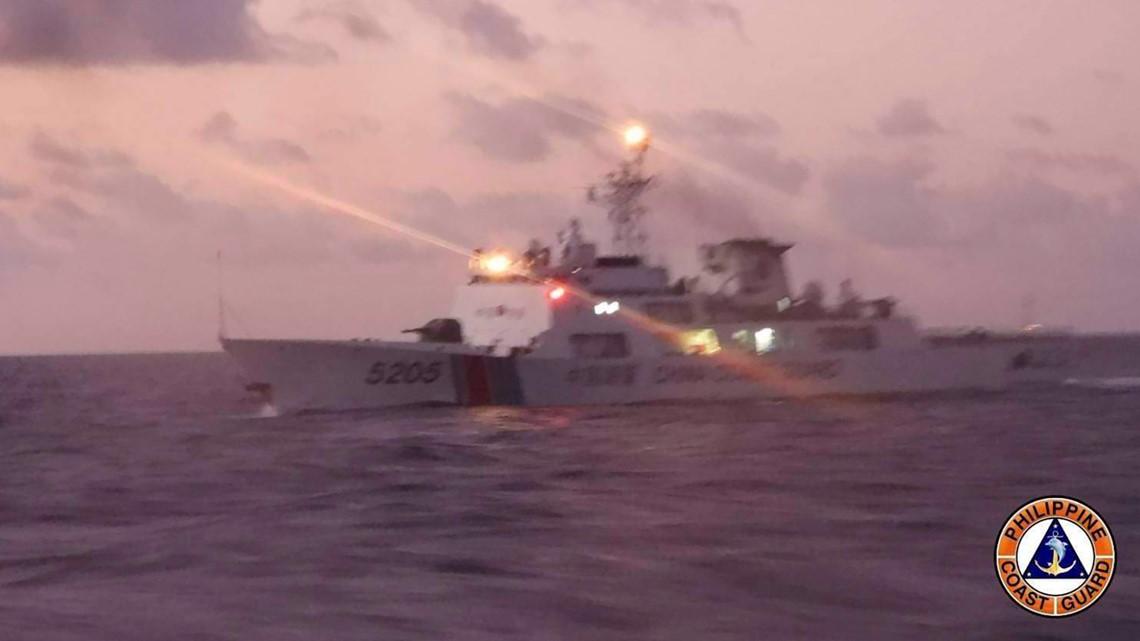
A still image taken from footage released by the Armed Forces of the Philippines showing China Coast Guard personnel confronting a resupply mission to Scarborough Shoal (Photo: Armed Forces of the Philippines)

Baird Maritime offers an opinion piece, “OVERCOMING THE DELIBERATE LEGAL AMBIGUITY ADOPTED BY CHINA’S COAST GUARD.” It is well done.

I will only say, that in the view of myself and, I believe, most of the rest of the world, there is no ambiguity here. What the China Coast Guard is doing in the EEZs of their neighbors is criminal. It began with the destruction of their neighbor’s natural resources as they build artificial islands destroying natural ecosystems. They claim resources that are not theirs. They drive away local fisherman depriving them of their livelihood. They protect a rapacious Chinese fishing fleet that has overfished their own waters and are now destroying vital natural resources in the waters of their neighbors. They have threatened deadly force to intimidate. They have attacked government vessels conducting peaceful routine operations and injured their crewmembers. Now they are threatening kidnapping.

This is state sponsored theft and piracy and an assault on the expected norms of international behavior. We need a forceful international response.

Philippine Navy Upgraded WHEC

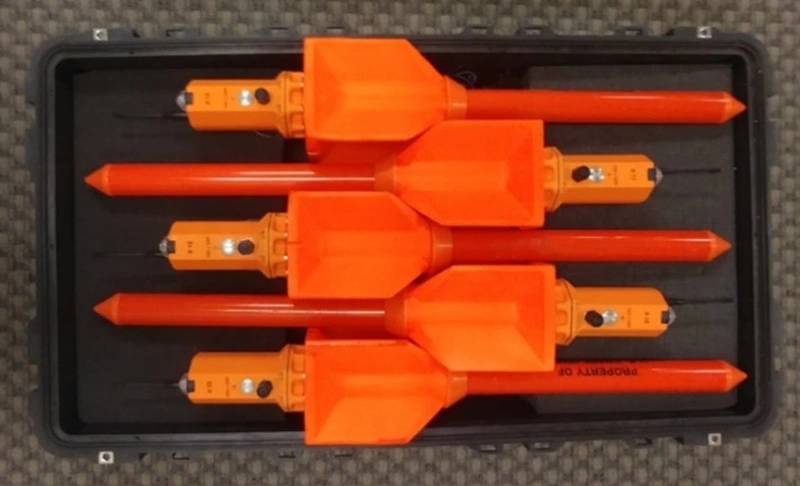
Sharing something I found on Facebook, BRP Andres Bonifacio (PS-17), former USCGC Boutwell, testing their recently added Mark 36 Super Rapid Bloom Offboard Countermeasures Chaff and Decoy Launching System. Upgrades to the Philippine Navy’s three former USCG WHECs are discussed here.

BRP Andres Bonifacio (PS-17) deployed its newly installed Mark 36 Super Rapid Bloom Offboard Countermeasures Chaff and Decoy Launching System during a gunnery exercise in the SCS on June 19. Note modern multimode radar on main mast. Photo from Aaron-Matthew Lariosa.

BRP Andres Bonifacio (PS-17) deployed its newly installed Mark 36 Super Rapid Bloom Offboard Countermeasures Chaff and Decoy Launching System during a gunnery exercise in the SCS on June 19, 2024. Photo from Aaron-Matthew Lariosa.

Thanks to Buddy Stewart who provided link to the source. 

“US Coast Guard Cutter Dauntless celebrated for 56 years’ service during heritage recognition ceremony” –Having Done More than Ever Anticipated

USCGC Dauntless being launched on 21 October 1967.

Below is a press release marking the effective decommissioning of USCGC Dauntless. (Go to the link for photos.) (My comments have been modified from the original publication.)

I have to take issue with a statement in the news release,

“These cutters were designed for search and rescue, law enforcement missions such as counterdrug and migrant interdiction, as well as national defense and international engagement.”

This reflects what the ship has done, but it is a misrepresentation of what was envisioned when the 210s were designed more than 60 years ago. SAR was the primary mission, law enforcement (fisheries) was secondary, but drug and migrant interdiction and international engagement were not the radar at all.

The flight deck was to be used as a “lily pad.” They were not expected to deploy with a helicopter attached.

There is an important lesson here, that adaptability and flexibility are important in the design of an asset that will be used for decades.

Where did I get this?”

I did a post in 2011, “The Coast Guard Shipbuilding Program, 1964” that referenced  an article, “Developments and Problems in Coast Guard Cutter Design,” that appeared in the 1964 US Naval Institute Naval Review (published at that time as a separate hard bound book, copyright 1963, United States Naval Institute, Annapolis, MD, Library of Congress Catalog Card Number 62-21028) that discussed the then new generation of Coast Guard Cutters.

There was no clue drug enforcement would become important. In contrast to the prohibition era the authors noted, “…nor are they (cutters) much concerned with the apprehension of smugglers.”

Intended to replace twenty five 125 ft WSCs, 165 ft WPCs, 143 ft ATAs, 205 ft ATFs, and 213 ft ARS, the considerations that drove the design of the 210s were relatively straight forward, to make “A better rescue ship.” LE was secondary. Military readiness, a distant third, was still considered. The 3″/50 fitted for SAR and Law Enforcement was to be “…augmented for the ship’s wartime role as a coastal patrol vessel….Although their peacetime armament is minimal, space and weight compensation have been provided  for sonar, hedge hog projectors, ASW torpedoes, and additional guns, small rockets, or other armament as may be required.”

We have been repeatedly told the Coast Guard is now in the greatest period of recapitalization since World War II. That is not really true, the Coast Guard commissioned 12 WMECs between 1967 and 1972, 16 WMECs between 1964 and 1969, 79 WPBs between 1960 and 1970, and five WLMs between 1964 and 1971. That is 112 vessels in 13 years 1960 to 1972.

In the last 16 years we have commissioned ten National Security Cutters and 56 Fast Response Cutters, a total of 66 ships. We are planning to add 11 more FRCs and 25 OPCs, for a total of 102 ships, but in the 60s we had planned to build 36 WHEC378s and 29 WMEC210s, which would have brought that total to 149 vessels.

Replacing all of our ships in huge programs 40 years apart is not a good idea. Where we really need to get to, is building ships continually with constant progressive improvements overseen by an organic design staff.

Since we seem to be dragging out the Offshore patrol cutter program, we may get there for patrol cutters since we really need more than the 36 large patrol cutters and the Bertholf will be 30 years old when the last planned OPC is finished in 2038. We may just continue to build one or two a year indefinitely.

The oldest FRC was commissioned in 2012 and the 67th will probably be commissioned in 2027, so we will not need to replace them for a while, but we have already started decommissioning 87 foot “Marine Protector” class WPBs, nominally because they can be replaced in some roles by the FRCs and Response Boat, Mediums, but in any case, they are reaching the end of their useful lives, the first having been commissioned 26 years ago. We should be designing their replacements now.

To make this work we really need a long-term ship building plan. The Navy already does one. Congress is used to the idea of 30 year plan. That time horizon is not an accident. We should not be keeping ships for more than 30 years. Once they reach that point, they should be passed over to the foreign military sales program to help our friends and allies. Replacing ships at a predictable, realistic threshold will help both the Coast Guard and the shipbuilding industry that is essential for national security. 


PRESS RELEASE | June 21, 2024

NAVAL AIR STATION PENSACOLA, Fla. — The Coast Guard held a heritage recognition ceremony, Friday, in Pensacola to honor the U.S. Coast Guard Cutter Dauntless (WMEC 624) and recognize its 56 years of exemplary service.

The ceremony was presided over by Vice Adm. Nathan Moore, Atlantic Area commander, and served to celebrate Dauntless’ contributions to the service and Nation in the presence of cutter leadership, current and former crew members, families and friends.

The event also marked the ship’s exit from active-duty service for an indeterminate time, placing it in commission, special status. The 210-foot Dauntless operated as a Coast Guard Atlantic Area command asset, based in Portsmouth, Virginia, and was most recently homeported in Pensacola.

Dauntless was built in Lorain, Ohio and commissioned in 1968. The cutter is the 10th of 16 vessels built in the Reliance-class of medium endurance cutters that have operated in the Coast Guard’s fleet. These cutters were designed for search and rescue, law enforcement missions such as counterdrug and migrant interdiction, as well as national defense and international engagement.

Dauntless was named after the inspirational trait, which means to persevere fearlessly. It’s motto, “Sin Miedo,” translated as “Without Fear,” also underscores the same spirit valued by the cutter’s crews. It is the first Coast Guard cutter to bear its name.

Dauntless spent its first 25 years assigned in the Coast Guard Seventh District area of responsibility and was homeported in Miami Beach.

Throughout the cutter’s storied career, it has earned a reputation as one of the nation’s preeminent drug-busting vessels. Of note, Dauntless has over 85 illegal narcotics interdictions to its credit, executing more busts than any other cutter.

On March 8, 1973, Dauntless became the first cutter in history to seize one ton of marijuana after its crew boarded the fishing vessel Big L. The boarding team arrested the master and crew.

Dauntless was also the second cutter in Coast Guard history to seize one million pounds of marijuana, following in the footsteps of U.S. Coast Guard Cutter Steadfast (WMEC 623). This milestone accomplishment earned Dauntless the large gold marijuana leaf painted on its superstructure.

Dauntless responded to the mass Cuban exodus known as the Mariel Boatlift in 1980. Between April 23 and May 13, crew members towed over 25 vessels to safety, rescued eight persons adrift at sea, and conducted 55 search and rescue cases.

President Ronald Reagan visited the cutter on November 17, 1982, and awarded Dauntless with the Coast Guard Unit Commendation. It was the first time in almost 20 years that a sitting U.S. president had visited a Coast Guard cutter.

Dauntless’ most publicized search and rescue case occurred in January 1986. The cutter was first to arrive during the response to the NASA space shuttle Challenger disaster. Serving as the on-scene commander for over a week, crew members tended to safety management and debris recovery.

During the 1980s, Dauntless appeared in two motion pictures. In “The Island,” the cutter is portrayed as a fictitious ‘U.S. Coast Guard Cutter New Hope,’ which is boarded and seized by Caribbean pirates. Dauntless was also featured later in the James Bond film, “License to Kill.”

In June of 1993, Dauntless was decommissioned and underwent an 18-month-long Major Maintenance Availability at the Coast Guard Yard in Baltimore. After its completion, Dauntless relocated to the Coast Guard Eighth District area of responsibility and reported to its new home port of Galveston, Texas in March of 1995.

On November 24, 1995, crew members rescued 578 migrants from a grossly overloaded 75-foot coastal freighter. It was the largest number of migrants rescued from a single vessel in Coast Guard history.

In 2009, Dauntless underwent a second drydock availability at the Coast Guard Yard. During the 10-month period, the cutter received an increase in its long-term capability through equipment upgrades, habitability improvements and structural repairs to improve reliability and drive down costs.

Dauntless relocated to its current home port in July 2018.

In 2022, the cutter received a six-month drydock availability at the Brooklyn Navy Yard in New York City. Dauntless underwent hull restoration and preservation projects, prolonging the ship’s life further.

Recently working alongside the Royal Netherlands navy, Dauntless’ crew seized approximately 8,500 pounds of cocaine and apprehended 13 suspected drug smugglers with Dominican Republic and Colombian nationalities following a 45-day patrol in the Caribbean Sea.

During the cutter’s final patrol this year, Dauntless completed a 61-day deployment in the Windward Passage and Florida Straits. On March 8, crew members conducted a search and rescue case on a moonless night. After searching for several hours, the crew located an unlit, overloaded and disabled sail freighter with 65 Haitian migrants on board, including several children. The crew safely rescued all 65 migrants.

“To the crew, thank you all for the work you put forth in maintaining and operating the Dauntless,” said Vice Adm. Nathan Moore, Atlantic Area commander. “Your work is the heart of what we do as a sea-going service, and your collective energy, work ethic, character and sacrifice is what sets the tone for the sailors that will follow in your footsteps. Although your time on Dauntless is coming to an end, I look forward to your continued leadership and contributions to our Service’s missions and culture as you move on to your next assignments.”

The Dauntless now transitions into an inactive shipyard status as part of the Coast Guard’s greater “AY24 Force Alignment Initiative,” a program to temporarily adjust operations to better reflect the approximate 10% shortage of enlisted members while the Service reassigns personnel and assets to ensure the essential mission readiness demanded by the American public.

This initiative will enable the Coast Guard to meet growing demands for the service’s unique capabilities and authorities during the workforce recruitment and retention challenges facing all U.S. military service branches.

“The Coast Guard cannot maintain the same level of operations with our current shortfall – we cannot do the same with less,” said Coast Guard Commandant Adm. Linda Fagan and Master Chief Petty Officer of the Coast Guard Heath Jones in a joint statement. “Conducting our missions is often inherently dangerous, and doing so without enough crew puts our members and the American public at increased risk.”

Once back at the Coast Guard Yard, Dauntless’ current crew will transfer to different units both ashore and afloat, a step taken to help ensure the Coast Guard’s ability to prioritize lifesaving missions, national security, and protection of the Maritime Transportation System with no degradation to these critical services.

“It has been the honor of a lifetime to have served with the men and women that comprise the exceptional crew of Dauntless,” said Cmdr. Aaron Kowalczk, commanding officer of Dauntless. “This crew embodies the Coast Guard’s Core Values of Honor, Respect, and Devotion to Duty; their dedication to their shipmates, ship, and country is inspiring. In my 13 months on board, I have seen them serve with distinction, protecting the homeland, enforcing our laws at sea, and saving lives. Every day they remind me of our cutter’s motto, “Sin Miedo,” as they face every challenge and obstacle ‘Without Fear’. They have written an epic final chapter to close Dauntless’ 56 historic years of dedicated service to America.”

Dauntless is a 210-foot, Reliance-class medium endurance cutter with a crew of 62. Since commissioning in 1968, Dauntless has executed counterdrug and migrant interdiction operations, supported national defense and homeland security missions, and conducted search and rescue missions in support of Coast Guard operations throughout the Western Hemisphere.

More information about the U.S. Coast Guard’s AY24 Force Alignment Initiative can be found here.

For information on how to join the U.S. Coast Guard, visit GoCoastGuard.com to learn about active duty, reserve, officer and enlisted opportunities.

Information on how to apply to the U.S. Coast Guard Academy can be found here.

“Coast Guard starts fourth phase of work to extend Polar Star’s service life” –CG-9

Below is a news release from the Acquisitions Directorate (CG-9).


Coast Guard starts fourth phase of work to extend Polar Star’s service life

Coast Guard Cutter Polar Star docks at Mare Island Dry Dock in Vallejo, California, on April 3, 2024, for the fourth phase of its service life extension program. U.S. Coast Guard photo.


The Coast Guard has initiated the fourth of five planned phases of Coast Guard Cutter Polar Star’s service life extension program (SLEP). The work is part of the In-Service Vessel Sustainment Program and is being completed at Mare Island Dry Dock in Vallejo, California.

The SLEP is being conducted in phases to take advantage of the planned maintenance availabilities that follow the cutter’s annual deployment to the polar regions. Polar Star completed a 138-day deployment to Antarctica, including operating for 51 days below the Antarctic Circle, in support of Operation Deep Freeze 2024, the annual joint military logistics mission to support the National Science Foundation, the lead federal agency with responsibility for management of scientific research that comprises the U.S. Antarctic Program. Polar Star and crew contribute to this yearly effort through icebreaking to clear the channel for supply vessels.

Phase 4 work began on April 1, 2024, and targets three systems:

  • The heating, ventilation and air conditioning system is undergoing a refurbishment/overhaul of the ventilation trunks, fans and heaters that supply berthing areas of the ship.
  • All of the boiler support systems will be recapitalized/redesigned, including the electrical control station that is used to operate them.

A complete recapitalization/redesign of the flooding alarm system will occur from bow to stern to monitor machinery spaces for flooding.

The boiler system of Coast Guard Cutter Polar Star, which will receive a recapitalization/redesign. U.S. Coast Guard photo.


A section of the heating, ventilation and air conditioning system, which is undergoing a refurbishment/overhaul of the ventilation trunks, fans and heaters that supply berthing areas of the ship. U.S. Coast Guard photo.


This phase of the SLEP is scheduled to be completed by August 2024 to enable Polar Star to meet its commitment to Operation Deep Freeze 2025.

The Polar Star SLEP addresses targeted systems such as propulsion, communication and machinery control systems for recapitalization. Major maintenance extends the service life of Polar Star beyond that of its original design. By replacing obsolete, unsupportable or maintenance-intensive equipment, the Coast Guard is mitigating the risk of lost operational days due to unplanned maintenance or system failures. The contracted SLEP work items and recurring maintenance is taking place within a five-year, annually phased production schedule running from 2021 through 2025.

Polar Star is the Coast Guard’s only active heavy polar icebreaker. The Coast Guard is investing in a new fleet of polar security cutters that will sustain the service’s capabilities to meet mission needs in both the Arctic and Antarctic regions.

For more information: In-Service Vessel Sustainment Program page and Polar Security Cutter Program page.

“First Look At Houthi Kamikaze Drone Boat That Struck Cargo Ship In Red Sea” –The War Zone

Houthi Kamikaze Drone Boat That Struck Cargo Ship in Red Sea, peopled with dummies. 

The War Zone reports,

“The Houthi’s crude uncrewed surface vessel…featured human dummies and approached the ship while security took no defensive action.”

While the Houthi have made several attempts to use kamikaze Unmanned Surface Vessels, this is their first successful in a long time. Deception was the key to success. The attack craft was not small, fast, or highly maneuverable. The attack was not made under cover of darkness. It just looked like all the other local traffic. There is probably a lesson here.