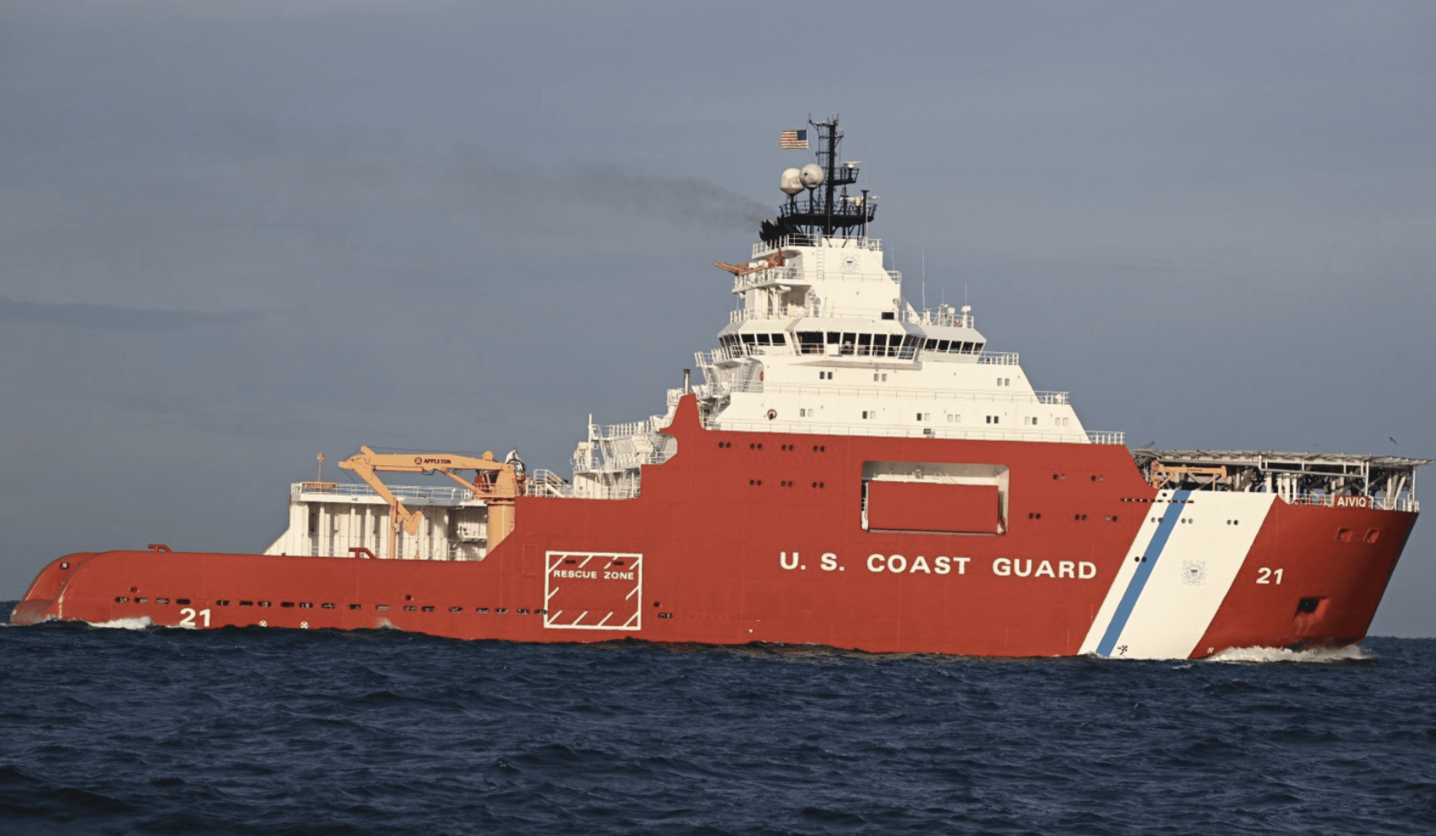
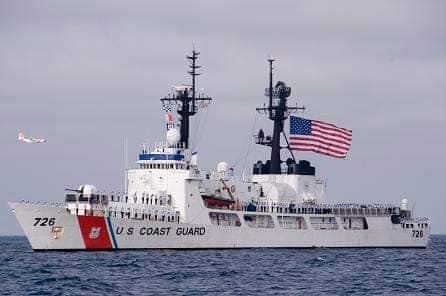
“Globally deployable Coast Guard units conclude participation in RIMPAC 2024” –Coast Guard News & Why No Missiles On Cutters?

U.S. Coast Guard Diver 2nd Class Connor Madsen, Regional Dive Locker West, cuts line, freeing a bundled chain to hook it onto a sunken buoy during a training exercise with the Republic of Korea Navy Underwater Construction Team divers off the coast of Oahu, Hawaii, July 18, during Exercise Rim of the Pacific (RIMPAC) 2024. Twenty-nine nations, 40 surface ships, three submarines, 14 national land forces, more than 150 aircraft, and 25,000 personnel are participating in Exercise Rim of the Pacific (RIMPAC) 2024 in and around the Hawaiian Islands, June 27 to Aug. 1. The world’s largest international maritime exercise, RIMPAC provides a unique training opportunity while fostering and sustaining cooperative relationships among participants critical to ensuring the safety of sea lanes and security on the world’s oceans. RIMPAC 2024 is the 29th exercise in the series that began in 1971. (U.S. Navy photo by Chief Mass Communication Specialist Kathleen Gorby)

Below is a press release from Coast Guard News.

RIMPAC 2024 was a big complex event. I had hoped to hear more about the Coast Guard’s participation, perhaps a release from each of the units, like the Pacific Strike Team did (linked in the news release), particularly news about the National Security Cutter (NSC) Midgett’s participation.

Was her CO a task force commander? Did she host a Navy helicopter? Did they do an anti-submarine exercise? NSCs did these things in the previous two RIMPACs.

This is what we got about Midgett’s role,

“Coast Guard Cutter Midgett conducted a broad spectrum of operations with the Canadian MV Asterix, Italian Navy offshore Patrol Vessel ITS Montecuccoli, Arleigh Burke-class guided-missile destroyer USS Kidd (DDG 100), Royal Brunei Navy offshore patrol vessels KDB Darussalam and KDB Darulaman, Mexican Navy frigate ARM Benito Juarez and the ROK Navy submarine Lee Beom-seok. Operations covered both national defense as well as humanitarian assistance and disaster relief missions.”

Seven surface ships, embarked helicopters, and a submarine. That looks like a task force and Midgett’s CO was probably the senior officer among the ships’ crews, but someone else might have been assigned to command the task force. The presence of a submarine suggests ASW exercises. Some of the photos that accompany the news release give us some clues.

The U.S. Coast Guard helicopter tie-down team aboard legend-class cutter USCGC Midgett (WMSL 757) secures a Mexican navy Panther Helicopter ANX 2161 during Exercise Rim of the Pacific (RIMPAC) 2024 off the coast of Hawaii, July 14.  (U.S. Coast Guard photo by David Lau)

Legend-class cutter USCGC Midgett (WMSL 757) hosts a multi-ship interdiction and boarding exercise with Italian Navy offshore patrol vessel ITS Montecuccoli (P 432), who fast-roped a boarding team of seven onto Midgett simulating an at-sea boarding of a suspected arms smuggling vessel during Exercise Rim of the Pacific (RIMPAC 2024), July 15, while underway in the Pacific Ocean. (U.S. Coast Guard photo by David Lau)

The press release linked above also has a photo of Midgett’s 57mm Mk110 gun firing. We can also be pretty sure Midgett did an underway replenishment.

Would love to hear more from people who were there.


I will make one observation. Of the six surface combatants, Midgett was the only one that did not have missiles of any sort.

  • Obviously, USS Kidd, a DDG, is well equipped with 96 VLS cells for very sophisticated missiles.
  • Italian offshore Patrol Vessel ITS Montecuccoli would probably be considered a frigate in any other navy. It is about a third larger than Midgett and has 16 full size VLS and eight ASCMs.
  • Mexican Navy ARM Benito Juarez , classified as a “long-range ocean patrol ship,” is about two thirds the size of Midgett and has eight Mk41 VLS and a SeaRAM system. 
  •  Royal Brunei Navy offshore patrol vessels KDB Darussalam and KDB Darulaman,  are a little more than one third the size of Midgett. Each can be equipped with four Exocet anti-ship cruise missiles. 

Of the five missile carriers, four are described as Offshore Patrol Vessels. That is what Midgett is.

The Coast Guard seems to be allergic to putting missiles on their ships, as if they are super weapons reserved only for the most sophisticated ships. Why I reported to the Academy in 1965, 59 years ago, that may have been the case, but now they come in all sizes and shapes. There is a good reason for this proliferation. They are effective. Many require very little training and little or no maintenance. They can provide an outsized effect at relatively low cost.

A common argument is that the price of a cannon projectile is far less than the cost of a missile, but that limited view misses the point that total lifecycle costs for missile systems may be much less than the cost of a gun system and its magazine load out of hundreds of rounds.

Maybe if you expect to do shore bombardment, firing thousands of ammunition at a target area, rather than a particular point, maybe guns are the smart choice, but the smaller the number of expected engagements, the smaller the number of rounds expected to be fired in each engagement, and the quicker you need to take out the threat, the more attractive missiles become.

Is seeing a missile system on a Coast Guard cutter going to make it look more threatening or aggressive, assuming we want to avoid looking like we can defend ourselves?

Guns, even as small as the 57mm Mk110 are pretty obvious and recognizable. Missile launcher can be much less obvious and may be overlooked entirely. Vertical Launch systems (VLS) barely protrude above the deck. Launchers for APKWS, Hellfire and similar systems may escape notice entirely. (My wife says most warship just look like a pile of junk.)

Guided weapons offer other advantages as well:

  • There is less likelihood of collateral damage.
  • We can put missiles on smaller platforms that could never mount guns with similar capability.
  • Visible missiles systems can be temporarily removed much easier that gun systems. (It can be very obvious whether or not a ship is carrying anti-ship cruise missiles like Harpoon or Naval Strike Missile.)

Aug. 10, 2024

Globally deployable Coast Guard units conclude participation in RIMPAC 2024

HONOLULU – Four Hawaii-based and two California-based Coast Guard units, all globally deployable, concluded operations at the Rim of the Pacific (RIMPAC) 2024 Exercise and returned to service of the residents of Hawaii and the Pacific region, Aug. 1.

U.S. Coast Guard Cutters Midgett (WMSL 757) and Juniper (WLB 201), the Regional Dive Locker Pacific, Port Security Unit (PSU) 311, the Pacific Strike Team and Maritime Safety and Security Team (MSST) Honolulu partnered with military members from Peru, Mexico, Republic of Korea, Italy, Brunei and Japan throughout the in-port and at-sea portions of the RIMPAC Exercise, which ran from late June to early August. The exercise marked a series of “firsts” for Coast Guard participation.

PSU 311 was the first PSU to deploy to a RIMPAC exercise, where they set up a forward-deployed security force on land and on sea. They conducted vessel escorts of high-value U.S. and partner nation ships and patrolled both on land and water. They hosted advisors from the Naval Cooperation and Guidance for Shipping group in their tactical operations center – an essential international service in protecting merchant ships traveling through hazardous areas. They also partnered with MSST Honolulu and divers from the Coast Guard and the Republic of Korea (ROK) Navy to conduct underwater port surveys following a simulated natural disaster, a key part of the port reopening process that is essential to saving lives in emergencies.

The Coast Guard Pacific Strike Team also completed a first-of-its-kind deployment, partnering with forces from Mexico and Peru to conduct urban search-and-rescue exercises on water and land. A full summary of their efforts is available here.

The Coast Guard Regional Dive Locker Pacific completed its most thorough humanitarian response exercise at RIMPAC to date, partnering with the ROK Navy to conduct harbor surveys, underwater pier inspections, and land and shipboard-based buoy salvage operations. Their collaboration will prove instrumental in speedy response to future disasters.

Coast Guard Cutter Midgett conducted a broad spectrum of operations with the Canadian MV Asterix, Italian Navy offshore Patrol Vessel ITS Montecuccoli, Arleigh Burke-class guided-missile destroyer USS Kidd (DDG 100), Royal Brunei Navy offshore patrol vessels KDB Darussalam and KDB Darulaman, Mexican Navy frigate ARM Benito Juarez and the ROK Navy submarine Lee Beom-seok. Operations covered both national defense as well as humanitarian assistance and disaster relief missions.

“The global maritime environment is too large and complex for any one nation to safeguard – we have always relied on strong international partnerships to serve the larger Pacific community,” said Vice Adm. Andrew J. Tiongson, Commander of Coast Guard Pacific Area and Commander of Defense Force West. “In RIMPAC and beyond, we continually work with our partners to remain integrated and prepared. Through exercises, real-world operations, and a spirit of collaboration, we work together for a free and open Indo-Pacific region.”

RIMPAC 2024 was the 29th exercise in the series that began in 1971. As the world’s largest international maritime exercise, RIMPAC combines force capabilities in a dynamic maritime environment to demonstrate enduring interoperability across the full spectrum of military operations.

“Coast Guard Cancels Icebreaker Healy’s Arctic Mission” –USNI

US Naval Institute News Service reports,

“An electrical fire in a transformer forced USCGC Healy (WAGB-20), one of two American icebreakers, to cancel its Arctic mission, USNI News has learned.”

The fire and Healy’s return to port have been mentioned in comments here at least a couple of time, but this clearly puts an end to any possibility the ship might be quickly repaired and return to the Arctic this year. “This is the second time in four years that a fire cut Healy’s summer mission short.”

The post talks a bit about “…controlled parts exchange with other ships at the pier. That’s a fancy term for cannibalization.” That helps keep Polar Star and the medium endurance cutters operational, but Healy is one of a kind so that is not even a possibility for some systems.

Keeping ships reliable and underway as they approach and pass 30 years of age gets increasingly difficult and possibly uneconomical. In this case, where we have no “bench strength,” it could be disastrous.

“Coast Guard Cutter Eagle and USS Constitution get underway in Boston with a 21-gun salute” –CG News

The U.S. Coast Guard Cutter Eagle (WIX 327) passes USS Constitution in Boston Harbor during the ship’s July Fourth turnaround cruise as part of Boston Navy Week. Boston Navy Week is one of 15 signature events planned across America in 2012. The eight-day event commemorates the bicentennial of the War of 1812, hosting service members from the U.S. Navy, Marine Corps and Coast Guard and coalition ships from around the world. (U.S. Navy photo by Sonar Technician (Submarine) 2nd Class Thomas Rooney/Released)

Below is an Atlantic Area news release on Coast Guard News. Wish I could see this.

Coast Guard Academy Cadets climb the rigging of Coast Guard Cutter Eagle (WIX 327) while underway July, 30, 2024. The Eagle serves as a classroom at sea for Academy Cadets and future leaders in the Coast Guard. (U.S. Coast Guard photo by Petty Officer 3rd Class Matt Thieme)

Aug. 7, 2024

BOSTON — U.S. Coast Guard Cutter Eagle (WIX 327) is scheduled to rendezvous with USS Constitution at approximately 11:30 a.m. Friday, in the vicinity of Castle Island, in Boston, Massachusetts, where the Constitution will fire a 21-gun salute.

Constitution will also fire a 17-gun salute as it passes U.S. Coast Guard Base Boston, the historic site of Edmund Hartt’s Shipyard where Constitution was built and launched on October 21, 1797.

Media members interested in riding in with Eagle for this transit can coordinate through Petty Officer Kate Kilroy at katlin.j.kilroy@uscg.mil. Those interested should RSVP by 3 p.m. Thursday and plan to be at Coast Guard Base Boston no later than 7:45 a.m. Friday.

Eagle will moor at Coast Guard Base Boston following the transit. On Saturday and Sunday, Eagle will be available for free tours for the following dates and times:

  • Saturday (10 a.m. to 7 p.m.)
  • Sunday (10 a.m. to 7 p.m.)

Military members and first responders with valid ID can attend tours one hour prior to posted tour times.

Media is invited to tour Eagle and conduct interviews from 10:00 a.m. to 11:00 a.m. on Saturday. Those interested should RSVP at katlin.j.kilroy@uscg.mil by 5 p.m. Friday.

At 295 feet in length, Eagle is the largest tall ship flying the stars and stripes and the only active square-rigger in United States government service. Eagle has served as a classroom at sea to future Coast Guard officers since 1946, offering an at-sea leadership and professional development experience as part of the U.S. Coast Guard Academy curriculum.

Eagle is a three-masted barque with more than 22,300 square feet of sail and six miles of rigging. The cutter was constructed in 1936 by the Blohm and Voss Shipyard in Hamburg, Germany. Originally commissioned as the Horst Wessel by the German navy, Eagle was a war reparation for the United States following World War II.

Additional information about the Eagle can be found here. The Eagle’s design dimensions can be found here.

For more information about Eagle, including port cities, tour schedules, and current events, follow the “United States Coast Guard Barque EAGLE” Facebook page or on Instagram @barqueeagle. All U.S. Coast Guard imagery is in the public domain and is encouraged to be shared widely.

Thanks to Paul for bringing this to my attention.

“Coast Guard participates in multinational exercise near Galapagos Islands” –Coast Guard News

The U.S. Coast Guard joined coast guards and navies from 13 nations, between June 24 and July 9, in an exercise hosted by Ecuador to align international mission priorities seeking to ensure the defense, security, multinational cooperation and governance of the maritime domain of the Eastern Pacific Ocean. (U.S. Coast Guard photo)

Below is a release from Coast Guard News. More photos and a video there. 

This is another outstanding performance by a Webber class WPC. District Eleven has sent Fast Response Cutters (FRC) down to the Eastern Pacific Drug transit zones before, but this is further and unlike previous deployments, the little ship was not accompanied by an accompanying larger vessel. 

No reason this size vessel should not be able to do it, but it requires a lot of planning. Fortunately, there is a new Expeditionary Logistics Element to provide support.

I would note that, despite the fact that the Atlantic Area has far more FRCs and at least 20 of them are closer to the Eastern Pacific than the four FRCs based in San Pedro, no Atlantic Area FRCs have made it into the Eastern Pacific. Perhaps this is a prototype operation, a proof of concept. Pac Area has proven its possible.


U.S. Coast Guard District 11, Aug. 6, 2024

ALAMEDA, Calif. – The U.S. Coast Guard joined coast guards and navies from 13 nations, between June 24 and July 9, in an exercise hosted by Ecuador to align international mission priorities seeking to ensure the defense, security, multinational cooperation and governance of the maritime domain of the Eastern Pacific Ocean.

The Eleventh Coast Guard District employed the Coast Guard Cutter Benjamin Bottoms, a 154-foot Fast Response Cutter, and subject matter experts to engage in professional exchanges with international partners completing a variety of exercises centered around countering illegal, unreported, and unregulated (IUU) fishing operations.

“Fostering strong diplomatic and operational relationships between the U.S. and partner nations is essential in having improved maritime security and governance,” said Capt. Jason Hagen, Eleventh District chief of Enforcement Division. “By participating in exercises like Galapex, the U.S. Coast Guard can assess and understand operational capabilities of other nations in the IUU domain, which strengthens future joint multi-agency and multi-national maritime operations.”

During the exercise, participants simulated real-world scenarios to refine response strategies for IUU fishing activities. The exercise helped participating nations to develop and refine procedures in enforcing maritime law.

“As the sole U.S surface asset to participate in the exercise, the cutter executed our first unsupported expeditionary patrol to the Southern Hemisphere in the Eastern Pacific area of operations,” said Lt. Cmdr. Allice Gholston, commanding officer of the USCGC Benjamin Bottoms (WPC-1132). “The crew engaged with 14 partner nations both on land and at sea and did so in impeccable fashion. We encourage the continued partnership with the Ecuador Navy in future iterations of Galapex.”

Transiting 3,500 miles from homeport to Ecuador and Galapagos Islands, the crew pushed the boundaries of mission sets and downrange operations. The ability to conduct expeditionary operations in support of our Central and South American partners could only be possible with the support of the Coast Guard’s Expeditionary Logisitics Element (LOG-X), providing foreign port contracting services and advanced medical staffing through the deployable independent duty health services technician billet.

Working with the CG Attache in the U.S. Embassy Quito, the cutter enacted the ship rider program under the maritime bilateral agreement with Ecuador, hosting an Ecuadorian Coast Guard officer while underway.

The scenarios were run out of Ecuador’s Maritime Operations Center in Salinas, Ecuador. Drills included nine ships including the cutter Benjamin Bottoms operating as a task force and implementing standard procedures and considerations for illegal, unreported, and unregulated (IUU) fishing operations within the South Pacific Regional Fisheries Management Organization (SPRFMO) high seas boarding inspections.

“AC-130J Ghostrider Hammers Amphibious Warship During Rare Appearance At Sinking Exercise” –The War Zone

The War Zone provides a video of one minute and 36 seconds of a RIMPAC2024 SINKEX.

The firing platform is an Air Force AC-130J and the weapons used were a 105mm (4.1″) howitzer and a 30mm chain gun.

As noted previously, to respond to a terrorist threat, the Coast Guard needs to be able to forcibly stop any ship, regardless of size. I don’t think the weapons the Coast Guard has can do that. So, I wanted you to see the effects of the weapons used in the video.

We already know that 30mm rounds, weighing about twice as much as the 25mm rounds, are much more effective. In a US Navy test against boats (65 feet long or smaller), the 30mm did nine times the damage to the hull and five times the damage inside the hull. The 25mm rounds, exploding on impact, failed to even penetrate the 1/4 inch aluminum hull of the Mk3 target boat.

Against larger targets, is even the 30mm gun used in the new Mk38 Mod4 effective? It appears the rounds may be exploding on impact. You would not want to be out on deck when this happening, but it appears the rounds may be exploding on contact and not penetrating.

The 57mm round is about 7 times larger than the 30mm, but still relatively small for a naval gun.

You see a hit from the 105mm at 30 seconds. The 105mm fires a 33 pound projectile, about 5 and a half times larger than the 57mm. It would have probably killed anyone in the bridge, but even it did relatively little damage to the structural integrity of the ship. It did not seem that any of the damage effected the engineering plant or the watertight integrity of the ship.

Getting a mobility kill on a ship with gun fire is extremely difficult. What the Coast Guard has is not what it needs.

More here, here, and here.

Changes to the Fleet / “MMEA to get ex-US Coast Guard cutter next year” –The Star

USCGC Steadfast (WMEC 623)

The Star, a Malaysian publication, reports,

“The Malaysian Maritime Enforcement Agency (MMEA) is set to receive the former United States Coast Guard Cutter (USCGC) Steadfast once its preparation in Baltimore, in the US, is completed and the vessel is transported back to Malaysia in the first quarter of 2025.”

Of the 16 original WMEC210s, two, Courageous and Durable were decommissioned in 2001 and later transferred to Sri Lanka and Colombia respectively. That left us with 14.

USCGC Decisive was decommissioned 2 March 2023, followed by USCGC Steadfast decommissioned Feb. 1, 2024. That left us with 12.

Most recently, this year, three more WMEC210s were effectively decommissioned, being placed in “In Commission, Special” status: Dependable, 9 April; Confidence 2 May; and Dauntless 21 June. This status suggests they might reenter active service sometime in the future, but it probably means they are being held as parts donors.

This leaves the Coast Guard with nine active WMEC210s, 13 WMEC270, Alex Haley, and ten National Security Cutters, a total of 33 large patrol cutters, fewer than the currently planned 36 (11 NSCs and 25 OPCs).

This is the smallest number of large patrol cutters the Coast Guard has had since 1941.

As much as I am impressed with the capabilities of the Webber class Fast Response Cutters, they are not a substitute for cutters that have an endurance of 21 days or more.

We can’t really expect the remaining WMECs to remain in service until replaced on a one for one basis. There is a good chance we will see the number drop further. We need to start completing more than two cutters a year. We have not been completing even one a year (10 NSCs in 16 years).

The Coast Guard has contract or options for 15 OPCs. Eleven have been named, one has been launched. I don’t think contracts have been awarded nor work done on any more than five. GAO anticipates there will be additional delays and costs will rise.

If planning started in the near future, instead of building the last ten OPCs, the Coast Guard could build about 20 true WMEC replacements of 2,000 to 2,500 tons for the about the same price and have at least ten of them completed by 2038 when the last OPCs is supposed to be completed. If we tried hard enough, we might have all 20 completed by then, providing 46 cutters by then instead of 36. It is not impossible. In only nine years, 1964 to 1972 the Coast Guard commissioned 28 ships, 16 WMEC210s and 12 WHEC378s.

Thanks to Peter for bringing the report of Steadfast’s transfer to my attention.

Coast Guard Day, 2024

240229-G-NJ244-1001 Crews from Coast Guard cutters Hamilton (WMSL 753) and Munro (WMSL 755) conduct at-sea training in the Pacific Ocean, March 12, 2024. Hamilton and Munro exchanged cutter boats and sailed in formation during this evolution. (U.S. Coast Guard photo by Ensign Ray Corniel)

Crews from Coast Guard cutters Hamilton (WMSL 753) and Munro (WMSL 755) conduct at-sea training in the Pacific Ocean, March 12, 2024. Hamilton and Munro exchanged cutter boats and sailed in formation during this evolution. (U.S. Coast Guard photo by Ensign Ray Corniel)

Happy Coast Guard Day, wherever you are.

U.S. Coast Guard Petty Officer 1st Class Chase Stewart, an Electrician’s Mate assigned to the Coast Guard Cutter Bertholf (WMSL 750) greets his family at the cutter’s return to home port on Coast Guard Base Alameda, Calif., following a 98-day patrol in the Indo-Pacific region, April 8, 2024. The Cutter Bertholf deployed to the Indo-Pacific to advance relationships with ally and partner nations to build a more stable, free, open and resilient region with unrestricted, lawful access to the maritime commons.​ (U.S. Coast Guard Photo by Petty Officer 3rd Class Hunter Schnabel)

Coast Guard C130J

47-Foot Motor Life Boat (MLB) 47231 from Station Morrow Bay, 4 Dec 2007. Photo by Mike Baird

Following efforts with Kiribati partners, the USCGC Oliver Henry (WPC 1140) crew transit in the Republic of Marshall Islands Exclusive Economic Zone during the next leg of their expeditionary patrol on Feb. 24, 2024. Underway in support of Operation Blue Pacific, the cutter crew showcased the effectiveness of the U.S. and RMI maritime bilateral agreement, conducting a shared patrol with shipriders emphasizing collaborative efforts in maritime safety, security, and stewardship in terms of resource protection. (U.S. Coast Guard photo)

ANTARCTICA 02.03.2024 Photo by Petty Officer 2nd Class Ryan Graves
U.S. Coast Guard Pacific Area
U.S. Coast Guard Lt. Cmdr. Don Rudnickas, the Coast Guard Cutter Polar Star (WAGB 10) operations officer, salutes Cmdr. Jayna McCarron, Polar Star’s executive officer, prior to a medal ceremony for Polar Star’s crew on the Ross Ice Shelf, Antarctica, Feb. 3, 2024. The U.S. military’s support of U.S. Antarctic research began in 1955. U.S. Indo-Pacific Command continues to lead the Joint Task Force-Support Forces Antarctica team in providing logistic support for the United States Antarctic Program. (U.S. Coast Guard photo by Petty Officer 2nd Class Ryan Graves)

The U.S. Coast Guard Cutter Tampa (WMEC 902) transits the Florida Straits on Feb. 4, 2024, supporting Operation Vigilant Sentry. Tampa is homeported in Portsmouth, Virginia. (U.S. Coast Guard photo by Senior Chief Petty Officer Brodie MacDonald)

Feb 15, 2024
U.S. 5TH FLEET – The U.S. Coast Guard Sentinel-class fast-response cutter USCGC Clarence Sutphin Jr. (WPC 1147) seizes a vessel carrying military-grade weapons and other lethal supplies in the Arabian Sea, Jan. 28. Clarence Sutphin Jr. operates in the U.S. 5th Fleet area of operations to help ensure maritime security and stability in the Middle East region.

Petty Officer 3rd Class Vincent Wassylenko, Coast Guard Cutter Willow buoy deck supervisor (wearing yellow safety hardhat in photo), prepares to set a relief hull in Mayaguez Bay, Puerto Rico Oct. 9, 2022. During Willow’s eight-day visit to Puerto Rico, crewmembers serviced 23 aids to navigation and performed eight buoy hull reliefs around island ports and navigable waters in Arecibo, Culebra, Guanica, Guayanilla, Ponce, San Juan, Tallaboa, and Vieques. (U.S. Coast Guard photo)

Rear Admiral F. J. Lowry on deck of the USCGC Duane. Photos by Dale Rooks, a Coast Guard Photographer’s Mate First Class.

Members of the Coast Guard Cutter Waesche (WMSL-751) law enforcement boarding team inspect a self-propelled semi-submersible (SPSS) in international waters of the Eastern Pacific Ocean, Nov. 20, 2023. The interdiction of the SPSS yielded more than 5,500 pounds of cocaine. In November 2023, Waesche crewmembers seized approximately 18,219 pounds of cocaine, with an estimated street value of over $239 million, during four separate suspected drug smuggling vessel interdictions or events off the coasts of Mexico and Central and South America. (U.S. Coast Guard photo)

CG Squadron 3 enroute Subic Bay, 1967, Vietnam War

A boat crew from Coast Guard Station St. Petersburg, Florida, conducts training near the station on a new 29-foot response boat-small II Aug. 25, 2014. The Coast Guard placed a delivery order for 20 additional boats Jan. 12, 2018. U.S. Coast Guard photo by Seaman Meredith Manning.

GULF OF OMAN (Nov. 14, 2023) Illegal narcotics seized from a stateless vessel are stacked on the deck of the U.S. Coast Guard Sentinel-class fast response cutter USCGC Emlen Tunnell (WPC 1145) in the Gulf of Oman, Nov. 14. Emlen Tunnell was operating under Combined Task Force 150, one of five task forces under Combined Maritime Forces, the largest multinational naval partnership in the world. CTF 150 focuses on maritime security operations in the Gulf of Oman, Arabian Sea and Indian Ocean. (Photo by U.S. Coast Guard courtesy photo)

Every Coast Guard Aircraft Type Pictured Together In Rare ‘Family Photo’. Pictured: HC-130J, C-27J, HC-144, C-37B, MH-60T, MH-65E.

US Coast Guard cutter Munro transits the Taiwan Strait with US Navy destroyer USS Kidd in August. US Navy

KEYPORT, Wash. (Aug. 18, 2009) U. S. Coast Guardsmen man the rails as the U.S. Coast Guard Cutter Sea Fox (WPB 87374) is brought to life at Naval Base Kitsap. (U.S. Navy photo Ray Narimatsu/Released)

U.S. Coast Guard Cutter Harriet Lane returns to home port after 79-day patrol, April 9, 2024. (U.S. Coast Guard photo by Senior Chief Petty Officer Charly Tautfest)

A U.S Coast Guard 87-foot patrol boat fleet stages in Freeport, Bahamas for storm avoidance, Sept. 27, 2022. The Coast Guard from South Carolina to the Florida Keys and Caribbean are urging mariners to secure their vessels and paddlecraft, stay informed and follow local evacuation orders, and use VHF Ch. 16 or 911 for emergency assistance. (U.S. Coast Guard video by Senior Chief Petty Officer Brodie MacDonald)

The Coast Guard Cutter Alert (WMEC 630) conducts an engagement coincidental to operations with members of the Guatemalan Navy August 23, 2022, five miles south of Puerto Quetzal, Guatemala. The engagement to strengthen law enforcement and search and rescue capabilities with our partners in Guatemala included joint pursuit training with two Guatemalan small boats, and a search-and-rescue exercise with the Guatemalan vessels Kukulkan and the Kaibil Balam. U.S. Coast Guard courtesy photo.

An Air Station Barbers Point HC-130 Hercules aircrew flies over the Coast Guard Cutters Midgett (WMSL 757) and Kimball (WMSL 756) off Oahu, Hawaii, Aug. 16, 2019. The Midgett joined the Kimball as the second national security cutter homeported in Hawaii. (U.S. Coast Guard photo by Petty Officer 3rd Class Matthew West/Released)

Lt. j.g. Mary Sims, executive officer of USCGC Frederick Hatch (WPC 1143), takes a photo with students touring the ship at the pier in Tacloban, Philippines, on Oct. 21, 2023. In a historic first, the USCGC Frederick Hatch (WPC 1143) visited Tacloban, Philippines, from Oct. 19 to 23, 2023, and the crew conducted engagements marking a significant milestone in the enduring relationship between the United States and the Philippines. (U.S. Coast Guard photo by Lt. j.g. Mary Sims)

Should There Be a Coast Guard Barbie?

A female U.S. Navy aviator Barbie doll of the character Natasha “Phoenix” Trace, from the movie ‘Top Gun: Maverick,’ is posed in Teterboro, New Jersey, on Monday, Nov. 22, 2021. Barbie has represented every long-standing U.S. military branch except the Coast Guard. (Ted Shaffrey/AP Photo)

There is a Barbie doll representing every US military service except the Coast Guard (and maybe Space Force). Should there be a Coast Guard Barbie? You can get the story and vote here.

Perhaps a rescue swimmer.

I think it would sell well at Coast Guard Exchanges.

Gun vs Missiles: Pakistan’s Damen Built 2600 Ton OPV

Naval News reports,

The Pakistan Navy has commissioned its first Offshore Patrol Vessel (OPV) 2600, named PNS HUNAIN, at Constanta Port in Romania.

This is a rare beast, a heavily armed Offshore Patrol Vessel. It is a medium sized OPV, little more than half the size of a National Security Cutter or Offshore Patrol Cutter:

  • Length: 98.0 m (321′)
  • Beam: 14.6 m (48′)
  • Draught: 4.0 m (13′)
  • Displacement: 2600 tons
  • Speed: 24 knots

The basic design, the DAMEN OPV 2600, may have been the Bollinger proposal for the Offshore Patrol Cutter competition. At that time DAMEN’s generic OPV 2600 looked like this.

OPV 2600 multi-mission patrol vessel rendering (Source: Damen)

The ship has not been fitted out yet. If the model seen in the report is actually the way the ship is equipped, the Pakistani OPV will have

Pakistan seems to have decided it was better to go with a small 40mm gun rather than a 76mm to make room for the air defense missiles. I think that was a good decision and may save money in the long run.

My own feeling is that the only thing guns can do that missiles cannot do as well or better is fire shots across the bow. To be able to fire a shot across the bow is a requirement for a law enforcement vessel, but while it is commonly done in the CG by a .50 caliber, if you want to do it at a greater range, say four km or about two nautical miles, the 40mm is a good choice. The need for a larger gun for that purpose is highly unlikely.

Upfront costs to buy a medium caliber gun, its fire control systems, and its initial ammunition allowance are high, as are long term personnel support costs.

A capability to launch missiles that have a higher probability of hit and greater hitting power beyond the effective range of 57 or 76mm guns may actually be relatively inexpensive. Plus, VLS missile launchers may actually look less intimidating than heavy guns.

Graphic from Leonardo