“US Coast Guard Cutter Confidence celebrated for 58 years’ service during heritage recognition ceremony” –Coast Guard News

USCGC CONFIDENCE SEIZURE

Below is a Coast Guard News release (more phots there). With this there are currently 34 large patrol cutters (fewer than the currently planned 36), 10 NSCs, 13 WMEC270s, Alex Haley, and 10 WMEC 210s.

This is a personal milestone for me. Confidence was the last of the four ships I served on that was still in active USCG service. I was ops on her 1973-74, fifty years ago, while she was stationed in Kodiak. Hopefully she will find a new home and continue to provide useful service.


Current and former crew members of U.S. Coast Guard Cutter Confidence (WMEC 619), along with senior leadership, host a heritage recognition ceremony for the cutter, May 2, 2024, in Cape Canaveral, Florida. Confidence was recognized for 58 years of service to the nation in the presence of crews, family, and friends before it was placed in commission, special status. (U.S. Coast Guard photo by Petty Officer 2nd Class Brandon Hillard)

Current and former crew members of U.S. Coast Guard Cutter Confidence (WMEC 619), along with senior leadership, host a heritage recognition ceremony for the cutter, May 2, 2024, in Cape Canaveral, Florida. Confidence was recognized for 58 years of service to the nation in the presence of crews, family, and friends before it was placed in commission, special status. (U.S. Coast Guard photo by Petty Officer 2nd Class Brandon Hillard)

US Coast Guard Cutter Confidence celebrated for 58 years’ service during heritage recognition ceremony

To view b-roll of the ceremony, click here.

CAPE CANAVERAL, Fla. — The Coast Guard held a heritage recognition ceremony, Thursday, in Cape Canaveral to honor the U.S. Coast Guard Cutter Confidence (WMEC 619) and recognize its 58 years of service.

The ceremony was presided over by Cmdr. Thomas Martin, commanding officer of Confidence, and retired Rear Adm. James Underwood, 15th commanding officer of Confidence, was a guest speaker at the ceremony, which served to celebrate the Confidence’s contributions to the service and Nation in the presence of cutter leadership, current and former crew members, families, and friends.

The event also marked the ship’s exit from active-duty service for an indeterminate time, placing it in commission, special status. The 210-foot Confidence operated as a Coast Guard Atlantic Area command asset, based in Portsmouth, Virginia, and was most recently homeported in Cape Canaveral.

In 1965, the Coast Guard began construction on Confidence at the Coast Guard Yard in Baltimore, Maryland and it was commissioned in 1966. The cutter is the fifth of 16 vessels built in the Reliance-class of medium endurance cutters operating in the Coast Guard’s fleet. These cutters were designed for search and rescue as well as law enforcement missions such as counterdrug and migrant interdiction.

The cutter spent its first 17 years assigned to the Coast Guard Seventeenth District and was homeported in Kodiak, Alaska. While patrolling the Bering Sea, northern Pacific Ocean, and Aleutian Islands, Confidence carried out missions to counter domestic and foreign vessels found in violation of treaties and engaging in illegal fishing practices.

Confidence’s crew fought a fire on the abandoned tugboat Pacific Titan in May of 1967, later towing it to Adak, Alaska. On July 17, 1967, Confidence seized the Japanese fishing vessel Tenyo Maru 3 for fishing within U.S. territorial waters off Alaska.

On March 1, 1968, Confidence rescued 3 fishermen from an oarless small boat adrift approximately six miles off the coast of Cape Creville, Alaska after they were spotted by a cargo ship. The fishermen had previously abandoned their fishing vessel Chirikof after it capsized off Kodiak Island. Days later, the crew was too weak from hypothermia to climb up the cargo ship’s ladder. Confidence arrived on scene to pull the men aboard from their skiff.

Throughout the 1970s, Confidence’s crews seized international vessels originating from the Soviet Union, South Korea, Panama, and other nations for violating U.S. fishery laws.

In the Spring of 1983, Confidence relocated to the Coast Guard’s Thirteenth District with a new homeport of Port Angeles, Washington, where the cutter carried out several drug interdictions at sea.

On July 23, 1984, the cutter interdicted sailboat Haja 150 miles off the coast of California with 30 pounds of marijuana on board. Confidence later seized motor vessel Eagle 1 with 506 pounds of cocaine stashed in a secret onboard compartment on Jan. 19, 1986, while underway in the Juan de Fuca Strait. It was the largest cocaine seizure on the U.S. West Coast at the time.

After completing a nearly two-year Major Maintenance Availability at the Coast Guard Yard in June of 1988 to upgrade onboard systems and conduct structural renovations, Confidence relocated to its present duty station of Cape Canaveral. Once it began operating in the Coast Guard Seventh District, the cutter played a large role in migrant interdiction in the Atlantic Ocean and Caribbean Sea.

During the 1990’s, Confidence participated in immigration operations by interdicting Cuban and Haitian migrants leaving their countries in unseaworthy and overcrowded vessels. While participating in Operation Able Vigil, the crew of Confidence rescued 1,123 Cuban migrants within four weeks. In early 1997, Confidence also interdicted 428 Haitian migrants during Operation Able Manner.

In 2005, Confidence was one of the first government vessels to respond after Hurricane Katrina made landfall along the U.S. Gulf Coast.

In January 2007, Confidence underwent the Mission Effectiveness Project, a second upgrade at the Coast Guard Yard to overhaul mechanical systems and receive a new davit system to launch the over-the-horizon cutter boat, prolonging the cutter’s lifespan further.

Recently, Confidence offloaded more than 12,100 pounds of cocaine worth an estimated $160 million at Coast Guard Base Miami Beach, Sept. 19, 2023, following multiple at-sea drug interdictions by various Coast Guard units to include Confidence.

During the cutter’s last patrol, Confidence’s crew interdicted two unsafe migrant ventures in the Windward Passage and oversaw the humanitarian treatment and processing of 65 migrants from various countries of origin. The crew also assisted a damaged, U.S.-flagged vessel low on fuel off the coast of Haiti.

“To the crews of Confidence, past and present, thank you all for the work you put forth in maintaining and operating this cutter for the past 58 years,” said Capt. Brian Anderson, chief of operations at Coast Guard Atlantic Area. “Confidence has served this nation proudly as a multi-mission platform for almost six decades, but without her crew she is just a shell.  The crew breathes life into the steel, making it a Coast Guard cutter.”

The Confidence now transitions into an inactive shipyard status as part of the Coast Guard’s greater “AY24 Force Alignment Initiative,” a program to temporarily adjust operations to better reflect the approximate 10% shortage of enlisted members while the Service reassigns personnel and assets to ensure the essential mission readiness demanded by the American public.

This initiative will enable the Coast Guard to meet growing demands for the service’s unique capabilities and authorities during the workforce recruitment and retention challenges facing all U.S. military service branches.

“The Coast Guard cannot maintain the same level of operations with our current shortfall – we cannot do the same with less,” said Coast Guard Commandant Adm. Linda Fagan and Master Chief Petty Officer of the Coast Guard Heath Jones in a joint statement. “Conducting our missions is often inherently dangerous, and doing so without enough crew puts our members and the American public at increased risk.”

Once back at the Coast Guard Yard, Confidence’s current crew will transfer to a different cutter, a step taken to help ensure the Coast Guard’s ability to prioritize lifesaving missions, national security, and protection of the Maritime Transportation System with no degradation to these critical services.

“It has been an honor for the crew to carry on Confidence’s 58-year legacy of outstanding service to the nation,” said Cmdr. Thomas Martin, commanding officer of Confidence. “It is a tribute to the hard work and dedication of all the crews that came before us that this cutter has been able to successfully execute the mission for almost six decades. ”

Confidence is a 210-foot, Reliance-class medium endurance cutter with a crew of 77. Since commissioning in 1966, Confidence has executed counterdrug and migrant interdiction operations, enforced federal fishery laws, and conducted search and rescue missions in support of Coast Guard operations throughout the Western Hemisphere.

More information about the U.S. Coast Guard’s AY24 Force Alignment Initiative can be found here.

For information on how to join the U.S. Coast Guard, visit GoCoastGuard.com to learn about active duty, reserve, officer and enlisted opportunities. Information on how to apply to the U.S. Coast Guard Academy can be found here.

“May 2, 2024 Joint Program Office uses the MQ-9 aircraft to save four souls off the coast of Texas” –MyCG

An MQ-9 Sea Guardian unmanned maritime surveillance aircraft system flies over the Pacific Ocean during U.S. Pacific Fleet’s Unmanned Systems Integrated Battle Problem (UxS IBP) 21, April 21. UxS IBP 21 integrates manned and unmanned capabilities into challenging operational scenarios to generate warfighting advantages. US Navy Photo

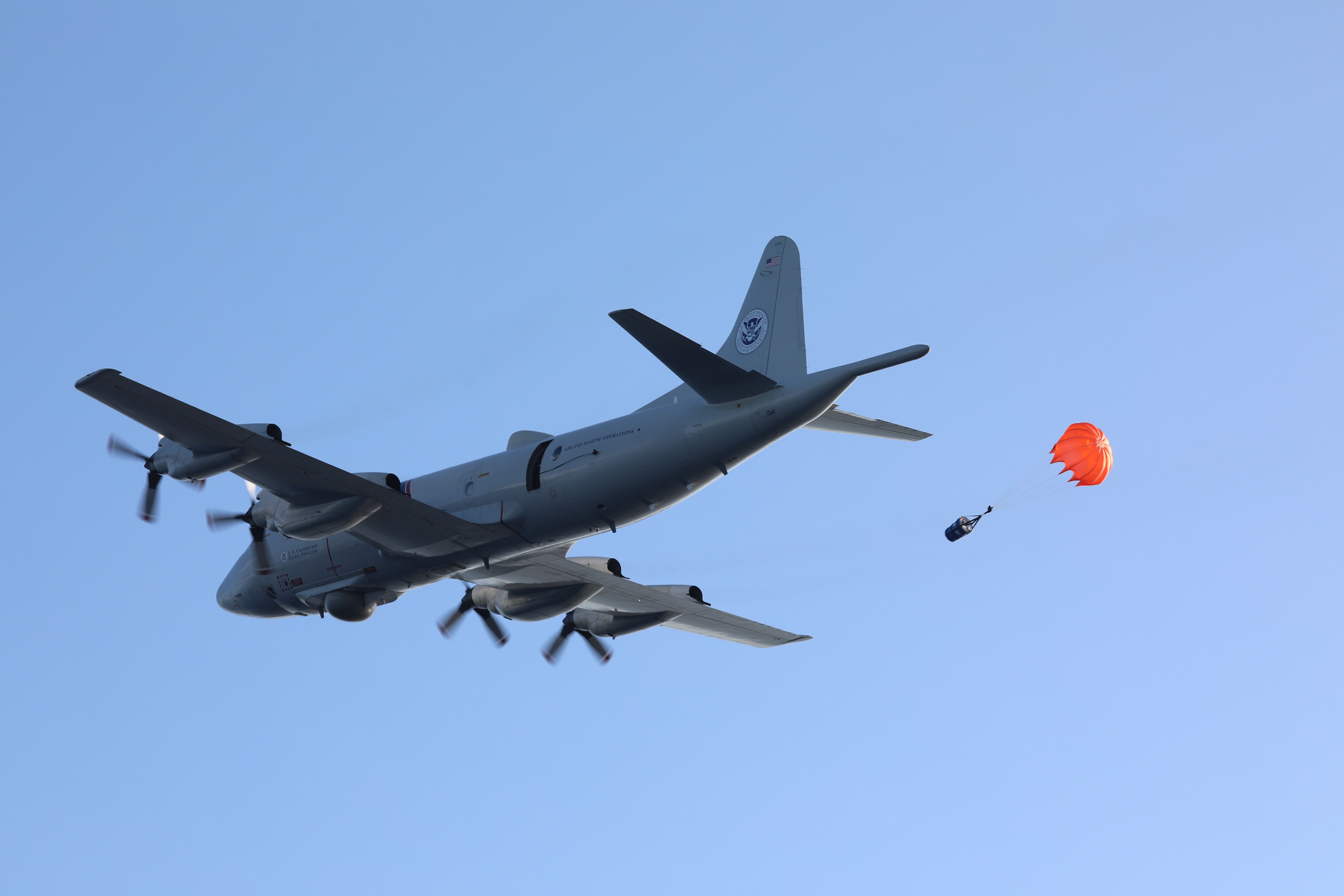
Below are two a news releases about a SAR mission, here and here. This is significant in that it demonstrates some of the potential of land based medium altitude long endurance uncrewed air systems. Unfortunately, it seems the Coast Guard has not yet chosen to invest in this technology. We continue to ride the coat tails of Customs and Border Protection. Meanwhile the capabilities of the systems continue to improve with the latest generation, like the one pictured above, incorporating sense and avoid systems that allow them to operate in the National Airspace.

It is time for the Coast Guard to ask for land based long endurance UAS of their own. If they operate in cooperation with Customs and Border Protection, that would not necessarily be a bad thing, but the Coast Guard needs to fund their own so that the Coast Guard can prioritize their employment.


May 2, 2024

Joint Program Office uses the MQ-9 aircraft to save four souls off the coast of Texas

By Jason Allred MyCG Web Editor

Military units are intended for collaboration. The concept is also true for various branches of federal services. Customs & Border Protection (CBP) and the U.S. Coast Guard (USCG) are two partners who mutually benefit from collaboration. Specifically, at the Joint Program Office in San Angelo, Texas, where USCG and CBP MQ-9 pilots, sensor operators, and radar operators support various functions within the maritime and land border domains.

On Friday, Nov. 17, 2023, the Joint Program Office received a call from Sector Corpus Christi to help support a SAR mission to find an overdue vessel with four souls aboard. Sector Corpus Christi called in support from the Joint Program Office in San Angelo following an uneventful search of the area by Coast Guard helicopters, aircraft and vessels. Lt. Cmdr. Luke Grant, an MQ-9 Pilot attached to the Joint Program Office, explained how the call to support the SAR case came in. “We’ve been working with Sector Corpus Christi on how they could use us and activate us in case they need us. It just happened that later that week they had a report of an overdue vessel. We already had a plane that was getting ready to launch, so we changed their mission set to go to that area and search for the overdue boaters.”

Historically, the Coast Guard has supported similar missions with helicopter and aircraft crews as well as various maritime assets to locate missing vessels. However, with recent capability advancements the Coast Guard is leveraging new ways to support legacy missions. With flight times of up to 24 hours, CBP’s MQ-9 offers a wide array of advantages over traditional manned assets. Lt. Cmdr. Grant says the platform has worked well in his experience. “It’s pretty good at finding the type of targets that we’re typically looking for in the Coast Guard. We’ve had good luck with finding go fast vessels.”

An additional advantage was Sector Corpus Christi’s ability to view the video feed from the MQ-9 during the SAR case. “They were pretty excited about being able to see what we were seeing and that definitely helps us reduce the number of communications with sector because they see exactly what’s happening.”

The impact the Joint Programs Office can make is literally the difference between a family member making it home or not. Petty Officer 1st Class David Garman, an avionics electrical technician (AET), explained his perspective after supporting this case. “I’m trained to operate this radar and assist in getting the vessel the assistance it required. It wasn’t until later when driving home at the end of the workday where I was like, I helped save lives today, I assisted in what I joined the Coast Guard to do 15 years ago. So, while it’s not the same as physically pulling them from a bad situation at night in a helicopter hovering 35-feet above the water, I was still elated and proud of the job the crew and I did to get them home safe.”

Lt. Cmdr. Grant was also pleased he was able to help bring a citizen to safety. “I know how important it is to people to get their family members back home, so there’s definitely a lot of job satisfaction when we can do a case like this and bring people back home.”

The mission and responsibility at the Joint Program Office at San Angelo is growing and the team couldn’t be more excited to share the possibility to recruit other aviators to their small community. Garman had a glowing review when asked about his current assignment. “This mission, skillset, and future opportunities available as an MQ-9 operator are well worth the time. Our mission is different than what most fellow AET’s experience in their time at normal Coast Guard air stations.”

For more information on the rescue or to watch the feed from the MQ-9 read here.

Resources:

Recommended Reading from Coast Guard News

USCGC James. USCG photo.

Of course, United States Coast Guard News is on my list of recommended blogs. I frequently publish their news releases, but they seem to have been particularly busy lately. Lots of good stuff here that is out of the ordinary.

“Long-standing shiprider agreements boost Free and Open Indo-Pacific, protect EEZs” –Indo-Pacific Defense Forum

U.S. Coast Guard Cutter Harriet Lane returns to home port after 79-day patrol, April 9, 2024. (U.S. Coast Guard photo by Senior Chief Petty Officer Charly Tautfest)

The Indo-Pacific Defense Forum, the on-line magazine of US Indo-Pacific Command, provides a review of the history and current status of the shiprider program that is part of the U.S. Indo-Pacific Command’s Theater Security Cooperation initiative, which seeks to enhance regional stability and security.

The Cook Islands and the U.S. established the first shiprider effort in the Indo-Pacific in 2008. The U.S. Coast Guard now has bilateral fisheries law enforcement agreements with 12 Indo-Pacific nations. The pacts enable each nation’s military and/or maritime law enforcement officers to ride aboard the other’s vessels and enforce laws within their respective waters, including exclusive economic zones (EEZ). They are permitted to stop, inspect and detain vessels suspected of illicit maritime activity, particularly illegal, unreported and unregulated fishing.

This seems to be in response to recent Chinese push back. Both China and the US may be looking toward the possibility of such an agreement being made between the US and the Philippines or Viet Nam. The piece concludes,

“The PRC is increasingly concerned the shiprider program will extend to the Philippines or Vietnam, which are among the nations that reject the PRC’s arbitrary and expansive territorial claims in the South China Sea…”

Such an Agreement might see a US Coast Guard cutter with Philippine shipriders attempting to board and possibly detain Chinese fishing vessels in the Philippines’ Exclusive Economic Zone within the South China Sea in areas also claimed by China.

“Coast Guard ready to bolster homeland defense role in Arctic” –The Watch

Below is a report from the USNORTHCOM website “The Watch.” I have reproduced the text in full. I don’t think they will mind.

If “…eight to nine icebreakers is what we think we need to build,” then we really need to publish the new Fleet Mix Study to build a consensus.

Perhaps the new icebreakers should be armed, at least for self-defense, as the important naval auxiliaries that they are.

Related: “Embracing opportunities for resilient logistical infrastructure in the Arctic” –The Watch


THE WATCH STAFF, April 24, 2024

A U.S. Coast Guard vice admiral said his branch’s long history in the Arctic is entering a new phase as a changing climate and emerging threats have increased the emphasis on polar security in the region. Vice Adm. Peter W. Gautier, the Coast Guard’s deputy commandant for operations, is responsible for the development of operational strategy, policy, guidance and resources that address national priorities. He spoke March 5, 2024, at an event titled “Understanding U.S. Armed Forces Operating Capabilities in the Arctic,” an online and in-person event hosted by Rand Corp., a U.S. public policy research organization.

Gautier noted that the Coast Guard has been present in the Arctic since the U.S. acquired Alaska from Russia in 1867. Its traditional role of conducting search and rescue operations and scientific voyages in the region has broadened into maintaining a strong U.S presence in the Arctic and collaborating with allies and partner nations.

At its height during the Cold War, the Coast Guard had eight or nine icebreakers, Gautier said. Currently, it has two, with one assigned to Antarctica. The U.S. Coast Guard Cutter Healy, based in Seattle, is a medium icebreaker and is the only vessel that has made recent Arctic voyages. But up to six new icebreakers — three heavy and three medium — have been authorized. When those come online, Gautier said, the U.S. will be able to support the international rules-based order more efficiently as icebreakers will allow for more navigation in the region. “It will give us an enduring capability to have presence in the U.S. Arctic up around Alaska and to the north, and then to the Arctic in and around Greenland and Canada to the eastern side. … So eight to nine icebreakers is what we think we need to build,” Gautier said.

Recent international tensions, including the 2022 Russian invasion of Ukraine, have changed the risk calculus in the Arctic, Gautier said, but the Coast Guard has already adapted. Gautier spoke glowingly about Starlink satellite technology that has given the branch high-quality communications in the Arctic for the first time. And the service is undertaking a major infrastructure effort in Kodiak, Alaska, and Seattle to prepare for a larger Arctic presence, he said. “We’re building out Kodiak, Alaska, in terms of the air station there, in terms of home-porting offshore patrol cutters. They’re fast-response cutters,” he said. The service is also “building out Seattle as the preeminent home port for our polar fleet, so that costs a lot of money. And that also requires a mindset to enduring sustainment: everything like childcare centers to making sure we have housing in these locations to the ability to maintain the piers and infrastructure to keep our fleet actually operational,” Gautier said.

Gautier welcomed private investment, especially in ports, as critical for the Coast Guard completing its Arctic mission. He spoke positively of a possible deep-water port being built in Nome, Alaska, as a potential benefit for defending the U.S. homeland.

A November 2023 Rand report on U.S. military capabilities in the Arctic recommended a deep-water port at Nome. “This will emplace a more capable key maritime logistics node in the U.S. Arctic, more than 700 miles north of the one at Dutch Harbor in southern Alaska. The vast distances in the Arctic make it difficult to respond within a few days in many locations without port infrastructure to host ships and support operations,” stated the report, which was commissioned by the U.S. government.

The report said the most urgent needs for the U.S. Armed Forces in the Arctic are infrastructure, assets, domain awareness and communications, and enough Soldiers trained to operate in the harsh weather. “The Arctic has its unique challenges and is growing in strategic importance,” Gautier said.

Status: Island Class WPB 110 Foot Cutters / USCGC Orcas Decommissioned

Coos Bay, OR–The Coast Guard Cutter Orcas (WPB 1327) on patrol. U.S. COAST GUARD PHOTO

Below is a news release reporting the decommissioning of USCGC Orcas. That caused me to wonder, how many WPB110s are left? The Acquisitions Directorate poster on their web page, dated June 2023, showed nine out of the original 49 still in commission.

I attempted to determine which are still in commission and which have been decommissioned, noting the results of the research below. I just searched the ship name on my browser and then clicked on the result that came up for vesselfinder.com. Their reports are based on Automatic Identification System (AIS) data.

  • Mustang (WPB-1310) Seward, AK
  • Naushon (WPB-1311) decommissioned, last reported in Curtis Bay 443 days ago.
  • Sanibel (WPB-1312) decommissioned, last reported in Curtis Bay 318 days ago.
  • Key Largo (WPB-1324) decommissioned, last report 1334 days ago.
  • Orcas (WPB-1327) decommissioned, April 23, 2024
  • Sitkanak Island (WPB-1329) decommissioned, last reported in Curtis Bay 331 days ago.
  • Tybee (WPB-1330) decommissioned, last reported in Curtis Bay, 2023-03-25
  • Liberty (WPB-1334) Valdez, AK
  • Anacapa (WPB-1335) Port Angles, WA

The Webber Class Fast Response Cutters (FRCs) are nominally a direct replacement for these. The Coast Guard has already accepted 56 FRCs with Bollinger typically delivering four or five a year, so its only surprising that any of the 110s are still in commission. That seems to be because District 13 (Oregon and Washington) and District 17 (Alaska) have not gotten their full allowance of FRCs yet.

The next three FRCs are expected to go to D13 (1) and D17 (2) so all the Island class may be decommissioned by the end of the calendar year.


April 23, 2024

Coast Guard Cutter Orcas decommissioned after 35 years of service in Coos Bay, Oregon

COOS BAY, Ore. – The Coast Guard decommissioned the U.S. Coast Guard Cutter Orcas (WPB1327) during a ceremony, Tuesday.

Rear Adm. Charles Fosse, the commander of the Thirteenth Coast Guard District, presided over the ceremony honoring the 35 years of service Orcas and its crews provided to the nation.

Commissioned on April 14, 1989, Orcas was the twenty-seventh Island-Class cutter to join the fleet.

Orcas has been stationed in Coos Bay, Oregon, since 1989 and is the sixth Coast Guard cutter to be stationed in Coos Bay since 1935.

The Orcas was a multi-mission platform that conducted operations to support search and rescue response, marine environmental protection, and national defense.

“From training allied nation maritime forces, conducting the largest-ever cocaine seizure in the history of the Pacific Northwest, and saving countless lives and hundreds of millions of dollars’ worth of property on the Pacific Ocean – Orcas has done it all,” said Lt. Brendan O’Farrell, the commanding officer of the Orcas. “This ship, one of the last of its kind, is an old American-made workhorse built to endure the harsh Pacific waves. I’m extremely proud and blessed to have served with the finest crew in the fleet.”

Poster Download: “2024 Ships and Submarines of the United States Navy” –RTX

For 27 years, RTX (formerly Raytheon) has created a poster every year with the names of every ship and graphical representations of every ship class in the US Navy. It’s a giveaway at trade shows but is also available as a download. They have a story about its origin and the person who created it with a link to download a pdf copy here.

I downloaded a copy. I did have to enlarge it a bit (ctrl +) to make it readable on my laptop. It does also include ships under construction with no apparent differentiation.

“Third temporary channel opens for vessels to Baltimore port after bridge collapse” –WRAL News

Coast Guard Yard, Curtis Bay, MD.

WRAL News reports,

“A third temporary channel for boats to enter and depart the Port of Baltimore has opened…The new temporary path, with a controlling depth of 20 feet (6.1 meters), a horizontal clearance of 300 feet (91.4 meters) and a vertical clearance of 135 feet (41.2 meters), allows a greater variety of vessels to access the port while crews work to reopen the main channel, Coast Guard and port Capt. David O’Connell said in a news release.”

I added a comment noting this development on the earlier post about Coast Guard ships being trapped at the Coast Guard Yard, but on second thought I realized this was worth a separate post. As I noted in the comment, “With a controlling depth of 20 feet this should be sufficient for all Coast Guard vessels except the National Security Cutters. USCGC Eagle might have a problem with the vertical clearance, 135 feet. Reportedly fore and main mast height is 147.3 feet, but they can be lowered 13 feet. Probably at low tide, Eagle could transit the temporary channel OK, but it would look exciting. Maybe at high tide the NSCs could use it too.” (Please forgive the stream of thought approach.)

Before writing this post, I went to United States Coast Guard News hoping to quote the news release in full (surely it would be there) but for some reason there was no news release. Curious? Could this be because its Saturday?

Sea-Air-Space Graphics Available

As noted earlier, the Coast Guard made a number of presentations at the Navy League’s Sea-Air-Space exposition, April 8 and 9. Most of us were not able to attend, but we can still see some of the information provided. The Acquisitions Directorate (CG-9) webpage has links to the graphics that were used during most of the presentations.

A Window into what USCGC Frederick Hatch Has Been Doing

Lt. j.g. Mary Sims, executive officer of USCGC Frederick Hatch (WPC 1143), takes a photo with students touring the ship at the pier in Tacloban, Philippines, on Oct. 21, 2023. In a historic first, the USCGC Frederick Hatch (WPC 1143) visited Tacloban, Philippines, from Oct. 19 to 23, 2023, and the crew conducted engagements marking a significant milestone in the enduring relationship between the United States and the Philippines. (U.S. Coast Guard photo by Lt. j.g. Mary Sims)

Below is a news release from U.S. Coast Guard Forces Micronesia/Sector Guam. I don’t normally feature individual awards like this, but I think it gives a good sampling of what the patrol craft based in Guam are doing. Of course, we have heard about the fisheries enforcement and the capacity building, but there is at least one activity here that I don’t think has been commonly recognized. 

While serving as acting commanding officer, she showcased outstanding skills and tactical sense by spearheading the cutter effort in two complex nuclear missile submarine escorts with U.S. Navy Submarine Squadron 15.

The Coast Guard does have two Maritime Force Protection units dedicated to escorting Fleet Ballistic Missile Submarine as they operate on the surface, entering and exiting their homeports, but this is the first I have heard of this being done in Guam. Guam is a bit unique. There are four Los Angeles class SSNs based there as well as the only two submarine tenders in the US Navy, USS Emory S. Land (AS-39) and USS Frank Cable (AS-40). While I think the primary threat to the submarines transiting in an out of Puget Sound and Kings Bay is probably anti-nuclear protesters, Chinese fishing vessels operate close to Guam.


April 10, 2024

USCGC Frederick Hatch’s Lt. j.g. Mary Sims awarded for excellence in Pacific maritime operations

SANTA RITA, Guam — Aboard the USCGC Frederick Hatch (WPC 1143), Lt. j.g. Mary Sims sets an example of excellence on the vast waters of the Pacific Ocean. She was honored in March 2024 with the prestigious inaugural Sector Guam Officer Excellence Award for the second half of 2023 for her unwavering devotion to duty and outstanding leadership.

While she’s been doing incredible work for nearly two years, Sims serves as the executive officer and a boarding officer. She played an essential part in groundbreaking maritime operations, including the first-ever execution of enhanced maritime bilateral agreements with the Federated States of Micronesia (FSM) and the Republic of Palau. She also set an outstanding example as a boarding officer during 16 boardings of foreign-flagged fishing vessels, illuminating the issue of illegal fishing and capturing data on potential violations documented and turned over to the partner nation or regional fisheries management organization for further action. Her unwavering commitment to maritime law and steadfast support of good maritime governance represent the highest standards of professionalism and integrity.

While serving as acting commanding officer, she showcased outstanding skills and tactical sense by spearheading the cutter effort in two complex nuclear missile submarine escorts with U.S. Navy Submarine Squadron 15. Further demonstrating her diplomatic skills, Sims arranged a meeting between the Frederick Hatch crew and the BAP Unión crew, a Peruvian Navy tall ship voyaging around the globe and calling on Guam.

But her efforts go well beyond geopolitical concerns and tactical strategy. During the M/V Mama Loling towing operation, she showed resilience and fortitude in the face of hardship by expertly navigating the Frederick Hatch in eight-foot seas and hazardous weather to save five mariners and their damaged 39-foot research vessel in the Northern Mariana Islands threatened by an oncoming tropical cyclone. Her bravery and sound reasoning saved lives inspired the crew and honored the highest ideals of the U.S. Coast Guard.

Furthermore, Sims is an admirable contributor to community engagement and public service. During the cutter’s historic visit to Tacloban, Philippines, she led the organization of 14 community engagement activities over four days. This visit helped to build connections and improve diplomatic contacts with the local community and Philippine Coast Guard colleagues. On many occasions, Sims shared her experience with women and girls across the Pacific, which embodies the spirit of the Women, Peace, and Security (WPS) initiatives, as her presence not only showcases the importance of gender inclusivity within security operations but also serves as a potent symbol of empowerment, inspiring community resilience and fostering a more inclusive approach to regional peace and security efforts.

A native of Alabama, she has several siblings, including her sister Emma, who is also in the U.S. Coast Guard, assigned to USCGC Lawrence Lawson (WPC 1120) as the executive officer, out of Cape May, Jew Jersey. Sims is an avid runner, plays on a thriving local rugby team, and follows her faith.

In her upcoming assignment at U.S. Coast Guard Atlantic Area LANT-35, operations department maritime security enforcement, Sims will continue to excel and significantly contribute to the Coast Guard’s mission. Her transfer signifies the trust and confidence in her abilities to tackle new challenges and uphold the highest service standards as she concludes her tour here in Guam; her legacy of dedication, leadership, and commitment to excellence will continue to inspire her colleagues and leave an ever-lasting mark on the U.S. Coast Guard’s legacy! Bravo Zulu, Lt. j.g. Sims, and best wishes for continued success in your future endeavors.

-USCG-

U.S. Coast Guard Forces Micronesia/Sector Guam
The U.S. Coast Guard Forces Micronesia/Sector Guam team focuses on maritime safety, security, and stewardship in Oceania. With a primary presence in Guam and Saipan and over 300 members across Guam and the Commonwealth of the Northern Mariana Islands, the team maintains a strong U.S. presence in the Micronesia sub-region and adjacent areas, closely tied to local communities.

About USCGC Frederick Hatch (WPC 1143)
The Frederick Hatch is the 43rd 154-foot Sentinel-class fast response cutter named for a surfman and lighthouse keeper who was a two-time Gold Life Saving Medal recipient. The Service commissioned the ship along with its sister ships, Myrtle Hazard (WPC 1139) and Oliver Henry (WPC 1140), in Guam in July 2021.