“Coast Guard prepares for aircraft fleet expansions with awards for engines, radar” –Coast Guard News Release

201116-G-G0217-1002
A Coast Guard Air Station Kodiak HC-130 Hercules aircrew takes off from an airstrip in Sitka, Alaska, Nov. 16, 2020. The Kodiak aircrew delivered aircraft parts. Courtesy photo by Don Kluting.

Below is a USCG news release.


Sept. 23, 2025

Coast Guard prepares for aircraft fleet expansions with awards for engines, radar

WASHINGTON — The Coast Guard recently completed contract actions aimed at accelerating delivery of new MH-60 medium-range recovery helicopters and HC-130J long-range surveillance aircraft and expanding mission capabilities of the expanded aviation fleet.

On Sept. 8, the Coast Guard placed a $14.3 million order for delivery of 13 General Electric T700 engines for its MH-60 helicopter fleet. On Sept. 18, the Service contracted with L3 Harris Technologies Inc. for delivery of three AN/APY-11 multi-mode radar systems, valued at $13.9 million, to be installed on future HC-130Js during the Minotaur missionization process.

Both orders were made possible due to investments in the Coast Guard fleet made by the One Big Beautiful Bill Act (OBBBA).

The T700 engines are among the long lead-time components needed to grow the Coast Guard’s MH-60 fleet and expedite transition of several air stations from the MH-65E to the MH-60. The MH-60’s range, speed, payload and avionics and sensors suite make it a capable platform for all 11 Coast Guard missions. The aircraft’s ability to locate, identify and track surface targets day or night makes it a valuable search and rescue and law enforcement asset. Transition of air stations is necessary to sustain rotary wing capability as the MH-65E continues to face supportability issues driven by a diminishing supply base for an out-of-production aircraft.

The AN/APY-11 radar system was chosen as the optimal multi-mode radar to enhance operational effectiveness as part of the Minotaur Mission System Suite. The Minotaur Mission System enables the collection and correlation of sensor and track data, which is used to conduct drug and alien interdictions, search and rescue, and other statutory missions.

The Coast Guard’s long-range surveillance fleet is a proven asset vital to control, secure and defend the U.S. border and maritime approaches, facilitate commerce vital to economic prosperity, and respond to crises and contingencies. The Coast Guard HC-130J fleet is the Department of Homeland Security’s airlift asset and can provide critical support to DHS partners in response to national events as well as logistical support during routine operations.

The OBBBA includes more than $3.3 billion to expand the Coast Guard’s HC-130J and MH-60 fleets. Nearly $2.3 billion is for the production and fielding of new MH-60 aircraft and delivery of multiple simulators. Approximately $1.1 billion is for production and missionization of six additional HC-130J aircraft, along with associated spare parts and the service’s first HC-130J simulator.


“DIU wants nonlethal weapons to disable small boats, amid US crackdown on drug cartels” –Defense Scoop

A Coast Guard Cutter Vigilant (WMEC 617) small boat crew interdicts two suspected drug traffickers in the Caribbean Sea, July 25, 2025. (U.S. Coast Guard photo courtesy of Vigilant/DVIDS)

Defense Scoop reports.

“As the Trump administration unleashes a new strategy targeting Latin American drug cartels determined to be “narcoterrorists” with direct military action, the Pentagon is moving to buy nonkinetic weapons that can disrupt, disable, or prevent the operation of small watercraft with minimal collateral damage or potential harm to nearby civilians and boat operators.”

It does sound like they may also be talking about more than just getting a go-fast to stop, like maybe stop a swarm of USVs using micro waves.

Also looks like they do not want to spend the time the Coast Guard spends training their air borne use of force marksmen.

Years ago, I saw the Coast Guard was also looking for weapon/device that can stop a boat without the possibility of collateral damage. We would probably still like to have something like that.

“Japan Coast Guard to acquire four additional unmanned aircraft” –Naval News

Two MQ-9B SeaGuardians of the Japan Coast Guard. JCG picture.

Naval News reports,

At the end of August 2025, the Japan Coast Guard (JCG) released its preliminary budget request for fiscal 2026. The request revealed plans to procure four additional unmanned aircraft for maritime surveillance of Japan’s surrounding waters.

The budget documents do not specify a model name, but based on past developments this is believed to refer to the MQ-9B SeaGuardian.

The Japan Coast Guard first looked at the SeaGuardian in 2020. They leased three in 2022. The three were subsequently purchased.

Two additional MQ-9Bs are scheduled to be deployed by March 2026. Including the aircraft requested in the current preliminary budget, the JCG will hold a total of nine MQ-9Bs by fiscal 2028. All of these airframes are planned to be acquisitions (purchases), not leases.

The US Exclusive Economic Zone is about 2.5 times as large as that of Japan, so we would need about 23 aircraft to have about the same coverage as the Japanese are planning.

Only a little over two weeks ago we got the word that the Coast Guard would be spending $266M to buy its own shore based Medium Altitude Long Endurance (MALE) Unmanned Air Systems (UAS).

At the time I asked why the Coast Guard would be buying the MQ-9A rather than the MQ-9B that is optimized for maritime operation and has been selected by several navies and coast guards. Still have not seen any rationale. Maybe it was just a misunderstanding.

The first USCG shore based UAS are likely to look for drug smugglers and migrants, but they would also be very useful in the broad reaches of the Pacific, far from any existing Coast Guard air station.

“Building a ‘Heavy’ Icebreaker in Helsinki” –Sixty Degrees North

Sixty Degrees North intends to follow the construction of Canada’s heavy icebreaker in Finland,

“I intend to closely follow and document construction of the Polar Class 2 ‘heavy’ Polar Icebreaker at Helsinki Shipyard in my continuing effort to correct the false belief that Finnish companies cannot build the types of icebreakers needed by the U.S. Coast Guard…

“You will also see me reporting on Rauma Marine Construction’s (RMC) progress building the Finnish Navy Corvettes...At the moment, they have three (of a planned four) Corvettes in simultaneous production.”

The corvette is also interesting combining significant anti-air, anti-surface, and anti-submarine capability with a hull designed to operate in ice, all in a hull 15% smaller than that of an OPC. I look forward to hearing more about it.

The first multi-purpose corvette built for the Finnish Navy’s Squadron 2020 project was launched at Rauma shipyard on Wednesday 21 May 2025.

“Coast Guard seizes 75,000 pounds of cocaine through Operation Pacific Viper, averages over 1,800 pounds interdicted per day” –CG News Release

Left to right, LANT Area WMEC270 and WMEC210, and (I believe) USS Sampson (DDG-102) and USCGC Midgett . Coast Guard seizes 75,000 pounds of cocaine through Operation Pacific Viper, Aug. 8 to Sept. 18, 2025.

While kinetic attacks in the Caribbean have gotten headlines, the Coast Guard and partners have been removing far more product the old fashion way–20 interdictions in less than six weeks, in just the Eastern Pacific.

Below is a Pacific Area News release.


Sept. 18, 2025

Coast Guard seizes 75,000 pounds of cocaine through Operation Pacific Viper, averages over 1,800 pounds interdicted per day

WASHINGTON — The U.S. Coast Guard announced Thursday it has seized more than 75,000 pounds of cocaine in the Eastern Pacific Ocean since launching Operation Pacific Viper in early August, averaging over 1,800 pounds interdicted daily.

These drug seizures, and the apprehension of 59 individuals suspected of narco-trafficking, were the result of more than 20 interdictions since Aug. 8.

Through Operation Pacific Viper, the Coast Guard is accelerating counter-drug operations in the Eastern Pacific Ocean, where significant transport of illicit narcotics continues from South America. In coordination with international and interagency partners, the Coast Guard is surging additional assets—cutters, aircraft and tactical teams—to interdict, seize and disrupt transshipments of cocaine and other bulk illicit drugs. Operation Pacific Viper continues the Coast Guard’s efforts to protect the Homeland, counter narco-terrorism and disrupt Foreign Terrorist Organizations and Transnational Criminal Organizations and cartels seeking to produce and traffic illicit drugs into the United States.

“The Coast Guard’s maritime fighting force is relentless in our ongoing operations to counter narco-terrorism,” said Rear Adm. Jeffrey Novak, deputy commander Pacific Area. “Our latest milestone through Operation Pacific Viper – over 75,000 pounds of cocaine seized – underscores our commitment to dismantling Foreign Terrorist Organizations and Transnational Criminal Organizations engaged in narco-trafficking. The Coast Guard is bringing every authority and every capability at our disposal to disrupt cartels and criminal organizations, stop the flow of deadly drugs into the U.S., and secure U.S. borders and maritime approaches. While we continue our crucial work to defend America, I could not be prouder of the men and women of the Coast Guard in celebrating this milestone.”

Detecting and interdicting narco-terrorism on the high seas involves significant interagency and international coordination. U.S. Southern Command’s Joint Interagency Task Force-South, based in Key West, Florida, detects and monitors both aerial and maritime transit of illegal drugs. Once interdiction becomes imminent, the law enforcement phase of the operation begins, and control of the operation shifts to the U.S. Coast Guard throughout the interdiction and apprehension. Interdictions in the Eastern Pacific Ocean are performed by members of the U.S. Coast Guard under the authority and control of the Coast Guard’s Southwest District, headquartered in Alameda, California.

The Coast Guard is the United States’ lead federal agency for maritime drug interdiction. We are part of the Department of Homeland Security team protecting our nation and are at all times a military service and part of the joint force defending it.

“Major Acquisition Systems Infrastructure (MASI) Program” –CG-9

250917-G-G1790-1891 Aerial view of Coast Guard Yard in Baltimore. The Coast Guard awarded a contract for the reconstruction of Pier 1 (first from the left) on Sept. 9, 2025, to support future depot-level maintenance of the offshore patrol cutter class. (U.S. Coast Guard photo)

CG-9, the Acquisitions Directorate, has published an unusually comprehensive report on what they are doing to provide the infrastructure required to support the new assets coming on line.

It includes both a list of previous reports on infrastructure upgrades including seven in 2025, and a link to a one page briefing that includes a listing of projects completed:

  • Fast response cutter (FRC) homeports in San Juan, Puerto Rico; Miami and Key West, Florida; Cape May, New Jersey; Ketchikan, Alaska; Pascagoula, Mississippi; Atlantic Beach, North Carolina, San Pedro, California; Galveston, Texas; Apra Harbor, Guam; Honolulu; and Boston
  • National security cutter (NSC) homeports in Alameda, California; Honolulu; and expansion at Charleston, South Carolina
  • Hull, mechanical and engine training building for FRCs and NSCs in Yorktown, Virginia
  • C4ISR training building for FRCs and NSCs in Petaluma, California
  • Depot level maintenance hangar for medium range surveillance (MRS) aircraft in Elizabeth City, North Carolina
  • MRS aircraft maintenance training building in Elizabeth City
  • MRS aircraft hangar at Air Station Cape Cod in Bourne, Massachusetts
  • HC-130J support facilities including liquid oxygen (LOX) storage and servicing areas at Air Station Kodiak, Alaska
  • HC-130J LOX and propeller/mission shop facilities at Air Station Barbers Point, Hawaii
  • C-27J facility upgrades and LOX facilities at Air Station Clearwater, Florida

and a list of key projects in process:

  • Fast response cutter homeports/expansions in Astoria, Oregon; Kodiak, Seward and Sitka, Alaska; St. Petersburg, Florida; and a recurring depot availability facility at Coast Guard Yard in Baltimore
  • Offshore patrol cutter homeports in San Pedro, California; Kodiak, Alaska; and Newport, Rhode Island
  • Polar security cutter homeport in Seattle, Washington
  • Waterways commerce cutter homeports
  • National security cutter homeport expansion in Charleston, South Carolina
  • Second seagoing buoy tender berth in Honolulu
  • Engineering and weapons training building in Yorktown, Virginia
  • C-27J simulator building at Aviation Training Center in Mobile, Alabama


“U.S. Coast Guard awards contract for reconstruction of Pier 1 at Coast Guard Yard” –CG News Release

250917-G-G1790-1891 Aerial view of Coast Guard Yard in Baltimore. The Coast Guard awarded a contract for the reconstruction of Pier 1 (first from the left) on Sept. 9, 2025, to support future depot-level maintenance of the offshore patrol cutter class. (U.S. Coast Guard photo)

Below is a Coast Guard News Release. Don’t overlook the establishment of “Program Executive Office (PEO) Shore under the Systems Integration Directorate to implement a fully integrated, systems-based approach to asset lifecycle management” in the last paragraph.


Sept. 17, 2025

U.S. Coast Guard awards contract for reconstruction of Pier 1 at Coast Guard Yard

WASHINGTON — The Coast Guard awarded a contract valued at nearly $11 million to Ocean Construction Services Inc. on Sept. 9 for comprehensive modifications to Pier 1 at the Coast Guard Yard in Baltimore, Maryland.

The scope of work includes lengthening of the pier, construction of new fenders and robust fender boards, removal of deteriorating timber curbs that line the current pier, installation of upgraded shore ties and pier electrical capacity, and strengthening the existing pier’s horizontal load-bearing strength to support the future Coast Guard cutter fleet.

“For more than a century, the Coast Guard Yard has provided critical maintenance and repair services to the Coast Guard’s surface fleet, and this contract will deliver the improvements necessary to continue that long record of success, including the future sustainment of the Offshore Patrol Cutter class,” said Rear Adm. Michael E. Campbell, director of systems integration and chief acquisition officer of the Coast Guard. “Additionally, this work lays the groundwork for future improvements at the Coast Guard Yard – supported through the truly historic investments of the One Big Beautiful Bill Act – to fully transform the facility to meet the needs of the Coast Guard’s modern surface fleet.”

The Coast Guard Yard is the service’s only organic shipbuilding and repair facility. It is the Coast Guard’s largest, most modern industrial plant. The Coast Guard Yard is responsible for construction, repairs and renovation of vessels and various aids to navigation, and for the manufacturing of miscellaneous Coast Guard equipment.

Reconstruction of Pier 1 is critical to maintain the Coast Guard’s organic capabilities to perform depot-level maintenance for the fleet and to prepare for post-delivery activities as new cutters are delivered. The work awarded is a critical enabler of the larger Coast Guard Yard modernization initiative, which will leverage the historic investments made available under the One Big Beautiful Bill Act to support future sustainment and maintenance of the Coast Guard fleet. The Coast Guard Yard modernization project will be the largest infrastructure project in Coast Guard Yard’s history, and Pier 1 improvements will ensure continuity of operations at the Yard while future construction work proceeds.

Reconstruction of Pier 1 is expected to be substantially completed in 2027.

As part of the Force Design 2028 initiative, the Coast Guard established the new Program Executive Office (PEO) Shore under the Systems Integration Directorate to implement a fully integrated, systems-based approach to asset lifecycle management. The PEO provides comprehensive oversight, planning and execution of shore infrastructure and facilities projects through the capabilities of the Shore Infrastructure Logistics Center, the Facilities Design and Construction Center and six civil engineering units that provide program management and execution capabilities at the regional level. Civil Engineering Unit Cleveland serves all Coast Guard entities in the Great Lakes and Mid-Atlantic regions, which include over 132 facilities, 368 aid to navigation towers and lighthouses, 4,970 small aid to navigation structures and over 8 million square feet of buildings valued at over $3.9 billion.

“Coast Guard’s Helicopter Interdiction Tactical Squadron completes 1,000th interdiction” –Atlantic Area

250831-G-G0100-1001
Crew members from Coast Guard Cutter Midgett (WMSL 757), the Coast Guard Helicopter Interdiction Tactical Squadron (HITRON), Coast Guard Tactical Law Enforcement Team – South and unmanned aerial vehicle personnel pose for a group photo aboard Midgett while underway in the Eastern Pacific Ocean, Aug. 28, 2025. On Aug. 25, HITRON used airborne use of force to stop the non-compliant vessel, marking the unit’s 1,000th drug interdiction since the unit’s inception in 1999, which resulted in Midgett crew members seizing approximately 3,606 pounds of suspected cocaine worth an estimated $46 million and apprehending six suspected narco-traffickers. (U.S. Coast Guard photo) In the front is a V-Bat Vertical Take Off UAS.

Below is an Atlantic Area news release.

Recognizing this milestone is important because it shows how successful the program has been. The Coast Guard is shooting every nine days.

The Unmanned aircraft, first ScanEagle and then V-Bat have made the Coast Guard even more successful.


Sept. 10, 2025

Coast Guard’s Helicopter Interdiction Tactical Squadron completes 1,000th interdiction

JACKSONVILLE, Fla. — The U.S. Coast Guard’s Helicopter Interdiction Tactical Squadron (HITRON) achieved a significant milestone in its counter-drug mission, completing its 1,000th interdiction of suspected narco-trafficking vessels Aug. 25.

Since October 1, 2024, HITRON has interdicted $3.3 billion in illicit narcotics destined for the United States via maritime routes, a three-fold increase over its historic annual average of $1 billion.

“HITRON embodies the Coast Guard’s spirit of innovation and adaptability,” said Vice Adm. Nathan Moore, commander, U.S. Coast Guard Atlantic Area. “From its humble beginnings as a prototype program, it has evolved into a vital force in our counter-narcotics efforts. This milestone is a powerful reminder of the strategic value of this specialized unit in addressing the evolving complex maritime security challenges.”

On Aug. 25, a HITRON aviation detachment deployed aboard Coast Guard Cutter Midgett (WMSL 757) observed a suspected narco-trafficking vessel approximately 372 nautical miles southwest of Acapulco, Mexico in the early evening. The helicopter directed the vessel to heave to over the radio and with warning shots. When the vessel failed to comply, the crew used precision rifle fire from the helicopter to disable the vessel’s engine, in accordance with airborne use of force policy. A Coast Guard law enforcement boarding team from Midgett seized more than 3,600 pounds of suspected cocaine that was found aboard and jettisoned in the waters around the vessel, estimated to have a street value of $49 million.

HITRON is based in Jacksonville, Florida and a component of U.S. Coast Guard Atlantic Area Command. It was founded in 1999 as a classified prototype program to test the ability of Coast Guard aircraft to employ precision fire to disable narcotics smuggling vessels. With impressive early results, this team grew from the initial ten personnel to its current size of over 200 Active Duty, Reservists, and civilian members, including an exchange pilot from the United Kingdom’s Royal Navy. Since its founding, HITRON has interdicted $33.2 billion in illicit drugs during operations in the Eastern Pacific Ocean and Caribbean Sea, and over the past 26 years has averaged one interdiction every nine days.

Through Operation Pacific Viper, the Coast Guard is accelerating counter-drug operations in the Eastern Pacific Ocean, where significant transport of illicit narcotics continues from South America. In coordination with international and interagency partners, the Coast Guard is surging additional assets—cutters, aircraft and tactical teams—to interdict, seize and disrupt transshipments of cocaine and other bulk illicit drugs. These operations continue the Coast Guard’s efforts to protect the Homeland, project maritime law enforcement presence and disrupt transnational criminal organizations and cartels seeking to produce and traffic illicit drugs into the United States.

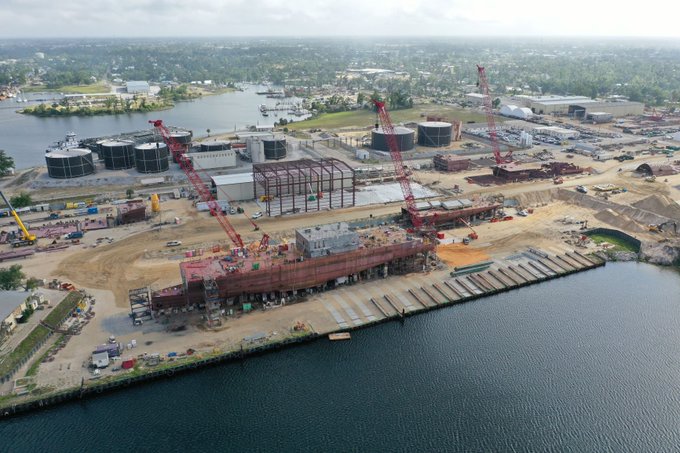
“Davie Unveils $1B ‘American Icebreaker Factory’ in Texas to Build Arctic Security Cutters” –gCaptain

A rendering of Davie Defense’s “American Icebreaker Factory,” a planned $1 billion transformation of the historic Gulf Copper shipyard in Galveston, Texas. Image courtesy Davie

gCaptain reports,

Davie Defense Inc., the newest entrant to the American shipbuilding sector, has revealed detailed plans for a $1 billion overhaul of the historic Gulf Copper shipyard in Galveston, Texas, aiming to create the “American Icebreaker Factory”—a purpose-built facility for constructing U.S. Coast Guard’s Arctic Security Cutters.

The project plans, announced Wednesday, marks what the company describes as the largest single increase in U.S. shipbuilding capacity in decades.

Note, this is intended to build the medium “Arctic Security Cutter.”

“Coast Guard Exercises Contract Option for 10 Additional Fast Response Cutters” –News Release

220822-A-KS490-1178 STRAIT OF HORMUZ (Aug. 22, 2022) From the left, U.S. Coast Guard fast response cutters USCGC Glen Harris (WPC 1144), USCGC John Scheuerman (WPC 1146), USCGC Emlen Tunnell (WPC 1145) and USCGC Clarence Sutphin Jr. (WPC 1147) transit the Strait of Hormuz, Aug. 22. The cutters are deployed to the U.S. 5th Fleet area of operations to help ensure maritime security and stability in the Middle East region. (U.S. Army photo by Spc. Noah Martin)

Below is a Coast Guard News Release.


Sept. 10, 2025

Coast Guard Exercises Contract Option for 10 Additional Fast Response Cutters

WASHINGTON — The U.S. Coast Guard has exercised a contract option with Bollinger Shipyards of Lockport, Louisiana, to fund initial construction on 10 additional Fast Response Cutters (FRCs), Tuesday. The $507 million option supports ongoing efforts to modernize the fleet and expand the Coast Guard’s global maritime mission.

The action made possible by the passage of Public Law 119-21, known as the One Big Beautiful Bill Act, increases the total number of FRCs ordered under the current agreement from 67 to 77. Supported by historic investments, this legislation provides nearly $25 billion – the largest single funding commitment in Coast Guard history – including $1 billion dollars for additional FRCs. The first FRC funded through this option is expected to be delivered in fiscal year 2028.

“As the first Coast Guard contracting action to execute over $100 million in reconciliation funds and the first reconciliation-funded action executed by a cutter program, this is a historic accomplishment for the Service,” said Rear Adm. Mike Campbell, the Coast Guard’s Director of Systems Integration and Chief Acquisition Officer. “Since its introduction to the fleet in 2012 as the successor to the 110-foot Island class patrol boat, the Fast Response Cutter has consistently proven its capabilities, adaptability and effectiveness in a wide range of maritime environments and Coast Guard missions.”

Sentinel-class FRCs are critical assets in the Coast Guard’s mission to control, secure and defend the U.S. border and maritime approaches. To date, 59 of these cutters are in service, replacing the aging fleet of 1980s-era Island-class 110-foot patrol boats. The Sentinel-class FRCs feature advanced command, control, communications, computers, intelligence, surveillance and reconnaissance equipment; over-the-horizon cutter boat deployment to reach vessels of interest; and improved habitability and seakeeping. Expanding the FRC fleet continues the Coast Guard’s modernization through Force Design 2028, an initiative introduced by Secretary of Homeland Security Kristi Noem to transform the Coast Guard into a more agile, capable and responsive fighting force.

The FRC fleet will complement the capabilities of the service’s national security cutters (NSCs), offshore patrol cutters (OPCs) and polar security cutters (PSCs) as an essential element of the Nation’s layered maritime security strategy.