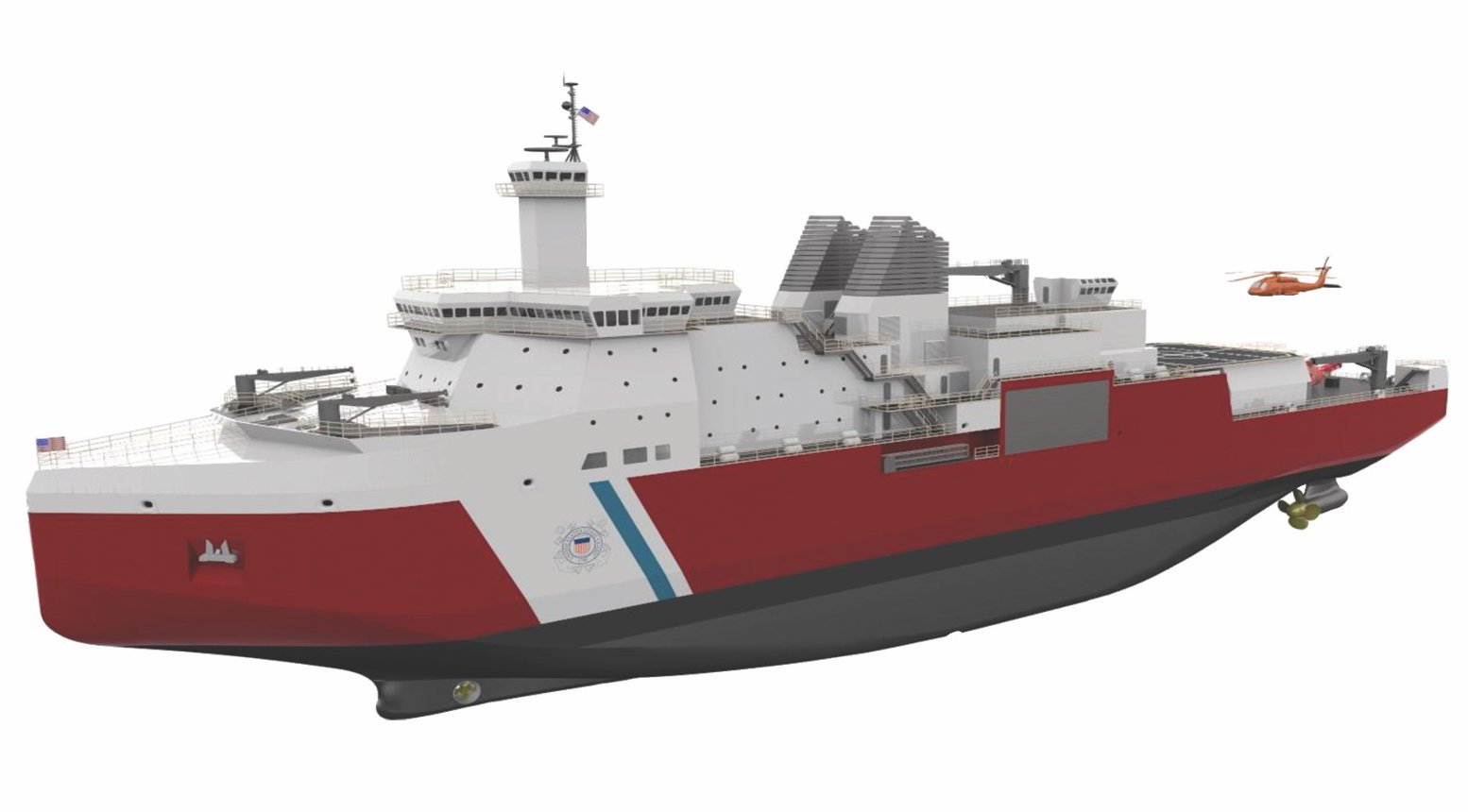
Artist rendering of the VT Halter Polar Security Cutter design.
Looks like it is official now, the the Coast Guard is seeking more than three heavy icebreakers (Polar Security Cutters), not in place of one or more of the three medium icebreakers (Arctic Security Cutters) but in addition. This presumably means we are seeking more than six polar icebreakers.
You have probably heard that HMS Defender was confronted by Russian military forces during a transit off Crimea. The Russians claim they dropped bombs in the path of the British Destroyer and that the Russian Coast Guard fired warning shots. The British say it did not happen. I can’t comment on the claim of bombs being dropped, but lets look at the evidence the Russians provided of warning shots, it the form of the photo above.
The gun is the AK-630, a 30mm Gatling gun. It is claimed to be effective against surface targets out to 5,000 meters or about 5,500 yards. It is an awsome weapon at close range, but its absolute maximum ballistic range is 8,860 yards (8,100 m).
HMS Defender, if that is the ship identified as such, is on the extreme horizon and might actually be somewhere beyond the visual horizon. Looking at the Rubin class cutter, it appears that the photo was taken from the Bridge or perhaps more likely, the flying bridge, on deck above to avoid reflections off the bridge windows. That puts the height of eye at about 30, or more likely 40 feet. We can calculate the distance to the horizon.
1.17 times the square root of your height of eye in feet = Distance to the horizon in nautical miles.
From a height of eye of 30 feet, the visual horizon is 6.4 nautical miles or more than 12,800 yards away. If the photo was taken from a height of 40 feet the distance to the visual horizon is 7.4 nautical miles or about 14,800 yards.
So HMS Defender was probably a minimum of 4000 yards or two nautical miles beyond the maximum range of the 30mm. In addition the gun was not pointed at the destroyer so the projectiles landed more than two miles from the Destroyer.
HMS Defender had no reason to believe that the shooting had any thing to do with them.
What we have here is a bite of theater. The Russians claim that fired warning shots while doing it in such a way that the British attached no significance to the firing.
The Drive seems to have come to the same conclusion.
I am afraid all I have is the head line and the lead in to a story behind a pay wall. I expect we will learn more.
“Cutting of steel on the first new Coast Guard heavy polar icebreaker could happen in the coming months, which is close to a year later than originally expected, but the forecast to start production still appears hazy.”
“Russian port operator Rosmorport recently took delivery of Viktor Chernomyrdin, the largest diesel-electric icebreaker ever built by a Russian shipyard….Viktor Chernomyrdin boasts a length of 146.8 metres, a moulded beam of 29 metres, a minimum draught of 8.5 metres, a maximum draught of 9.7 metres, and a displacement of approximately 19,070 tonnes. Because the vessel’s draught is variable, it can sail in inland waterways and other shallow areas aside form its primary area of operations that encompasses the Baltic Sea and the Gulf of Finland.”
This ship is slightly larger than the planned Polar Security Cutter, but is apparently less powerful (33,600 HP compared to 45,200 for the PSC). Using the Coast Guard classification, she is a medium icebreaker. But unlike many other Russian Icebreakers, this one seems to be capable of transiting to Antarctica if required.
Incident Commander Chris Graff of Gallagher Marine Systems and U.S. Coast Guard Commander Efren Lopez, Federal On-scene Coordinator, observe lifting and pollution mitigation operations at the Golden Ray wreck site. St. Simons Sound Incident response photo.
The U.S. Coast Guard and the National Transportation Safety Board signed an updated memorandum of Uunderstanding (MOU). Marine Link has the story.
The Navy League’s on-line edition of their magazine “Seapower” reports on the Commandant’s testimony before Congress on June 23.
As might be expected, there was a pitch for the Polar Security Cutters. I was pleased to see that the Commandant sighted not only a need for greater presence in the Arctic, but also in the Antarctic. Sooner or later, disputed claims will come to the fore there. I don’t think the existing treaty will be continued after its current expiration date, 2048, and we might see conflict before that.
There was also an interesting description of Healy’s next voyage,
“He said the Coast Guard is sending the medium icebreaker USCGC Healy to the Arctic this summer for some scientific research for about 30 days, followed by a transit of the Northwest Passage over the north coast of Canada. Some Canadian researchers, British sailors and others will be on board the Healy for the voyage. Current plans call for a port call in Greenland and then return to Seattle via the Panama Canal.”
There does seem to be a misstatement in the report, probably the reporter confused Dutch and Danish,
“Shultz also pointed out that Coast Guard medium-endurance cutters have exercised with Dutch and French forces in the Arctic region.”
And the Commandant did not stop at recommending three heavy and three medium icebreakers. “… Four to six heavy icebreakers are what we really need, and we need some medium breakers.”
South China Sea claims map by Voice of America, 31 July, 2012
China’s continued incursions into the Philippines’ EEZ have been ratchetting up the tension in the South China Sea. Philippine President Rodrigo Roa Duterte attempted to work with the Chinese, but that has been unrewarding and it now appears the Philippines is beginning to push back.
On one hand we might say that, since we no longer have bases in the Philippines what does the US get out of our mutual defense agreement? But on the other hand, we don’t want to see the Philippines become a Chinese satellite.
While on one hand the Chinese impoverish these nations they then offer loans for projects that frequently fail, leaving the countries in debt to China.
This is why there is increasing recognition of the Coast Guard’s importance in cooperative fisheries enforcement.
It appears a loitering munition, particularly suitable for Coast Guard use, is entering the Navy’s inventory. Essentially these “suicide drones” are small, short range, cruise missile with the unique feature of having a man in the loop who can evaluate the progress of the mission, switch targets, or abort the mission at his discretion. We talked about these earlier.
Naval News reports that the Marines are buying the UVision Hero-120 for installation on their Light Armored Vehicle-Mortar (LAV-M), Joint Light Tactical Vehicle (JLTV) and Long Range Unmanned Surface Vessel (LRUSV). The latter could be of particular significance to the Coast Guard in that the installation will be on a boat, unmanned, but still a boat, and in fact a relatively small boat.
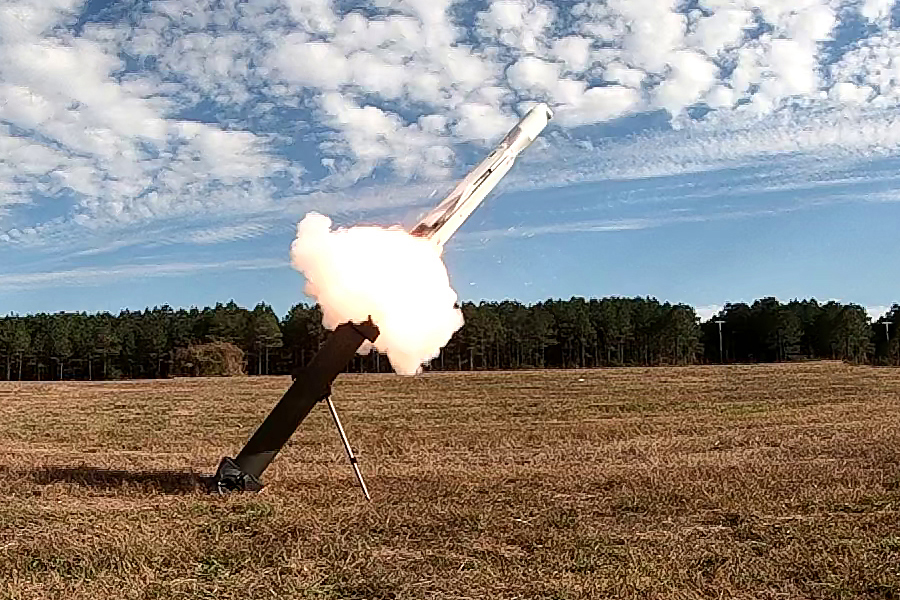
UVision Hero-120 and canister launcher
The Hero-120 is relatively small.It is shipped and stored in a cannister that is also its launcher.
Weight: 12.5 kg (27.6 pounds) Warhead: 4.5 (10 pounds) Range: 40 km (21.6 nautical miles) Endurance (min): 60 Engine: Electrical
The Long Range Unmanned Surface Vessel (LRUSV) is being built by Metal Shark and apparently uses the hull of the Navy’s new 40 foot patrol boat.
While I think these weapons have a place on most of the larger Coast Guard patrol craft, for the purpose of destroying small, fast, highly maneuverable craft that might be used in a terror attack, they really look like a good upgrade for the Webber class being deployed to Bahrain.
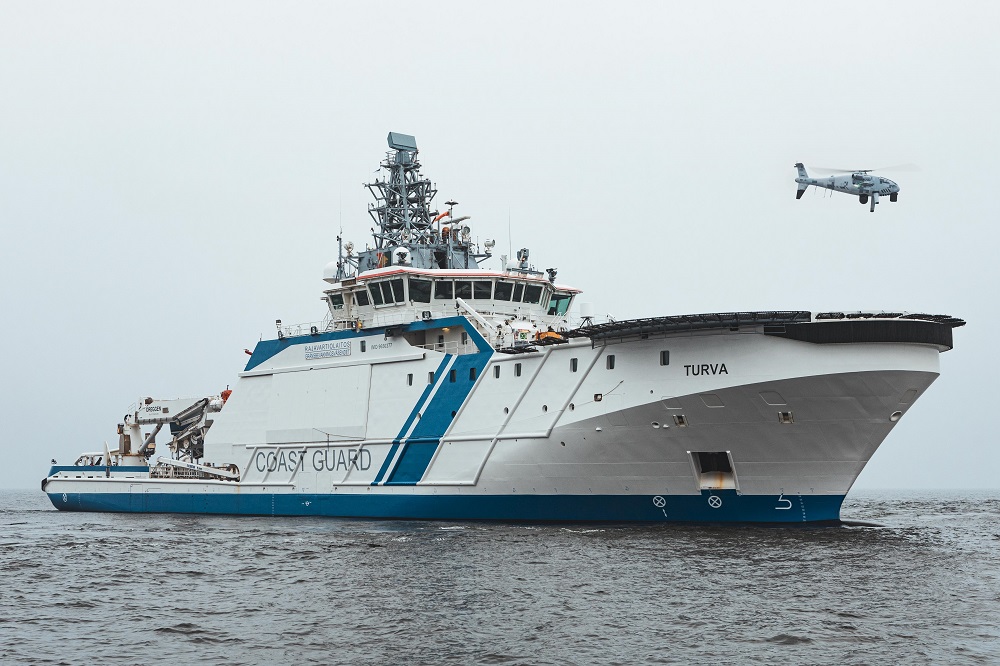
A short post in Naval News that reported the deployment of a Schiebel Camcopter UAS on a Finnish Coast Guard Cutter prompted me to look up the cutter involved, and it proved interesting for a couple of reasons,
its unique propulsion system and
the fact that it can break ice in spite of a bulbous bow.
Wartsila.com provides the information (excerpt below).
“TURVA is powered by three environmentally friendly Wärtsilä 34DF series dual-fuel engines capable of burning both diesel fuel as well as liquefied natural gas (LNG). For redundancy and safe return to port, the engines are arranged in two independent engine rooms divided by a watertight bulkhead. In the aft engine room, a 12-cylinder Wärtsilä 12V34DF producing 6400kW is mechanically coupled to a controllable pitch propeller. In the forward engine room, two 6L34DF generating sets with an output of 3000kW each produce power for two electrically-driven Azipull AZP120CP thrusters. If the forward engine room is damaged, the shaft generator coupled to the bigger engine can be used to produce electricity for the azimuth thrusters, which are required for steering the vessel as she has no separate rudders, and other onboard systems. Since the azimuth thrusters are powered by electric motors and the centerline shaft is mechanically coupled to the main engine, the propulsion system as a whole could be referred to as “combined diesel-electric and diesel” (CODLAD). TURVA is the first ship fitted with this type of propulsion arrangement – two azimuth thrusters and a centerline shaft – which was originally developed for icebreakers and icegoing LNG carriers. For maneuvering and DP2 class dynamic positioning, the ship has a transverse bow thruster and a retractable azimuth thruster in the bow.
“The service speed of the vessel will be 18 knots and despite her bulbous bow she will also be capable of breaking level ice up to 0.80m in thickness. With a bollard pull of approximately 100t, TURVA is capable of towing even the largest tankers regularly sailing in the Baltic Sea.“



 Chuck Hill's CG Blog