A reminder this blog is about Coast Guard operations and issues. It is not about politics. Support or neglect of the US Coast Guard has been nonpartisan. We have seen both from both parties. Generally the administrations have been parsimonious and the Congress has been more generous, regardless of party.
The wisdom of individual decisions is certainly fair game for discussion, but recently I have had to delete some comments that contained gross generalizations.
New Orleans, September 5, 2005 – A Disaster Medical Assistance Team member (left) assures a rescued man that the trip to the airport will be safe. Thousands of people were airlifted from the Ernest N. Morial Convention Center pickup site to the New Orleans Airport every day. Photo by Win Henderson / FEMA photo.
Sea Technology discusses a cooperative effort to use small Unmanned Air Systems to facilitate Disaster response.
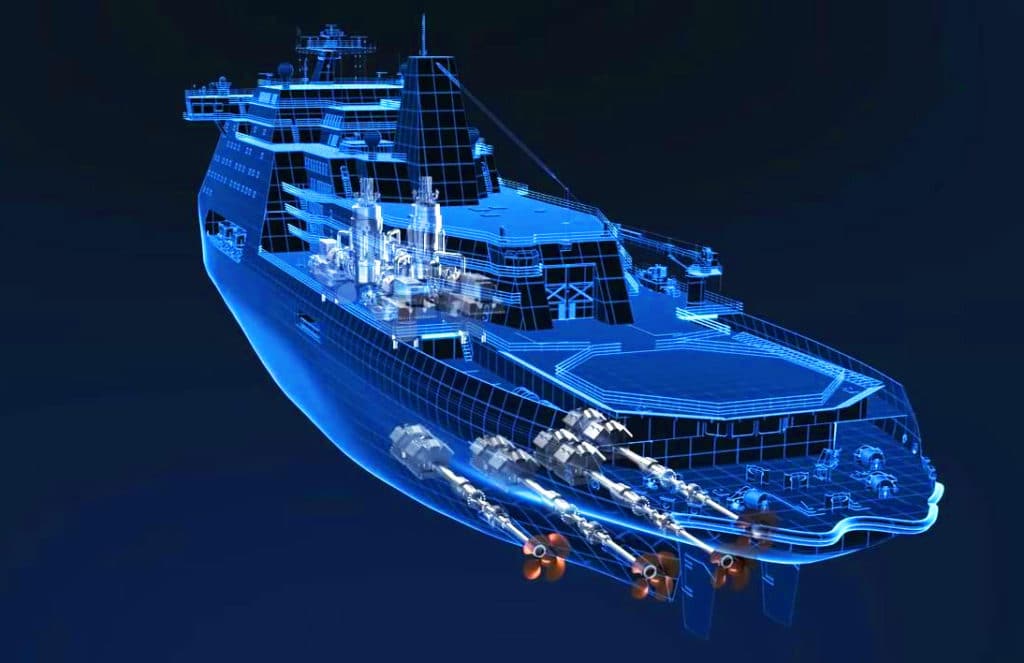
Note the two nuclear reactors are located high in the ship.
Naval News reports the first of the Russian Project 10510 Leader-class Nuclear-powered Icebreakers has been laid down. These ships dwarf the Polar Security Cutters. But perhaps of equal significance is that the new commercial shipyard where they are being built is on Russia’s Pacific coast.
Compared to the Polar Security Cutters (PSC), they are truly monsters, built with an eye to keeping the Northern Sea Route open year round. Not only are they far larger than any Coast Guard icebreaker, they are about twice as large and twice as powerful as the largest icebreakers currently in service, the nuclear powered Project 22220 Arktika class icebreakers.
The Leader class, Project 10510 icebreakers are 209 metres (686 ft) long and have a beam of 47.7 metres (156 ft). They draw 13 metres (43 ft) of water and have a displacement of about 69,700 tonnes (68,600 long tons). Their four electric motors will provide 120 MW (160,923 HP)
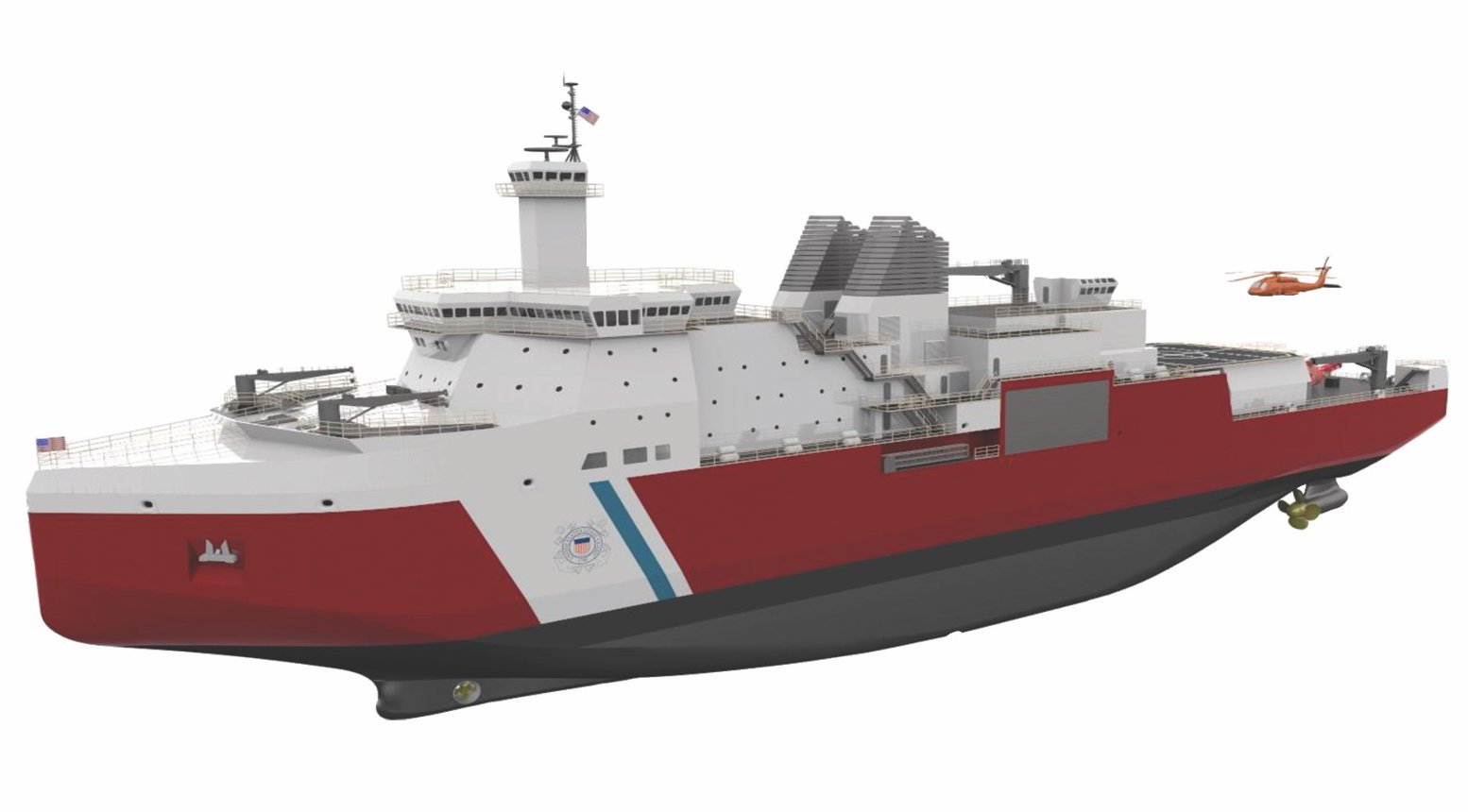
The PSCs are 460 ft (140 m) long and have a beam of 88 ft (27 m). PSCs will displace 22,900 long tons (23,300 t). The PSCs’ two Azipods and diesel electric center shaft will provide just over 45,000 HP.
While the PSCs should be able to break through ice of 6.5 feet (2.0 m) at a continuous speed of 3 knots, the Leader class will reportedly be able to maintain ten to eleven knots in the same conditions.
Zvezda-DSME shipyard. Photo from Russian.dissident via Wikipedia.
Significantly the shipyard in Bolshoi Kamen, on the Sea of Japan, near the Chinese and North Korea borders, where the Leader class are being built, is the Zvezda-DSME shipyard. DSME, Daewoo Shipbuilding Marine Engineering, is a South Korean company and one of the largest shipbuilding firms in the world. They are also a major defense contractor, building not only ships for the South Korean Navy but also submarines for Indonesia and underway replenishment vessels for the United Kingdom and Norway. They also built 15 LNG icebreaker/tanker ships for the Russians to use in the Arctic.
Real Clear Defense provides a look at the increasing likelihood that Antarctica will become a region of great power competition. Their conclusion,
“Antarctica can no longer rely on its distance to protect itself from the calculus of states. Trends including great power competition, expansion both of and into the grey zone by many actors, the fragility of international law, and mounting resource crises all mean that long-held assumptions around Antarctic geopolitics are being challenged. Meanwhile, its harshness and physical distance are posing less and less of an obstacle to interested parties. After centuries of international neglect, Antarctica’s isolation may have set the stage for a hard pivot in global interest. Discarding these holdover assumptions will be important to recalibrate our understanding of the region’s strategic relevance. Without reform to the Antarctic Treaty system, and great powers assuming collective responsibility, Antarctica could even become a potential catalyst for outright conflict.”
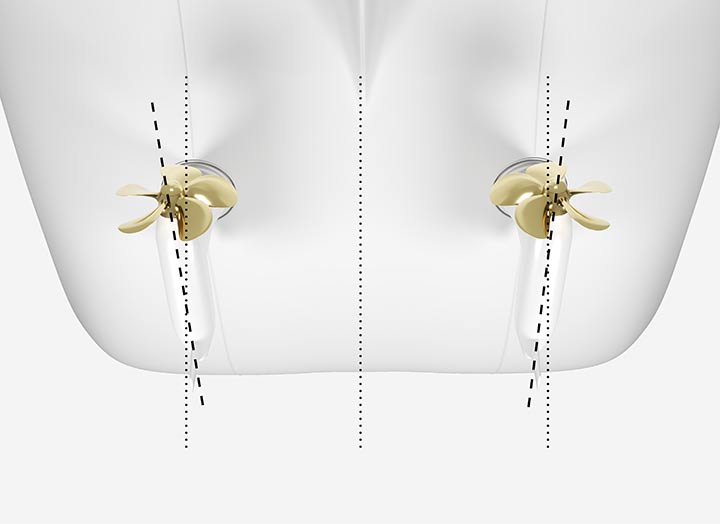
OptimE automatically selects the optimal steering angle for Azipod propulsion [Image: ABB]
Marine Log reports an additional refinement that is being applied to the software control for Azipods. Sounds a bit like toe-in on your car. And its something you can’t adjust dynamically with conventional shafts.
“Called ABB Ability OptimE – Toe Angle Optimization for Propulsion, the solution automatically selects the optimal steering angle for the Azipod system. ABB says that with OptimE, further fuel savings of up to 1.5 percent can be achieved depending on a ship’s operating profile. These savings are in addition to Azipod propulsion’s ability to cut fuel consumption by up to 20 percent when compared with a traditional shaftline setup.”
I would add that conventional propeller shafts are a weak point in ship damage survivability as well, in that, when damaged, they can open up avenues for progressive flooding that may extend half the length of the ship.
The Congressional Research Service has once again updated their look at the Polar Security Cutter (heavy icebreaker) program. (See the latest version here.)
While hindsight suggest that it should have been started much earlier, it seems the program, at least in Congress, is on track with bipartisan support. The first two ships have been funded, and the FY2022 budget includes money for long lead time items for number three.
Until recently the Coast Guard had been justifying the program based on a 2010 “High Latitude Mission Analysis Report” (my summary here) which indicated a requirement for three heavy and three medium icebreakers for the Coast Guard to complete its statutory missions. There have been suggestions that the total of six icebreakers should include four or even six heavy icebreakers, but,
“Starting in January 2021, Admiral Karl Schultz, the Commandant of the Coast Guard, has stated publicly that the Coast Guard would ideally like to have a fleet of six PSCs and three new medium polar icebreakers (which the Coast Guard in late 2020 began referring to publicly as Arctic Security Cutters, or ASCs), for a total fleet of nine PSCs and ASCs.” (p.4)
Reported Delay in Construction Start on First PSC?:
We know Halter Marine had to reinforce some of their facilities, because the Polar Security Cutter will be, on the basis of weight/length, the heaviest vessel they have ever built. But lately, there has been a report, that start of construction has been substantially delayed, and it is unclear if this will impact the planned delivery date.
“Another potential issue for Congress concerns a reported delay in the start of construction of the first PSC. A June 28, 2021, press report states:
“Cutting of steel on the first new Coast Guard heavy polar icebreaker could happen in the coming months, which is close to a year later than originally expected, but the forecast to start production still appears hazy.
“Coast Guard Commandant Adm. Karl Schultz said on Monday [June 28] that “They tell me we should be cutting steel on the first articles here in the coming months, so, hopefully there is steel cutting this year and contractually…we’re on contract for that ship [in] late ’24.”…“
“The Coast Guard originally had expected the first PSC to be delivered in the first half of 2024 the potential to accelerate delivery into late 2023. That appears unlikely now given that the start of construction appears to be about a year behind schedule.” (p.13)
Aerial view of Kotzebue, Alaska, U.S., U.S. Army Corps of Engineers, photographer not specified or unknown
Below is a District 17 news release in full. Kotzebue is located just North of the Arctic Circle.
News Release
U.S. Coast Guard 17th District Alaska
Coast Guard opens seasonal forward operating location in Kotzebue, Alaska
Editors’ Note: Click on image to download high resolution version.
JUNEAU, Alaska — Coast Guard Air Station Kodiak crews opened a seasonal forward operating location today in Kotzebue.
Air Station Kodiak aircrews transferred aviation airframes and equipment to Kotzebue to reduce response time to the Bering Strait and Northern Slope regions in anticipation of historically increased maritime activity in that region during summer operations.
“Establishing forward operating locations helps us mitigate many of the major challenges we face when operating in the Arctic, including the environment, vast distances, and limited infrastructure,” said Cmdr. Molly Hayes, Operation Arctic Shield operational planner. “Pre-staging flight crews from Air Station Kodiak saves critical time and resources when conducting missions in the Arctic region.”
In support of Arctic Shield 2021 operations, aircrews operate out of the forward operating location, where they provide coverage to the entire northwestern portion of Alaska. Operation Arctic Shield is the Coast Guard’s rapid and proactive mobilization of resources focused on performing the service’s 11 statutory missions throughout the Arctic to ensure maritime safety, security, and stewardship. It is an annual operation that began in 2009.
Sri Lanka Navy Offshore Patrol Vessel SLNS Gajabahu (P-626)the former USCGC Sherman
For those that might we wondering what has happened to those 378s we transferred to other navies and coast guards, here is a glimpse of the former USCGC Sherman participating in an exercise, as reported by the US Naval Institute News Service.
Participants included, in addition to Sri Lanka’s SLNS Gajabahu (P626), formerly USCGC Sherman (WHEC-720), transferred to Sri Lanka Navy in August 2018, Indian-built SLNS Sayurala (P623), the Sri Lankan Air Force, JMSDF Asagiri-class destroyer JS Yuugiri, USS Charleston (LCS-18), a USN P-8 maritime patrol aircraft, and an MH-60S attached to Charleston.
MetalCraft Marine 7 meter “The Watcher” Autonomous Surface Vessel (ASV)
Back in November 2020 we learned about a month long evaluation of unmanned surface systems. Now we have more information on one of the two systems tested.
BairdMaritime reports on the 22 foot (6.7 m) “The Watcher” autonomous surface vessel that is said to be capable of operating autonomously for up to 30 days. Three-liter Volvo 220 HP (164 kW) diesel inboards propel it up to 1,800 nautical miles, while solar panels power the electronics.
MetalCraft Marine 7 meter “The Watcher” Autonomous Surface Vessel (ASV)
This report is part of BairdMaritimes “Welcome to USA Week!” look at the US maritime industry. Check it out.
MetalCraft Marine 7 meter “The Watcher” Autonomous Surface Vessel (ASV)
News Release below. Quite an uptick in recreational boating deaths and injuries.
News Release
U.S. Coast Guard Headquarters
U.S. Coast Guard releases 2020 Boating Safety Statistics Report
WASHINGTON — The U.S. Coast Guard released its 2020 Recreational Boating Statistics Report Wednesday, revealing that there were 767 boating fatalities nationwide in 2020, a 25.1 percent increase from 2019.
From 2019 to 2020, the total number of accidents increased 26.3 percent (4,168 to 5,265), and the number of non-fatal injured victims increased 24.7 percent (2,559 to 3,191). There is evidence that boating activity increased significantly during the pandemic, from reports of increased boat sales, insurance policies taken out, insurance claims, and calls for towing assistance. With the increased exposure (i.e., more boating hours), there was greater risk of deaths, injuries, and accidents. The Coast Guard is analyzing variables associated with boating activity to normalize this accident data.
Alcohol continued to be the leading known contributing factor in fatal boating accidents in 2020, accounting for over 100 deaths, or 18 percent of total fatalities.
The report also shows that in 2020:
The fatality rate was 6.5 deaths per 100,000 registered recreational vessels, the highest in the program’s recent history. This rate represents a 25 percent increase from last year’s fatality rate of 5.2 deaths per 100,000 registered recreational vessels.
Property damage totaled about $62.5 million.
Operator inattention, operator inexperience, improper lookout, excessive speed, and machinery failure ranked as the top five primary contributing factors in accidents.
Capt. Scott Johnson, chief of the Office of Auxiliary and Boating Safety at Coast Guard Headquarters, reflected on a number of cases where boaters had recently purchased the vessel involved in the incident, but had not taken many of the proper safety precautions before getting underway.
Where the cause of death was known, 75 percent of fatal boating accident victims drowned. Of those drowning victims with reported life jacket usage, 86 percent were not wearing a life jacket.
“It’s crucial for boaters to wear a life jacket at all times because it very likely will save your life if you enter the water unexpectedly,” said Johnson. “The Coast Guard reminds boaters to make sure that life jackets are serviceable, properly sized, and correctly fastened.”
Where boating instruction was known, 77 percent of deaths occurred on vessels where the operator had not received boating safety instruction. The Coast Guard recommends that all boaters take a boating safety course that meets the National Boating Education Standards prior to getting out on the water.
The most common vessel types involved in reported accidents were open motorboats, personal watercraft, and cabin motorboats. Where vessel type was known, the vessel types with the highest percentage of deaths were open motorboats (50 percent), kayaks (15 percent), and pontoons (9 percent).
The report is based off on incidents that resulted in at least one of the following criteria: death, disappearance, injury that required medical treatment beyond first aid, damages to the vessel(s) or other property that equaled or exceeded $2,000, or a loss of vessel.
The Coast Guard reminds all boaters to boat responsibly on the water: wear a life jacket, take a boating safety course, attach the engine cut-off switch, get a free vessel safety check, and boat sober.
“The Coast Guard thanks our boating safety partners,” said Johnson, “they continue to demonstrate a committed effort to reduce loss of life, injuries and property damage through education and enforcement.”









 Chuck Hill's CG Blog