Aerial view of the Port of San Diego with three cruise ships in Port, from Oct. 4, 2012. Port of San Diego photo
This is a story about an alien migrant smuggling attempt, but that they were not interdicted earlier, says something about our Maritime Domain Awareness.
Why did they get all the way to the Cabrillo National Monument at the tip of Point Loma without being interdicted?
San Diego is something of a special case in terms of Maritime Domain Awareness, in that the distance from the entrance to San Diego harbor, with its cruise ships and Major US Navy bases, where there are aircraft carriers and nuclear submarines, to the Mexican territorial sea is less than ten nautical miles.
Reportedly the law enforcement is beefing up its resources to interdict migrants, but let us not forget that terrorists can also make this trip in less than an hour, so we really need constant vigilance and a ready response.
Below is a story from the Acquisitions Directorate (CG-9) web site.
—-
April 29, 2021 —
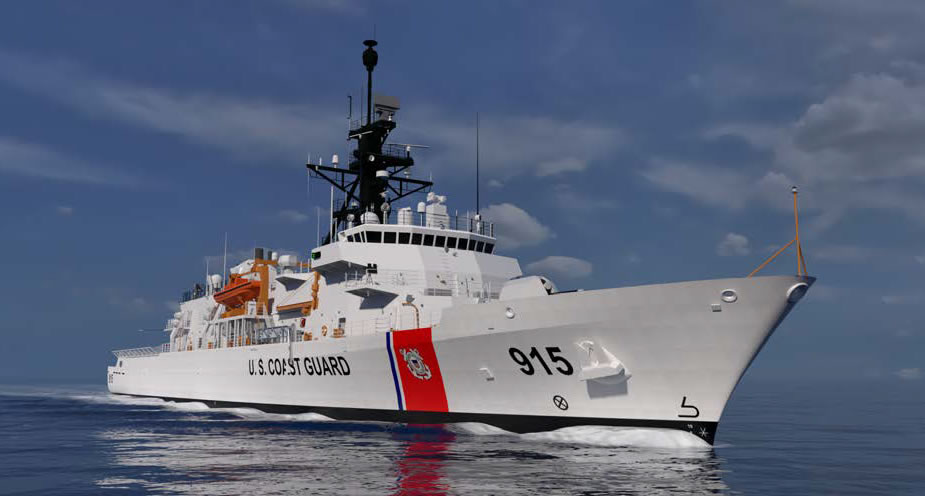
The Coast Guard modified its contract with Eastern Shipbuilding Group (ESG) today to begin construction of the third offshore patrol cutter (OPC) and to acquire long lead-time material (LLTM) for the fourth OPC. Contract delivery of the third OPC, to be named Ingham, is scheduled to occur in 2024. Total value of this contracting action is $356.5 million.
In addition to ordering the construction and supporting deliverables for the third OPC, this contracting action also covers the initial order of long lead-time components and materials necessary to support the future construction of the fourth OPC by acquiring propeller and steering components, marine diesel engines, the ship integrated control system, switchboards and generators.
The lead and second OPCs are currently in production at ESG’s shipyard in Panama City, Florida. Contract delivery of the lead OPC, Argus, is scheduled for 2022. Contract delivery of the second OPC, Chase, is scheduled for 2023.
The OPC meets the service’s long-term need for cutters capable of deploying independently or as part of task groups and is essential to stopping smugglers at sea, interdicting undocumented migrants, rescuing mariners, enforcing fisheries laws, responding to disasters and protecting our ports. The acquisition of up to 25 OPCs will complement the capabilities of the service’s national security cutters, fast response cutters and polar security cutters as an essential element of the Department of Homeland Security’s layered maritime security strategy. In accordance with direction from the Department of Homeland Security, the Coast Guard previously modified the contract to limit ESG’s current production to a maximum of four OPCs. The service is pursuing a full and open competition for Stage 2 design and construction of up to 11 OPCs and anticipates awarding a follow-on contract in early 2022.
Wind Farm and Response Boat-Medium off Block Island (Source)
gCaptain reports on aspects of the Coast Guard I don’t usually discuss here, but they is no denying their importance to the health of the nation’s economy. These include renewable energy sources, alternative fuels, unmanned vessels and aircraft, and cyber security.
An Academy news release. Sounds like two cruises, a long almost 11 week cruise, probably 1st and 3rd class, followed by a short cruise of less than three week for the incoming 4th class and the 2nd class.
News Release, U.S. Coast Guard Academy Coast Guard Cutter Eagle to depart New London for summer training NEW LONDON, Conn. — The U.S. Coast Guard Cutter Eagle is scheduled to depart New London to begin summer training for more than 130 U.S. Coast Guard Academy cadets on Saturday, May 8. At 295 feet in length, the Eagle, known as “America’s Tall Ship,” is the largest tall ship flying the stars and stripes and the only active square-rigger in U.S. government service.
“We are extremely excited to be getting back underway for a full summer training season,” said Capt. Michael Turdo, Eagle’s commanding officer. “The opportunity to sail abroad allows us to represent the Coast Guard and the United States to the public and international community.”
Specific port call dates this summer are:
May 25–28: Azores, Portugal June 11–16: Reykjavik, Iceland July 7–10: Hamilton, Bermuda July 23–26: New London, Conn. July 30–August 2: Newport, R.I. August 6–9: Portland, Maine August 13–14: New London, Conn.
Constructed in 1936 by the Blohm and Voss Shipyard in Hamburg, Germany, and originally commissioned as the Horst Wessel by the German Navy, the Eagle was taken by the United States as a war reparation following World War II.
With more than 23,500 square feet of sail and six miles of rigging, the Eagle has served as a classroom at sea to future Coast Guard officers since 1946, offering an at-sea leadership and professional development experience.
A permanent crew of nine officers and 49 enlisted personnel maintain the ship and guide the trainees through an underway and in-port training schedule, dedicated to learning the skills of navigation, damage control, watchstanding, engineering and deck seamanship.
To follow the Eagle’s summer cruise, visit the ship’s Facebook page here.
USCGC Robert Goldman (WPC 1142) arrives in Athens, Greece on April 26, 2021
Below is an Atlantic Are News Release. The Cutters making this transit seem to be trying to maximize their impact.
Might want to be on their toes when they transit the Bab el Mandeb Straits at the South end of the Red Sea, near Yemen. There are people there that do not like us.
U.S. Coast Guard visits partners in Athens, Greece
ATHENS, Greece — The Sentinel-class fast response cutters USCGC Charles Moulthrope (WPC 1141) and USCGC Robert Goldman (WPC 1142) arrived in Athens for a routine logistics visit and key leader engagements, April 29, 2021.
“A common theme discussed throughout our engagements with the Hellenic Coast Guard, government, and industry leaders is the long-standing history of cooperation between the United States and Greece, particularly in the maritime sector. The exercises and exchanges between our crews and the Hellenic Coast Guard continued this tradition of partnership between both nations,” said Lt. Cmdr. Steve Hulse, commanding officer of Charles Moulthrope.
This port visit marks the cutters’ third stop while conducting operations in the U.S. Sixth Fleet region en route to their new homeport of Manama, Bahrain.
“It was a pleasure working alongside our Greek partners, celebrating the 200th anniversary of their independence, and gaining an understanding of the similarities in our services’ missions and responsibilities,” said Lt. Cmdr. Samuel Blase, commanding officer of Robert Goldman.
The Moulthrope and Goldman Athens stop highlights the enduring partnership between the United States and Greece. It also provided exchanges between U.S. Coast Guard members and the Hellenic Coast Guard and Greek ministries before a planned underway exercise. The joint effort enhances the collective ability to respond to any number of maritime threats and challenges and builds familiarization across services.
“I’m very happy to welcome the U.S. Coast Guard fast response cutters Robert Goldman and Charles Moulthrope to the port of Piraeus following their historic transatlantic voyage in support of Operation Trailblazer,” said U.S. Ambassador to Greece Geoffrey R. Pyatt. “For 200 years, the United States and Greece have stood shoulder-to-shoulder to uphold our shared democratic values and promote peace and stability in the region. Maritime ties have been at the heart of that relationship, starting with the relief ships that sailed from New England to Greece in the 1820s and continuing to the global partnership today between the U.S. Coast Guard and Greek shipping.”
The U.S. Coast Guard worked with the Greek navy earlier this year in the Arabian Gulf under U.S. Naval Forces Central Command. The Greek ship HS Hydra joined cutters and patrol boats of the U.S. Coast Guard Patrol Forces Southwest Asia to operate alongside the two NATO partners. The U.S.-Greece relationship dates back more than 200 years, emphasizing democracy, partnership, and shared values.
“The Coast Guard compliments efforts from the Navy and Marine Corps by providing critical security expertise in shallow water environments, specializing in law enforcement missions and techniques,” said Rear Adm. Wayne Baze, director, Maritime Headquarters, U.S. Sixth Fleet. “Moulthrope and Goldman’s operations follow the aircraft carrier USS Eisenhower’s (CVN 69) visit to Souda Bay and work with the Hellenic Navy and Air Force. This dedicated, steady partnership demonstrates our shared commitment to security and stability across the entire maritime operations spectrum.”
Moulthrope and Goldman are en route to their new homeport in Bahrain to support the Navy’s U.S. Fifth Fleet and U.S. Coast Guard Patrol Forces Southwest Asia. While in the U.S. Navy’s Sixth Fleet area of responsibility, the crews will support engagements with partner countries strengthening relationships and demonstrating our continued commitment to global maritime security and stability.
Moulthrope and Goldman are the first two of six Sentinel-class ships headed to U.S. Patrol Forces Southwest Asia (PATFORSWA). Established in 2002 to support Operation Iraqi Freedom, PATFORSWA played a critical role in maritime security and maritime infrastructure protection operations. It is the U.S. Coast Guard’s largest unit outside of the United States.
The U.S. Coast Guard remains operational during COVID-19, following all COVID-19 safety precautions and regulations.
U.S. Sixth Fleet, headquartered in Naples, Italy, conducts the full spectrum of joint and naval operations, often in concert with allied and interagency partners, to advance U.S. national interests and security and stability in Europe and Africa.
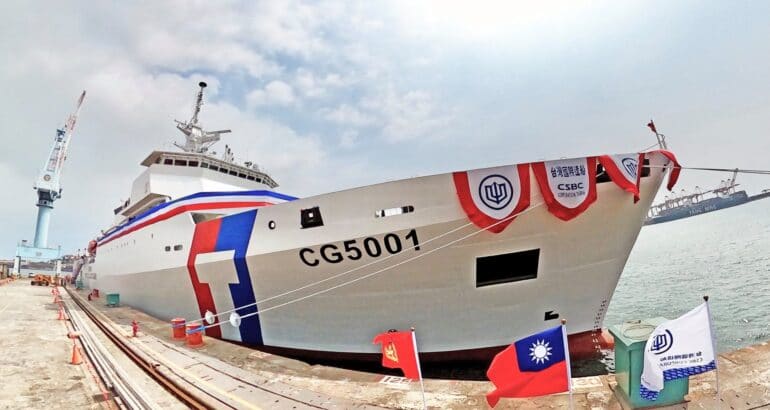
Taiwan Coast Guard Administration (CGA) commissioned it largest ship to date: The 4000-ton class “Chiayi” (CG5001). CGA picture.
Like many South East Asian countries, Taiwan is rapidly expanding its Coast Guard fleet. Naval News reports progress on their ambitious program. The same day the first of this new class of cutters was delivered, the second of the planned class of four was named and launched.
The class is nominally 4000 tons, but as is frequently the case in Asia, the displacement is understated. These ships are over 5000 tons full load and consequently larger than the Bertholf class National Security Cutters.
The use of a rocket launcher as main armament is unusual. They also have provision for mounting anti-ship cruise missiles. I have more information on these ships in an earlier post.
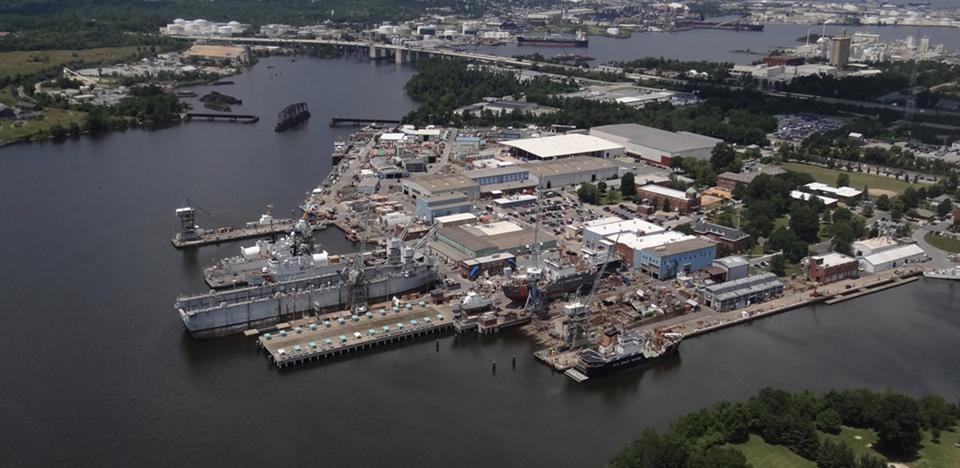
“As Navy backers in Congress introduce the “SHIPYARD” Act, legislation to fully fund a 20-year, $21 billion plan that recapitalizes the Navy’s four public shipyards, America’s fifth taxpayer-owned shipyard, the low-profile Coast Guard Yard, risks being left out in the cold, with no extra funding. Operated by the Department of Homeland Security in Maryland’s 2nd Congressional District, the shipyard supports the U.S. Navy fleet, consistently completing high quality repair work, and, unlike the four Navy yards, the Coast Guard Yard is getting their repair projects done on time and on budget.”
I think their next major refit project will be the service life extension program for six 270s.
The CG Yard has done construction work in the past including five of the 210 foot WMECs. Would be nice to see them building Offshore Patrol Cutters in parallel with the private yard chosen for the second phase of the OPC program. We really need to build this class faster than currently planned.
Crewmembers aboard the U.S. Coast Guard cutter USCGC Adak (WPB-1333) raise the American flag. Adak is assigned to CTF 55, supporting maritime security operations and theater security cooperation in the U.S. 5th Fleet area of responsibility. U.S. Coast Guard photo by Seaman Frank Iannazzo-Simmons
Two bits of news about USCGC Adak, one of the 110s currently assigned to Bahrain as part of PATFORSWA.
First, it is to be sold to Indonesia in three days. Not surprising considering the first two of six Webber class intended to replace the six Island class cutters should be there any time now.
Second, there is a move afoot to try to retain Adak as a museum ship because of her role in the evacuation of Manhattan following the attack on 9/11.
Have to say I have mixed feelings about this. At this late date, if we back out of the deal with Indonesia, it might be viewed badly by a nation we want to help and maintain good relations with. Substituting one of the other cutters might suffice, but ultimately all these boats are probably going to allies in the Pacific. There they can continue to do good work.
I have also seen too many attempts to keep museum ships that have foundered leaving the ship derelict. There is also the fact that the evacuation was such a massive effort by mariners of all kinds that I almost feel focusing on the Coast Guard’s efforts diminishes recognition of the scope of the effort.
On the other hand, if any 110 should be preserved, Adak is an excellent choice, given her role in 9/11, the Gulf War, and PATFORSWA.
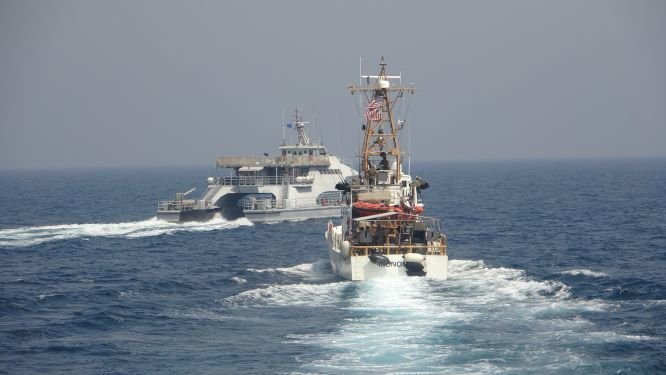
Photo from the previous incident: Iran’s Islamic Revolutionary Guard Corps Navy (IRGCN) Harth 55, left, conducted an unsafe and unprofessional action by crossing the bow of the Coast Guard patrol boat USCGC Monomoy (WPB-1326) on April 2, 2021. US Navy Photo
At 8 p.m. local time on Monday, a trio of fast inshore attack craft belonging to the Islamic Revolutionary Guard Corps Navy (IRGCN) quickly approached Cyclone-class patrol coastal ship USS Firebolt (PC-10) and U.S. Coast Guard patrol boat USCGC Baranoff (WPB-1318), coming within 70 yards of the U.S. vessels operating in international waters, according to a statement from U.S. 5th Fleet.
“The U.S. crews issued multiple warnings via bridge-to-bridge radio and loud-hailer devices, but the IRGCN vessels continued their close-range maneuvers. The crew of Firebolt then fired warning shots, and the IRGCN vessels moved away to a safe distance from the U.S. vessels,” reads a Tuesday statement from U.S. 5th Fleet.
Unlike the earlier day light incident, this one happened in the early evening.
The following is copied from MyCG. Looks like this my be a very important change in the long run.
Reserve aviation workforce roll-out
By Cmdr. Marc McDonnell, Office of Aviation Forces
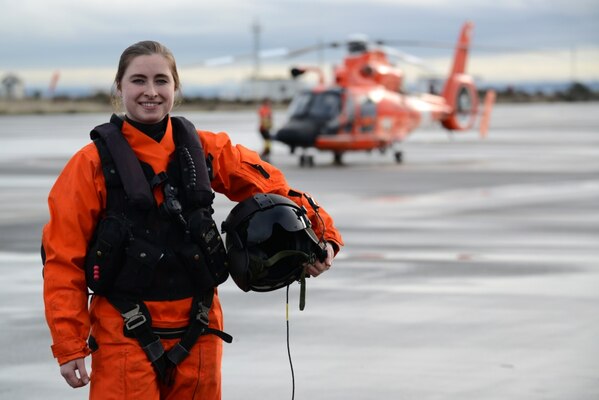
Coast Guard Petty Officer 3rd Class Amber Brewer, an aviation maintenance technician, Air Station Port Angeles, Wash., poses for a picture on the the flight line in front of an MH-65 Dolphin Helicopter, Jan. 26, 2018. Brewer not only maintains the readiness of the aircraft, but is also a qualified flight mechanic responsible for overseeing the mechanical safety of the helicopter and conducting the essential hoisting operations conducted during rescue swimmer deployments. U.S. Coast Guard photo by Chief Petty Officer David Mosley
April 27, 2021 —
The reserve component delivers tremendous value to the Coast Guard and is, without question, key to the Coast Guard’s long history of operational success. Yet, Coast Guard aviation, one of our service’s largest communities, is not represented in the reserve. With over 4,000 enlisted personnel and over 1,000 officers in aviation, there is a tremendous opportunity for the Coast Guard to develop a new capability in the reserve that directly supports our missions and our people.
To remedy this capability gap, the Office of Aviation Forces and the Coast Guard reserve are working to develop the reserve aviation workforce. With a target start date of Summer 2021, the initiative will start by making 50 billets available to enlisted aviation personnel (E-4 to E-6) who are separating from active duty. The motivation for developing this workforce is simple: enable our aviation personnel to continue their chosen career path in the reserve, retain aviation technical expertise, and develop an aviation surge and mobilization capability.
Capability and Integration
The new reserve aviation workforce will focus on providing ground-based aviation maintenance and support equipment maintenance. The reservists will drill under traditional SELRES drilling requirements and be available for mobilization. Flight status designation will remain under the authority of the local air station’s commanding officer, but this is envisioned only as long-term support mechanism. Historically, aviation mobilization has been 100% supported by our active-duty members and multi-day surge operations required duty-grid shuffles to both support the surge op and sustain the unit’s search and rescue readiness requirements. In the future, aviation reservists will help meet the surge mobilization request by either responding directly or backfilling home units. The key to the successful implementation of the workforce is already part of the Coast Guard’s DNA with aviation’s commitment to standardization and the reserve’s philosophy of integration. In aviation, integrating mixed crews from multiple air stations is already normal ops for surge events; mobilizing reservists to integrate with active duty maintenance teams will become a welcomed and standard practice.
Delivering Value and Next Steps
This will be a culture shift for our hangar decks and wardrooms. To aid in the workforce’s rollout, Aviation Forces and the Deputy Commandant for Mission Support will schedule training events to ensure our new reserve personnel and air stations are well prepared. We believe that the workforce will retain valuable aviation expertise, deliver on our duty to people commitment, and increase the flexibility of aviation to overcome future challenges.
Author’s note: The Office of Aviation Forces is also working to establish reserve aviator (pilot) billets in FY22. These aviator positions will require SELRES drilling requirements of 60 to 72 days. Locations for these billets have not been finalized, but they will support flight training at Naval Flight School and operational missions at Coast Guard air stations.




 NEW LONDON, Conn. — The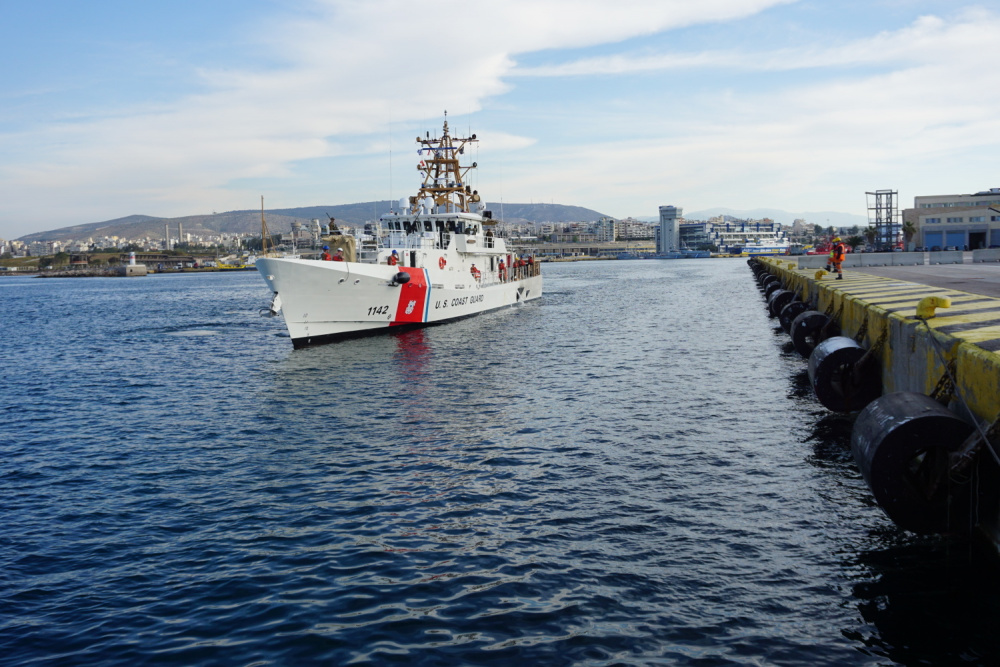



 Chuck Hill's CG Blog