30mm Mk38 Mod4

30mm Mk38 Mod4

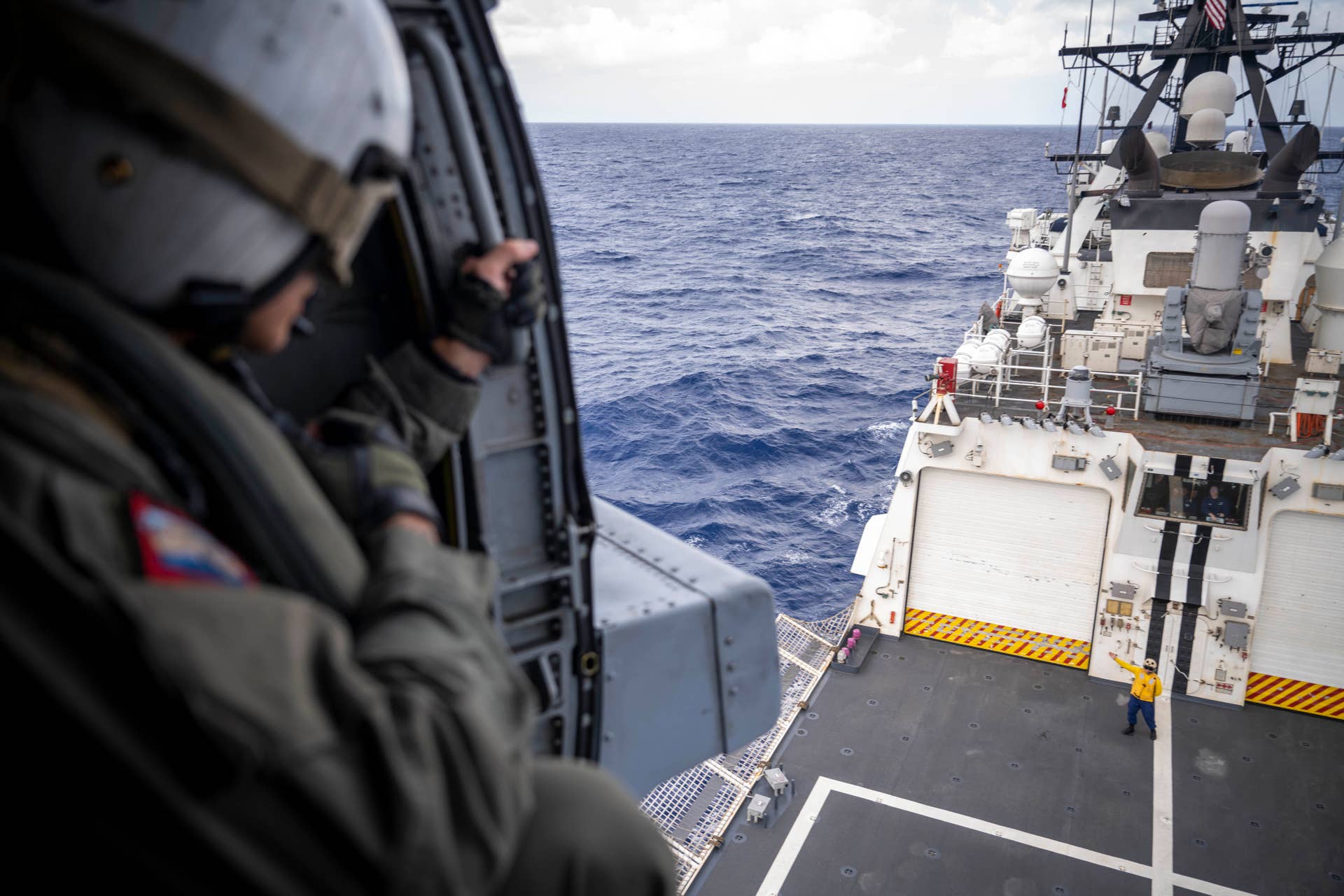
The Navy has decided to replace the 25mm Mk38 gun mounts on Burke class guided missile destroyers with the 30mm Mk38 Mod4. They have completed their first installation. (Marines are also likely to upgrade to the 30mm.)

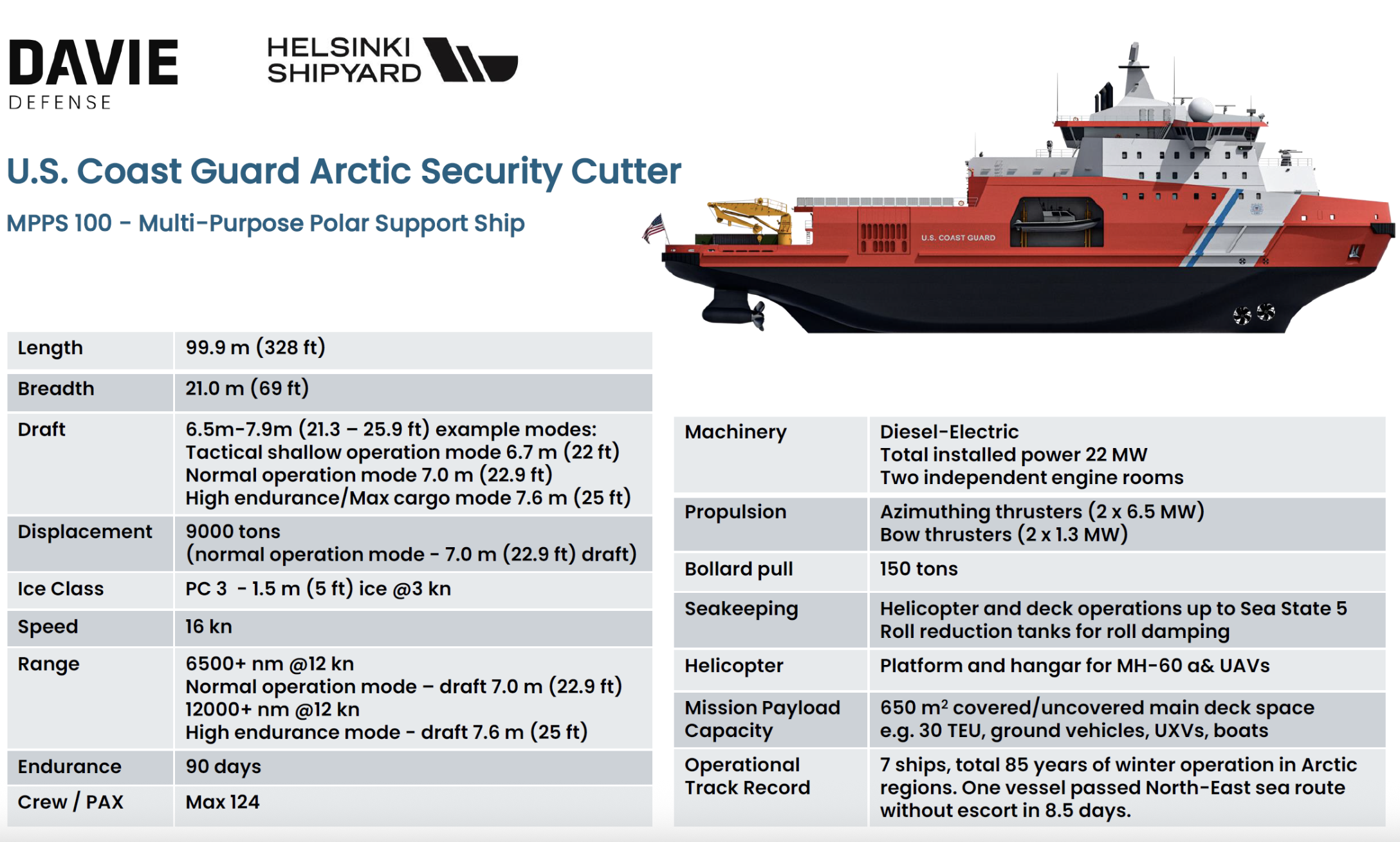
We have heard the Polar Security Cutter will get the 30mm Mk38 Mod4 but so far no indication other Coast Guard classes will get the weapon.

I would like to see all Coast Guard Cutters armed with the 30mm because unlike the 25, the 30mm can fire an air burst round that is effective against UAS. In addition the 30mm is also significantly more effective against small craft than the 25mm (“nine times the damage to the hull and five times the damage inside the hull”).

“The MK38 MOD4 Machine Gun System (MGS) is an upgrade to the MK38 MOD3 MGS to address deficiencies in meeting Counter Unmanned Aerial Systems (C-UAS) requirements. In addition, the upgrade will also improve performance against surface targets and maintain Anti-Terrorist / Force Protection capabilities. This system will be composed of the MK48 MOD2 Electro-Optical Sight System (EOSS), MK88 MOD4 Gun Mount (GM) and the MK134 MOD0 Console. This contract is to procure the MK88 MOD4 GM and the other components will be procured separately. The system is intended for installation aboard the U.S. Navy and U.S. Coast Guard vessels.”

The Mod4 is significantly different from the earlier Mod 2 and 3 in that the earlier units had the electro-optics mounted on the gun mount. In the case of Mod4, the electro-optics are mounted separately.

MK 48 MOD 2 electro-optical sight system (EOSS)

It might be assumed that any future installations will be the new 30mm, but replacing two of the earlier mods on over 70 DDGs with Mod4s will free up a lot of earlier Mod2 and Mod3 gun mounts. I am afraid the Coast Guard will continue to get 25mm gun mounts for their FRCs and OPCs unless we make a strong case for the 30mm.

“USCGC Myrtle Hazard returns home after Operation Blue Pacific patrol to combat illegal fishing, deepen regional cooperation”

The USCGC Myrtle Hazard (WPC 1139) crew departs Guam for Honolulu on May 13, 2024, marking a significant milestone as the crew prepare for the first drydock maintenance period of approximately four and a half months. Commissioned in 2021, the Myrtle Hazard is the first of three Guam-based Fast Response Cutters to make the transit to Hawaii from Guam, traveling 3,743 miles to undergo this crucial maintenance phase. (U.S. Coast Guard photo by Chief Warrant Officer Sara Muir)

Below is a U.S. Coast Guard Forces Micronesia news release


Dec. 19, 2025

USCGC Myrtle Hazard returns home after Operation Blue Pacific patrol to combat illegal fishing, deepen regional cooperation

SANTA RITA, Guam — The USCGC Myrtle Hazard (WPC 1139) crew returned home Sunday after completing a successful expeditionary patrol under Operation Blue Pacific, deepening partnerships with Pacific nations and bolstering maritime security in the region.

The Sentinel-class fast response cutter crew operated for over 500 hours, patrolling 5,380 nautical miles from Nov. 17 to Dec. 14, with 15 days dedicated to providing a persistent presence in the exclusive economic zones of the Federated States of Micronesia and the Republic of Palau, as well as on the high seas.

Crew members worked closely with partners from FSM and Palau. They enacted the bilateral maritime law enforcement agreements with Pacific partners and embarked law enforcement officers from these nations’ maritime police forces to conduct interoperable patrols. This hands-on cooperation enabled the joint teams to conduct six bilateral boardings and inspections of fishing vessels in the FSM EEZ. On the high seas, the cutter’s crew inspected one vessel under the authority of the Western and Central Pacific Fisheries Commission.

These efforts helped combat illegal fishing and other illicit maritime activities. They also enhanced maritime domain awareness, supported the safe flow of commerce, and promoted good maritime governance.

Myrtle Hazard’s team stepped in to provide critical presence in Palau’s waters during a five-day patrol. This coverage supported Palauan authorities while their Guardian-class patrol boat underwent scheduled maintenance. The patrol went beyond simple transit. It focused on building maritime security, engaging directly with Pacific partners, and enforcing international maritime law through shared operations.

“The relationships we build with our Pacific partners are at the heart of this mission,” said Lt. Emma Saunders, commanding officer of Myrtle Hazard. “Executing bilateral maritime law enforcement operations with our partners allows us to work side by side with the common goals of deterring illicit maritime activities, protecting our oceans, and supporting the communities that rely on their natural resources.”

These actions advanced U.S. Coast Guard priorities, enabling border security, protecting lawful commerce and trade, and staying ready for contingencies. A persistent, low-visibility presence fosters trust and strengthens ties within the Pacific community through shared law-enforcement-led and community-engagement efforts.

To build goodwill, the crew organized five community events in Pohnpei and Kosrae, FSM. These included a volleyball game with locals, swimming lessons for children, and tours of the cutter.

“The community events in Pohnpei and Kosrae were some of our favorite parts of the patrol,” said Saunders. “We have some pretty good athletes on the crew, and sharing the court with the all-stars from the local village teams made for an unforgettable volleyball match full of laughs and friendly competition. The swimming lessons for local youth and cutter tours for veterans and their families were a hit all around. It’s moments like these that really help build lasting relationships.” Crew members further maintained readiness through training, earning new qualifications and currency, and completing 10 drills covering navigation, engineering, damage control, and medical response. During the patrol, Myrtle Hazard crossed the equator. The crew celebrated with traditional ceremonies, including a line-crossing event, a Cutterman ceremony recognizing a member serving more than five years at sea, and a promotion to lieutenant junior grade.

-USCG-

About Operation Blue Pacific Operation Blue Pacific is the U.S. Coast Guard’s strategic, multi-mission campaign to foster security, safety, sovereignty, and economic prosperity across Oceania and the Pacific Islands, working collaboratively with island nations to combat illegal fishing, narcotics, support search and rescue, and build strong mutual maritime governance through ship patrols, training, and shared operations, enhancing regional stability and the U.S.’s role as a trusted partner.

About USCGC Myrtle Hazard The Myrtle Hazard is the 39th 154-foot Sentinel-class FRC, named in honor of the first enlisted woman in the U.S. Coast Guard who served as an electrician and radio operator. It is one of three cutters currently based in Guam, a cornerstone for the U.S. Coast Guard’s ongoing commitment to the U.S. and the people of Oceania.

Turkish-built Hisar-class Offshore Patrol, Another Cutter X

The first Hisar-class OPV TCG Akhisar during sea trials (ASFAT photo)

A Defense News story, “Romania to boost its Black Sea fleet with Turkish-made patrol ship,” prompted me to look up the Hisar class OPV.

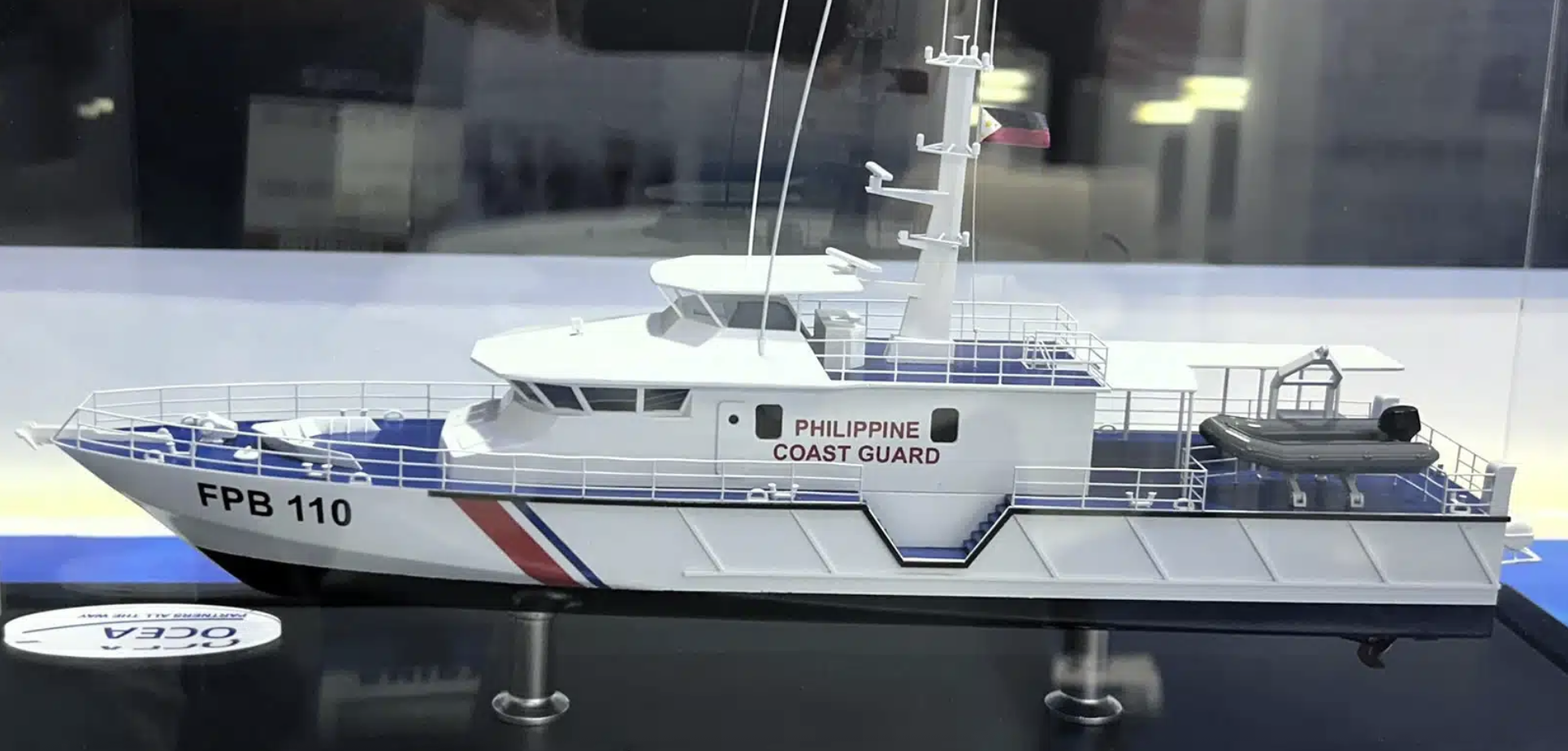
ASFAT full armament configuration of the Hisar-class Offshore Patrol Vessel on display at the IDEF25 defence exhibition held in Istanbul. The full armament loadout option for the Hisar-class OPVs includes the addition of eight MİDLAS vertical launch cells, Atmaca anti-ship missiles, and ROKETSAN ASW rocket launcher.

Seeing the model above, ships of this class potentially make pretty good warships, but that should not be too surprising since they are mildly modified versions of Ada class corvettes, using a more efficient but less powerful CODELOD (Combined Diesel-Electric or Diesel) power plant that increased endurance 50%.

I admit a bit of prejudice in favor of this class because of its length. They are 327s. I still have great affection for the 327 I served on. It also looks like it would make a great “Cutter X” my proposal for a true WMEC replacement to be built in greater numbers in lieu of some OPCs.

This class is what I would call a prototyptical modern OPV–medium size (close to 100 meters in length overall), efficient propulsion, moderately fast, helicopter and UAS hangar and flight deck, crew of less than 100, and the ability to function as an escort in wartime.

Specifications:

  • Overall length: 99.56 m (326 ft 8 in)
  • Beam: 14.42 m (47 ft 4 in)
  • Draft: 3.77 m (12 ft 4 in)
  • Maximum speed: 24 knots
  • Displacement: 2300 tons

The Coast Guard definitely needs more large patrol cutter. I would say at least 45. I still think substituting a greater number of cutter X for a smaller number of OPCs is a better idea than the program of record, but given the Navy’s decision to build frigates based on the NSC, I now favor building frigates for the Coast Guard as well. This would require accepting both that that the Coast Guard needs more than 35 large patrol cutters and that the frigates will cost more than OPCs. The payoff would be a more capable Coast Guard whether we are at peace or at war.

It might not add much to the total US budget. To some extent, if the Coast Guard has frigates, the Navy might not need as many.

“U.S. Seizes Second Tanker Near Venezuela, Reuters Reports” –gCaptain

The chart above is a bit disorienting because South is up. 

gCaptain reports,

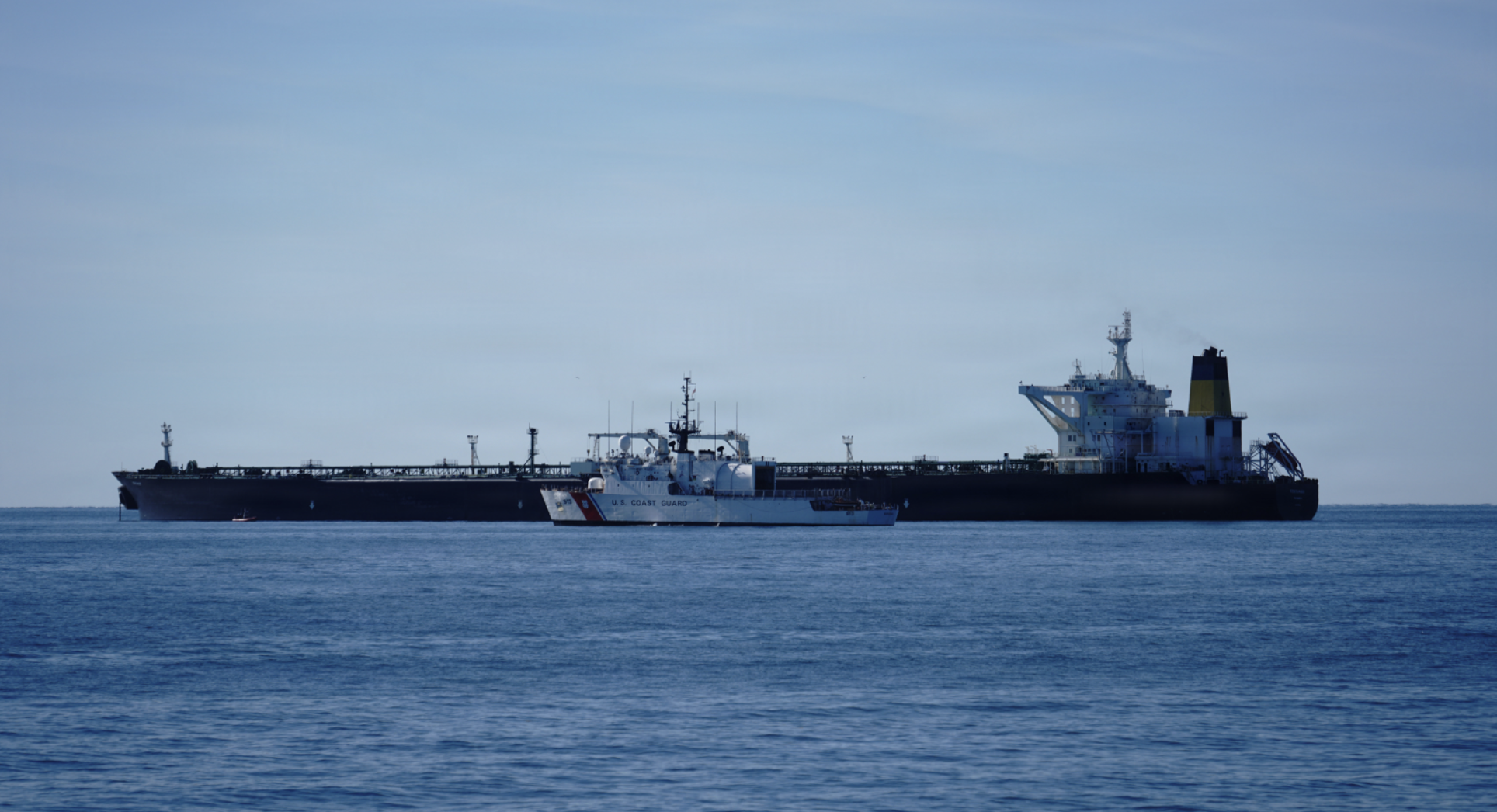
Dec 20 (Reuters) – The United States is interdicting and seizing a vessel off the coast of Venezuela in international waters, three U.S. officials told Reuters on Saturday, a move that comes just days after U.S. President Donald Trump announced a “blockade” of all sanctioned oil tankers entering and leaving Venezuela.

It also provides an overview of what is happening in regard to the blockade announced by the President.

Apparently the Coast Guard, after seizing the first tanker, is still deeply involved.

“The officials, who were speaking on the condition of anonymity, did not say where the operation was taking place but added the Coast Guard was in the lead.”

The chart at the head of the post was found on Facebook. I can’t vouch for its accuracy, but the list of Navy assets seems to reflect what I have heard from reliable sources so I suspect the Coast Guard assets listed are at least representative, though I question 26135 and 55115 which in silhouette appear to be 87 foot WPBs.

I wish I could give you a more comprehensive overview of what the Coast Guard is doing but I have seen almost nothing official.


“USS St. Louis returns home after deployment near southern border” –The Watch

NORTHCOM’s on line magazine “The Watch” reports,

“TThe USS St. Louis returned to its home port of Mayport, Florida, on November 10 following a surge deployment in support of the United States Coast Guard’s maritime interdiction mission. The U.S. Navy Freedom-variant littoral combat ship, which carried a Navy helicopter and embedded U.S. Coast Guard law enforcement detachment (LEDET), patrolled U.S. waters near the southern border with Mexico, under the direction of the U.S. Northern Command (USNORTHCOM).

This was an unusual deployment. Normally US Navy ships supporting Coast Guard interdiction efforts operate under SOUTHCOM, specifically under Joint Interagency Task Force South.

No interdictions were reported.

“SECNAV: New Frigate will be Based on National Security Cutter, First FF(X) to be Built at Ingalls” –USNI

An artist’s rendering of the proposed FF(X) frigate. US Navy image

A US Naval Institute report confirms that the new US Navy frigate will be based on the National Security Cutter.

Following last month’s truncation of the Constellation-class frigate program at Fincantieri Marinette Marine, the Navy selected HII’s Ingalls Shipbuilding’s 4,000-ton design cutter to base the new FF(X) program on, Phelan said in the video posted on “X.”

“We will deliver on a wartime footing, and we will unleash the American industrial base to do it, competition, accountability and real output steel in the water,” Phelan said. “To deliver its speed and scale, I have directed the acquisition of a new frigate class based on HII’s Legend-class National Security Cutter design, a proven American-built ship that has been protecting U.S. interests at home and abroad.”

A Defense News report indicates an intention to ultimately have at least two yards building this class.

“Phelan added that the new class will be acquired using a lead shipyard, with a competitive follow-on strategy for multi-yard construction.”

The USNI report was less specific,

“We will initially sole-source the lead ship to Ingalls, but we will move to competition as soon as possible,” a senior official told USNI News.

21 round Rolling Airframe Missile (RAM) launcher. Image credit Darkone via Wikipedia.

Looking at the artist rendering of the FF(X), I see what appear to be launchers for up to eight Naval Strike missiles on the fantail and a 21 round Rolling Airframe Missile launcher.

Perhaps surprisingly, there are apparently no VLS missile launch tubes on the foc’sle. I also note that the term FF(X) is being used rather than FFG(X) which would indicate a combatant with a significant anti-air capability.

The USNI report indicates the ships will be built with no organic ASW capability,

“… things that are more intrusive to install, like anti-submarine warfare equipment, would be something we would look to do in the future.”

They will have a space on the fantail for containerized mission modules,

“One of the few changes the Navy intends to make to the NSC design is to construct a platform above the open boat deck for containerized mission packages, the officials said…The Navy is developing more containerized packages that can be swapped from ship to ship…“Those containers could do a host of missions. That’s a core element of the future force design.”

A rendering of the FF(X) design as seen from the top down. USN capture

I hope this means we will see a containerized towed array that we can use on cutters.

Disappointed I don’t see provision for 30mm Mk38 Mod4, ESSM or vertical launch ASROC. Hopefully the Mk58 very light weight torpedo hard kill torpedo countermeasure will be included with NIXIE.

A full on rush to build these in quantity might mean the Coast Guard could get a few in the new Navy configuration in lieu of a third phase of OPCs.

“America’s Tall Ship, U.S. Coast Guard Barque Eagle, announces 2026 sail training schedule for Nation’s 250th anniversary” –News Release, Atlantic Area

190815-F-WJ663-0759
U.S. Coast Guard Barque Eagle (WIX 327), arrives in New York City, August 15, 2019. Eagle is a tall ship used as a training platform for future Coast Guard Academy officers as well as vessel for establishing and maintaining domestic and international relationships. (U.S. Air Force photo by Staff Sgt. Cory D. Payne)

Below is a Coast Guard news release.


Dec. 19, 2025

America’s Tall Ship, U.S. Coast Guard Barque Eagle, announces 2026 sail training schedule for Nation’s 250th anniversary

PORTSMOUTH, Va. — U.S. Coast Guard Barque Eagle (WIX 327) announced its 2026 schedule of port calls Friday. 

The selected port calls include the five Sail250 ports of New Orleans, Norfolk, Baltimore, New York City, and Boston. Sail250, a global gathering of tall ships and military ships to celebrate the 250th anniversary of the founding of the United States. It will offer crews, cadets and visitors from all over the world an unforgettable experience and a world-class maritime celebration.

“It is an immense honor for the Coast Guard Barque Eagle and crew to participate in the Sail250 festivities and celebrate the 250th anniversary of our nation,” said Capt. Kristopher Ensley, commanding officer of Eagle. “This voyage not only serves as a vital training experience for the next generation of Coast Guard officers but also allows us to share America’s proud maritime heritage with the public. We are thrilled to visit these historic ports and sail alongside magnificent vessels from around the world.”

The summer schedule includes the following dates and locations:

  • May 8 – 11: TBD

  • May 23 – 25: Pensacola, Florida

  • May 28 – June 1: New Orleans, Louisiana

  • June 11 – 14: Charleston, South Carolina

  • June 19 – 22: Norfolk, Virginia

  • June 25 – 28: Baltimore, Maryland

  • July 4 – 8: New York, City, New York

  • July 11 – 14: Boston, Massachusetts

  • July 24 – 27: Portland, Maine

  • July 31 – August 3: Newport, Rhode Island

  • August 7 – 10: Greenport, New York

  • August 14: New London, Connecticut

For the first time since 1976, Eagle and its sister ships, Gorch Fock (Germany), Sagres (Portugal) and Mircea (Romania), will be competing for the Five Sisters Trophy. The sail race will be between New York City and Boston starting July 9 off the coast of New York.

Public tour schedules for the Eagle at each port will be announced closer to the event dates.

Limited opportunities for media members to ride aboard the Eagle during its inbound transits to select ports will be available. All interested media should contact lantpao@uscg.mil for details and to inquire about availability.

About Eagle: 

At 295 feet in length, Eagle is the largest tall ship flying the stars and stripes and the only active square-rigger in United States government service. Constructed in 1936 by the Blohm and Voss Shipyard in Hamburg, Germany, and originally commissioned as the Horst Wessel by the German Navy, Eagle was a war reparation for the United States following World War II. Eagle is a three-masted barque with more than 22,300 square feet of sail and six miles of rigging. Eagle has served as a classroom at sea to future Coast Guard officers since 1946, offering an at-sea leadership and professional development experience as part of the Coast Guard Academy.

For a continuous stream of information about Eagle, including port cities, tour schedules, current events, as well as cadet and active duty crewmember photographs, follow the United States Coast Guard Barque EAGLE Facebook page or on Instagram @barqueeagle.

About Sail250: 

Sail250 is a series of maritime festivals in 2026 celebrating the 250th anniversary of the United States. The events will feature a grand spectacle of international tall ships, military vessels, and other maritime activities in the host cities of New Orleans, Norfolk, Baltimore, New York City, and Boston.

Contract for “Polar Security Cutter land based test facility and production integration facility long lead time material”

DOD “Contracts For Dec. 18, 2025” included this for the Polar Security Cutter program.

Bollinger Mississippi Shipbuilding (BMS), Pascagoula, Mississippi, is awarded a $33,077,880 cost reimbursable contract modification to previously awarded contract (N00024-19-C-2210) for Polar Security Cutter land based test facility and production integration facility long lead time material. Work will be performed in Pascagoula, Mississippi, and is expected to be completed by September 2027. Fiscal year 2025 procurement, construction, and improvement (Coast Guard) funds in the amount of $16,505,862 will be obligated at time of award and will not expire at the end of the current fiscal year. Naval Sea Systems Command, Washington, D.C., is the contracting activity.

Thanks to Paul for bringing this to my attention.

“Enhancing the Maritime Patrol Operational Picture” –Seapower

A screen grab of the Labyrinth, a Minotaur cloud-platform, software. Labyrinth adds robust scalability in handling and correlating large volumes of data while providing external stakeholders access via a secure web-based interface.

The Navy League’s on-line magazine, Seapower, gives us a look at the growing power of the Minotaur Family of Systems (MFoS), that is being incorporated into all Coast Guard fixed wing patrol aircraft.

Looks like a major piece of the Maritime Domain Awareness puzzle.

“Mystery Surrounds Luxury 737 That Appears To Be Flying For Department Of Homeland Security” –The War Zone

The War Zone has an interesting article about a 737 Boeing Business Jet (BBJ) apparently being used by the Department of Homeland Security for VIP transportation. Normally this task has been done by smaller Coast Guard Command and Control aircraft. Additionally this aircraft appears to have been accompanied by a Coast Guard aircraft on a recent trip to Crete, Jordan, and the United Arab Emirates (UAE).

The U.S. Coast Guard’s lone C-37B, a version of the Gulfstream G550 business jet, also departed from National Airport in D.C. on December 14 and arrived in Amman yesterday after stopping in Chania. That aircraft had arrived in both locations just ahead of N471US, lending credence to a direct connection between the two flights, and underscoring the 737 BBJ’s links to DHS.

This seems to raise a question about the future of Coast Guard owned and operated command and control aircraft.

DHS is also buying a fleet of six 737s for ICE deportation flights.