gCaptain’s Maritime Monday for 1 July is a tribute to the Royal National Lifeboat Institution, Britain’s mostly volunteer maritime rescue service.
Royal National Lifeboat Institution Tribute
Reply

gCaptain’s Maritime Monday for 1 July is a tribute to the Royal National Lifeboat Institution, Britain’s mostly volunteer maritime rescue service.
This post from gCaptain starts talking about Bananas but the topic, ship board spaces with oxygen deficiencies is applicable to cutters as well.
Thinkdefense recently reported on the test of a new application of the proven Brimstone missile. (They also have some additional video, and excellent commentary.) Three missiles were launched almost simultaneously against five boats (four stopped and one underway at about 20 knots) simulating a swarm attack. The three missiles each hit a separate target.
Targeting:
The thing that makes this missile so interesting is the range of options it provides the user to ensure that the right target is hit and there is little or no chance of collateral damage. It is equipped with an all weather millimetric radar that will show the shape of the target, and in the latest version semi-laser homing. It can be “fire and forget,” but it can also allow a “man-in-the-loop.” It can be given a laser designation and then continue to independently track the target. It has a terrain avoidance feature allowing it to hit targets on the far side of islands. A kill box can be designated so that it will ignore targets outside the box and self-destruct if it passes through the box without finding a target. Multiple rounds can be fired in a salvo, against one or more targets.
Will the US consider it?:
Clearly this weapon is being marketed to the US, including apparently for use on the Littoral Combat Ship as a competitor to an enhanced Griffin. US Special Forces have already shown an interest in the missile.

Diagram source: http://brimstonemissile.com/brimstone/
“BRIMSTONE is also being proposed as a surface-to-surface missile for deployment within the SEA SPEAR self-defence system against FIACs (fast inshore attack craft–Chuck) and other small surface threats. With a range of deck-mounted launcher options, from single to six-pack configurations, the system’s very small footprint gives it a high level of deck positioning flexibility making it suitable for small vessels such as FACs as well as much larger vessels such as auxiliary ships.”

Footprint:
It is relatively small, about 107 pounds, less than six feet long, and approximately seven inches in diameter. They claim it is suitable for vessels as small as 15 meters (50 feet).
Alternatives
The nearest similar missile in US service right now is the Hellfire. Brimstone developed out of a program to improve Hellfire, so not surprisingly, Hellfire is very similar in size but has a shorter range. Hellfire has been used on the Combat Boat 90 (a 52 foot boat). It does not have the sophisticated dual mode guidance and collateral damage avoidance features of the Brimstone. Several types have been built. Most are semi-active laser homing, but there is a millimetric radar homing version also, but it does not include the man-in-the-loop feature of the Brimstone. The model that appears most useful in a naval environment is the “N” model. The Thermobaric warhead does sound interesting.
What would we use it for?
New weapons like this are beginning to give even very small craft the punch that once came only with something like a 5″ gun, but perhaps more importantly it allows a very precise application of force. That should be very important to the Coast Guard in that their units are most likely to operating in and around the US including densely populated areas.
This may not be a ship killing, or even ship stopping weapon (although it might help), but it might be useful against a different type of difficult target. We might someday need to stop a terrorist or an enemy in wartime employing a fast highly maneuverable craft operating inshore or among a number other vessels where gunfire is likely to cause civilian casualties. This system would be much safer, and more likely to succeed, than using guns, in that circumstance.
Too good to be true?
With the possibility of being surrounded, pushing one button, and wiping out all your enemies, I was reminded of this sequence from the movie “The Last Starfighter.”
More info here:
Brimstone Advanced Anti-Armour Missile, United Kingdom
|
Historical Photo – Dockside
|
|||
|
|||
 |
Apparently, the former USCGC Ewing is up for sale, only $69,000. Considering how the Coast Guard’s budget has been cut, and shipbuilding has been slowed, perhaps the Coast Guard should get her back. It is only 86 years old.
An interesting development in the Philippines and in part credited to the transfer of former Coast Guard WHECs to the Philippine Navy.
Manila plans air, naval bases at Subic with access for U.S.
Fiercehomelandsecurity.com is reporting (small extract below),
“A proposed substitute amendment for the comprehensive immigration bill under consideration in the Senate that would increase border security funding by $38 billion and deploy an additional 20,000 Border Patrol agents to the southwestern border has livened prospects for bill passage in the Senate–although critics from left and right have been quick to criticize it.”
When border security gets tight on land, where do you think illegal immigration will spike?
An additional 20,000 agents is equal to half the size of the Coast Guard to perform only one mission, Alien Migrant Interdiction Operations (AMIO).
If no attempt is made to tighten the maritime borders, it is not to difficult to foresee what will happen.
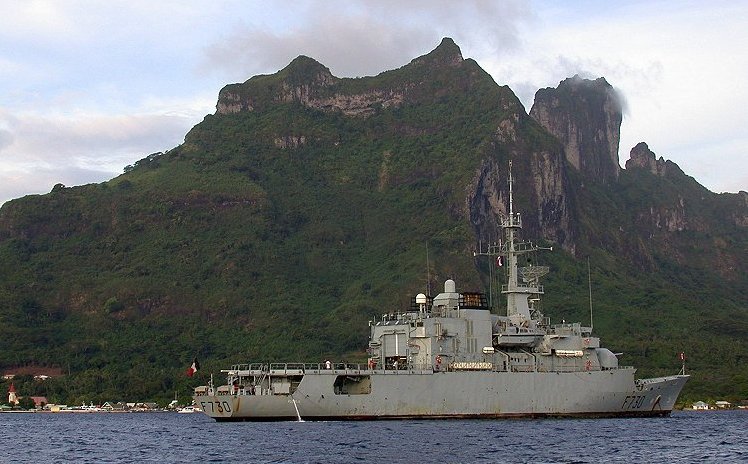
FRANCE: Defence minister indicates plans for long-term replacement of FLOREAL class patrol frigates with a new class of light (3,000 – 4,000 tons) frigates (Frégates de Taille Intermédiaire – FTI) … contract decision by end of decade with first ship arriving around 2025.
The lightly armed Floreal Class Frigates essentially serve as cruising cutters for the French Navy since they do not have an American style Coast Guard. Perhaps DCNS’s participation in the Offshore Patrol Cutter competition will serve them well in developing a contender.
DefenseNews reports the Brits have seen the need for a shipboard machine gun simulator. Considering how many 7.62mm and .50 cal machinegun mounts the Coast Guard uses–certainly more than the Royal Navy, it might be worth considering.

The Navy’s experimental Countermeasure Anti-Torpedo launches from the fantail of USS George HW Bush in May. US Navy Photo
In an age where missiles can shoot down ICBMs, the only surprise is that this has not happened sooner.
The US Naval Institute News is reporting that the Navy is developing a small torpedo to intercept Russian/Soviet designed torpedoes that are immune to normal acoustic torpedo countermeasures, because they follow the target’s wake rather than passively homing on the ship’s noise. I would expect it to work against other types of torpedoes as well.
The existence of wake homing torpedoes has been known for decades. Not mentioned in the article, but the Germans were working on these in WWII and the British unsuccessfully attempted to make a wake homer before the first World War.
Initial Operational Capability (IOC) of this hard kill system is expected in 2019 with fleet wide adoption by 2035. What are the implications for the Coast Guard, other than perhaps having the countermeasure on our largest ships?
This anti-torpedo torpedo (ATT) might be adapted to become the “ship stopper” I believe the Coast Guard needs to ensure the ability to stop determined terrorists in control of a medium to large ship. With its relatively small charge it might even be usable in more typical law enforcement situations. The Navy might also find it useful if they are engaged in a blockade operation. I wonder if it might also be useful against swarming small boats.
The ATT is only 6.75 inches in diameter, only slightly more than half the diameter of existing light weight ASW torpedoes. It probably weighs on the order of 100 pounds and the warhead is almost certainly less than 25 pounds, but it would likely suffice to destroy propellers and possibly the rudder of even a large vessel. The fact that it would likely stop a vessel without sinking it, might be seen as an advantage. It is also less likely to create collateral damage, and it would be less dangerous to own ship than the carriage of larger torpedoes. It would have a very small footprint and could be carried on even the smallest cutters.

Slide from a Naval Sea Systems Command presentation on the Surface Ship Torpedo Defense system. NAVSEA Image
MarineLog is reporting tests of a 99 meter catamaran ferry, built by Australian shipbuilder Incat Tasmania, that reportedly made 58.1 knots while fueled with Liquefied Natural Gas. It is claimed to be “…the world’s first dual fuel high speed ferry to operate on LNG as its primary fuel, and the fastest, environmentally cleanest, most efficient, high speed ferry in the world.”
“The vessel’s high speed can be attributed to the combination of Incat wave piercing catamaran design, the use of lightweight, strong marine grade aluminum, and the power produced by the two 22MW GE LM2500 gas turbines driving Wartsila LJX 1720 SR waterjets.”
“Incat has built 25 High Speed Craft over 5,000 gross tonnes with a top speed in excess of 45 knots.”
The similarities to the Navy’s new JHSV and China’s much smaller type 022 missile boat are apparent.
Incidentally, in spite of the advanced hull form, this still takes a lot of power, two 22MW GE LM2500 turbines equates to over 59,000 shaft horsepower, so its going to use a lot of fuel.
 Chuck Hill's CG Blog