“Bloodstained Sea” –a Book Review, and more on Convoys

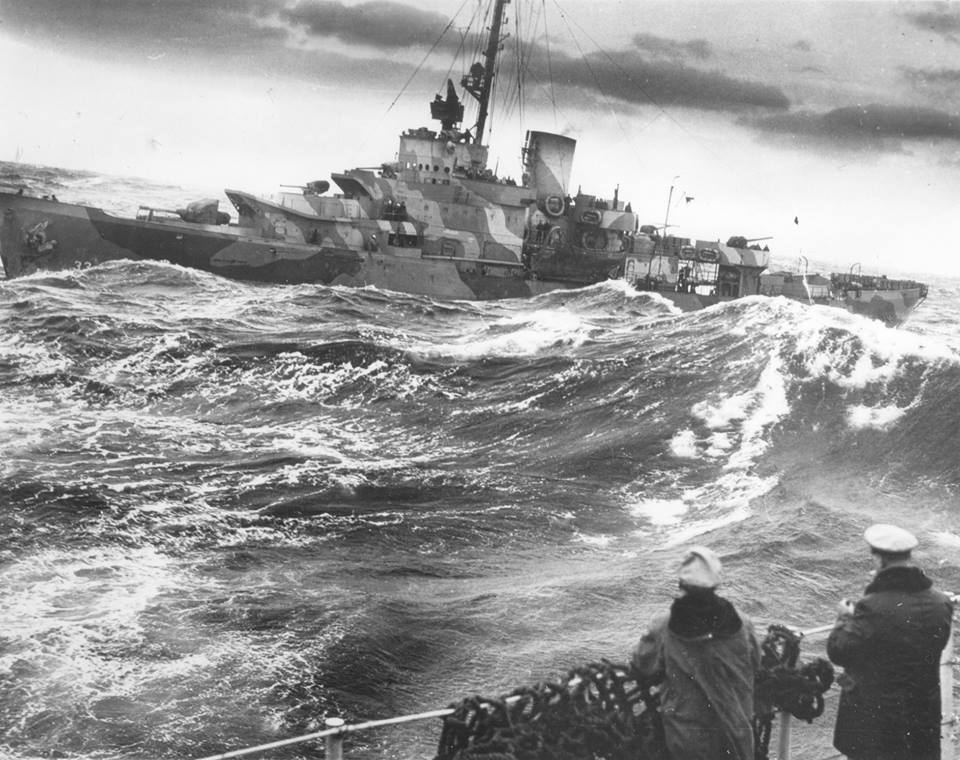
USCGC Duane on North Atlantic Convoy Duty

During my recent vacation I had time to read a bit of Coast Guard history, the book “Bloodstained Sea, The U. S. Coast Guard in the Battle of the Atlantic, 1941-1944,” by Michael G. Walling. copyright 2004.

It may not capture everything the Coast Guard did in the Battle of the Atlantic, in that there is relatively little mention of the 30 Destroyer Escorts and 75 Patrol Frigates manned by the Coast Guard, but it follows the exploits of the seven 327 foot cutters in great detail. It also talks a bit about the two U-boats sunk by 165 foot cutters early in the war. So the emphasis is on the desperate early days, before US industry supplied a glut of escort vessels.

When I was XO on Duane, one of those seven 327s, I had access to here War Diaries written 40 years earlier. (Hopefully they found a home somewhere safe.) They seemed to prove the adage that “war is months of boredom punctuated by intense terror.” Most of her convoys were uneventful, the exceptions are of course the story here.

There is an almost mind numbing recitation of ships sunk, lives lost, and lives saved. Attacks on U-boats were numerous, but sinkings were few. The cutters’ achievements in this respect were quite remarkable, but what caught my attention was the number of rescues in extremely adverse conditions. In almost every case there were attempts to rescue the crews of torpedoed ships even when it put the escorts in danger.

I recently saw some figures for the loss rate for US merchant seamen compared to that of the military. One in 26 merchant seamen were lost compared with something like one in 45 for the US military. Those rescue attempts, particularly in the early years before the U-boat threat was tamed, must have been essential to maintain the morale of merchant seamen and their willingness to undertake another voyage.

Currently we are short of American flag ships and perhaps even shorter of American merchant seamen to sail them.
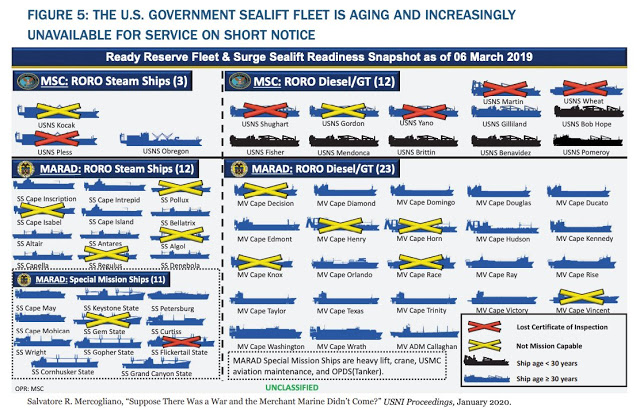
Less than two years ago, MARAD was told, ‘You’re on your own’: US sealift can’t count on Navy escorts in the next big war.

OK, its bad enough that there may be no escorts defending your ship, but that also means if your ship sinks, there is no one to rescue you. We can’t afford to loose the few mariners we have and we can’t put them in a situation where they have no hope of rescue if their ship is sunk. A cutter with helicopter might be a viable rescue vessel.

As noted before, I think convoy escort would be a good wartime role for upgraded National Security Cutters and Offshore Patrol Cutters.

Fortunately it does seem the Navy has at least begun to think about escorting convoys again, but all the corporate knowledge is buried somewhere in dusty vaults.  They need to pull up lessons learned from the Cold War “Reforger” exercise series. The new exercise is under 2nd Fleet in the Atlantic, but frankly I think we need to worry more about the Pacific. Chinese nuclear submarines, that are at a disadvantage relative to their American counterparts, could do a lot of damage to the sea lanes in the mid-Pacific and even operate off the US coast, tying up fleet assets needed in the Western Pacific. .

USCGC Spencer (WPG-36) in 1942 or 1943. Spencer sank U-175 with assistance of USCGC Duane, on April 17, 1943.

A word about the upcoming movie Greyhound: 

I look forward to the movie “Greyhound” staring Tom Hanks, who also wrote the screen play. It is based on one of my favorite books, “The Good Shepherd,” by C. S. Forrester, also author of the Horatio Hornblower series.

Remember, if you see it, that in 1942, the flagship for a US led mid-ocean escort group in the North Atlantic would have been a Coast Guard 327 foot cutter, usually USCGC Spencer, not a well armed US Navy destroyer, and its captain would have been a Coast Guard Officer. Early in 1942 he would also have been in charge of the escort group, but in May 1942 a Navy Captain was placed in charge of the escort group. Except for short periods, this was Capt. Paul R. Heineman. That split the responsibility, allowing the CO to concentrate on fighting his own ship.

USCG Cmdr Harold S. Berdine of cutter Spencer talking with US Navy Capt Paul Heineman of the Escort Group A-3 after sinking German submarine U-175, North Atlantic, 500 nautical miles WSW of Ireland, 17 Apr 1943. US Coast Guard photo by Jack January


“Precision-Guided Munitions: Background and Issues for Congress” –CRS

The Congressional Research Service issued an update of their 42 page “Precision-Guided Munitions: Background and Issues for Congress” on February 27, 2020. This contains a lot of information on weapons we have discussed here, for potential Coast Guard applications to improve our ability to stop threats ranging from small fast highly maneuverable small craft to medium or large sized ships. The weapons that might be of interest to the Coast Guard include Hellfire (also discussed here and here) and its successor the Joint Air to Ground Missile (JAGM), the Precision Strike Missile, the Naval Strike Missile (NSM), and the Long Range Anti-Ship Missile (LRASM). Missing from the list is the Advanced Precision Kill Weapons System (APKWS) which is really a guidance kit used to provide semi-active laser homing for the 70 mm Hydra rocket.

For some reason the Coast Guard seems to be guided weapon phobic. Is it the Coast Guard not asking? or the Navy not supporting? No way to tell, but it does look like guided weapons could answer an unfulfilled need to be able to forcibly stop any vessel, regardless of their size, speed or maneuverability. Also unlike conventional naval guns they provide greater precision, minimizing the potential for collateral damage. This could be a significant advantage in view of the fact that the Coast Guard may be called upon to engage terrorists near population centers.

Yes, individual guided weapon rounds are more expensive than conventional gun projectiles, but the total cost to provide a given level of capability and train and provide supporting personnel is usually less. (The 57mm Mk110, its ammunition, and people to support it are not cheap. Reportedly the gun cost $7.2M and the rounds $1200 each.)

The ubiquity and sheer number of modern precision-guided weapons is staggering.

In FY2021, the Department of Defense (DOD) requested approximately $4.1 billion for more than 41,337 weapons in 15 munitions programs. DOD projects requesting approximately $3.3 billion for 20,456 weapons in FY2022, $3.9 billion for 23,306 weapons in FY2023, $3.9 billion for 18,376 weapons in FY2024, and $3.6 billion for 16,325 weapons in FY2025.

Below I will provide a brief description of the weapon and using the figures from the report provide an approximate unit cost.

ATLANTIC OCEAN—A Longbow Hellfire Missile is fired from Littoral Combat Ship USS Detroit (LCS 7) on Feb. 28 2017 as part of a structural test firing of the Surface to Surface Missile Module (SSMM). The test marked the first vertical missile launched from an LCS and the first launch of a missile from the SSMM from an LCS. (Photo by U.S. Navy)

AGM-114 Hellfire Missile: 

Originally designed as a helicopter launched anti-tank weapon, Hellfire is relatively small at about 110 pounds. It has a surface launch range of about eight kilometers or about 4.3 miles. The warhead is about 20 pounds. It could be highly effective against small, fast, highly maneuverable targets. Even multiple hits would be unlikely to sink a medium to large ship, but at least it has the possibility of disabling one.

These weapons are procured in very large quantity.

All three military departments procure Hellfire missiles. From 1998 through 2018, DOD procured more than 71,500 missiles at a cost of $7.2 billion. Congress appropriated nearly $484 million for approximately 6,000 missiles in FY2019. For FY2020, DOD requested approximately $730 million for 9,000 Hellfire missiles, and it plans to purchase 13,100 missiles at a cost of $1.2 billion between FY2021 and FY2024 (Table 3). In its FY2020 recent budget request, DOD states that it is requesting to procure the maximum production of Hellfire missiles.

Unit cost on the basis of the FY2020 request would be less than $83,000.

AGM-169 Joint Air-to-Ground Missile (JAGM):

JAGM is expected to replace the closely related Hellfire Missile, but there is as yet no firm timeline. In form, it is very similar to Hellfire but has various improvements.

“JAGM has a maximum effective range of 8.6 nautical miles when launched from a helicopter…” the surface launched range should be similar. It uses an existing AGM-114R rocket motor so presumably the range of the latest versions of Hellfire may be similar.

Requested and Programmed procurement for the JAGM for the six years from 2020 through 2025 amount to 4,771 missiles at a cost of $1,624.96M for a unit cost of about $341,000

US Navy photo. A U.S. Navy Long Range Anti-Ship Missile (LRASM) in flight during a test event Dec. 8, 2017 off the Coast of California.

LRASM:

LRASM is a relatively large, very sophisticated anti-ship missile with a range of over 200 nautical miles. It weighs 4400 pounds in its surface launch configuration and has a 1000 pound warhead.

Requested and Programmed procurement for the LRASM for the six years from 2020 through 2025 amount to 356 missiles at a cost of $1,260,350,000 for a unit cost of about $3,540,309.

Precision Strike Missile: 

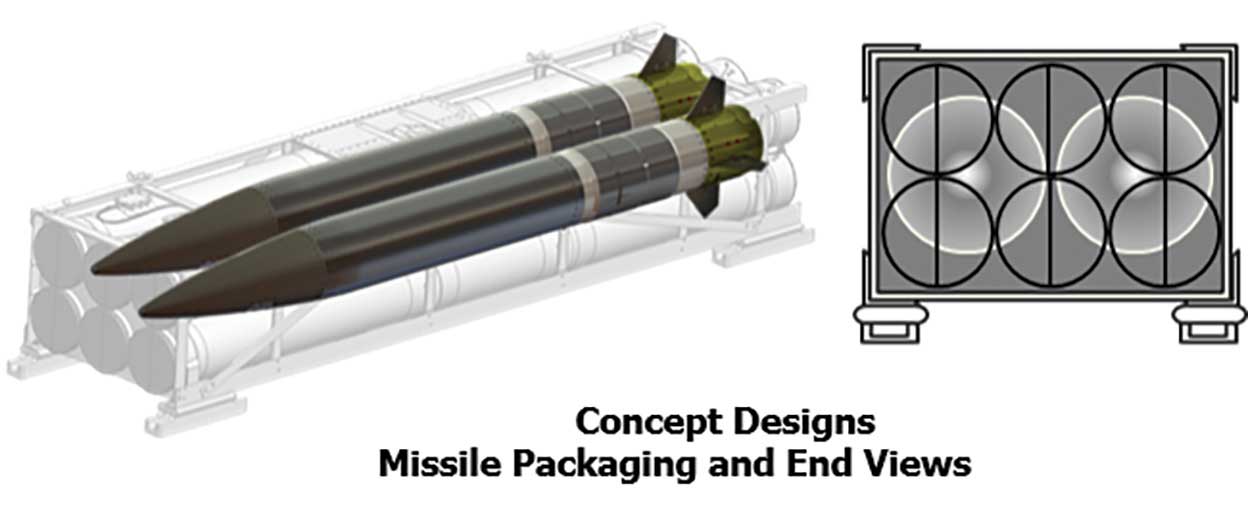
This is a ballistic missile rather than a sea-skimmer. It has a range “in excess of 400 kilometers.” It is intended to replace the ATACM artillery rocket which is being modified for use against naval targets. Since the missile is physically smaller than the ATACM, it is likely the warhead is smaller than the 500 pound warhead used on some versions of ATACM.

Requested and Programmed procurement for the Precision Strike Missile for the five years from 2021 through 2025 amount to 1,018 missiles at a cost of $1,073,410,000 for a unit cost of just over $1M.

Naval Strike Missile (NSM) :

The Naval Strike Missile (NSM) is smaller than the more familiar Harpoon missile. It is only 13 feet long and weighs only about 900 pounds. It has a 125 kg (276 lb) warhead. That is not large enough to sink most ships without multiple hits, but it is a smart missile and it may be possible to direct the missile precisely enough to do critical damage.

The CRS report indicates that the range for this missile is between 100 and 300 nautical miles depending on launch and cruise altitude. 100 for a low (launch altitude), low (cruise altitude), low (terminal approach) flight profile and 300 for a high, high, low profile. Assuming it can be programmed for a low, high, low, it might have a surface launched range considerably greater than 100 miles, which would increase it utility for the Coast Guard as this could allow more distant large cutters to target larger threat vessels, in cooperation with less well armed local units.

Requested and Programmed procurement for the NSM for the six years from 2020 through 2025 amount to 207 missiles at a cost of $366,010,000 for a unit cost of about $1.77M.

How much would it cost to equip the Coast Guard?

There are certainly a lot of unanswered questions here, but I think we could at least approximate the cost within an order of magnitude.

Such a program would extend over several years. This would reduce the annual impact.

While all the missiles mentioned above have potential Coast Guard applications, the Hellfire and Naval Strike Missiles also selected for installation on the Littoral Combat Ships and the new FFG are the most likely be supported by the Navy. After all, the new larger cutter share much in common with the LCS.

Hellfire: Just as a notional approximation, let us say we are going to put six Hellfire on each of the Webber Class FRCs, the Bertholf class NSCs, and the Argus class OPCs. That is 100 installations and 600 missiles. The missiles would cost about $50M. I would assume the launchers and control systems might double the cost to $100M. But this would be a multi-year program. The OPCs will not be finished until well into the 2030s so it would be unlikely the program would cost more than $20M/year.

Naval Strike Missile: Assuming an installation similar to that we are seeing on the LCSs, this would include two, four cell launchers. We probably would not necessarily routinely fill all eight cells, but if we did so equip eleven NSC and 25 OPCs that would be a total of 288 missile. The missiles would cost approximately $510M. Installation of launchers and control equipment might bump the total cost to about $1B, but again this would be spread over several years, continuing into the late 2030s as the OPCs are completed, and the Navy would be footing most of the bill. Installation on two ships a year would probably cost on the order of $50-60M/year.

Two Articles on Coast Guard/Navy Cooperation/Coordination –CIMSEC and USNI

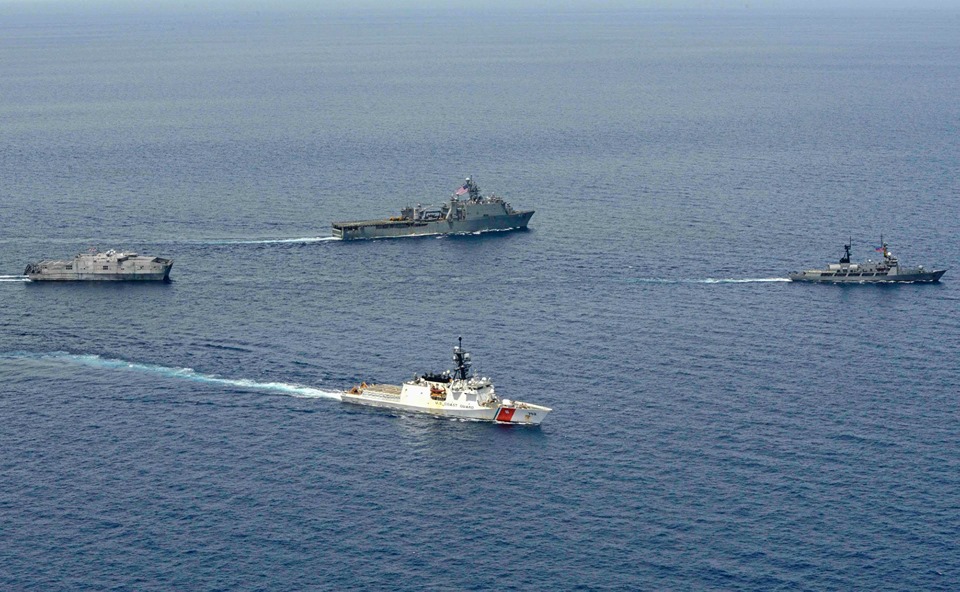
The Philippine Navy’s BRP Andres Bonifacio (PS 17), USS Germantown (LSD-42), USCGC Stratton (WMSL 752) and USNS Millinocket (T-EPF 3) break formation after steaming together this week in the Sulu Sea as part of Maritime Training Activity Sama Sama.

Two recently published articles suggest greater cooperation and coordination between the Navy and Coast Guard. Both were written by a Marine, Captain Walker D. Mills, USMC, an infantry officer currently serving as an exchange officer in Cartagena, Colombia.

The Proceedings article talks about ways the Coast Guard could contribute to a rules-based international order in the Western Pacific but points out that the Coast Guard is underfunded and points to this as a reason given for not assuming a greater role in the Western Pacific. I don’t think he is saying these arguments absolutely preclude a greater Coast Guard role in the Western Pacific, but he does present the argument.

The CIMSEC post, points out that the Chief of Naval Operations’ recent FRAGO (shortened form of fragmentary order. An abbreviated form of an operation order) directing increased coordination between the Navy and Marine Corps missed an opportunity to highlight the reality of continuing cooperation between the Navy and Coast Guard.

“Some observers have raised objections to including the Coast Guard in the U.S. response to Chinese belligerence and encroachment in the South China Sea – it has repeatedly been a focus of commentary without generating a consensus. Generally, these objections are based on the small size and meager funding that the Coast Guard has and how the Coast Guard would be unprepared if a shooting conflict broke out in the region. Both of these are reasons why the CNO needs to plan for and mention the inclusion of the Coast Guard in his guidance to the force and make them a part of the larger conversation. Ignoring the Coast Guard, minimizing their potential contribution, or leaving them out of the discussion entirely would only serve to exacerbate these two issues.”


Conclusion

The CNO dedicated part of his FRAGO to guidance on building “alliances and partnerships” internationally – but it is just as if not more important to build partnerships and interoperability between sister services and other U.S. agencies. The CNO’s FRAGO is a far cry from the level of Coast Guard inclusion that permeated the 2015 Cooperative Strategy for 21st Century Seapower. While CNO Gilday obviously does not have the statutory authorities to direct his FRAGO at the Coast Guard – he can make it clear to his sailors that he views the Coast Guard as playing a critical role in the Navy-Marine Corps-Coast Guard team. That would be moving toward a truly integrated national maritime architecture and force structure. This direction will be critical for preserving U.S. primacy at sea and enforcing rule of law in the global commons.