
CGAS Miami H-65 in a CGAS Clear Water C-130
The Drive has a short post noting the Coast Guard’s ability to move its H-65s by C-130.
Some nice photos, kind words, and a video.

CGAS Miami H-65 in a CGAS Clear Water C-130
The Drive has a short post noting the Coast Guard’s ability to move its H-65s by C-130.
Some nice photos, kind words, and a video.

The US Naval Institute Blog has a post by LCdr John H Walters, USCG, who is the MQ-9A platform manager within the CG Office of Unmanned Aircraft Systems.
It pleads the case for unmanned systems (and satellite systems). The author is obviously a true believer (as am I to an extent).
The thing that I find encouraging is that there is a Coast Guard Office of Unmanned Aircraft Systems. What I find discouraging is that the Coast Guard has yet to procure its own shore based UAS and is still riding the coat tails of the Customs and Border Protection program that is still operating old versions of the MQ-9 that are not optimized for the Marine environment and do not have the “see and avoid” capability that would allow them to operate in airspace where mid-air collision is a possibility. There may be operational reasons to continue a relationship with the CBP unit, but as a learning experience, it has served its purpose. DBP has been operating their MQ-9s for 16 years. It is time for the Coast Guard to field its own land based unmanned air systems.
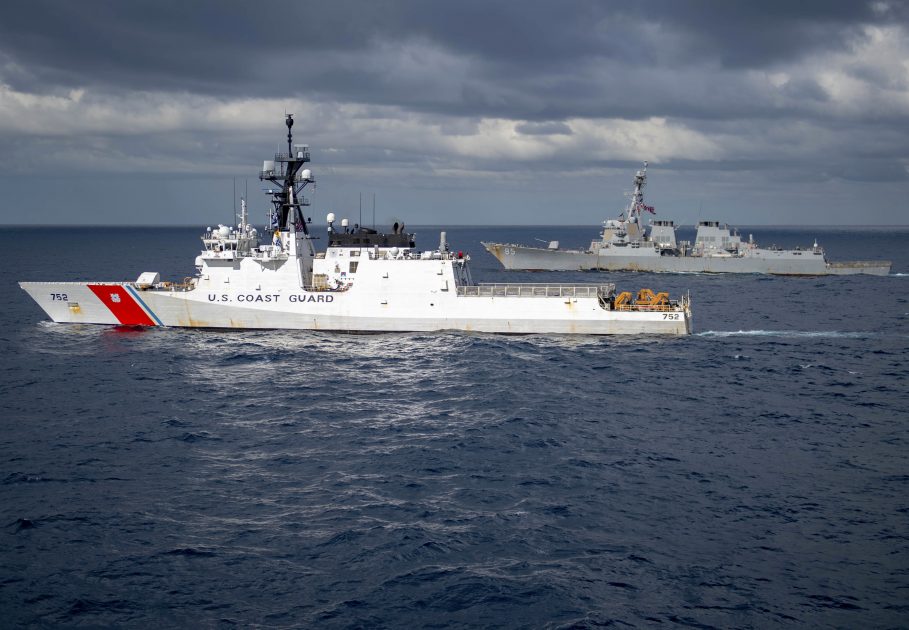
USCGC Stratton (WMSL-752), left, and the U.S. Navy Arleigh Burke-class guided-missile destroyer USS McCampbell (DDG-85) maneuver in formation during Talisman Sabre 2019 on July 11, 2019. US Navy Photo
The December 2021 issue of US Naval Institute Proceedings has an article that suggests, “NSCs and OPCs are ideal vessels to take over FONOPs.”
Why do the authors, two Navy LCdr. and a Marine Capt., think this? They contend:
They talk about using LCS as an alternative, but then denigrate the possibility,
The Navy has rightfully used littoral combat ships (LCSs) to conduct limited FONOPs in the South China Sea, somewhat relieving overworked destroyers like the USS John S. McCain. However, the smaller LCS’s myriad of problems, curtailed acquisition numbers, and early retirement of the first four hulls mean the Navy will soon have to lean even more heavily on larger and generally older ships. With only 10 to 14 cruisers and destroyers available to Seventh Fleet at any given time, the Navy can ill-afford to use these high-demand, low-density, Aegis ships for FONOPs.
This, in spite of the fact, that LCS have only recently begun making regular deployments to the Western Pacific and LCSs are being added to the fleet at a rate of four per year.
First, I have no problem with Cutters doing FONOPs when they are in the Western Pacific, but that should not be the only reason, they are there.
US Navy ships are not overworked. That is a fiction. Having looked at the “USNI News Fleet and Marine Tracker” over many years, I can say, Navy ships are typically deployed about one third of the time, and they are underway only about 25% of the time, far less than Coast Guard cutters. That is not to say the people are not overworked, by burdensome administrative and overly broad qualification requirements for their junior officers. The ships are behind in maintenance because of lack of support, not time underway. Ships don’t need to spend 75% of their time, tied up in maintenance, to remain effective.
In war time, well over half the navy should be underway and forward deployed. The fact that they cannot support a much smaller forward presence, of which much of the time is not underway, in peacetime, points to a serious deficit in the Navy’s support structure. Where are the repairs ships, the tenders, the floating dry docks that allow a navy to be truly expeditionary?
If the Navy does not want to use carriers, cruisers, or destroyers for FONOPs because they are afraid of having them damaged, there are other alternatives. They could use amphibs: LHAs, LHDs, LPDs, and LSDs. They could use Military Sealift Command ships. MSC ships are clearly not as intimidating as carriers, cruisers, and destroyers. Were they to be damaged “the ensuing visuals, narratives, and potential loss of combat capability would be starkly different…”
I would suggest using the new Navaho class tug and salvage ships. They are an excellent choice for playing bumper boats. They have strong steel hulls and are powerful enough to tow a nuclear-powered carrier. Their hulls are reinforced to allow hull to hull contact with other ships. Plus, they are a lot less expensive. Even less expensive than a Coast Guard cutter.
But really, using tugs or cutters to do FONOP kind of misses the point. The Chinese and the Russians are not upset because foreign ships are transiting waters they claim. They are upset because foreign warships are transiting the waters the claim. If we stop sending warships into the waters they claim, we are creating a defacto case that they have a right to such exclusion. That Coast Guard cutters may not be considered warships would weaken our case that, foreign warships in these waters is the norm.
The US Naval Institute has announced a special event to be held at the US Coast Guard Academy on 20 January.
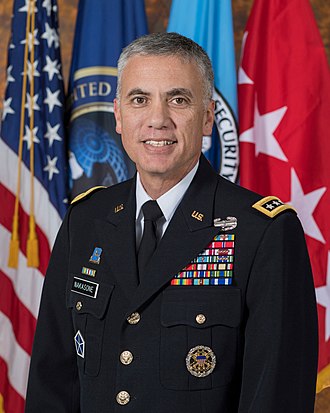
General Paul M. Nakasone, U.S. Army, Commander, U.S. Cyber Command and Director, National Security Agency/Chief, Central Security Service will be the featured speaker at an annual event hosted by the Naval Institute and the Loy Institute for Leadership at the U.S. Coast Guard Academy on Thursday, 20 January, in New London, CT. Admiral Charles W. Ray, U.S. Coast Guard (Retired),former Vice Commandant and current Tyler Chair in Leadership Studies at the U.S. Coast Guard Academy, will lead this engaging discussion with General Nakasone on all things cyber. This special event is made possible through support from the William M. Wood Foundation.
The link in the quote above notes:
Please contact conferences@usni.org with questions about this event.
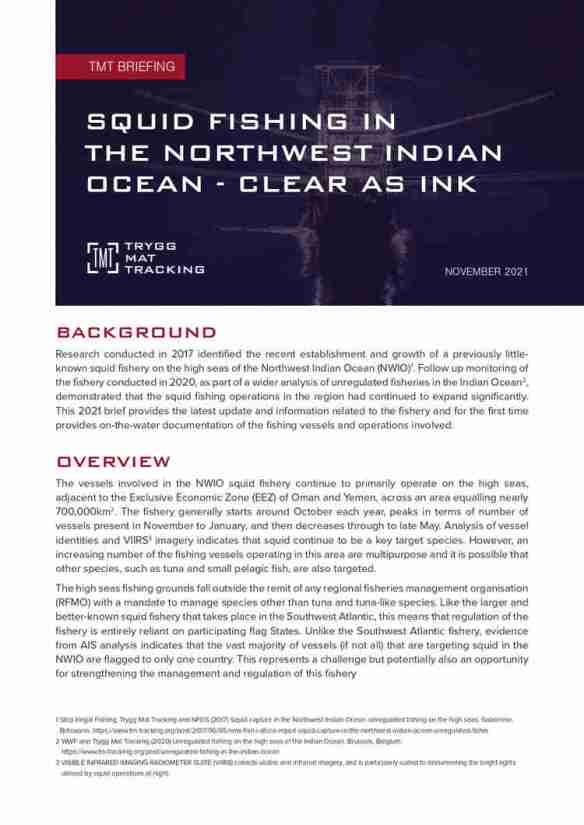
Below is an announcement of publication of a brief from Trygg Mat Tracking (TMT), regarding Illegal, Unregulated, Unreported (IUU) fishing in the Northwest Indian Ocean.
I think this is something the Coast Guard units of PATFORSWA might become involved with, at least in a training and capacity building role.
This is a quote from the website explaining how TMT sees its mission.
“TMT provides national fisheries authorities and international organisations with fisheries intelligence and analysis, to assist enforcement actions and broader improvements in fisheries governance. While TMT works with governments and organisations worldwide, particular focus is on targeting illegal fishing and associated fisheries crime in and near African waters and assisting coastal African States.”
December 8th 2021: TMT has been monitoring the high seas squid fishery taking place in the northwest Indian Ocean since 2017. The fishery is currently unregulated and has seen significant expansion year on year.
The brief provides extensive images of the fishing activities taking place. This has provided us with extensive new understanding of this operation, but also raises many new questions and concerns.
· There are very low levels of AIS transmission by some vessels – a significant number of vessels were identified which transmitted over AIS whilst en route to the region and then switched AIS off or transmitted only very intermittently whilst on the fishing ground. Further to this, the quality of identifying information transmitted over AIS was often poor, making it challenging to monitor the fishery.
· Transshipment at sea was documented from fishing vessels to reefers, confirming that this is an important component of the operation.
· There are indications of potential EEZ incursions into Oman and Yemen by vessels in the fleet, but no clarity if these are licensed or not.
· The vast majority of the vessels were identified as Chinese. Equally the majority of relevant port calls by both fishing vessels and reefers are in China. Chinese research vessels have also been active in the area.
· All vessels documented in the fishery are using a type of gear we have not previously observed, involving large ‘dip’ nets. Many of the vessels appear to be able to deploy multiple gear types. This is significant for several reasons, including that recent announcements by the Chinese Government to limit high seas squid fishing specified that this applies to squid jigging vessels only.
The fishery is now starting up again for the 2021-2022 fishing season. As they do so it is important to note that this northwest Indian Ocean squid fishery continues to be subject to very little management and limited regulatory oversight. This represents a threat, not only to the sustainability of squid stocks in the region but potentially also to other regional fisheries, given the key role that oceanic squid plays in the marine food chain.
There is a clear need to address the current management gap as this fishery falls outside the geographical scope of the Southern Indian Ocean Fisheries Agreement (SIOFA) and outside the species mandate of Indian Ocean Tuna Commission (IOTC). Positive engagement by China in this process is crucial, as flag state for the fleet and port state receiving the catches, and as the only party with relevant information on the species, catch levels and fishing operations.
This briefing has been produced by Trygg Mat Tracking (TMT), with data and analytical support from Global Fishing Watch. At-sea documentation of vessels and fishing operations conducted in cooperation with Greenpeace International.
Download the 2021 brief: Squid Fishing in the North West Indian Ocean: Clear as Ink.


 Chuck Hill's CG Blog