
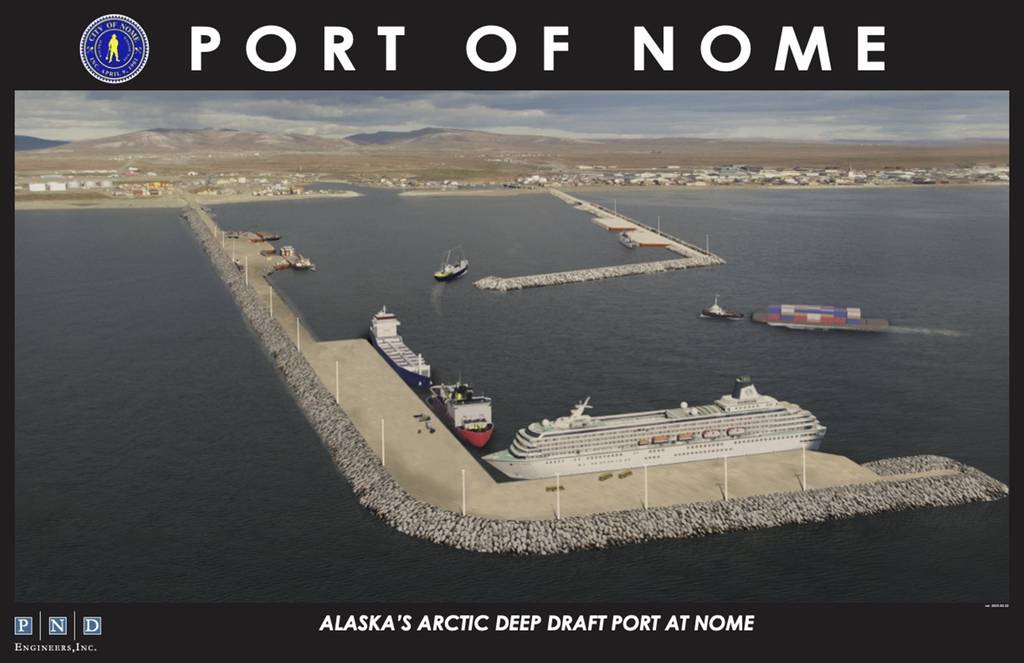
This rendering provided by the City of Nome shows how the Port of Nome, Alaska, will appear following an expansion project that will cost more than $600 million. Shipping lanes that were once clogged with ice for much of the year along Alaska’s western and northern coasts have relented thanks to global warming, and the nation’s first deep water Arctic port should be operational in Nome by the end of the decade. (PND Engineers Inc./City of Nome via AP)
Workers will dredge a new basin 40 feet (12.2 meters) deep, allowing large cruises ships, cargo vessels, and every U.S. military ship except aircraft carriers to dock, Port Director Joy Baker said.

Nome in red. Adapted from Wikipedia’s AK borough maps by en:User:Seth Ilys.
We have been talking about a deepwater port in the area for some time,
- New Base at Port Clarence?, Dec., 2018
- “The United States Needs a Deep-water Arctic Port” –USNI, Sept., 2019
- “Coast Guard Focused On Being Sea-Based In Arctic As Merits Of Deep-Water Port Debated” –USNI, Oct. 2019
- “Military activity is picking up in the quiet waters between the US and Russia” and a Deep Water Port at Nome, Nov., 2020
- New Units for Alaska, the Haley, and Nome, May, 2023

Alaska and the Bering Strait
Nome isn’t actually in the Arctic, despite the fact that the US government defines the Arctic to include the Bering Sea. The Arctic Circle runs just a little North of Nome, essentially at the Bering Strait. The Bering Strait connects the Pacific with the Arctic Ocean and is about 44 nautical miles (82 kilometers) wide at its narrowest point. Whoever controls the Bering Strait can regulate traffic between the Pacific and the Arctic Oceans. Having a nearby deepwater port would certainly help, if it were desirable to regulate that traffic. Nome is within 160 nautical miles of the Russian side of the Strait.
Traffic through the Strait has increased and the possibility of a cruise ship disaster in the Arctic is probably a District 17 nightmare, but I think the probability is low that large numbers of CG units will be based at Nome. As noted earlier, I don’t think we will see either large patrol cutters (unless it is the Alex Haley) or FRCs based there but moving one of the Juniper class seagoing buoy tenders there, with its light icebreaking capability might make sense. A medium icebreaker might be a possibility, but that is a very long shot.
As I have noted before, the US Navy’s Pacific Fleet surface ships have not really shown much interest in operating in the Arctic. Their “Arctic” exercises have been in the Gulf of Alaska or little, if at all, North of the Aleutians.
We might see Air Force and Marines in the area in time of War. Airpower and/or shore based anti-ship missiles could control surface traffic through the Strait. Those forces would have to be supplied, which would mean logistics shipping to what we now know will be the deepwater port at Nome. The shipping would presumably require naval protection, air and/or surface.
 Chuck Hill's CG Blog
US Army Corps of Engineers; Alaska District Website
Port of Nome Modification Project
https://www.poa.usace.army.mil/Library/Reports-and-Studies/Port-of-Nome-Modification-Project/
Time for more icebreakers than now officially planned…… and for fighting in the Artic, since the Navy doesn’t want to do it.