
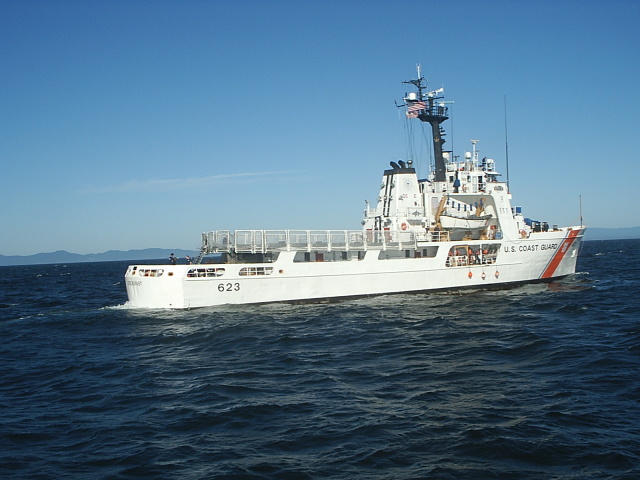
USCGC Steadfast (WMEC-623)
Below is a Coast Guard News Release. It is in fact a pretty typical news release. There are lots of these, and I usually don’t bother to publish them, but this one has prompted me to make some observations.
USCGC Steadfast had a very successful patrol. In fact, she did as well as any National Security cutter might have done despite the fact, she is less than a quarter the size of an NSC. Despite her age, size, and relatively slow speed, she has the critical assets necessary for success–good boats, an airborne use of force helicopter, and a crew that knew how to use them. Conclusion: It is a numbers game. Not every cutter needs to be 4500 tons, because we need numbers and smaller cutters can do the job. (I do like the fact that the newer cutters are faster.)
Looking back on six months’ worth of Coast Guard News reports (60 pages) it looks like a disproportionate part of the Eastern Pacific drug interdiction patrols are being done by PACAREA cutters. It is counter intuitive, but LANTAREA ships are actually much closer to the patrol areas and LANTAREA has many more large patrol cutters (NSCs and MECs: LANT 25 / PAC 9).
PACIFIC AREA CUTTERS:
- U.S. Coast Guard Cutter Steadfast returns home after 70-day counternarcotics patrol in Eastern Pacific, July 23, 2023
- U.S. Coast Guard Cutter Alert returns home after 61-day counternarcotics patrol in Eastern Pacific, June 16, 2023
- Coast Guard Cutter Active returns home following a 76-day counternarcotics patrol in the Eastern Pacific, April 19,2023
- Coast Guard Cutter Waesche returns home following (90 day) counternarcotics patrol; $166M in contraband seized, April 12, 2023
- Coast Guard Cutter Steadfast returns home following (69 day) counternarcotics patrol, Mar. 16, 2023
ATLANTIC AREA CUTTERS:
- USCGC Vigilant returns from (50 day) Eastern Pacific (and Florida Strait) patrol, conducts international collaboration, June 27, 2023
LANT Cutters do all the drug interdiction in the Caribbean and Migrant interdiction as well but, in addition to the 25 large ships, LANTAREA also has something like 35 Webber class cutters (in addition to the six in PATFORSWA), with 19 or 20 in the 7th District alone. By comparison, PAC AREA, with 84% of the entire US EEZ, has only 13 Webber class, four in the 11th District, six in the geographically huge 14th District that must also assist the nations of the Compacts of Free Association, and three in the 17th District (Alaska). The 13th District, where PACAREA’s three 210s, that are apparently doing most of the Eastern Pacific drug interdiction work are based, has not a single Webber class. Conclusion: PACAREA needs more ships than currently assigned or planned. The Webber class have probably made it possible to move more MECs to the Pacific. In the meantime, LANTAREA should be sending more ships to the Eastern Pacific drug transit zone.
U.S. Coast Guard Cutter Steadfast returns home after 70-day counternarcotics patrol in Eastern Pacific
ASTORIA, Ore. – The U.S. Coast Guard Cutter Steadfast (WMEC 623) and crew returned to homeport, Friday, after a 70-day counternarcotics patrol in the Eastern Pacific.
Steadfast’s crew disrupted the flow of illegal narcotics on three separate occasions during their patrol, preventing a combined total of more than 11,550 pounds of cocaine from reaching the U.S.
The crew steamed more than 16,000 nautical miles conducting training, law enforcement missions, providing search-and-rescue coverage, and conducting helicopter operations while patrolling the waters between their Astoria homeport and the international waters off the coasts of Central and South America.
While patrolling in the Eastern Pacific, June 9, Steadfast’s cutter boat crew detected a suspected narcotics-smuggling panga-style vessel. Coast Guard personnel conducted a boarding on the vessel, resulting in the interdiction of 2,200 pounds of cocaine.
On June 18, Steadfast was notified by a Customs and Border Protection Maritime Patrol Aircraft and crew (MPA) of another suspected narcotics-smuggling vessel. Steadfast personnel launched the helicopter, which was able to visually detect the target. Steadfast’s boarding team interdicted the 50-foot low profile vessel (LPV), a type of vessel specifically designed for avoiding radar detection, which make them difficult to detect. Steadfast personnel were able to interdict and seize 6,864 pounds of cocaine from the vessel.
During routine operations on July 9, Steadfast personnel were notified by MPA crew of a suspected narcotics-smuggling vessel transiting international waters. Steadfast launched a cutter boat with a boarding team and HITRON helicopter and aircrew to interdict the vessel. The target vessel attempted to evade the pursuit crew and began jettisoning suspected packaged narcotics overboard. The gunner aboard the HITRON helicopter used disabling fire to stop the engines of the smuggling vessel, ending the pursuit. Steadfast personnel recovered the jettisoned contraband, resulting in the seizure of another 2,464 pounds of cocaine.
The seized contraband was offloaded in San Diego during Steadfast’s transit home.
The ongoing battle against drug cartels in the Eastern Pacific theater demands united efforts on all fronts. Between initial detection, gathering intelligence, interdiction, and case prosecution, the Coast Guard works closely with partner nations and other U.S. agencies to interrupt the flow of illegal narcotics and chip away at the influence of cartels.
“This patrol marked another epic adventure for the crew of Steadfast,” said Cmdr. Brock Eckel, Steadfast’s commanding officer. “The crew’s teamwork and dedication were key to our operational success and their camaraderie made memories of a lifetime at sea and in exotic foreign ports. In keeping with the traditions of the sea services, I am also proud to have inducted 55 pollywogs into the glorious realm of Neptunus Rex’s Kingdom as Honorable Shellbacks.”
Notably, Steadfast became the second known U.S. military vessel to cross the equator on the 4th of July, earning 55 crew members the title of “Star-Spangled Shellbacks.” Steadfast’s crew was able to participate in a line crossing ceremony that solidified crew camaraderie and upheld the long-practiced traditions of seagoing services.
In addition to the ship’s successes in the counternarcotics arena, Steadfast and crew enjoyed several new and exciting experiences in other areas. During their port call in Panama City, Steadfast crew members spent time bolstering relationships with the Panamanian Navy, participating in a volleyball tournament and a barbeque. One of the ship’s small boat crews also rescued a sea turtle that had been entangled in fishing gear, cutting it free and releasing it back to the sea.
Commissioned in 1968, Steadfast is a 210-foot Reliance-class medium endurance cutter homeported on the Oregon coast. The cutter and crew deploy along the western seaboard from North America to South America conducting missions such as living marine resource law enforcement, counter-narcotics and migrant smuggling, and search-and-rescue operations.
 Chuck Hill's CG Blog
Did almost four years on the Active out of Port Angeles. 210s get “rode hard and put away wet” as the saying goes. We spent more than one patrol down there as the only asset in the area due to the 378s being down hard while the 270s were tied up on AMIO ops.
I’ll never forgive PACAREA for diverting us away from a narco-sub so a WMSL (that was over 50 miles away) could swoop in to make the interdiction, despite us being well within intercept range. There were days when we’d launch on two targets at once and less than 24 hours later putting the boat in the water for a third target.
We were ragged by the end of some of those patrols but the taxpayers got their money’s worth.
USCGC Steadfast – El tiburón blanco (The Great White Shark) – A nickname given to her in the 1980’s in the Caribbean as she was everywhere making marijuana busts back in the day – I believe Steadfast is the only Cutter with a permanent GOLD pot leaf on her mast – signifying 1,000,000 lbs of MJ!