
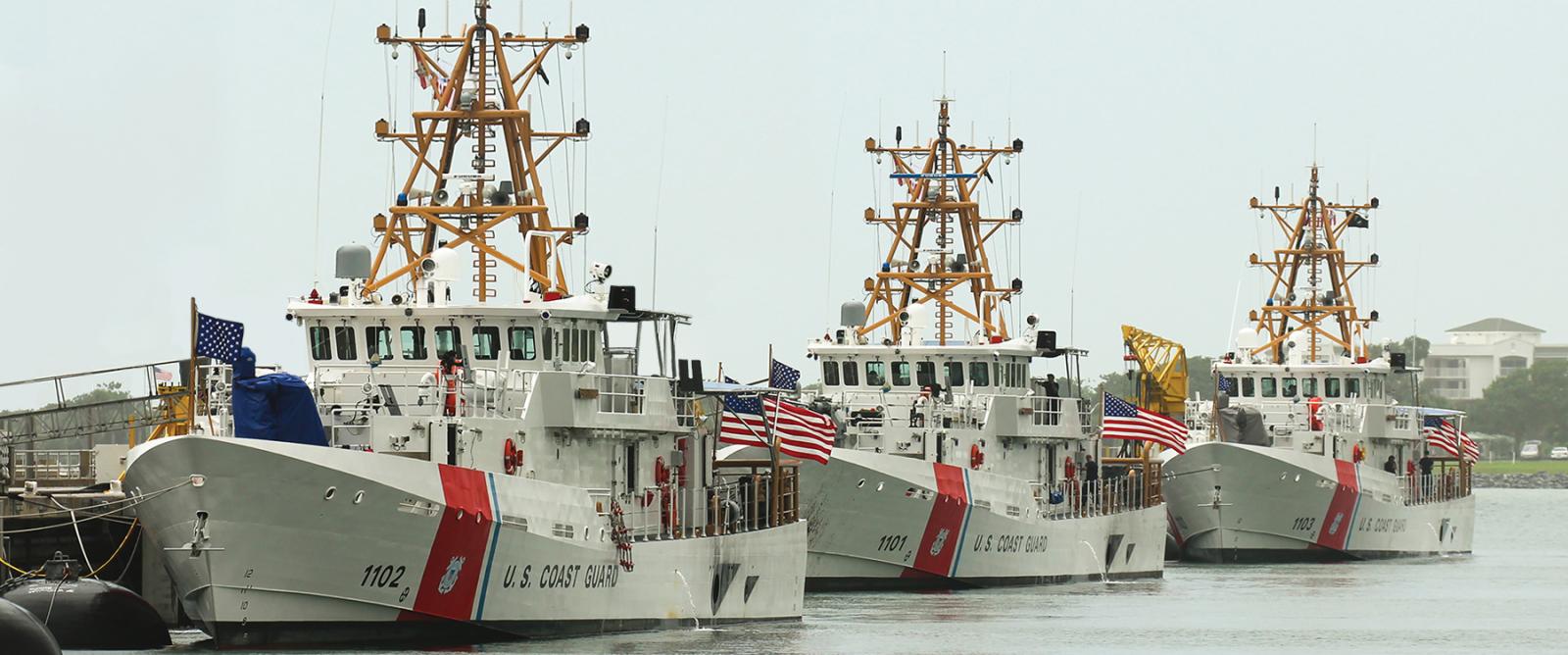
The first three fast response cutters—the USCGC Richard Etheridge (WPC-1102), Bernard C. Webber (WPC-1101), and William Flores (WPC-1103).
U.S. COAST GUARD
The September issue of US Naval Institute Proceedings has two articles about the Webber class WPCs that are currently featured articles online.
- Modern Cutters for IndoPaCom Partners is a Win-Win Opportunity, by Lt. Tai T. Chan, U.S. Coast Guard
- The Navy Should Use the Fast Response Cutter as a Patrol Boat, by Cdr. Steve Hulse, U.S. Coast Guard
MSN shared a 1945 article by James Holmes, J. C. Wylie Chair of Maritime Strategy at the Naval War College, that seconds Cdr. Hulse proposal, “The U.S. Navy Needs Sentinel-Class Cutters to Serve as Missile Patrol Craft,”
These are the right ships to help carry out U.S. maritime strategy in congested coastal terrain such as the Western Pacific, in wartime and times of tense peace alike. Denying an antagonist like China’s navy access to waters around and between Pacific islands is the strategy’s beating heart. Swarms of small, cheap, lethal surface and subsurface warships working with aircraft overhead and troops on the islands can close the straits along the first island chain, laying fields of overlapping fire that imprison Chinese sea and air forces within the island chain and bar the return home to units plying the Western Pacific. For self-defense, small surface combatants can mingle with merchant traffic amid East Asia’s cluttered maritime geography. In so doing they obscure their whereabouts and turn ambient conditions to tactical advantage. Let Chinese rocketeers try to distinguish friend from foe.
The first article by Lt. Chan suggests,
Continuing production of fast response and national security cutters and transferring early hulls to regional allies would improve deterrence and interoperability.
This may not seem to make sense from the Coast Guard’s point of view in that USCGC Bernard C. Webber was commissioned in 2012 and the last of the 65 funded vessels of the class will be commissioned in about three years at which point the Webber will be only about 14 years old, still pretty new for a Coast Guard vessel. But looking at this from a whole of government perspective it looks a bit different. State Department hopes to gain or maintain influence with friendly nations that may not be able to afford adequate resources to patrol their waters. We also have an interest in the health of our ship building industry. There is presidency for this. Australia has twice built new patrol boats for their Western Pacific neighboring island nations. The Coast Guard would, of course, be much more receptive to the idea if funding for the replacement craft came out of someone else’s budget.
If the Navy did choose to build vessels of this class, and keep the production line going, then transfers of early model FRCs might be more readily accepted as they reach 20 or more years old.
The Second Article by Cdr. Hulse suggests,
“…the FRC’s Mk IV over-the-horizon cutter boat weighs 8,700 pounds and is stored in a notch near the stern. While this boat is highly capable for a variety of Coast Guard missions, it would not play a role for the Navy in conflict. Instead, a Navy FRC could mount a Naval Strike Missile box launcher with four tubes (8,600 pounds) at the stern, making it a formidable surface combatant. In addition, the deck forward of the pilothouse has considerable space for launching and recovering unmanned aerial vehicles (UAVs), enabling aerial surveillance and targeting. In fact, a Coast Guard FRC launched and recovered an Aerovel Flexrotor UAV while operating with the U.S. Navy’s Task Force 59 in Bahrain…with the current production line delivering four new FRCs per year to the Coast Guard at $65 million each. At that rate, the Navy could field 20 FRCs in just five years for the price of one Constellation-class frigate, which is projected to cost $1.3 billion per hull.”
The article goes into considerable detail about how the class has exceeded expectations along with cautions about what was required to make them succeed. It also suggests that the FRC could be the basis for an unmanned surface vessel.
Boots on the Ground, Navy Style:
City police forces have found they need patrolmen walking the beat who know the neighborhood and the people who live there to effectively fight crime. Armies need infantry to control and hold territory.
High end combatants can defeat their hostile counterparts to make sea control possible, but effective sea control is not possible without craft that can get into shallow water and enter every port. As Julian Corbett would said, Naval Control is not exercised by battleships.
The US Navy, forever focused on winning the big battle, has never had much enthusiasm for the craft that are the “boots on the ground” of a naval war. They tend to assume that allies and/or the Coast Guard will fill that role, or if not, they can build them when they need them and to some extent it has worked. Even so, it might have worked better if we had built and operated more of the vessels of the type before the shooting started.
In World War I, the US built hundreds of subchasers and 1000 ton destroyers. In WWII it was hundreds of PT boats that proved largely ineffective as torpedo boats but essential for the destruction of coastal traffic in both the Pacific and the Mediterranean. They were supplemented by the original LCS, Landing Craft Support, heavily armed shallow draft landing craft, nearly the same size as the FRCs. For Vietnam the Navy called on the Coast Guard and also built 170 Swift Boats and 718 Patrol Boat, River.

The U.S. Navy destroyer USS William D. Porter (DD-579) sinking after she was near-missed by a “Kamikaze” suicide aircraft off Okinawa, 10 June 1945. USS LCS(L)(3)-86 and McCool‘s LCS(L)(3)-122 are alongside, taking off her crew. Though not actually hit by the enemy plane, William D. Porter received fatal underwater damage from the near-by explosion.
Why would the Navy want these Patrol Craft?:
- To enforce blockades
- To counter kamikaze UAS and USV.
- To support UAS, USV, and UUVs
- To counter covert mine laying, arms smuggling, and intelligence agent or special forces transportation by boat.
- To escort landing craft into an amphibious objective area. To rescue personnel from craft that are sunk. To tow disabled craft to safety. If properly equipped, to provide short range direct Naval fire support.

Strait of Hormuz, august 6, USS Thomas Hudner, the Navy’s Lewis and Clark class cargo ship USNS Amelia Earhart and the U.S. Coast Guard’s Sentinel class cutter USCGC Charles Moulthrope, L3Harris Arabian Fox uncrewed surface vessel (USV)

If assigned to 5th Fleet, it would be logical to equip them with Hellfire/JASM or APKWS to counter Iranian drones and swarm tactics. In the Western Pacific arming with Naval Strike Missile is logical as would using the same air-search radars being used on the FRCs based in Bahrain. It might be possible to fit a Sea RAM forward, but if not, one or two remote weapon stations with an AAW capability might be enough.
A Final Note:
There is another reason we might want to have other nations to have FRCs. Since my cell phone has facial recognition, I think US Navy ships will have a hard time hiding among the traffic, particularly at the start of a conflict when their satellites are operational, and their fishing boats and merchant ships seem to be everywhere. But telling a USN FRC from a Vietnamese, Philippine, or Malaysian FRC would be quite difficult. It would complicate targeting.
 Chuck Hill's CG Blog
There are probably opportunities for a better-designed Patrol-Boat-Missile, BUT, there is one thing which makes this a critically important opportunity: the hot production line.
Congress has finally recognized and offered money to do something actually meaningful when it comes to countering China; however, they drug their feet too long, and it is now too late. And the solutions the Navy offered and asked for are too big and will take too long.
China will act in the next five years, if they act at all. Having a 350-400 ship US Navy and increased shipbuilding capacity in 10-20 years will not help a bit in the next 5 years.
The price is known, and relatively cheap. Production is underway, and could probably be increased at least slightly. Congressional support is there to keep building them. The Navy would be stupid not to jump on this idea. (But Navy brass has been stupid before…)
They can produce up to one every 70 days, a bit better than five a year.
Anything James Holmes says should be taken very seriously.
Very confused as to whether I have or have not posted this.
…In that I think our timeline with China is closer to 14 months, I can be comfortable with this idea. The ship isn’t exactly set up ideally to be a FAC. Plus, aren’t the 2024 FRCs budgeted at 100 million each?
…The other ship, the “undiscovered country,” is the MUSV. They could choose to man it. Put a Mk 38 mod IV or probably more realistically an XM914 30mm RWS that can also mount Stingers and Javelin. That way you might also mount one facing aft. Use the RPS-42 radar we see on all the anti drone gear including Bahrain FRCs and the Marine MADIS/LMADIS which also makes use of the XM914. Then ISO containers with a containerized SEWIP/Decoy system and 4 mk 70 launchers. Satcom, Link-16. Now we have a patrol boat that can choose to launch 16 SM-6 or Tomahawk as soon as the ISR assets can provide the target. Max speed 38 knots. Range around 3800nm at over 20 knots.
…The small SAM system we aren’t using is an 11 cell RAM launcher without the Searam/Phalanx radars. I am guessing RPS-42 isn’t enough radar for RAM and of course needs integrated.
Should pursue the FAC idea, probably a good foreign aid boat for our allies, too.
I think their are better designs suited for the US Navy’s Presence missions BUT I think this where Congress wants to push the US Navy into FRC because the production line is HOT and the US Navy can cut the cost of the FRC down.
I do think the US Navy should reconsider bringing back the Concept we had with the Motor Torpedo squadrons of WW2 and center the FRC’s into a squadron. Imagine a squadron of FRC’s say in Northern Mariana Islands or American Samoa. The other in the Med such as Rota Spain or Bahrain with Centcom.
The other option I believe and no one is looking at is Swiftship’s 75 Meter Corvette as an option for the US Navy. That would be great for the US Navy’s Low end presence mission in the region and on top of that, it would give every prospective LT and LT(jg) a chance to prove if they have what it takes to command a larger ship in the future.
Here’s Swiftship’s design
https://swiftships.com/vessels/75-meter-swift-corvette/
Effectively the Coast Guard has been basing FRCs in three ship divisions and six or seven ship squadrons, but without the squadron staff anywhere but PATFORSWA.
Effectively D7 has three squadrons and every other district has one.
I would say the US Navy should bring back the Motor Torpedo squadrons like the days of then Lt John F Kennedy. If the US Navy did that with the FRC’s or even a low end ASW/ASUW Corvette, it would give the US Navy the ability to evaluate LT’s and LT(jg)’s a chance to see if they have what it takes to command an FRC or Corvette. If they can, then they can be in line for a frigate, destroyer or even an Amphibious assault ship down the line.
I just wonder chuck, could we ever revive the US Navy’s Motor Torpedo squadrons of the WW2 era into the 21st century FRC squadron.
@Nicky, the only afloat commands for officers O-4 or junior, are likely to be the Landing Ship, Medium. The Navy does not seem to be interested in building them, but the Marines want them, and they have a lot of influence. Otherwise, the Navy has shown no interest in building anything small.
– Pakistan appears to have cancelled their deal for these 75m which is where I think the concept originally came from.
-Austal just got the future LCU-1700 and some of that already contracted to Swiftships because they have failed to build these very basic hulls.
– Swiftships is to be building the MUSVs. I bet we see some issues there before its over. The design these are based on had previously been built by ulf Craft LLC nearby, but since they don’t lobby and have the business set up to deal with the government, here we go.
In the things that are small enough we could get several yards building them who will honor their construction contract, I’d toss out the Damen 6211 aka Warrior class in Australian service. Yes, its over double the displacement of FRC, but you could keep the boat launch, keep a decent C4I suite and deck weapons while carrying 2 Mk 70 launchers for Tomahawk and SM-6. Manned and very seaworthy. Half the main loadout we can squeeze from an MUSV, but it ccan also be out there patrolling and probably doing a great job if having to play bumper boats.
”BZ…Bravo Zulu; Keep Up The Great Work, and Lets Keep W.W.II/1939-1945 Naval History, ALIVE!!!”