
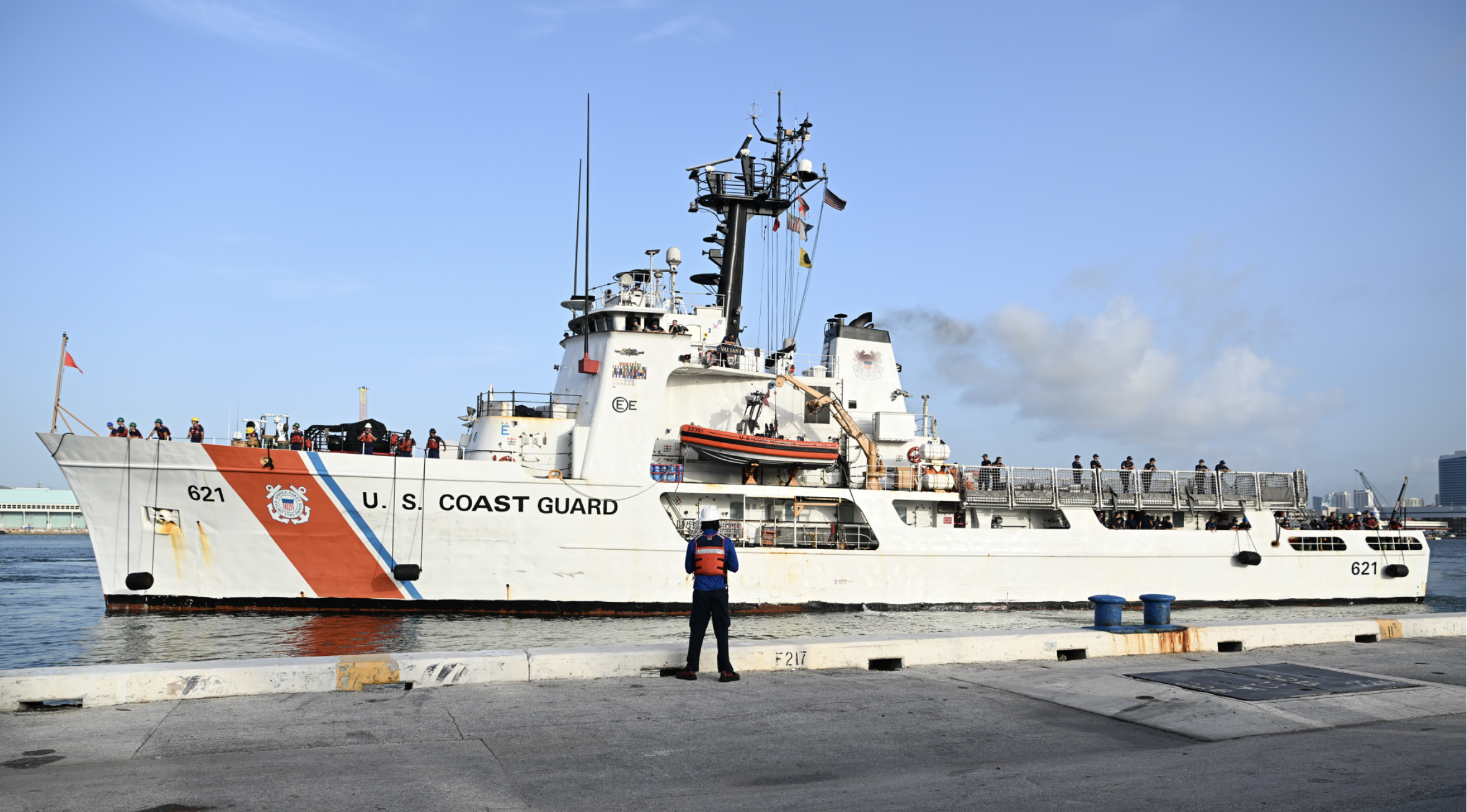
USCGC Valiant (WMEC 621) crew moors at Port Everglades in Fort Lauderdale, Florida, June 6, 2025. The Valiant crew offloaded more than $132 million in illicit drugs interdicted in the Caribbean Sea. (U.S. Coast Guard photo by Petty Officer 1st Class Diana Sherbs)
Below the line is a Coast Guard News release.
It includes a report of offload of drugs seized by USS Gravely.
Since March the Navy has kept two or three ships deployed to “secure the Southern Border” against illegal immigration and drug smuggling.
Departures of US Navy destroyers were widely reported, frequently with implications that the Coast Guard had not been paying attention to the Southern border or that the Coast Guard was incapable. Center for Strategic and International Studies stated,
First and foremost, the deployments send a powerful signal that the United States is taking border security, and the Western Hemisphere more broadly, seriously. In a statement from U.S. Northern Command (NORTHCOM) upon deployment of the Spruance, the ships will “restore territorial integrity at the U.S. southern border” and will support operations related to “combating maritime related terrorism, weapons proliferation, transnational crime, piracy, environmental destruction, and illegal seaborne immigration.” The tasking of some of the United States’ most exquisite naval capabilities to support Southwest border operations accordingly provides yet another indicator that a strategic pivot to the Western Hemisphere in general, and the U.S.-Mexico border in particular, is well underway.
The DDGs are marvelous ships as demonstrated by their performance against the Houthis in the Red Sea. Their more sophisticated sensors were also touted, but the results have been underwhelming.
Results:
So what happened? Let’s give credit where credit is due.
Guided missile destroyers involved, as far as I can determine, have been USS Gravely, USS Spruance, USS Stockdale which replaced Spruance in mid April, USS Cole which very recently replace Gravely, and Sampson which just replaced Stockdale.
As far as I can tell, the interdiction of 840 pounds of cocaine valued $13.7M by USS Gravely, which deployed March 15, reported below, is the only interception of drugs reported by a destroyer in the almost three months since their intervention began.
By comparison:
USS Minneapolis-Saint Paul (LCS-21) which deployed March 25 has made three interdictions. USS Charleston Deployed May 21. I presume she is replacing Minneapolis-Saint Paul. The first two resulted in seizure of 580 kilograms (1,279 pounds) of cocaine valued at $9,463,860 and 1,125 kilograms (2,480 pounds) of marijuana valued at $2,807,360. I was not able to find similar figures for the third.
In an earlier post I posted the results of drugs landed on thirteen different occasions from February 13 to May 2, 2025 comparing interdictions in the Eastern Pacific with those made in the Atlantic, Gulf, and Caribbean. In total 168,574 pounds or more than 84 tons, valued at $1,702.9 million. There have been additional offloads since then including the one below.
That is 196 times as much as was seized by Navy Destroyers. Only a very small part of which was marijuana rather than cocaine, none of which was seized in the Eastern Pacific. Notably no Fentanyl was included.
Our Canadian and Netherlands Navy partners each seized more contraband than the US Navy this period.
Why the poor showing?:
Functionally the DDGs should have been at least as effective as other units doing this mission, so why weren’t they more effective?
I think because they were looking in the wrong place.
Early announcements seem to indicate they primarily being deployed primarily to interdict immigrants with drug interdiction a secondary mission, but as I noted in the earlier post,
Perhaps surprisingly, cutters in the Western Atlantic areas looking for drugs don’t intercept many migrants and cutters looking for migrants don’t find much in the way of drugs or even migrants. There were four WMEC patrols identified as looking for migrants. None of the four found any drugs. One intercepted no migrants. The three remaining patrols intercepted a total of 184.
The West coast deployment seems to have been in vicinity of San Diego. Most drug interdictions in the Pacific happen off the Central and South American coast.
There has been something of a surge in maritime illegal migrant interdictions on the West Coast but they have been concentrated close to shore near San Diego and the Mexican border, using recreational style small craft, but the totals are still relatively small.
As far as I have heard (and I think I would have) none of the US Navy ships have intercepted any immigrants.
Other thoughts:
Any assistance the Navy might provide is always welcome, but any implication that the Coast Guard has not been working the problem with considerable success, limited only by resources available, is unfair. There simply is no such thing as 100% secure.
The Navy has also provided additional ISR resources. Both the Navy and Coast Guard can only benefit from better Maritime Domain Awareness even if the information is used for different purposes.
Having an alert, active DDG positioned off US naval bases (like San Diego) might be a good idea since, as yet, we really have no land based missile defenses capable of countering cruise missiles that might be launched from container ships in an initial surprise attack.
June 6, 2025
Coast Guard offloads more than $138 million in illicit drug interdictions in Caribbean Sea
Coast Guard Seventh District – 786-367-7649
MIAMI –U.S. Coast Guard Cutter Valiant’s crew offloaded 17,450 pounds of cocaine and 2,585 pounds of marijuana worth $132 million, Friday, at Port Everglades.
U.S. Coast Guard Cutter Vigorous crew offloaded approximately 840 pounds of cocaine worth an estimated $6.2 million, Thursday, at Coast Guard Base Miami Beach.
The seized contraband was the result of six interdictions in the Caribbean Sea by Coast Guard and interagency partners.
“I am incredibly proud of our Valiant team and how they exemplify American values. They sacrifice time away from their families and when necessary, put themselves in harm’s way to secure our borders and protect the American people,” said Cmdr. Matthew Press, commanding officer of Valiant. “Collaborating with the United States Navy, Royal Canadian, and Royal Netherlands Navies, our multinational team disrupted transnational criminal organizations making the world a safer place.”
On May 19, a maritime patrol aircraft located a suspicious vessel approximately 85 miles north of Aruba. Valiant’s crew interdicted the vessel and seized approximately 2,645 pounds of cocaine.
On May 22, a maritime patrol aircraft located a suspicious vessel approximately 170 miles north of Aruba. Valiant’s crew interdicted the vessel and seized approximately 7,750 pounds of cocaine.
On May 25, a maritime patrol aircraft located a suspicious vessel approximately 290 miles south of the Dominican Republic. USS Gravely’s crew and embarked U.S. Coast Guard Law Enforcement Detachment 401 interdicted the vessel and seized approximately 840 pounds of cocaine. The narcotics were transferred to the Vigorous.
On May 29, a maritime patrol aircraft located a suspicious vessel approximately 140 miles south of the Dominican Republic. His Majesty’s Canadian Ship William Hall’s crew and embarked Coast Guard LEDET 103 interdicted the vessel and seized approximately 750 pounds of cocaine. The narcotics were transferred to the Valiant.
On May 29, a maritime patrol aircraft located a suspicious vessel approximately 15 miles north of Venezuela. The Royal Netherlands Navy ship HNLMS Friesland crew and embarked Coast Guard LEDET 404 interdicted the vessel and seized approximately 4,050 pounds of cocaine and 2,585 pounds of marijuana. The narcotics were transferred to the Valiant.
On May 31, a maritime patrol aircraft located a suspicious vessel approximately 185 miles north of Colombia. HMCS William Hall’s crew and embarked Coast Guard LEDET 103 interdicted the vessel and seized approximately 2,250 pounds of cocaine. The narcotics were transferred to the Valiant.
The following crews assisted with interdiction operations:
- Joint Interagency Task Force-South (JIATF-S)
- U.S. Coast Guard Tactical Law Enforcement Team South
- U.S. Coast Guard Tactical Law Enforcement Team Pacific
- USS Gravely (DDG 107)
- U.S. Navy Helicopter Maritime Strike Squadron (HSM) 74
- Royal Netherlands Navy ship HNLMS Friesland (P-842)
- HMCS William Hall (AOPV 433)
- Seventh Coast Guard District watchstanders
Detecting and interdicting illicit drug traffickers on the high seas involves significant interagency and international coordination. Joint Interagency Task Force-South, in Key West, conducts the detection and monitoring of aerial and maritime transit of illegal drugs. Once an interdiction becomes imminent, the law enforcement phase of the operation begins, and control of the operation shifts to the U.S. Coast Guard for the interdiction and apprehension phases. Interdictions in the Caribbean Sea are performed by members of the U.S. Coast Guard under the authority and control of the Seventh Coast Guard District, headquartered in Miami.
These interdictions relate to Organized Crime Drug Enforcement Task Forces’ Strike Force initiatives and designated investigations. OCDETF identifies, disrupts, and dismantles the highest-level criminal organizations that threaten the United States using a prosecutor-led, intelligence-driven, multi-agency approach. Additional information about the OCDETF program can be found at https://www.justice.gov/OCDETF.
USCGC Valiant is a 210-foot medium endurance cutter homeported in Jacksonville under U.S. Coast Guard Atlantic Area Command.
USCGC Vigorous is a 210-foot medium endurance cutter homeported in Virginia Beach, Virginia under U.S. Coast Guard Atlantic Area Command.
For breaking news, follow us on X (formerly Twitter). For additional information, find us on Facebook and follow us on Instagram.
 Chuck Hill's CG Blog
The destroyers are going to be better at tracking drones, small, low flying aircraft and semi-submersibles than the Cutters.
The Cartels have reportedly started using drones for recon and delivery. The better sensors of the Destroyers have a role to play even if its just tracking and vectoring other assets.
This is not knocking the Coasties, just saying the Navy has more sophisticated sensors and they will be useful.
The drones are not way off shore. They are flying over the border.
We already track more smugglers than we can intercept.
Just look at the results.
The ships are being misused.
We will just have to agree to disagree on that.
The tracking and interdiction of drones is a real thing but one not discussed much publicly.
In the current era, border security is more than boarding operations.
Maybe if the Coast Guard got the same budget as the rest of the military they good do their job better than its doing now, Its pretty sad we expect the Coast Guard to do a job that is big as the military doing over seas with a small budget that is 1/3 or less than the rest of the military gets. Its also sad that we let our Ice breaking fleet dwindle to nothing and then buy an ice breaking vessel that has known flaws and issues to support the Arctic issue, Its about time the rest of the military help the Coast Guard in protecting our borders.
USS Cole has transported some contraband seized by a Coast Guard team operating from a Canadian vessel and transferred it to a cutter.
this is news worthy?
https://seapowermagazine.org/uss-cole-assists-royal-canadian-navy-u-s-coast-guard-conduct-at-sea-transfer-of-intercepted-contraband/
U.S. Coast Guard, USS Sampson Conduct Drug Interdiction In Eastern Pacific https://seapowermagazine.org/u-s-coast-guard-uss-sampson-conduct-drug-interdiction-in-eastern-pacific/
Looks like Navy ships are finally being sent to areas where they can intercept drugs if not immigrants.