
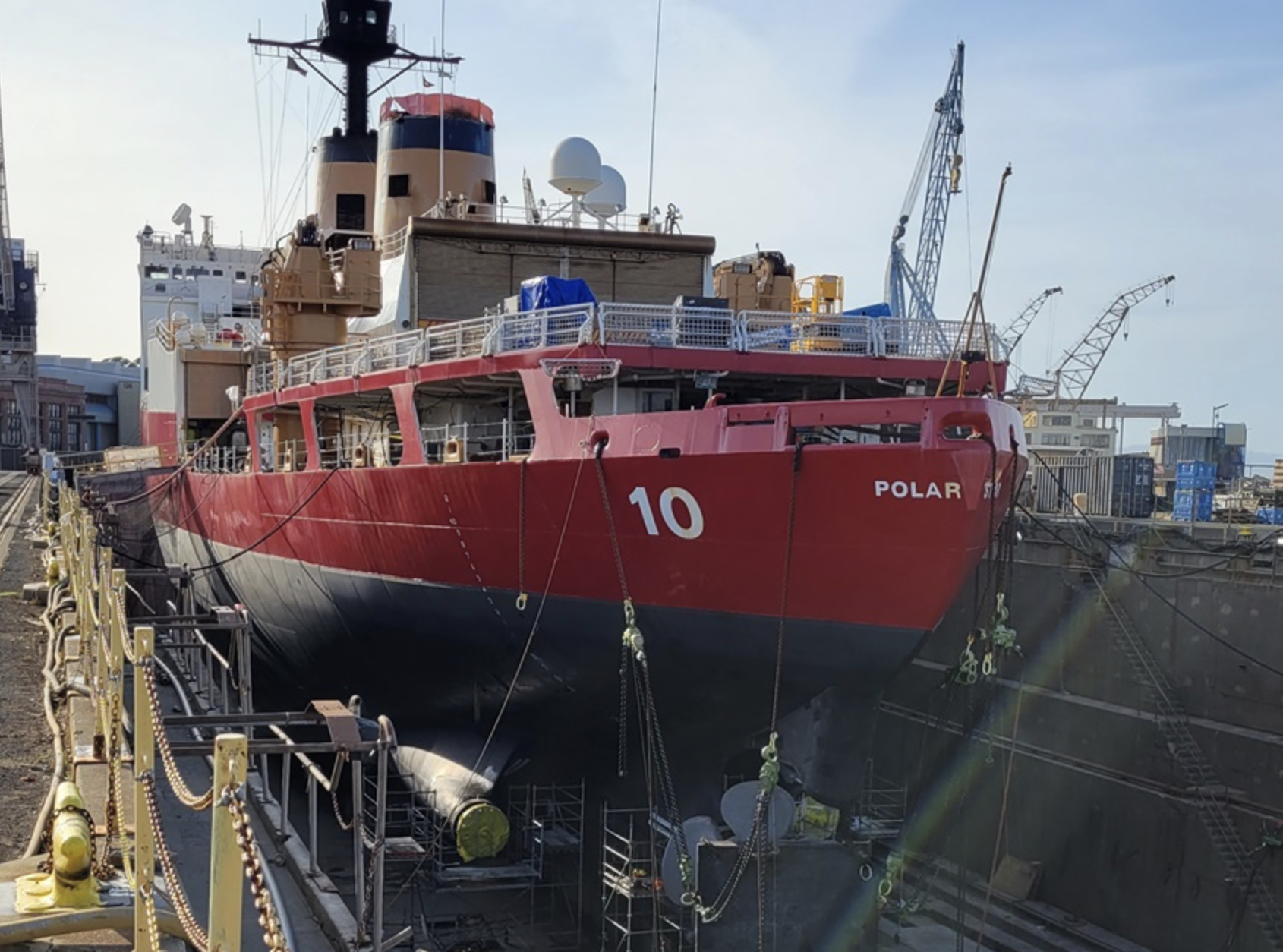
The rudder of the USCGC Polar Star (WAGB 10) is being removed while in a Vallejo, Calif., dry dock, April 1, 2025. The maintenance work completed over the past five years recapitalized integral systems, including propulsion, communication, and machinery control systems. (U.S. Coast Guard photo by Seaman Nestor Molina)
“On Dec. 30, 2025, California ship repairer Mare Island Dry Dock LLC (MIDD) informed the City of Vallejo that it would permanently close its Mare Island facility, resulting in the termination of all employees over the coming days.
The plan had been for USCGC Healy to go through a phased Service Life Extension program at this yard in much the same way as USCGC Polar Star had done. Apparently that plan has changed.
Having a yard with the potential of Mare Island close when the country is waking up to the fact that it needs more shipyards, particularly on the West Coast, seems unwise. This may be an opportunity for the Federal Government to recover all the Mare Island yard for future development. Government owned shipyards are an advantage, particularly for emergency repairs. No need to send out for bids. No need to wait for a court decision if loosing bidder objects.
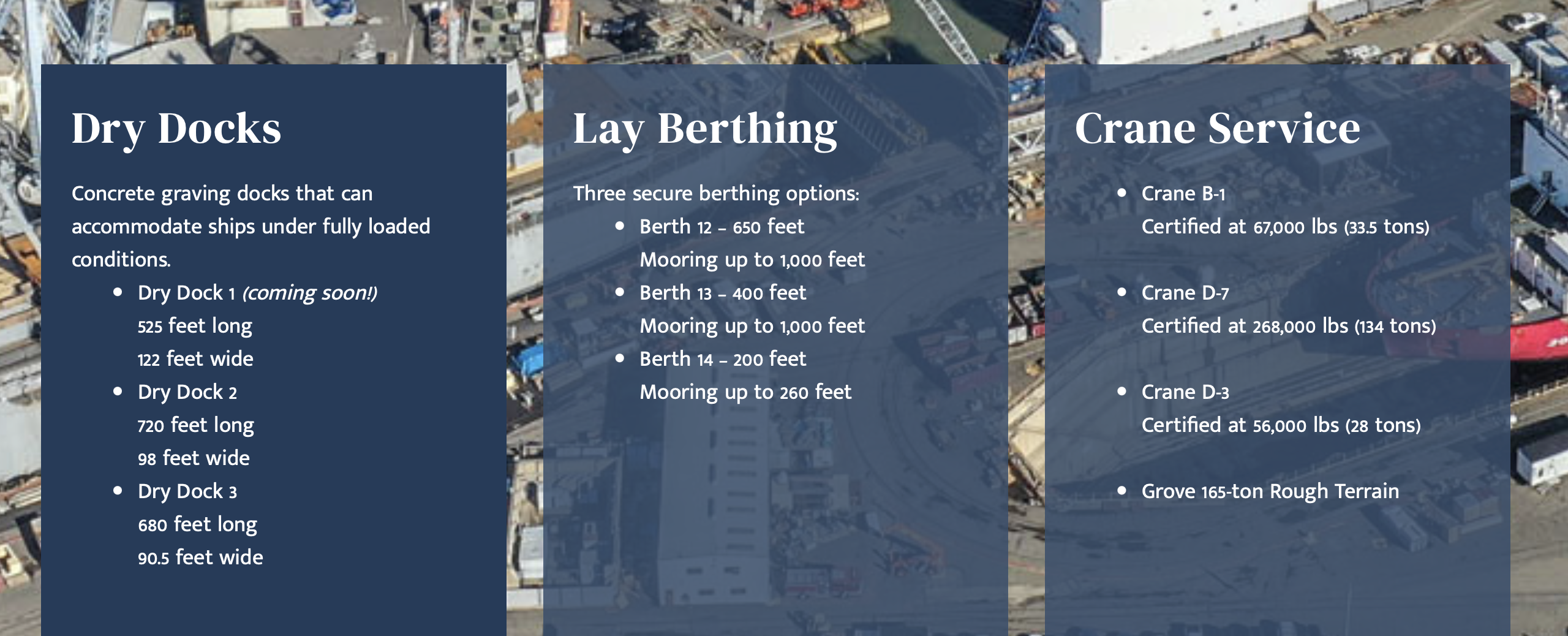
This could be Coast Guard Yard West. It could also be a homeport.
The Polar Security Cutters and most of the Arctic Security Cutters will be coming to the West Coast.
Its true that the cost of living and consequently wages would be higher than most East Coast Yards, but by West Coast standards, Vallejo is a relative bargain with cost of living far lower than Seattle, Alameda, Long Beach, San Diego, or Honolulu.
 Chuck Hill's CG Blog
What does Mare Island have that PSNS in Bremerton doesn’t?
I don’t know but why didn’t Polar Star get her five part Service Life Extension at PSNS Bremerton?
There is a Nationwide shortage of dry docking facilities.
I don’t know if the rational for scheduling icebreaker maintenance availability at Mare Island was technical or political/commercial. Healy and the Polaris can fit in all six graving docks, most can fit one of each simultaneously.
There sure was a large crew that couldn’t spend couldn’t spend the off season in their home port. I presume that much of the crew would have preferred the ability to live in Kitsap County or take the ferry rather than get Bay Area TDY per diem. A people first strategy would have favored PSNS or a home port change to Alameda but obviously neither happened.
@R, yes, several times I pointed out how this was a hardship on the crew.
MIDD is capable of constructing ships up to 500’ in length and maintaining ships up to 700’ in length…
Something I have never understood is . . . why a Polar Class Icebreaker has to be retired. The hull-form is the working end of this construct and it works perfectly when properly manned, powered, and maintained.
These “Polar Class” icebreaker constructs can be rebuilt to a standard configuration for both, and that in a mission set for these two unique hull-forms. Those extremely valuable hulls are no longer made yet extremely effective in performing their mission. Rebuilding these two hulls to common/equipment sets (standard) is much less expensive over building new.
I am not saying we do not need more icebreakers because we do need them, and they should be under construction already.
Concerning shipyards . . . perhaps it is time for the U.S. government to buy another shipyard, and begin re-vamp operations.
USCG actually made an estimate for the cost of reactivation of USCGC Polar Sea. In short, 8 years and $1.3 billion would give you between 7 and 10 years of additional service life, and anything beyond that would require further recapitalization. After a certain point, the same price tag would likely apply to USCGC Polar Star.
https://www.dhs.gov/sites/default/files/2024-12/2024_1002_uscg_coast_guard_cutter_polar_sea_reactivation.pdf
Having actually visited USCGC Polar Sea when it was laid up in Seattle, I don’t even want to start imagining the compromises that would have to be made when shoehorning modern technology into those 50-year-old hulls after they have been scooped clean of obsolete systems.
So . . . in your qualified professional opinion even a deliberate commonality design would not be worth the effort?
@TORCH, yes, in my qualified professional opinion it would not be worth the effort.
The USCG Polar-class icebreakers were practically built around the never-tried-before-and-never-used-since 60,000-horsepower combined diesel-electric or gas (CODLOG) power plant. While it certainly has provided unrivaled power-to-displacement ratio and enormous icebreaking capability, it is also very complex and has suffered from major reliability issues throughout the service life.
Extending the service life would certainly include replacing the existing gas turbines, diesel generators, propulsion motors, shaft lines and controllable pitch propellers with a modern fully diesel-electric plant and fixed pitch propellers. Given just how different these modern systems would be, shoehorning them into the football-shaped hull would not be easy. Since cutting into the hull made of the exotic CGA537M grade steel no-one knows how to weld would be out of the question, the only solution would be to temporarily remove the whole superstructure to gain access to the engineering compartments.
Even if all that could be done successfully — and that’s a big “if” — you would still be left with numerous 50-year-old design solutions, the first and foremost being a triple-shaft propulsion layout in the era where more capable azimuthing propulsion has become practically a standard for modern icebreakers.
In my opinion, the best course of action would be to keep USCGC Polar Star in service as long as it can be done reasonably, for example by using parts from the inactive USCGC Polar Sea — which, I recall reading, is already largely exhausted — but forgo the kind of major refit I described above. If you had the resources to essentially rebuild a 50-year-old icebreaker, you would certainly have the resources to build a completely new icebreaker. It could be even cheaper.
I wonder about the qualifications and temperament of the estimator. Was he a Montgomery or a Patton?
At a time when there is a resurgence in the need for capacity, this could be an opportunity for someone (Korean or Canadian Shipyard) or the US Government, to buy the yard. Graving docks don’t come along every day.
AMEN!
They need to eminent domain back some of the buildings that have businesses in them and probably get CS Marine to move elsewhere. They should definitely look at a clean sheet reconfiguration of the yard with a Pearlson shiplift and or floating drydock for land level activity. My guess is they shoot for a graving dock or 2 to allow the largest conceived iteration of a Columbia SSBN and a Virginia SSN or SSNX as I have never seen where we lift those back to land level elsewhere. Make some new land in the redesign. The locals will hate it. Tough.
The locals would love having the employment opportunities back.