
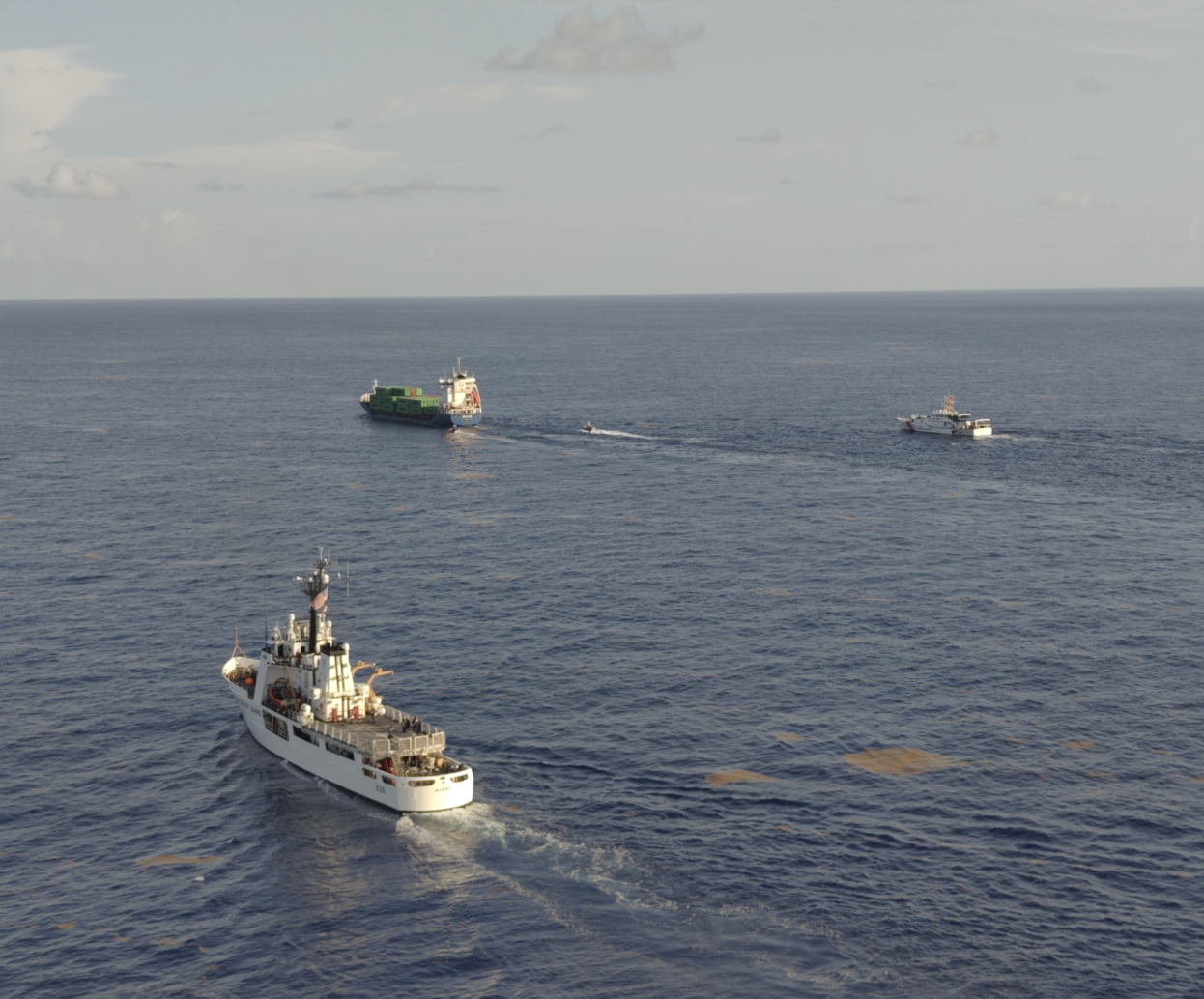
U.S. Coast Guard Cutters Alert (WMEC-630) and Charles Sexton (WPC-1108) escort the motor vessel Grace in early September 2026. The Coast Guard interdicted the vessel following a coordinated international enforcement operation concerning its suspected illicit transport of fuel to Cuba. The vessel was later escorted to Progreso, Mexico, where a Mexican Navy inspection team confirmed the presence of large quantities of fuel in its ballast tanks. (U.S. Coast Guard photo)
This is unusual. Below is a news release from CG HQ. No indication in the release as to why the Mexican Navy was involved. I suspect that Mexico was the last port of call. No flag state is reported, but it appears she was last registered in COMOROS, an independent volcanic island nation, located in the Indian Ocean off the eastern coast of Africa, at the northern end of the Mozambique Channel between Mozambique and Madagascar.
Obviously M/V Grace is not a tanker.
Most interestingly the release seems to indicate that this is a continuing operation.
Coast Guard intercepts Motor Vessel Grace, continues operations to interdict illicit Cuban fuel shipments
WASHINGTON – The Coast Guard concluded the successful interdiction of the Motor Vessel (M/V) Grace, following a coordinated international enforcement effort confirming the vessel’s illicit trafficking of fuel to Cuba.
In early September, a Coast Guard tactical team boarded M/V Grace in the Caribbean Sea. M/V Grace was transiting to Cuba, carrying fuel, and was believed to be employing tactics common amongst the “dark fleet.” Following the boarding, the Coast Guard escorted the M/V Grace to Progreso, Mexico, where a Mexican Navy (MARINA) inspection team confirmed the presence of large quantities of fuel in the vessel’s ballast tanks. The vessel was also carrying several containers believed to contain illicit fuel.
The unsafe stowage of fuel in ballast tanks represents an inherent hazard to the marine environment. The actions of the United States and Mexico prevented an unregulated fuel transfer in the Caribbean Sea, where deceptive shipping practices, unsafe vessel conditions and concealed cargoes can increase the risk of oil spills and other pollution incidents that threaten coastal communities, fish stocks and sensitive marine ecosystems.
“Illicit fuel shipments violate international law and pose severe environmental threats in the Caribbean Sea, said Vice Adm. Nate Moore, deputy commandant for operations. “As the Coast Guard leverages our unique authorities and capabilities on the high seas, coordinated efforts are vital to stopping illegal fuel shipments and upholding international law. We thank the Government of Mexico for its assistance in bringing M/V Grace to justice.”
The Coast Guard employed a range of assets and specialized capabilities to ensure a safe, seamless operation in accordance with U.S. and international law. The following assets and crews were involved in the interdiction operations:
- U.S. Coast Guard Cutter Alert (WMEC-630)
- U.S. Coast Guard Cutter Charles Sexton (WPC-1108)
- U.S. Coast Guard HC-144 Fixed-Wing Aircraft
- U.S. Coast Guard Tactical Law Enforcement Team South
- U.S. Coast Guard Southeast District watchstanders
“The high seas are not a sanctuary for lawlessness,” said Adm. Kevin Lunday, commandant of the Coast Guard. “Dark fleet actors who employ deceptive tactics to engage in illicit activities will not evade justice. The Coast Guard is bringing every capability to bear to interdict these vessels and uphold international law.”
The interdiction of M/V Grace follows the Coast Guard’s boarding and detention of the M/V Jaira Provider, another substandard vessel determined to be carrying illicit fuel to Cuba earlier this summer. In support of U.S. Government policy and in coordination with interagency and international partners, the United States Coast Guard continues to conduct operations to counter illicit maritime activity by dark fleet, stateless and vessels that fail to adhere to international standards. These efforts are conducted consistent with customary international law as reflected in the Law of the Sea Convention and in cooperation with Flag State and Port State authorities.

