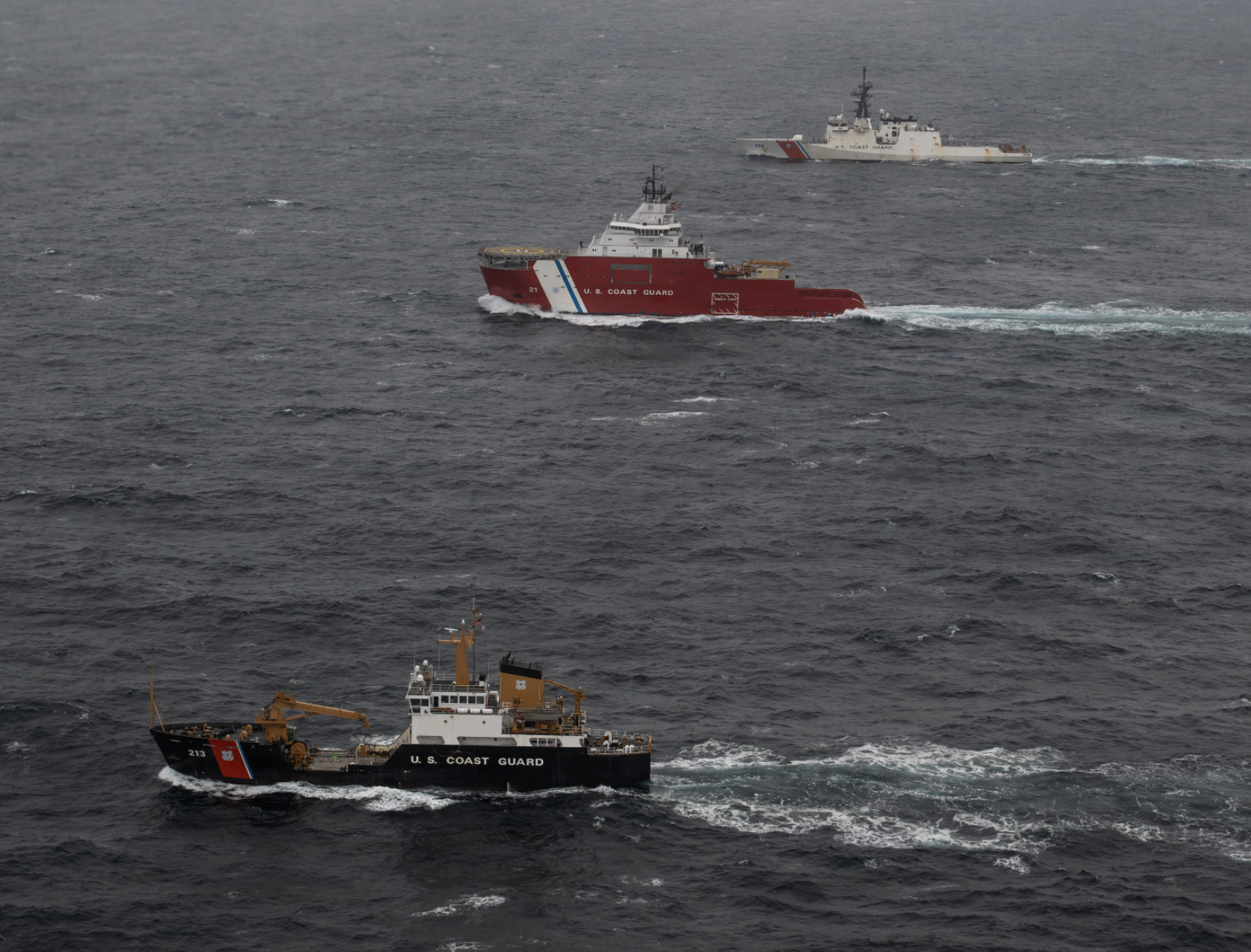
USCGC Munro (WMSL 755) transits in formation in the high latitudes of the Arctic Ocean alongside USCGC Storis (WAGB 21) and USCGC Fir (WLB 213) in support of Operation Tundra Merlin, July 21, 2026. The joint high‑latitude sail brought together three distinct cutter classes — a national security cutter, a medium‑endurance icebreaker and a seagoing buoy tender — demonstrating the Coast Guard’s versatile surface capabilities to safeguard national security and environmental stewardship in Arctic waters. (U.S. Coast Guard courtesy photo.) Note, of the three ships, only Munro is armed with something more than a .50 caliber machine gun.
Below is a District SW news release.
There are a couple of things that are noteworthy, first the length of this almost four month deployment and the fact that it included operation in the Arctic Ocean, both are departures from the ALPATSs I experienced and they indicate growing concern for US interest in the Arctic Ocean.
Notably the US Pacific Fleet does not send surface vessels into the Arctic Ocean. They seldom operate much North of the Aleutians.
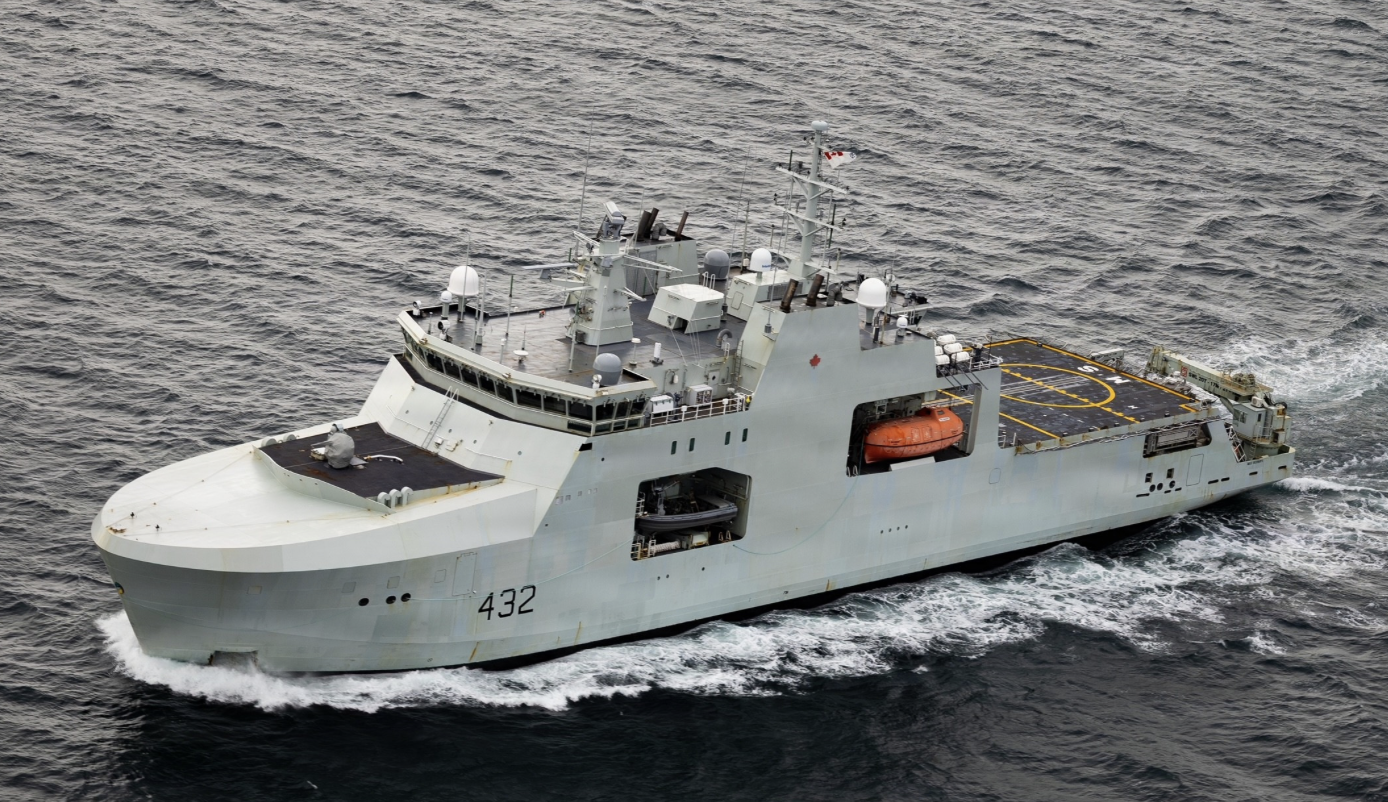
Royal Canadian Navy HMCS Max Bernays (AOPV 432) patrols the Bering Strait during a combined sail with U.S. Coast Guard Cutter Stratton (WMSL 752) Aug. 11, as part of Operation TUNDRA MERLIN. This combined sail directly supports the Canadian Armed Forces core missions to detect, deter, and defend Canada against potential threats, while contributing to the security of the North American continent in partnership with the United States. (U.S. Coast Guard Courtesy photo)
The Canadian Navy vessel mentioned, HMCS Max Bernays (AOPV 432), is a DeWolf class Arctic Offshore Patrol Ship (AOPS), a light icebreaker armed with a single 25mm Mk38 mount modified for the Arctic environment. She is one of six of this class in the Canadian Navy. Two of the class are being built for the Canadian Coast Guard.
I also love this accompanying photograph which shows an over-the-horizon boat (center) alongside a long range interceptor (right), the boat launching slip, and the over-the-horizon boats cradle (left).
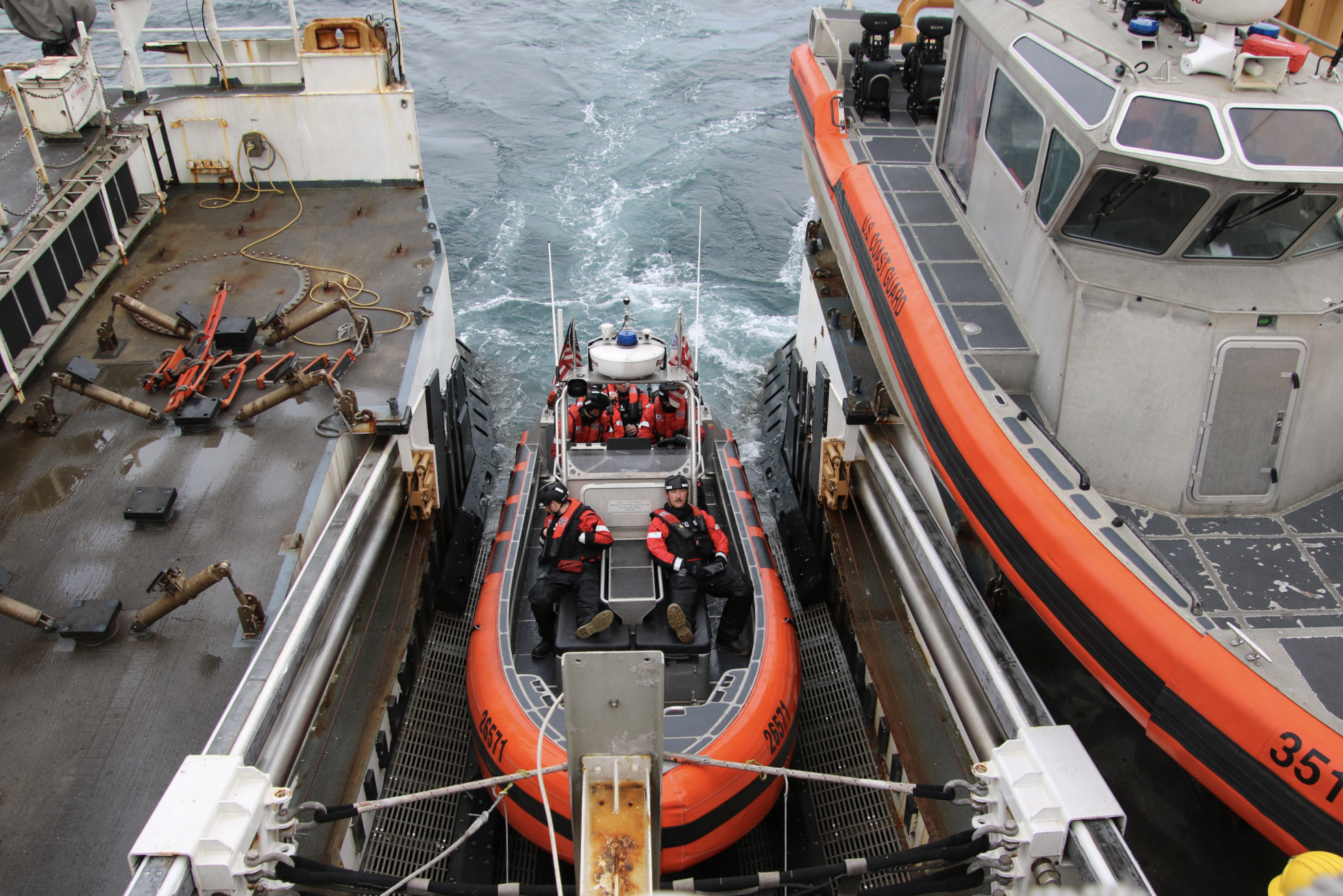
A boarding team deployed from USCGC Munro (WMSL 755) returns aboard an over‑the‑horizon small boat following the completion of a living marine resources boarding in the Bering Sea, Aug. 25, 2026. After concluding its safety and compliance inspection aboard a commercial fishing vessel, the team navigated challenging Bering Sea conditions to rendezvous with the cutter, highlighting the coordination between the cutter, small‑boat crews and boarding personnel tasked with maintaining a regular law‑enforcement presence across Alaskan fisheries. (U.S. Coast Guard photo by Ensign Andres Garcia Rodriguez)
ALAMEDA, Calif. — The crew of Coast Guard Cutter Munro (WMSL 755) returned to their Base Alameda homeport on Coast Guard Island Oct. 9, 2026, following a 112-day Alaska patrol that covered more than 23,000 nautical miles across the Bering Sea and Arctic Ocean.
Operating under the Coast Guard Arctic District, Munro deployed to control, secure and defend the nation’s northernmost maritime approaches, enforce living marine resource regulations and strengthen defense interoperability with joint and international partners in an increasingly contested region.
During the patrol, Munro executed Operation Frontier Sentinel, monitoring three Chinese-flagged research vessels operating in and around the U.S. Arctic maritime domain. Munro’s crew ensured the foreign vessels complied with international maritime law while asserting U.S. sovereignty.
Highlighting close allied interoperability, Munro conducted combined exercises with the Royal Canadian Navy. These engagements enhanced bilateral law enforcement cooperation, joint maneuvering, and shared domain awareness among the allied maritime services operating in polar waters.
Munro also integrated into strategic Western Hemisphere defense operations, supporting Operation Tundra Merlin. These operations brought Munro together with U.S. Department of War and Canadian Armed Forces assets to test multi-domain homeland defense architecture, integrate command-and-control networks and validate joint force lethality and response readiness in northern maritime corridors.
“The Arctic is a demanding maritime environment that can test any crew and vessel,” said Capt. Adam J. Disque, Munro’s commanding officer. “We were proud to sustain U.S. presence in the region to safeguard our Arctic coastline and reinforce a rules-based order in the High North. We also strengthened our enduring partnership with Canadian counterparts, advancing shared domain awareness and coordination across the remote region. I am exceptionally proud of everything this crew accomplished in one of the world’s most challenging maritime environments.”
Munro served as the frontline guardian of the $6 billion Alaskan commercial fishery. Law enforcement teams conducted living marine resources boardings on commercial fishing vessels operating in the Bering Sea, ensuring compliance with federal safety regulations and fisheries laws to preserve vital fish stocks
Commissioned in 2017, Munro is one of four 418-foot Legend-class national security cutters homeported in Alameda. The cutter is named in honor of Signalman 1st Class Douglas A. Munro, the only member of the Coast Guard to receive the Medal of Honor for his heroism at Point Cruz, Guadalcanal, on Sept. 27, 1942, where he gave his life rescuing nearly 500 Marines under enemy fire.