“America’s Tall Ship, U.S. Coast Guard Barque Eagle, announces 2026 sail training schedule for Nation’s 250th anniversary” –News Release, Atlantic Area

190815-F-WJ663-0759
U.S. Coast Guard Barque Eagle (WIX 327), arrives in New York City, August 15, 2019. Eagle is a tall ship used as a training platform for future Coast Guard Academy officers as well as vessel for establishing and maintaining domestic and international relationships. (U.S. Air Force photo by Staff Sgt. Cory D. Payne)

Below is a Coast Guard news release.


Dec. 19, 2025

America’s Tall Ship, U.S. Coast Guard Barque Eagle, announces 2026 sail training schedule for Nation’s 250th anniversary

PORTSMOUTH, Va. — U.S. Coast Guard Barque Eagle (WIX 327) announced its 2026 schedule of port calls Friday. 

The selected port calls include the five Sail250 ports of New Orleans, Norfolk, Baltimore, New York City, and Boston. Sail250, a global gathering of tall ships and military ships to celebrate the 250th anniversary of the founding of the United States. It will offer crews, cadets and visitors from all over the world an unforgettable experience and a world-class maritime celebration.

“It is an immense honor for the Coast Guard Barque Eagle and crew to participate in the Sail250 festivities and celebrate the 250th anniversary of our nation,” said Capt. Kristopher Ensley, commanding officer of Eagle. “This voyage not only serves as a vital training experience for the next generation of Coast Guard officers but also allows us to share America’s proud maritime heritage with the public. We are thrilled to visit these historic ports and sail alongside magnificent vessels from around the world.”

The summer schedule includes the following dates and locations:

  • May 8 – 11: TBD

  • May 23 – 25: Pensacola, Florida

  • May 28 – June 1: New Orleans, Louisiana

  • June 11 – 14: Charleston, South Carolina

  • June 19 – 22: Norfolk, Virginia

  • June 25 – 28: Baltimore, Maryland

  • July 4 – 8: New York, City, New York

  • July 11 – 14: Boston, Massachusetts

  • July 24 – 27: Portland, Maine

  • July 31 – August 3: Newport, Rhode Island

  • August 7 – 10: Greenport, New York

  • August 14: New London, Connecticut

For the first time since 1976, Eagle and its sister ships, Gorch Fock (Germany), Sagres (Portugal) and Mircea (Romania), will be competing for the Five Sisters Trophy. The sail race will be between New York City and Boston starting July 9 off the coast of New York.

Public tour schedules for the Eagle at each port will be announced closer to the event dates.

Limited opportunities for media members to ride aboard the Eagle during its inbound transits to select ports will be available. All interested media should contact lantpao@uscg.mil for details and to inquire about availability.

About Eagle: 

At 295 feet in length, Eagle is the largest tall ship flying the stars and stripes and the only active square-rigger in United States government service. Constructed in 1936 by the Blohm and Voss Shipyard in Hamburg, Germany, and originally commissioned as the Horst Wessel by the German Navy, Eagle was a war reparation for the United States following World War II. Eagle is a three-masted barque with more than 22,300 square feet of sail and six miles of rigging. Eagle has served as a classroom at sea to future Coast Guard officers since 1946, offering an at-sea leadership and professional development experience as part of the Coast Guard Academy.

For a continuous stream of information about Eagle, including port cities, tour schedules, current events, as well as cadet and active duty crewmember photographs, follow the United States Coast Guard Barque EAGLE Facebook page or on Instagram @barqueeagle.

About Sail250: 

Sail250 is a series of maritime festivals in 2026 celebrating the 250th anniversary of the United States. The events will feature a grand spectacle of international tall ships, military vessels, and other maritime activities in the host cities of New Orleans, Norfolk, Baltimore, New York City, and Boston.

Contract for “Polar Security Cutter land based test facility and production integration facility long lead time material”

DOD “Contracts For Dec. 18, 2025” included this for the Polar Security Cutter program.

Bollinger Mississippi Shipbuilding (BMS), Pascagoula, Mississippi, is awarded a $33,077,880 cost reimbursable contract modification to previously awarded contract (N00024-19-C-2210) for Polar Security Cutter land based test facility and production integration facility long lead time material. Work will be performed in Pascagoula, Mississippi, and is expected to be completed by September 2027. Fiscal year 2025 procurement, construction, and improvement (Coast Guard) funds in the amount of $16,505,862 will be obligated at time of award and will not expire at the end of the current fiscal year. Naval Sea Systems Command, Washington, D.C., is the contracting activity.

Thanks to Paul for bringing this to my attention.

“Enhancing the Maritime Patrol Operational Picture” –Seapower

A screen grab of the Labyrinth, a Minotaur cloud-platform, software. Labyrinth adds robust scalability in handling and correlating large volumes of data while providing external stakeholders access via a secure web-based interface.

The Navy League’s on-line magazine, Seapower, gives us a look at the growing power of the Minotaur Family of Systems (MFoS), that is being incorporated into all Coast Guard fixed wing patrol aircraft.

Looks like a major piece of the Maritime Domain Awareness puzzle.

“Mystery Surrounds Luxury 737 That Appears To Be Flying For Department Of Homeland Security” –The War Zone

The War Zone has an interesting article about a 737 Boeing Business Jet (BBJ) apparently being used by the Department of Homeland Security for VIP transportation. Normally this task has been done by smaller Coast Guard Command and Control aircraft. Additionally this aircraft appears to have been accompanied by a Coast Guard aircraft on a recent trip to Crete, Jordan, and the United Arab Emirates (UAE).

The U.S. Coast Guard’s lone C-37B, a version of the Gulfstream G550 business jet, also departed from National Airport in D.C. on December 14 and arrived in Amman yesterday after stopping in Chania. That aircraft had arrived in both locations just ahead of N471US, lending credence to a direct connection between the two flights, and underscoring the 737 BBJ’s links to DHS.

This seems to raise a question about the future of Coast Guard owned and operated command and control aircraft.

DHS is also buying a fleet of six 737s for ICE deportation flights.

“Coast Guard seizes 150,000 pounds of cocaine through Operation Pacific Viper, interdicts drug smuggling vessel loaded with over 20,000 pounds of cocaine” –News Release

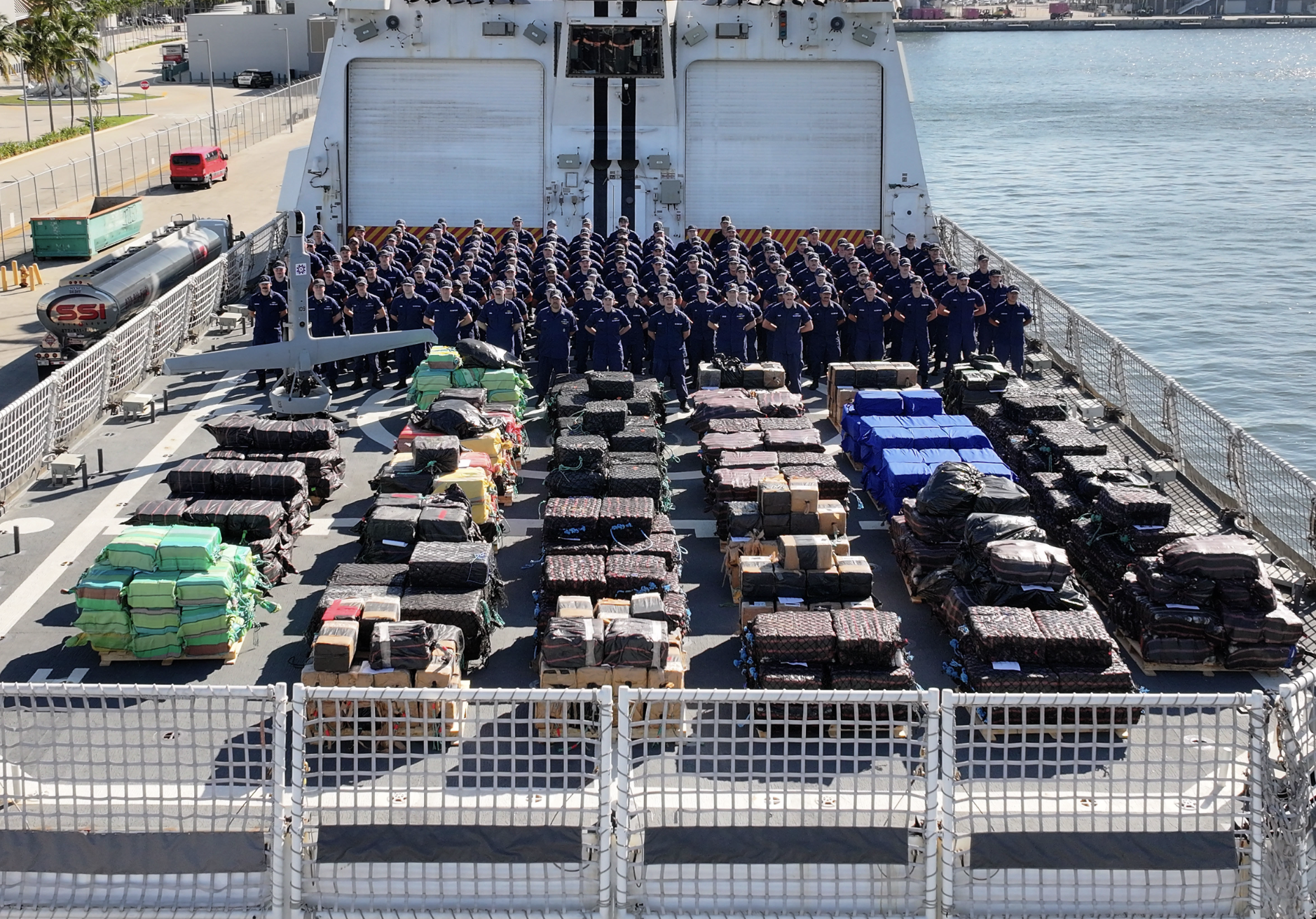
251118-G-G0107-1008
Coast Guard Cutter Stone’s crew poses for a group photo on the flight deck of the ship, Nov. 18, 2025, Port Everglades, Florida. Coast Guard Cutter Stone’s crew offloaded approximately 49,010 pounds of illicit narcotics worth more than $362 million. (U.S. Coast Guard photo by Cutter Stone’s crew)

Below is a Coast Guard Headquarters news release.


Dec. 9, 2025

Coast Guard seizes 150,000 pounds of cocaine through Operation Pacific Viper, interdicts drug smuggling vessel loaded with over 20,000 pounds of cocaine

WASHINGTON — The U.S. Coast Guard announced Tuesday it has seized more than 150,000 pounds of cocaine in the Eastern Pacific Ocean since launching Operation Pacific Viper in early August.

With a dose of 1.2 grams of cocaine being enough to kill a person, the amount seized through Operation Pacific Viper equates to over 57 million potentially lethal doses.

“Operation Pacific Viper has proven to be a crucial weapon in the fight against foreign drug traffickers and cartels in Latin America and has sent a clear message that we will disrupt, dismantle and destroy their deadly business exploits wherever we find them,” U.S. Department of Homeland Security Secretary Kristi Noem said. “In cutting off the flow of these deadly drugs, the Coast Guard is saving countless American lives and delivering on President Trump’s promise to Make America Safe Again and reestablish our maritime dominance.”

Through Operation Pacific Viper, the Coast Guard has been accelerating counter-drug operations in the Eastern Pacific Ocean, where significant transport of illicit narcotics continues from Central and South America. The Coast Guard surged additional assets — cutters, aircraft and tactical teams — to interdict, seize and disrupt transshipments of cocaine and other bulk illicit drugs. Operation Pacific Viper continues the Coast Guard’s efforts to protect the Homeland, counter narco-terrorism and disrupt Foreign Terrorist Organizations, Transnational Criminal Organizations and cartels seeking to produce and traffic illicit drugs into the United States. 80% of all U.S.-bound narcotics seizures occur at sea, highlighting the impact of maritime drug interdiction.

“This milestone is a testament to the vigilance and tenacity of our crews,” said Adm. Kevin Lunday, the Coast Guard’s acting commandant. “When we say we own the sea, it reflects our relentless pursuit to securing the maritime domain and disrupting the criminal networks that threaten our communities.”

Recent operations have highlighted the effectiveness of this surged posture, including multiple record-setting efforts. On Dec. 2, Coast Guard Cutter Munro seized over 20,000 pounds of cocaine in a single interdiction, after utilizing disabling fire on a heavily laden go-fast vessel. This was the Coast Guard’s largest at-sea interdiction since March 2007. The crew of the Coast Guard Cutter James executed a remarkable run of four significant seizures across 10 days in November, netting 19,819 pounds of cocaine. This series of interdictions included 9,581 pounds on Nov. 15, 3,225 pounds on Nov. 23, and two separate seizures on Nov. 25 totaling 7,055 in coordination with Coast Guard Cutter Active.

The success of Operation Pacific Viper is marked by unprecedented seizure amounts, demonstrating continued success in the fight against narco-terrorism and Transnational Criminal Organizations. These operations deny smugglers from using Eastern Pacific maritime routes to transport illicit narcotics from South and Central America to the United States. The Coast Guard Cutter Stone made history in November, offloading approximately 49,010 pounds of illicit narcotics worth over $362 million at Port Everglades — the largest single-patrol seizure by any Coast Guard cutter.

These continuous interdictions deny criminal organizations more than $1.1 billion dollars in illicit revenue. By disrupting the flow of cocaine and other bulk illicit drugs, the Coast Guard is cutting off revenue that fuels the ability for narco-terrorists to produce and traffic illegal fentanyl, threatening American communities.

Detecting and interdicting narco-terrorism on the high seas involves significant interagency and international coordination. U.S. Southern Command’s Joint Interagency Task Force-South, based in Key West, Florida, detects and monitors both aerial and maritime transit of illegal drugs. Once interdiction becomes imminent, the law enforcement phase of the operation begins, and control of the operation shifts to the U.S. Coast Guard throughout the interdiction and apprehension. Interdictions in the Eastern Pacific Ocean are performed by members of the U.S. Coast Guard under the authority and control of the Coast Guard’s Southwest District, headquartered in Alameda, California.

The Coast Guard is the United States’ lead federal agency for maritime drug interdiction. We are part of the Department of Homeland Security team protecting our nation and are at all times a military service and part of the joint force defending it.

Maybe Time to Look at an Amphibian

I know the Coast Guard does not need our aircraft to land on the water very often but sometimes there is no substitute and there might be additional justification.

The potential advantages for medical evacuations are obvious, but thinking outside the box maybe US Special Operation Command (USSOCOM) might want the Coast Guard to have a few of these so that they could barrow one occasionally.

USSOCOM identified a need for something similar and looked at creating a MC-130J Amphibious Capability (MAC) but that program is on hold.

A rendering of a C-130 floatplane previously released in relation to the MAC project. USAF

Potential dual use makes acquiring the capability more attractive. Coast Guard markings might even provide a cover story for deploying the aircraft. A MAC flown only by USSOCOM would be a bit of a give away.

Thanks to Sven for getting me to think about this.


“Coast Guard Cutter James conducts counter-drug patrol in Eastern Pacific Ocean” –District SouthEast

This is from her previous patrol. James (WMSL 754) poses for a photo on the cutter’s flight deck with contraband interdicted during their 112-day deployment, April 8, 2025.

Below is a news release from District SouthEast. James seems to interact with partner nations perhaps more than most. 22 detainees were transferred to Ecuador. This patrol she also offloaded some of the contraband she intercepted. Two Colombian detainees and approximately 9,500 pounds of cocaine were transferred to Costa Rica.

Dec. 12, 2025

Coast Guard Cutter James conducts counter-drug patrol in Eastern Pacific Ocean

NORTH CHARLESTON, S.C. — The crew of the U.S. Coast Guard Cutter James (WMSL 754) returned to their home port in Charleston, Wednesday, following a 92-day deployment conducting counter-narcotics operations in the Eastern Pacific Ocean in support of Operation Pacific Viper.

During the patrol, the James crew interdicted over 46,500 pounds of narcotics valued at nearly $350 million. The James crew conducted nine interdictions and detained 33 suspected drug traffickers. The patrol focused on disrupting illegal narcotics smuggling in collaboration with international partners.

The James crew worked alongside international partners including Costa Rica, Ecuador, Mexico, and Colombia. The collaboration included multiple partner nation transfers.

To support maritime governance and strengthen international relations, the James crew transferred 22 detainees pier side in Manta, Ecuador, prior to a visit from Department of Homeland Security Secretary Kristi Noem.

The James crew worked with the Costa Rican coast guard and national police to transfer two Colombian detainees and offload approximately 9,500 pounds of cocaine in Golfito, Costa Rica. During the visit, James hosted Costa Rican Minister of Security Mario Zamora Cordero.

“I am exceptionally thankful and proud of this crew’s dedication,” said Capt. Thomas Rodzewicz, commanding officer of the James. “Time away from family and missed holidays is never a small sacrifice, but the crew’s time and commitment to combatting narco-terrorism and protecting our nation from illicit drugs crossing our borders are highlighted by the success of this patrol.”

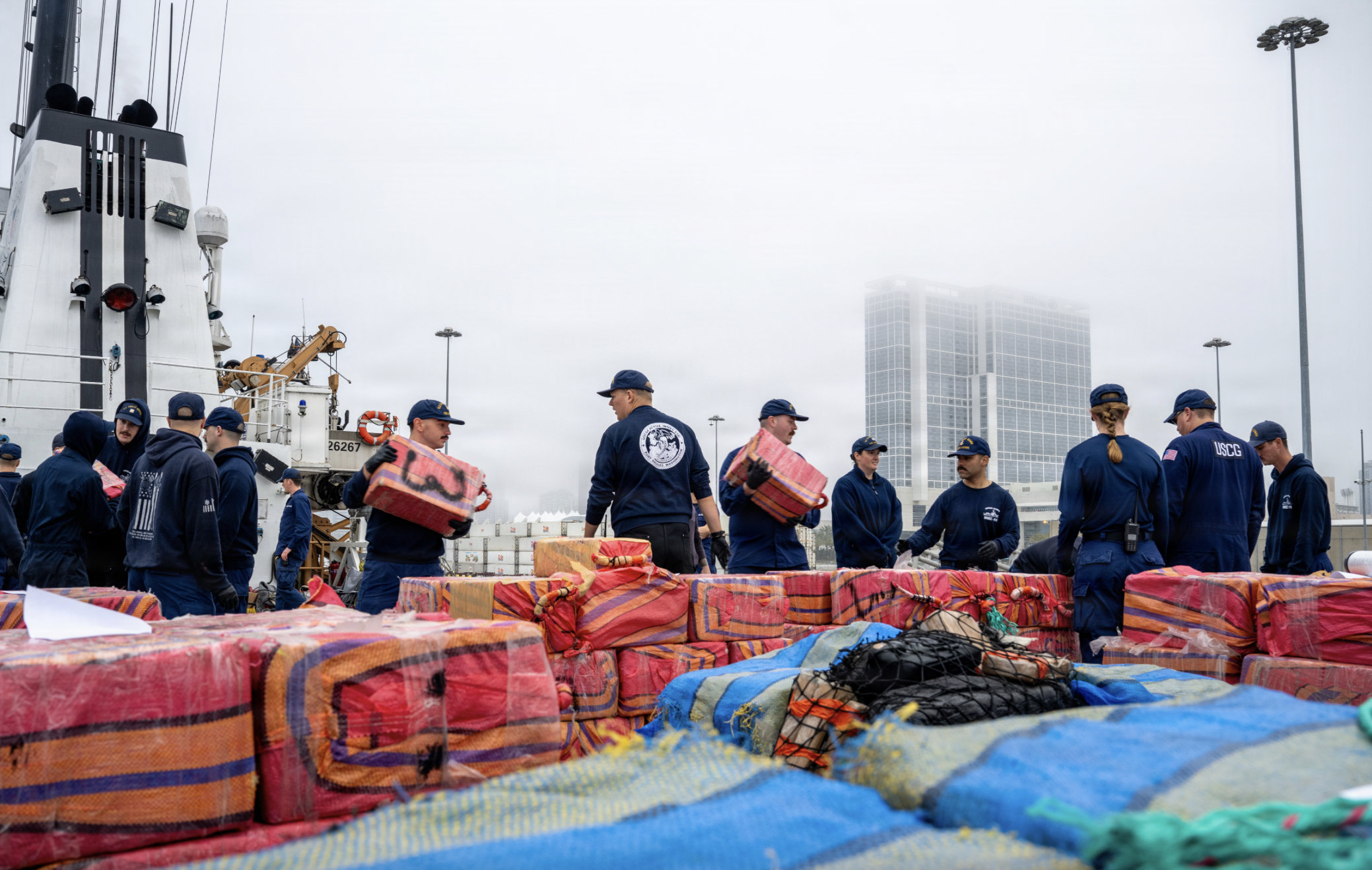
The James crew offloaded more than 26,000 pounds of cocaine and 500 pounds of marijuana in Port Everglades, Florida, Monday, before heading home.

Since 2017, Coast Guard Cutter James crewmembers have interdicted 104 shipments totaling 285,140 pounds of cocaine worth $2.11 billion wholesale and 34,539 pounds of marijuana worth $27.8 million wholesale.

James is one of four 418-foot Legend-class national security cutters homeported in Charleston under U.S. Coast Guard Atlantic Area Command. The cutter’s primary missions are counter-drug operations and defense readiness.

Detecting and interdicting narco-terrorism on the high seas involves significant interagency and international coordination. U.S. Southern Command’s Joint Interagency Task Force-South, based in Key West, Florida, detects and monitors both aerial and maritime transit of illegal drugs. Once interdiction becomes imminent, the law enforcement phase of the operation begins, and control of the operation shifts to the U.S. Coast Guard throughout the interdiction and apprehension. Interdictions in the Eastern Pacific Ocean are performed by members of the U.S. Coast Guard under the authority and control of the Coast Guard’s Southwest District, headquartered in Alameda, California.

The Coast Guard is the United States’ lead federal agency for maritime drug interdiction.

“Coast Guard Cutter Harriet Lane returns home following 81-day patrol in Oceania” –District Oceania

USCGC Harriet Lane (WMEC 903) transits offshore Rabaul, Papua New Guinea, Oct. 26, 2025. Commissioned in 1984, the Harriet Lane is a 270-foot cutter homeported in Honolulu to support Coast Guard missions in the Pacific region. (U.S. Coast Guard Photo by Petty Officer 3rd Class Austin Wiley)

Below is a District Oceania news release. Gives a good idea what they are doing with this ship since it changed homeport after a Service Life Extension (SLEP).


Dec. 12, 2025

Coast Guard Cutter Harriet Lane returns home following 81-day patrol in Oceania

Editor’s Note: Download video here and here.

HONOLULU – The crew of USCGC Harriet Lane (WMEC 903) returned to Honolulu Saturday following an 81-day patrol in support of Coast Guard Oceania District’s Operation Blue Pacific.

The Harriet Lane crew departed Joint Base Pearl Harbor-Hickam in September to conduct joint operations and territorial integrity missions across Oceania. Patrolling more than 16,000 nautical miles throughout Oceania to include the Republic of the Marshall Islands, Papua New Guinea, Vanuatu, Tonga, and American Samoa, the cutter’s crew worked alongside interagency and Pacific Island partners to deter transnational criminal organization activities, facilitate the flow of commerce, and protect critical ocean resources.

“This patrol was a resounding success for the crew of Harriet Lane and reinforced the Coast Guard’s commitment as a trusted partner across Oceania,” said Cmdr. Justin Matejka, commanding officer, Harriet Lane. “It was a pleasure to partner with the many professional officers from multiple Pacific Island Countries to combat illegal, unreported, and unregulated fishing and transnational criminal organization activity. I am proud of the crew’s incredible commitment to operational success and look forward to being a part of Harriet Lane’s growing impact across the region.”

The Harriet Lane crew exercised partnerships with the Marshall Islands, Papua New Guinea, Vanuatu, and Tonga through bilateral maritime law enforcement agreements, professional exchanges, and domestic federal maritime law enforcement operations. In total, the Harriet Lane crew and Pacific Island enforcement officers conducted 31 boardings of fishing vessels, resulting in 20 potential violations.

The crew conducted 15 additional high seas boarding and inspections on commercial fishing vessels, resulting in 2 potential violations of conservation and management measures under the Western and Central Fisheries Commission.

Enhancing diplomatic relationships within the Pacific Quadrilateral Defence Coordinating Group, the Harriet Lane crew also integrated Royal New Zealand Navy sea riders for a portion of the patrol.

Harriet Lane’s visit to Tonga included strategic discussions with Defense and Foreign Minister, Crown Prince Tupouto’a ‘Ulukalala, focusing on enhancing bilateral cooperation to address maritime security threats and counter illegal, unreported, and unregulated fishing activity in the region.

Commissioned in 1984, Harriet Lane is a 270-foot medium endurance cutter homeported in Honolulu to support Coast Guard missions in the Pacific region. The service’s medium endurance cutter fleet supports a variety of Coast Guard missions including search and rescue, law enforcement, maritime defense, and protection of the marine environment.

For more information follow us on Facebook, X, and Instagram.

-USCG-

“Time Charter Lease for Transportation and Logistics Support in Support of United States Coast Guard (USCG)”

The Coast Guard intends to lease a contractor provided and crewed vessel for a period of five years.

This is the “Concept of Operations”

2.1 Relationship with Coast Guard Personnel

The contractor shall operate and maintain the vessel, navigating under the guidance of the embarked USCG Operations Manager. The contractor shall engage the Contracting Officer’s Representative (COR) regarding ongoing contract management and execution activities, concerns, and issues. The contractor’s personnel (e.g. ship’s Master) will retain command and control of the vessel safety and operation in execution of the Operations Manager and COR direction.

2.2 Concept of Operations

The primary mission is to project sovereignty and augment the Coast Guard’s current fleet to achieve complete operational control of the U.S. border and maritime approaches. The contractor will provide a logistics and mission support vessel to increase the capability and capacity of existing assets (e.g. food, fuel, potable water, laundry, personnel).

It I not clear how this ship will help the current fleet “achieve complete operational control of the U.S. border and maritime approaches.” Potential operating areas include just about anywhere the Coast Guard currently operates. Required capabilities are listed below.

The range is shorter than that of an FRC.

In terms of logistics, as an underway replenishment vessel the 10,000 gallons is 62.5% of the fuel capacity of an FRC.

Perhaps she will be used to transport and house migrants, but that does not seem to go with the command and control mission mentioned or the twelve Coast Guard passengers.

Ultimate capability depends very much on what will be in the four containers she can carry. Do we have anything ready to go?

The failure of the Littoral Combat Ships was that they built the ships before they built the mission modules. Hope we don’t make the same mistake here.