PATFORSWA Cutters Go to the Philippines

Sea Waves reports,

The Armed Forces of the Philippines and the United States Coast Guard conducted a Maritime Cooperative Activity (MCA) within the Philippine Exclusive Economic Zone, June 27-28, 2026. This activity demonstrated a collective commitment to strengthening regional and international cooperation in support of a free and open Indo-Pacific.

As the eighth MCA of 2026, this exercise was designed to expand capabilities at sea by incorporating and refining shared Coast Guard law enforcement tactics, specialized procedures, and maritime doctrines. The two-day exercise included series of interoperability activities including a search and rescue exercise, maritime domain awareness activity, and division tactics.

WarshipCam -Official
March 29 at 4:49 PM
·
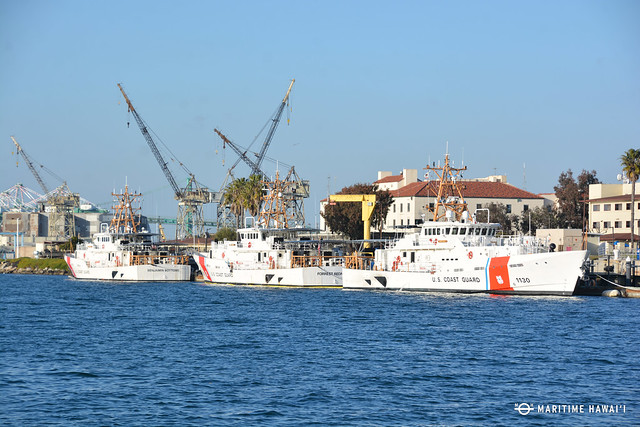
All six Bahrain-based USCG Sentinel-class cutters eastbound in the Singapore Straits – USCGC Charles Moulthrope (WPC-1141),USCGC Robert Goldman (WPC-1142), USCGC Glen Harris (WPC-1144), USCGC Emlen Tunnell (WPC-1145), USCGC John Scheuerman (WPC-1146) & USCGC Clarence Sutphin Jr. (WPC-1147) – March 2026 SRC: X-@StraitsSights

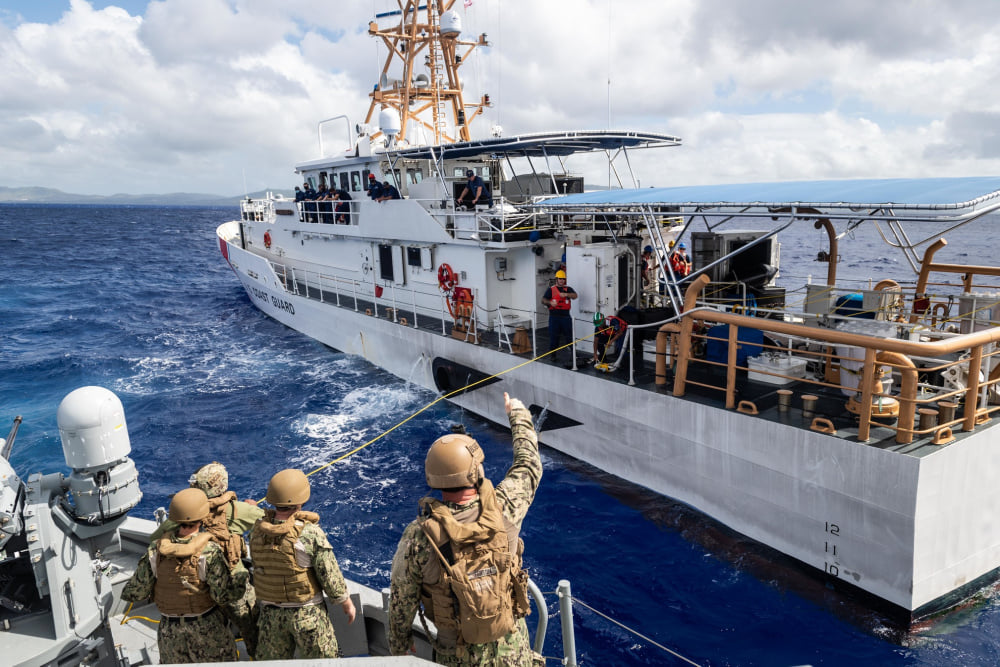
Participating units included U.S. Coast Guard PATFORSWA fast response cutters USCGC Charles Moulthrope (WPC 1141) and USCGC Emlen Tunnell (WPC 1145), normally home-ported in Bahrain,

Philippine Navy Jose Rizal-class frigate BRP Antonio Luna (FFG 15) sails during part of the Maritime Cooperative Activity (MCA) in the Philippines’ Exclusive Economic Zone, June 27, 2026. US Coast Guard photo.

South Korean built Philippine Navy Jose Rizal-class frigate BRP Antonio Luna (FFG 15),

USCGC Waesche accompanies the PCG’s Melchora Aquino during a search-and-rescue exercise in the South China Sea in July 2024. (USCG)

and Japanese built Philippine Coast Guard patrol vessels BRP Teresa Magbanua-class BRP Melchora Aquino (MRRV 9702),

BRP Capones in Davao Gulf. Photo credit Philippine Information Agency

and the 44 meter BRP Capones (MRRV 4404).

This does at least tell us what some of the PATFORSWA cutters are doing since they left Bahrain as a result of the war with Iran.

“Guardians of the Deep: An Inside Look at the Elite Submarine Protection Coast Guard Unit” –by Navy Lt. Zachary Anderson, Submarine Group 9

Service members assigned to the Maritime Force Protection Unit Bangor pose for a photo with Royal Marines, assigned to the 43 Commando Fleet Protection Group, on the waters of the Puget Sound, Wash., Nov. 4, 2025.

Department of War posted a story about Coast Guard Maritime Force Protection Unit Bangor, which provides protection for Fleet Ballistic Missile Submarines, during their surface transits to and from their base.

Two Coast Guard special purpose craft-screening vessels, assigned to the Maritime Force Protection Unit Bangor, transit the waters off Port Angeles, Wash., March 18, 2025. 

Note the .50 caliber machine guns in remote weapon station mounts which provide augmented vision as well as a stabilized weapon with the operator out of sight.

We have talked about these units before (see below), but it has been quite a while. The post includes photos of a Coast Guard WPCs and a helicopter apparently escorting an SSBN. These are not part of the full time single mission Force Protection Unit but were apparently operating in cooperation with them.

USCGC Florence Finch sails alongside the ballistic-missile submarine USS Maine as it transits the Strait of Juan de Fuca off the Washington CoastCoast, March 18, 2025.

There was one statement that particularly caught my attention, “…the MFPU mission has given Cifelli the chance to experience a wide variety of weapons systems within his rating, from small arms to the .50-caliber machine gun and even new systems designed to counter emerging threats.” I am guessing this refers to counter UAS systems.

Previous posts on the subject

Thanks to Paul for bringing this to my attention. 

“If China Recovers Russian Far East Coast…” –The Strategist

It has been almost three years since I posted, “Why Russia Should be Worried, ARCTIC PRC’s 13th Arctic expedition creating concerns for Russia” –The Watch.” Now the we have another clear explanation of why China may attempt to recover territory handed over to Russia under the “unequal treaties” in 1858/1860, “If China recovers Russian Far East coast, it will suddenly outflank island chain,” which appeared in “The Strategist” an on-line magazine of the Australian Strategic Policy Institute.

This new post primarily suggests this development would make it more difficult to track Chinese submarines. (China has overtaken Russia and the US to become the largest builder of submarines in the world.) In addition, it provides additional reasons why China would want to do this.


“Coast Guard Taps Commercial Supply Vessel to Keep Cutters on Station Longer” –gCaptain

Homeland Security Cutter-Ocean is moored at U.S. Coast Guard Base Miami Beach, Florida, June 26, 2026. Cutter Ocean will serve as the first vessel contracted in a new initiative using commercial vessels to transport supplies, equipment and personnel to Coast Guard cutters operating in the Caribbean, Gulf of America, and other maritime areas in the Western Hemisphere. (U.S. Coast Guard photo by Petty Officer 3rd Class Reese Hindmarsh)

gCaptain reports,

“The U.S. Coast Guard is turning to the commercial offshore industry to strengthen logistics support for its cutter fleet, awarding a contract to Louisiana-based Bordelon Marine for the Connor Bordelon, a commercial offshore support vessel that will operate under the designation Homeland Security Cutter-Ocean (HSC-Ocean).

“The vessel will transport supplies, equipment, and personnel to Coast Guard cutters operating throughout the Caribbean, Gulf of America, and other maritime areas across the Western Hemisphere as part of the Coast Guard’s new HSC-Ocean initiative.”

I do feel a bit uncomfortable with calling this a cutter. That implies this is a Coast Guard cutter, but operating with a civilian crew it will have none of the law enforcement authorities of a Coast Guard cutter.

Thanks to Patrick for bringing this to my attention, 

“Canada Invests $816M in Great Lakes Maritime Security” –Canadian Defence Review

Change is coming to the Canadian Coast Guard since it was “transferred from the Fisheries and Oceans Canada to the National Defence on September 2, 2025. It remains a civilian Special Operating Agency.”

Perhaps most importantly,

On April 1, 2026, the Government of Canada’s civilian aircraft services and assets were transferred to the Canadian Coast Guard, giving the agency operational control of the civilian aerial fleet, meaning greater capacity to support its growing role in maritime security.

But of course there is more. Check it out.

“Coast Guard helicopter crashes in Sitka, Alaska” –Arctic District (Updated)

Below is a news release.

June 22, 2026

UPDATE: Coast Guard responds to Coast Guard helicopter crash in Sitka, Alaska

JUNEAU, Alaska — The four Coast Guard crew members involved in a helicopter crash in Sitka, Alaska, Monday, are reported safe with non-serious injuries.

Watch standers at the Arctic District command center received the initial report of the crash through the activation of the aircrew’s personal locator beacon at approximately 10:07 a.m.

Sitka Fire and Rescue arrived on scene at approximately 11:00 a.m. and transported the crew members to Mt. Edgecumbe Medical Center.

“We are incredibly relieved our crew members survived with only minor injuries,” said Rear Adm. Bob Little, commander of the Coast Guard’s Arctic District. “We are grateful for the swift response by the Sitka Fire and Rescue who assisted us during this critical time.”

Coast Guard Air Station Kodiak is repositioning a helicopter and crews to Coast Guard Air Station Sitka to augment and maintain operational readiness in the Southeast Alaska region.

The cause of the crash is currently under investigation.

“Coast Guard to build 30 additional housing units, child development center at Base Kodiak” –Seapower

A computer-generated image shows Coast Guard housing units delivered through the Nemetz Park housing project at Base Kodiak, Alaska. In May 2026, the Coast Guard ordered construction of 30 additional housing units and a child development center to support families assigned to base units. (U.S. Coast Guard image)

The Navy Leagues on line magazine, Seapower, reports,

“The Coast Guard awarded two task orders in May 2026 to the Tutor Perini Corporation to construct 30 additional housing units, a child development center and other infrastructure improvements at Base Kodiak.

“Both task orders were issued under the National Multiple Award Construction Contract III. The first task order, valued at $81.8 million, constructs 15 family housing duplexes, featuring 20 three-bedroom and 10 four-bedroom units. The second task order, valued at $61.6 million, supports construction of a 22,000-square-foot child development center and an 11,000-square-foot outdoor play area. Construction of both task order projects is expected to finish in 2028.”

What the Navy is Using to Disable Merchant Ships

More video on the links below

I have long felt there is a gap in the Coast Guard’s ability to respond to a maritime terrorist attack, in that the Coast Guard is unlikely to be able to stop such an attack if it employs a medium or large merchant ship manned by a determined crew. The large cutters are not likely to be underway in the vicinity when need, and the smaller cutters are not adequately armed.

The threat requires at least an ability to forcibly stop a ship, regardless of size, before it gets to its target.

Historically the objective was more frequently to sink rather than stop merchant ships. Turns out merchant ships are very had to sink unless torpedoes are used. There have not been many examples of attempts to simply disable a vessel, but the US blockade of Iran has given us several recent examples.


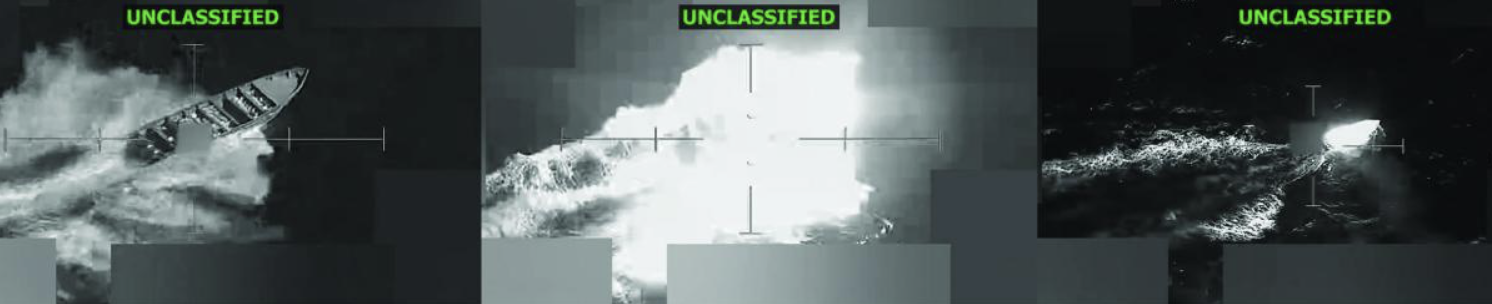
U.S. forces disabled an oil tanker in the Gulf of Oman at 11:20 p.m. ET on June 10after the vessel violated the blockade against Iran by attempting to transport Iranian oil, marking the third commercial ship disabled by American forces this week.

U.S. Central Command (CENTCOM) acted against Guinea-Bissau flagged M/T Jalveer as it attempted to transport oil from Iran through the Gulf of Oman. A U.S. aircraft fired two Hellfire missiles into the ship’s engine room after the crew repeatedly failed to comply with directions from U.S. forces.

Earlier this week, U.S. aircraft disabled Palau-flagged vessels M/T Marivex and M/T Settebello on Monday and Tuesday, respectively. Marivex violated the blockade by attempting to sail to an Iranian port and Settebello attempted to transport Iranian oil.

CENTCOM forces have disabled nine non-compliant vessels,


At 11:14 p.m. on June 9, U.S. forces disabled an oil tanker in the Gulf of Oman for the second consecutive day after another vessel violated the ongoing blockade by attempting to transport oil from Iran.

U.S. Central Command (CENTCOM) disabled Palau-flagged M/T Settebello as it transited the Gulf of Oman. A U.S. aircraft fired precision munitions into the ship’s engine room after the crew repeatedly failed to comply with directions from American forces.


U.S. forces disabled an unladen oil tanker that was attempting to sail toward an Iranian port on the Arabian Gulf, June 2.

U.S. Central Command (CENTCOM) enforced blockade measures against Botswana-flagged M/T Lexie as it transited international waters toward Kharg Island. The ship’s crew ignored repeated warnings, failing to comply with directions from U.S. forces multiple times over a 24-hour period.

A U.S. aircraft ultimately disabled the vessel by firing a Hellfire missile into the ship’s engine room, preventing the tanker from reaching Iran.


U.S. forces operating in the Gulf of Oman enforced blockade measures by disabling a Gambia-flagged maritime vessel attempting to sail toward an Iranian port, May 29.

U.S. Central Command (CENTCOM) forces observed M/V Lian Star transiting international waters toward an Iranian port on the Gulf of Oman and issued more than 20 warnings while informing the vessel it was in violation of the U.S. blockade.

A U.S. aircraft disabled the vessel by firing a Hellfire missile into the ship’s engine room after Lian Star’s crew failed to comply.


It certainly appears Hellfire has become the go-to munition for disabling these ships. It is less clear how disabled they really were. Could they have continued their voyage? Were they really unable to continue or were their civilian crews really simply intimidated. I haven’t heard anything about tugs taking them in tow.

It is an important question of the Coast Guard because if they were really successful in fully disabling the ships, this could be the system we need. It could not only take on large ships, it would also be very effective against small, fast, highly maneuverable threats.


“Coast Guard, Eastern Shipbuilding Terminate Offshore Patrol Cutter Contract; Rick Scott Ends Promotion Holds” –USNI

Future USCGC Argus at launch Eastern Shipyard, Oct 27, 2023.

The USNI reports,

The Coast Guard and Eastern Shipbuilding have reached an agreement to terminate a 10-year-old agreement to build the service’s Offshore Patrol Cutters, USNI News has learned.

“The Coast Guard has reached an agreement with the Offshore Patrol Cutter (OPC) Stage 1 shipbuilder to close out the contract,” the service said in a Friday statement to USNI News. “The Coast Guard will acquire and deliver the OPC class as fast as possible to address the nation’s security and safety needs, while maintaining public trust and stewardship of American taxpayer dollars.”

There has been no news release from either the Coast Guard or Eastern. No details of the agreement were provided, so there are still questions. Is Eastern going to finish OPCs #1 and #2? (I don’t think so.) Are they to be towed away and finished elsewhere? Is the Coast Guard going to have to pay Eastern more money for not completing their contract? All that seems to be certain is that the previous contract has been terminated and that Representative “…Rick Scott (R-Fla.) lifted a hold on Coast Guard officer promotions…”

Thanks for small favors. I don’t think there is any reason for the House to have to approve the promotion of junior to middle grade officers. This sounds like a hold-over from the spoils system. I would think they have more important things to think about. Using it to get apply pressure to get favors for your constituents is really immoral.

I will say this again. There really should be an investigation of how Eastern got the contract in the first place. Who made the final decision? Was it a Coast Guard decision? a DHS decision? Were there questions about Eastern’s competence? Was political pressure applied?