The Coast Guard Research and Development Center has provided a video showing some of the projects they have been working on.
I am bit late in showing this, but think it is still worth a look

The Coast Guard Research and Development Center has provided a video showing some of the projects they have been working on.
I am bit late in showing this, but think it is still worth a look

The Pakistan Navy has commissioned its first Offshore Patrol Vessel (OPV) 2600, named PNS HUNAIN, at Constanta Port in Romania.
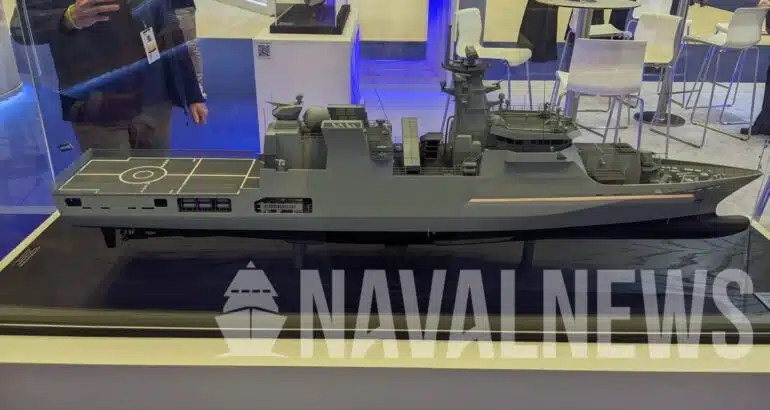
This is a rare beast, a heavily armed Offshore Patrol Vessel. It is a medium sized OPV, little more than half the size of a National Security Cutter or Offshore Patrol Cutter:
The basic design, the DAMEN OPV 2600, may have been the Bollinger proposal for the Offshore Patrol Cutter competition. At that time DAMEN’s generic OPV 2600 looked like this.
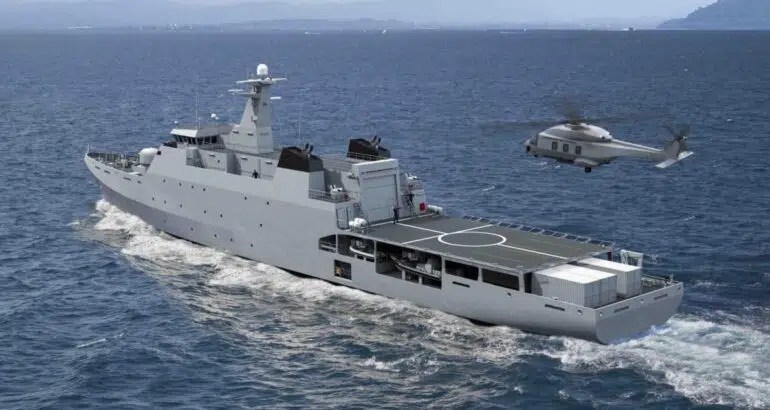
OPV 2600 multi-mission patrol vessel rendering (Source: Damen)
The ship has not been fitted out yet. If the model seen in the report is actually the way the ship is equipped, the Pakistani OPV will have
Pakistan seems to have decided it was better to go with a small 40mm gun rather than a 76mm to make room for the air defense missiles. I think that was a good decision and may save money in the long run.
My own feeling is that the only thing guns can do that missiles cannot do as well or better is fire shots across the bow. To be able to fire a shot across the bow is a requirement for a law enforcement vessel, but while it is commonly done in the CG by a .50 caliber, if you want to do it at a greater range, say four km or about two nautical miles, the 40mm is a good choice. The need for a larger gun for that purpose is highly unlikely.
Upfront costs to buy a medium caliber gun, its fire control systems, and its initial ammunition allowance are high, as are long term personnel support costs.
A capability to launch missiles that have a higher probability of hit and greater hitting power beyond the effective range of 57 or 76mm guns may actually be relatively inexpensive. Plus, VLS missile launchers may actually look less intimidating than heavy guns.

Graphic from Leonardo

The spouse of a Coast Guard Cutter Healy (WAGB 20) crewmember waves goodbye as the cutter departs Base Seattle for a multi-month deployment to the Arctic, June 12, 2024. (U.S. Coast Guard photo by Petty Officer 3rd Class Annika Hirschler)
Having recently reread the Acquisition Directorate’s In-Service Vessel Sustainment web page, I found this.
Service life extension program for Coast Guard Cutter Healy will occur in a five-year phased production between 2026 and 2030. Healy is a 420-foot cutter, the service’s only active medium polar icebreaker, which was commissioned in 1999. When completed, the SLEP effort will recapitalize a number of major systems and extend the service life of the cutter until the polar security cutters are operational.
This sounds an awful lot like what was done to Polar Star over a five year period. Healy, like Polar Star, is based in Seattle, but Polar Star’s five year rolling Service Life Extension Program was not done in Seattle, it was done in Vallejo, CA. Vallejo is 776 miles from Seattle. These five phased Yard periods were extremely long, so the ship spent about half its down time far from home. I know they tried to mitigate the effect on the crew, but it had to be bad for crewmembers whose families were in Seattle.
I can’t help but think it would have been a good idea to change Polar Star’s homeport to Vallejo or Alameda (water depth at the Support Center permitting). Vallejo is a lower priced area than Seattle and there is property there from the old Navy shipyard that the city is still trying to develop. Pretty sure the city would be happy to have Healy homeported there.
If Vallejo was not possible, it is 31 miles from Vallejo to Alameda. That is not a particularly long commute in the Bay area, for the relatively short time the ship would be in Alameda, and there are relatively affordable places to live in between.
Is it going to be different for Healy?
I also notice this, that the SLEP is intended to “extend the service life of the cutter until the polar security cutters are operational.” Since Healy is nominally a medium icebreaker, I would have thought the Coast Guard would keep her in service until replaced by an Artic Security Cutter (medium icebreaker). Healy was commissioned in 1999, so I would have thought she would remain in service 40 years, until 2039. A SLEP ending in 2030/31 also suggests another ten years of life. Are we going to have to wait until 2039 for the Polar Security Cutters to be completed?

The Coast Guard Cutter Legare (WMEC 912) weighs anchor near the Statue of Liberty in New York City, New York, March 17, 2024. (U.S. Coast Guard photo courtesy of Legare)
The Acquisitions Directorate (CG-9) website includes a photo of USCGC Legare (WMEC-912) and the caption “270- foot medium endurance cutter Legare begins service life extension program at Coast Guard Yard.” Normally clicking on the caption would lead to a post expanding on the title, but in this case, it takes you to the In-Service Vessel Sustainment Program page. That page gives us this information about the 270 SLEP.
“Service life extension program for the 270-foot medium endurance cutters involves targeted system replacement to address system reliability, supportability, obsolescence and interoperability. This work will include upgrades or replacements to the electrical power generation and distribution system as well as the main propulsion engines. The mission is to facilitate continued operations during transition to the offshore patrol cutter by extending the service life of 270-foot cutters for up to 10 years. Work began on one prototype vessel at the Coast Guard Yard in July 2021 and on the second cutter in April 2022. Full production is scheduled to begin in 2023.”
The intention is not to SELP all 13 WMEC270s, rather they did two limited prototype SLEPS (Seneca, WMEC-906, and Harriet Lane, WMEC-903), and plan to do six full production SLEPs. These 270s should be the last WMECs in commission as they are replaced by Argus class Offshore Patrol Cutters. Harriet Lane’s most visible change was removal of her 76mm Mk75 gun and Mk92 fire control system. A 25mm Mk38 remote weapon station was mounted on the bow on an elevated position. This change is to be applied to all subsequent 270 SLEPs.
Spencer, (WMEC-905) was the first full production 270 SLEP. Spencer was the first 270 to receive new engines. Spencer’s old engines were to be remanufactured and reinstalled on a subsequent WMEC270 SLEP, presumably the newly arrived Legare.
This is a long process. Work on Harriet Lane lasted 15 months, so I expect we will have at least one 270 in the Yard being SLEPed for the next five years.

Coast Guard Cutter James (WMSL 754) personnel pose for a photo with other law enforcement agency officials, July 19, at the White House in Washington, D.C. for the annual United States Interdiction Coordinator Awards. James’ crew was recognized with the top maritime interdiction during the awards ceremony. (Photo courtesy of the White House)
Below is a release from Coast Guard News.
Wanted to highlight this, because it all goes back to one very junior person who took her job seriously and a command that believed in her.
To view the full event, click here.
WASHINGTON — The crew of the Coast Guard Cutter James (WMSL 754) was honored at the White House during the United States Interdiction Coordinator Awards Ceremony on July 19.
The annual event, held by the Office of National Drug Control Policy (ONDCP), recognized the exceptional contributions and achievements of various law enforcement entities in drug interdiction efforts. James’ crew was recognized for top maritime interdiction.
Amidst heavy seas on the afternoon of Sept. 11, 2023, a junior watchstander noticed what appeared to be the wake of a go-fast vessel approximately 10 nautical miles off James’ bow. The cutter set its go-fast response bill, spurring the entirety of James’ crew in motion to prepare for a counter-drug pursuit. James used an operational procedure agreed upon with Ecuador that allowed law enforcement teams to embark the foreign-flagged vessel, where they found 73 bales of cocaine. Following the successful seizure of 3,863 pounds of cocaine and the detention of three suspected narcotraffickers, James coordinated an at-sea transfer of the detainees and contraband with Ecuador to enable home country prosecution and strengthen a key partnership.
To successfully spot a target of interest on the high seas without positive identification from aerial assets or radar is known as a cold hit. Within the realm of maritime interdiction, cold hits are the equivalent of finding the proverbial needle in a haystack, a complex difficult task made more challenging by the heavy seas and gray skies that limited visibility on that day. In this case, the cold hit detection of the go-fast vessel was made by the lookout, one of James’ most junior crewmembers, who had been in the Coast Guard for only six months. Her initial cold hit spurred the rest of the crew and teams into action.
During the ceremony, ONDCP Director Dr. Rahul Gupta, commended the crew of James for their outstanding service and unwavering commitment to protecting the nation’s borders and safeguarding the lives of countless Americans. The cutter’s achievements are a testament to the Coast Guard’s enduring legacy of excellence in maritime law enforcement and drug interdiction.
“It was an honor to receive this award on behalf of the entire James crew,” said Capt. Donald Terkanian, commanding officer of James. “Our crew’s exceptional efforts disrupted illicit drug trafficking, deprived transnational criminal organizations of millions of dollars in revenue, apprehended suspected traffickers, strengthened a key partnership, and helped save lives by preventing drugs from reaching the streets.”
James is a 418-foot, Legend-class national security cutter, homeported in North Charleston, South Carolina. The cutter’s primary missions are counter-drug operations and defense readiness. Stone falls under the command of the Coast Guard Atlantic Area in Portsmouth, Virginia. Atlantic Area oversees all Coast Guard operations east of the Rocky Mountains to the Arabian Gulf. In addition to surge operations, Atlantic Area also allocates ships to deploy to the Caribbean Sea, Eastern Pacific Ocean, and South Atlantic Ocean to combat transnational organized crime and illicit maritime activity.
For information on how to join the U.S. Coast Guard, visit GoCoastGuard.com to learn about active duty, reserve, officer, and enlisted opportunities. Information on how to apply to the U.S. Coast Guard Academy can be found here.
We are starting to hear some stories about what was done during RIMPAC 2024. The Aviationist reports,
The U.S. Air Force B-2 Spirit carried out a QUICKSINK demonstration during the second SINKEX (Sinking Exercise) of RIMPAC 2024. This marks the very first time a B-2 Spirit has been publicly reported to test this anti-ship capability… During the drills, two long-planned live-fire sinking exercises (SINKEXs) led to the sinking of two decommissioned ships: USS Dubuque (LPD 8), sunk on July 11, 2024; and the USS Tarawa (LHA 1), sunk on July 19.
The video above is from 2022. Unlike the recent RIMPAC sinking, the weapon was delivered by an F-15 and the target was only a small ship.
We talked about QuickSink earlier and why preparing Coast Guard aircraft to use it on the first day of a war might be a good idea.
Perhaps the threat of an invasion of Taiwan may have influenced the choice of targets for the SINEXes.
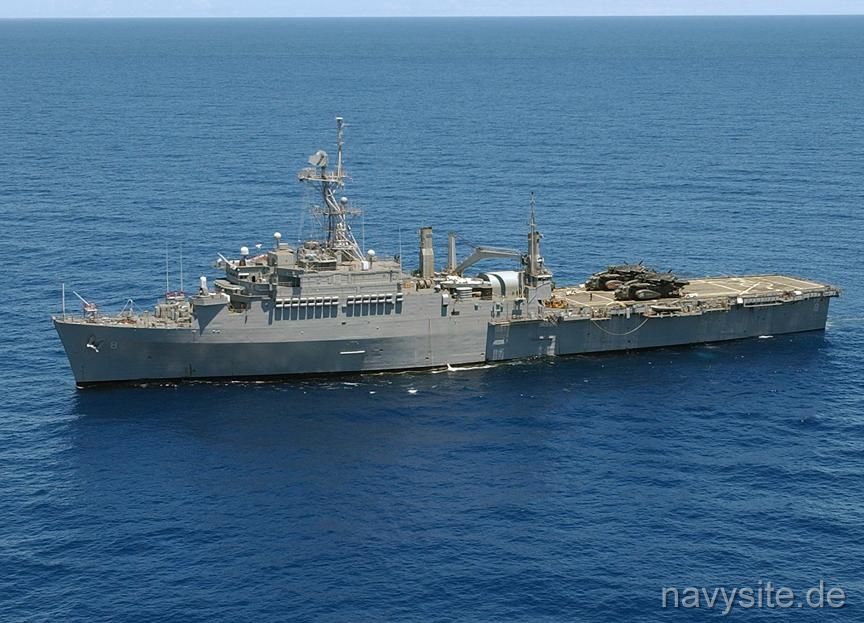

Yuzhao (Type 071) Class Amphibious Ship With two Houbei (Type 022) fast attack craft behind. CSR Report RL33153 China Naval Modernization: Implications for U.S. Navy Capabilities—Background and Issues for Congress by Ronald O’Rourke dated February 28, 2014.

020628-N-3228G-001.Pearl Harbor, HI (Jun. 28, 2002) — Amphibious warfare ship USS Tarawa (LHA 1) leaves Pearl Harbor to participate in exercise “Rim of the Pacific” (RIMPAC) 2002. U.S. Navy photo by Photographer’s Mate 1st Class William R. Goodwin. (RELEASED)

Type 075 landing helicopter dock. By China News Service, CC BY 3.0, https://commons.wikimedia.org/w/index.php?curid=149168539
I look forward to seeing the Videos. Would really like to know how many weapons of each type were used. These big ships can be very hard to sink.
QuickSink, a modified 2,000-pound GBU-31 JDAM that blows up under the keel, is the only non-nuclear weapon that may be more deadly to ships than a torpedo, and the B-2 can carry 16 of them. Employing the Rapid Dragon system, C-17s and C-130s could bring many more.
Below is video of the USS Denver SINKEX in 2022. She was a sister ship of USS Debuque.

Wärtsilä 14RT-flex96C engine. This is the smaller six cylinder engine version of the 14 cylinder engine described in the article.
MSN/SlashGear has a post about what they report as the largest marine diesel engine, “How Big Is The World’s Largest Piston Engine? And How Much Power Can It Deliver?”
There is a large element of “Gee Whiz” here, but it may be something more Coast Guard members should know about. Marine Inspectors are certainly aware. The post is a five-minute read and there is a short video of “Top Gear” presenter Richard Hammond getting a literal inside look at a smaller, but still very large, marine diesel.
In addition, since the Coast Guard has an implicit requirement to be able to forcibly stop any ship, regardless of size, think about how hard it will be to hurt one of these massive engines. Large explosions are going off inside 1400 times a minute. A 25 or 57mm projectile exploding in the engine room may not have much effect.

Coast Guard C130J
This from Defense Industry Daily,
Lockheed Martin has delivered the first of eight C-130J-30 Super Hercules aircraft to the Youngstown Air Reserve Station in Ohio as part of a project to modernize the installation’s aging military transport fleet. The plane incorporates a new configuration of aerial spray capability to secure large areas from disease-carrying insects and other pests as well as to disperse oil spills in water surface domains. Lockheed wrote that this function marks the 19th unique mission feature of the C-130J product line. (Emphasis Applied–Chuck)
Usually, we try to recover oil at spills, but using fixed wing aircraft to disperse oil spills might be a capability the Coast Guard could use, either organically or by tapping other service resources.
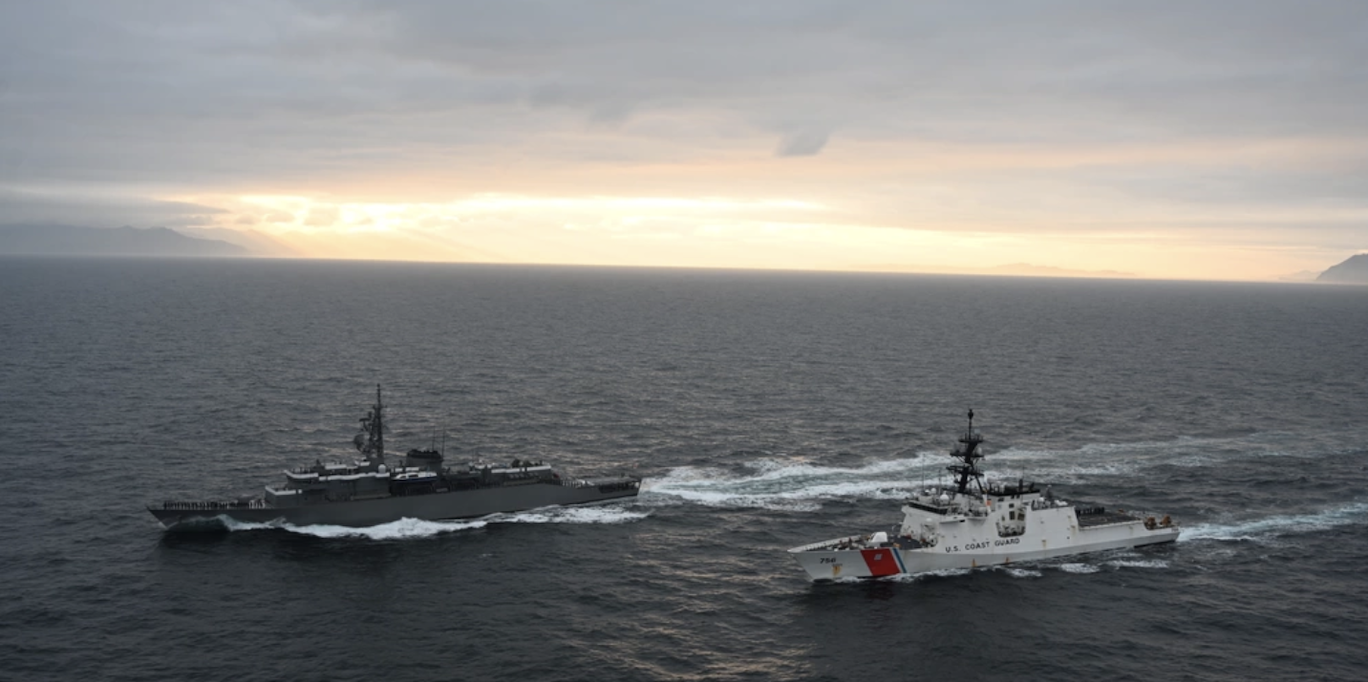
The U.S. Coast Guard Cutter Kimball, right, and a Japanese naval training vessel travel near the island of Unalaska in 2021. (U.S. Coast Guard photo)
The Alaska Beacon reports on the local reaction to the presence of Chinese ships in the Bering Sea, July 6 and 7.
The reaction clearly favored a more powerful and more visible response than a Coast Guard cutter and C-130.
So why use a cutter? Wouldn’t a destroyer or frigate be more appropriate?
A destroyer would have been faster, but the cutter is actually faster than the frigates the Navy is currently building.
The immediate answer is that there probably were no US Navy surface combatants in the vicinity, but would that have even been desirable?
What if they had suddenly become hostile?
Well, the cutter would probably have been sunk. That is a fact, but that is probably equally true of a destroyer outnumbered and taken by surprise at close range. Losing a cutter would be less of a loss and a prompt response from the Air Force would follow, probably quickly sinking the Chinese warships that have no fighter protection. That’s assuming they had not already been sunk by a US Navy submarine that may or may not have also been following them.
The US Navy just does not routinely keep surface vessels in the area of the Aleutians. Apparently, the Chinese were only there for two days. It would probably take longer than that for a USN combatant to make a transit, putting it out of position for its normal duties.
They were probably only doing this because the US does Freedom of Navigation Exercises in their backyard. But their response just plays into our narrative that we have every right to transit the Taiwan Straits–Look, they are transiting a narrow passage between US islands, and we didn’t object.
Would I like to see the cutters better equipped to defend themselves, sure, but it probably would not make any difference if they came to blows. Meanwhile the cutter makes a pretty good AGI.
The Chinese are unlikely to start a war in the Aleutians unless they simultaneously also start it somewhere else, like Taiwan, but we still want to keep an eye on them, to discourage mischief.
Thanks to David for bringing this to my attention.
Marine Link reports on, “Maritime Implications of Recent US Supreme Court Rulings.”
The impacts for regulatory agencies such as the FMC, USCG, and EPA could be widespread. As an initial matter, the Loper Bright ruling may open up the opportunity for regulated entities to challenge agency interpretations of ambiguous statutory provisions. The result of such potential increased litigation – and the lack of deference for an agency’s interpretation – is that maritime stakeholders will be increasingly reliant upon, and subject to, court interpretations of law. There is also an associated risk that, without deferring to agency interpretations, differing jurisdictions can more easily reach differing results when interpreting ambiguous statutes. As such, entities operating in multistate operations, such as maritime operators, may encounter greater difficulty in complying with the law when moving between jurisdictions.
There are also changes to the Statute of Limitations.
This is all well outside my wheelhouse, but feel free to comment and discuss the implications.
 Chuck Hill's CG Blog