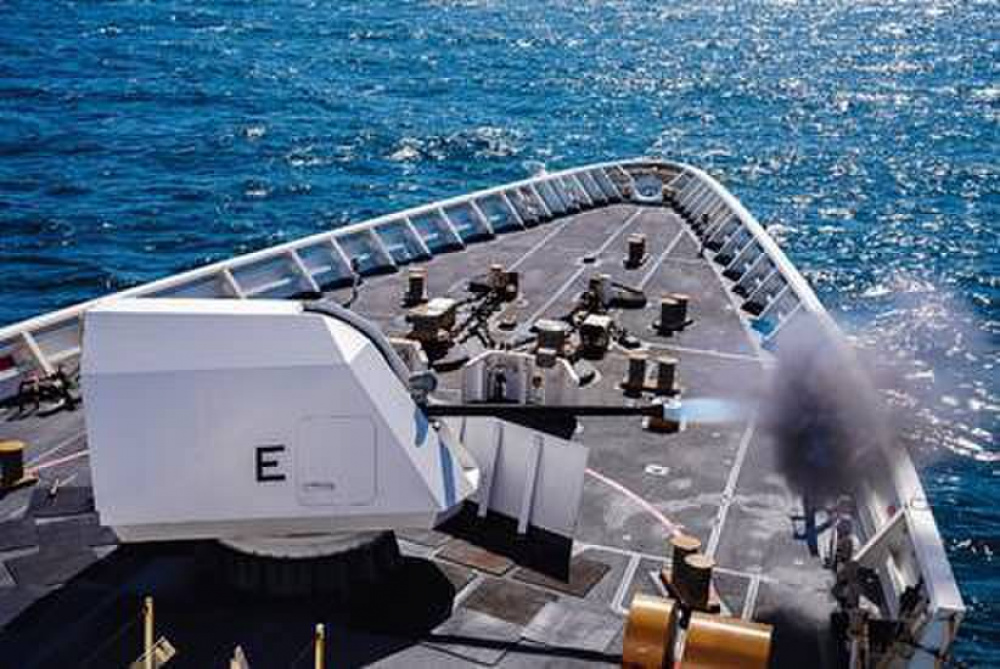
Coast Guard Cutter Stratton fires its MK 110 during a gunnery exercise in the Bering Sea April 28, 2021. U.S. Coast Guard photo courtesy Ensign Molly Dolan.
The Royal Navy has chosen the BAE Bofors 57mm Mk3 to arm a new class, the Mk31 general purpose Frigates. This is the same gun that arms National Security Cutters (NSCs) and Littoral Combat Ships (LCSs) and which will arm the Offshore Patrol Cutters (OPCs) and the new Constellation class guided missile frigates.
UK based Navy Lookout has published an independent evaluation of the weapon and its ammunition. This is almost two years old, but it is well done. It makes some good points discussing the both the advantages and limitations of the weapon. I would point out that they note, “The days of medium calibre guns being used against other ships are long gone…” It is adequate for signaling by firing across the bow and for engaging small craft, but maybe we might want to think about adding a weapon suitable for use against ships since that should be part of even our peacetime skill set.
Unfortunately, their hopes for the “Multi- Azimuth Defense Fast Intercept Round Engagement System” (MAD-FIRES) guided round will not be realized. It seems the MAD-FIRES round was a non-starter. I checked both the Raytheon/RTX and the DARPA websites and neither had any mention of MAD-FIRES. I thought perhaps the MAD-FIRES program had failed when Northop Grumman was awarded a contract to develop a maneuvering 57mm round, but even in that case, it was intended for use against “fast moving surface threats, drones and swarming threats” not cruise missiles as was the case for MAD-FIRES.
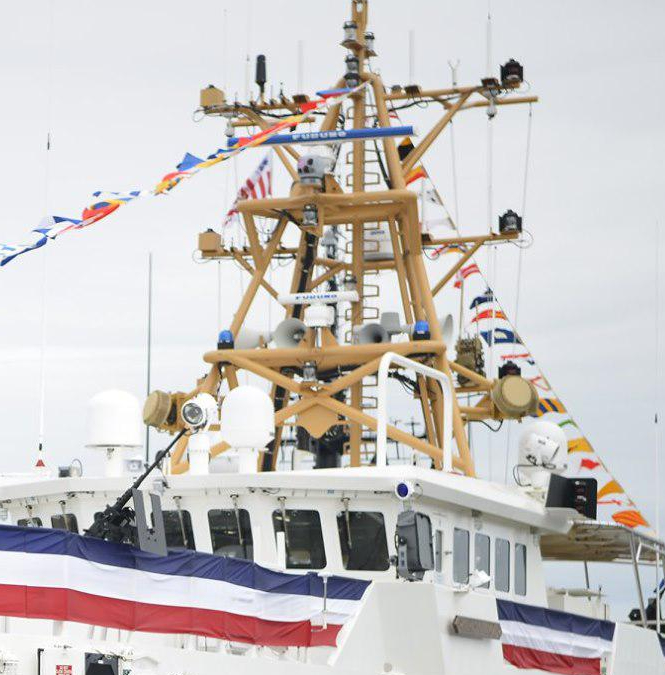
See the four fixed radar antenna on top of the cab? Look familiar?
From the Company web site: RPS-42 is an S-Band tactical hemispheric air surveillance radar system. It is a member of the non-rotating, solid-state, digital radar family Multi-mission Hemisphere Radar (MHR), developed by RADA Electronic Industries Ltd. The RPS-42 is a pulse Doppler, software-defined radar platform, that can detect, classify and track all types of aerial vehicles – including fighters, helicopters, UAVs, transport aircraft, etc. at tactical ranges. A single radar platform provides 90º azimuth coverage. Hemispheric coverage is achieved when four radars are employed as a system. Mobile or stationary, the system can be integrated with any C⁴I system and other radars and sensors. The software is able for On-the-Move (OTM) Operation. The radar can operate either as a stand-alone or as part of a large-scale surveillance system. The Antenna is an Active Electronically Scanned Array (AESA) based on Galliumnitrid (GaN) Amplifiers. Its diameter is 50.4 cm, the max width is 16.5 cm. The achievable range for detection of the smallest drones (known as Nano UAV) is 3.5 km.
Looks like they or close cousins are on PATFORSWA cutters. (Click on the photo below to enlarge.) They are on the mast.
USCGC Charles Moulthrope (WPC-1141) prior to departure for PATFORSWA.
The TWZ post has a bit of cost comparison as well.
The laser-guided rockets are modular and low-cost, with the guidance section designed to slot in between existing standardized 70mm warheads and rocket motors. The unit cost of the APKWS II guidance section is around $25,000, with the warhead and rocket motor together typically only costing a few thousand dollars more depending on their exact types, according to Navy budget documents. For comparison, the cost of a single Coyote Block 2 interceptor, another counter-drone weapon currently deployed to help protect U.S. Forces in the Middle East, is reportedly roughly around $100,000. Current generation Stinger short-range heat-seeking surface-to-air missiles, which include new features to improve their effectiveness against drones, have a unit cost of around $400,000.
While you may have heard the Coast Guard is headed for an all H-60 rotary wing fleet, it seems we will continue to have H-65a for some time.
The upgrades comply with the Federal Aviation Administration’s Next Generation Airspace Transportation System requirements, and extends the aircraft service life to the late 2030s.
The Coast Guard plans to convert all 98 of its Dolphin helicopters to the MH-65E configuration by the end of 2024.
News Release U.S. Coast Guard 5th District Public Affairs North D5 Public Affairs North, Baltimore, Md
Coast Guard delivers upgraded multi-mission helicopters to Air Station Atlantic City
ATLANTIC CITY, N.J. — Coast Guard Air Station Atlantic City received its first upgraded MH-65E Dolphin helicopter Monday to replace the legacy MH-65D helicopters that serve out of the Coast Guard’s largest MH-65 helicopter unit.
The avionics upgrade to the Echo or “E” configuration will provide enhanced search and rescue capabilities including modern “glass cockpit” technology that increases pilot and aircrew situational awareness.
The Dolphin upgrades also include reliability and capability improvements for the automatic flight control system, enhanced digital weather and surface radar, and multifunctional displays with more accurate fuel calculations.
The upgrades comply with the Federal Aviation Administration’s Next Generation Airspace Transportation System requirements, and extends the aircraft service life to the late 2030s.
The transition of Air Station Atlantic City’s 12 MH-65D helicopters to the upgraded “E” configuration is expected to take approximately 10 months.
During the upgrade period, the unit’s 62 pilots and 104 aircrew members will undergo a three-week transition course at the Aviation Training Center in Mobile, Alabama. Aircrew and mechanics will undergo formal training specific to their roles and duties during this course.
“The upgrades and advanced training will enhance the situational awareness of our aircrews and improve mission planning capabilities aboard the Coast Guard’s most prolific rotary-wing asset,” said Cmdr. Christian Polyak, engineering officer at Air Station Atlantic City. “The replacement and inspection of key aircraft components as a part of the upgrade are also expected to extend the aircraft’s service-life and enable us to continue safeguarding and securing our coasts for years to come.”
Air Station Atlantic City Dolphin helicopter crews perform search and rescue, provide aids to navigation support, and maritime law enforcement and marine environmental protection to the mid-Atlantic region from Long Island, New York, to the Maryland/Virginia border.
Air Station Atlantic City helicopters and aircrews also provide continuous support for the North American Aerospace Defense Command’s airspace security mission in Washington, D.C., and throughout the country as necessary.
Additionally, the upgrades also include advanced navigation capabilities that will allow pilots to safely maneuver through highly congested, complex air traffic that can be encountered in situations such as disaster response.
The Coast Guard plans to convert all 98 of its Dolphin helicopters to the MH-65E configuration by the end of 2024.
Most of us are familiar with the M2 .50 cal. machine gun. It is found on most Coast Guard Cutters. Its familiar. Its simple. It is a stand alone weapon that requires no external power. It is frequently a Coast Guard vessel’s primary weapon, as on the 87 foot patrol boats, buoy tenders, and icebreakers. It is the secondary as on the FRCs and WMECs.
Modern-day air-cooled 0.50″ (12.7 mm) Browning Machine Gun. US Navy Photograph No. 020704-N-0156B-002.
Nominally it has an effective range of 2,200 yards, but I suspect that is only against advancing infantry formations. It is certainly not accurate at that range after the first round in full auto.
Aside from firing warning shots at close range, it is frankly not a very good weapon for use in the naval environment. The gunner is largely exposed, where he can be picked off by a sniper. Even terrorists or criminals can easily obtain weapons that equal or overmatch it range and hitting power. The damage it can do to anything beyond the smallest vessels is very limited.
When used in a crowded harbor, its range, combined with its inaccuracy, and the lack of a self-destruct feature for it projectiles, mean it may cause collateral damage.
It is almost totally useless against aircraft. During World War II, Navy experience was that it required an average of 11,285 rounds for a .50 caliber machine gun to bring down an aircraft. The .50 caliber weapons on ships were credited with 14.5 aircraft kills for 163,630 rounds expended, so it probably not going to be very useful against drones.
We should not expect it to provide an effective self defense capability.
Northrop Grumman seems to think they have a replacement, perhaps two. Most recent is the 20mm Sky Viper proposed to equip the Army’s planned Future Attack Reconnaissance Aircraft (FARA) seen in the video above.
As with General Dynamics’ offering, specialty munitions for use against troops, unmanned aerial vehicles, ground vehicles and other helicopters, can be integrated with Sky Viper, flexibility which naturally suggests other applications.
While emphasizing that Sky Viper is a FARA-focused effort (with DEVCOM funding), Canole acknowledges that Northrop Grumman is looking beyond the platform to where it might offer a solution “with a lot more firepower than a .50 caliber”. That could include the Army’s new Mobile Protected Firepower light tank prototypes for which .50 caliber (12.7mm) auxiliary guns are already spec-ed.
“The low recoil and a relatively lightweight system really opens the door for [applications] where .50 calibers tend to be the mainstay,” Canole says.
The Sky Viper, which uses the same 20x102mm round as the 20mm Vulcan Gatling gun, that equips the Phalanx CIWS, is evolved from the 30mm M230 that fires the 30x113mm. You can see in the photo above that the 20x102mm is a much smaller round than either the 30x113mm or the 25x137mm used by our current 25mm MK38 mounts, but it is substantially more powerful than the .50 caliber.
As the newest member of the chain gun family, we can expect some improvements. Compared to the M230 it has much lower recoil forces, a higher rate of fire, and is lighter, lighter in fact, than the .50 caliber M2.
It is in service with the Marine Corps, so it is already in the Navy inventory and ammunition supply system. It is actually smaller, more compact, lighter, and has far less recoil than the 25mm M242 in the Mk38 mounts.
Compared to the .50 caliber, the 30x113mm projectile is far more effective against larger targets and is effective at a greater range.
Used in a remote weapon station, it is far more accurate than a .50 caliber M2, and anytime you add a remote weapon station, the ship benefits from the high quality optics that come with it.
Plus there is a programable air burst fuse already available for the 30x113mm round that is apparently effective against drones.
I would not suggest replacing the 25mm Mk38s with either of these, unless the remote weapon station also incorporated missiles like Hellfire/JAGM and/or Stinger, but as replacements for .50 caliber they offer great advantage.





 Chuck Hill's CG Blog