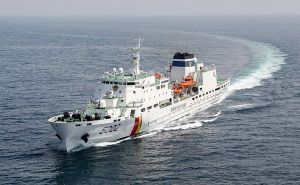
Jane’s 360 is reporting that the S. Korean Coast Guard has commissioned their largest and most heavily armed cutter.
Lee Chung-ho has a length of 150.5 m, a beam of 16.5 m, a loaded displacement of 6500 tonnes and a complement of 104 persons, although 140 persons can be embarked.
The hybrid propulsion system has four MTU 20V1163M94 diesels (each rated at 9,900 bhp) and two 750KW electric motors that are connected to the propellers.
How big is it?
The cutter, at 6,500 tons, is 44% larger than the Bertholf class. While its length and beam are almost identical to Japan Coast Guard’s two largest cutters, the displacement is reportedly far less. I have seen no info on the draft, so that is at least possible. In any case, it is definitely much smaller than the huge cutters the Chinese have built.
The post compares the new cutter to the slightly smaller Sambong-ho (pennant 5001), which entered service in 2002 and was previously the largest cutter in the S. Korean Coast Guard, stating it is three knots faster. That would indicate a top speed of 24 knots. The new cutter has a four diesel power plant compared to its predecessor’s two engine plant. In addition, the two 750 HP electric motors mounted on the shafts which should allow the cutter to slow cruise while the main diesels are cold iron.
Weapons:
According to Wikipedia, S. Korean has 34 cutters over 1000 tons. All are armed with one or more 20 mm Vulcan Gatling Guns and .50 caliber machine guns. Fourteen have Bofors 40 mm guns, and one other also has a 76 mm. The 20 mm and 40 mm mounts are locally produced in S. Korea.
Looking at the armament, it may be an upgrade compared to the typical S. Korean cutter, but only slightly better armed than what appears to be, becoming a world wide standard for offshore patrol vessels–a medium caliber gun, 57 or 76 mm, and a pair of 20 to 30mm machineguns in remotely controlled weapon stations. It is really no better armed than the 1,150 ton PC-1005, the Hankang, smallest of S. Korea’s 34 cutters major cutters, commissioned in 1985.
All the weapons appear to have been recycled from previous installations. In the photo, an older model OTO Melara 76 mm, like those used on the FRAMed Hamilton class WHECs and Bear class WMECs is clearly visible on the bow. There is also a Vulcan 20 mm mount on the O-3 deck superfiring over the 76 mm mount forward of the bridge. It also appears to have a locally built twin Bofors 40 mm compact mount using an earlier version of the Bofors than the 70 caliber weapon currently offered, which appears to be atop the superstructure aft. She has no CIWS, missiles, or ASW capability.
What is it with these very large cutters?:
Japan, China, and S. Korea, have now each built two very large cutters. Why to they exist?
It is their size, not their weapons, that make them exceptional. The Russian Coast Guard has smaller, but much more heavily armed ships (Krivak III frigates and Grisha II class corvettes).
There has been a general trend for ships of all types to grow in size. Their crews are not exceptionally large, so the operating cost may not be that much more.
Still these are significantly bigger than other cutters built by the same coast guards, at the same time, apparently for the same missions.
None of these three nations has a patrol area as distant and demanding as Alaska.
Japan did have a reason for building the first of these. Shikishima, commissioned in 1992, was intended to escort plutonium transport ships between Europe and Japan, but I have seen no explanation for the ships that followed.
Is it prestige, just “keeping up with the Jones?”
Are they intended for a future shoving match? If so, they are giving up agility for presence.
Are they perhaps intended as flag ships for long term operations?
I would love to hear the reasoning from someone in the know.



 Chuck Hill's CG Blog