“North American Arctic defense could shape outcome of Indo-Pacific conflict” –Indo-Pacific Defense Forum

A U.S. Army Green Beret observes an incoming CH-47 Chinook helicopter during Operation Polar Dagger in Wales, Alaska, in August 2024. IMAGE CREDIT: SPC. BRYON DAVIDSON/U.S. ARMY

The Indo-Pacific Defense Forum reported on a Special Operations Command North (SOCNORTH) exercise,

“To address growing concerns in the Arctic, SOCNORTH recently executed two phases of Operation Polar Dagger, an operational series that demonstrates rapidly deployable, joint SOF capabilities throughout the North American Arctic. It forms the basis of options to deter, disrupt and deny adversary activity in support of U.S. Northern Command’s (USNORTHCOM) layered defense of the U.S. homeland…

“In 2023 and 2024, SOCNORTH and the U.S. Navy partnered to deploy the amphibious transport dock ship USS John P. Murtha and the USS John L. Canley, an expeditionary sea base vessel that supports SOF operations and other maritime missions, to the Bering Sea and the Arctic Circle to support Operation Polar Dagger. USSOF is enhancing its navigation expertise in Arctic terrain and has demonstrated the ability to thrive in the region by executing long-range movements, maritime interdiction operations, rapid infiltration/exfiltration, air-to-ground integration, critical infrastructure defense, domain awareness, and medical evacuation validation, among other engagements.”

(I suspect what this means is that USS John P. Murtha participated in 2023 and USS John L. Canley participated in 2024. Both could not have participated both years.)

A lot of the post is an attempt to explain to an Indo-Pacific audience why a NORTHCOM exercise should be important to them.

Observations: 

It appears that Polar Daggar is a part of the larger NORTHCOM NOBLE DEFENDER exercise. This is apparently a regular annual exercise. NORTHCOM’s on-line magazine reported on the 2023 exercise.

“U.S. Army and Navy assets conduct an interdiction operation in the Bering Sea in July 2024.” Note how flat the seas are. That’s not normal. They did do this in July. You can’t count on seas like this. IMAGE CREDIT: SENIOR AIRMAN JOHNNY DIAZ/U.S. AIR FORCE

There is a serious problem here because there was apparently no Coast Guard participation in these exercises. The Navy’s Pacific Fleet almost never has surface ships anywhere near the Arctic. If you have an urgent need for a ship to do something in the Bering Sea, the Coast Guard is really the only option most of the time. SOCNORTH should be learning how they can exploit Coast Guard resources including ships, boats and aircraft. If you want maritime interdiction in the Bering Sea, if you want maritime domain awareness, who should NORTHCOM call? –the Coast Guard.

Want to fly a “Night Stalker” helicopter off of a ship? Want to launch ATACMS from the Chukchi Sea or maybe Tomahawk or SM-6 from a Mk70 launcher? You could put it on the flight deck of a cutter. 

Need follow-up logistics for paratroopers dropped into an isolated coastal location? Coast Guard.

A satellite image of Shemya Island. What is now called Eareckson Air Station, with its lengthy runway, is seen along the southern edge. Google Earth

Not enough Air Force transports available when you need to move troops to reinforce Shemya? Kodiak C-130Js can help with that.

Cutter might even put a landing party ashore to provide quick protection for a critical facility and stand offshore to provide some AAW protection with its 57mm.

East-Coast-based U.S. Naval Special Warfare Operators (SEALs) conduct an over the beach infiltration on Shemya Island, Alaska, Sept. 6, 2023, as part of Operation Polar Dagger. During the operation, special operations forces projected the ability of U.S. forces to defend critical infrastructure, enhanced all-domain awareness, demonstrated operational reach, and strengthened our understanding of activity in the Arctic. (U.S. Navy photo by Mass Communication Specialist 2nd Class Matthew Dickinson)

In 2023, Special Forces operating from USS John P. Murtha (LPD-26) did an infiltration exercise. A cutter could have done the same thing, and it probably would have been more realistic since an LPD is unlikely to be available.

Any surface or land action at the start of a conventional conflict against Russian and/or China that involves the Arctic is likely to be a surprise involving small units, probably involving covert actions from unconventional platforms, paratroopers, and small unit insertions. At least initially, it will be a “run what you brung” war. We will have to fight with what we have and effectively the Coast Guard is the surface navy for Alaska.

The “Center of Gravity” for the theater is likely to be the Bering Strait. As long as the US controls the strait, the Northern Sea Route will be useless for traffic between the Russian North coast and China or the Russian Pacific Coast.

The photo that leads off this post was taken at Wales, Alaska, population 145, 111 miles (179 km) northwest of Nome. The location is significant in that it is on the Eastern edge of the Bering Strait. It appears someone has recognized the significance of the location.

“U.S. Coast Guard encounters People’s Republic of China military naval presence in Bering Sea” –D17

A Coast Guard Cutter Kimball crewmember observing a Russian Destroyer in the Bering Sea, September 19, 2022. Coast Guard Photo

Below is a District 17 (Alaska) news release. USCGC Kimball was doing the same thing two years ago. Last year the US Navy had four destroyers doing the shadowing. In 2021 it was Bertholf. Chinese warship operated legally off American shores back in 2015. NORTHCOM’s on-line magazine, The Watch, suggested how these visits should be viewed.

Two items of note, (1) this is a little earlier in the year than we have seen them in the past, (2) where are the Russians? Usually there are Russian ships with the Chinese.

This provides another example of how the National Security Cutters are taking on a role comparable to AGIs of the Soviet Era.

It is ironic and a bit funny that the Chinese are doing “freedom of navigation operations.”

I will note again that the nearest US Navy surface ship is probably at least 1000 miles away, probably in Japan.


July 10, 2024

JUNEAU, AK –The U.S. Coast Guard encountered multiple People’s Republic of China military ships in the Bering Sea, Saturday and Sunday.

The crew of U.S. Coast Guard Cutter Kimball (WMSL 756) detected three vessels approximately 124 miles north of the Amchitka Pass in the Aleutian Islands, and an HC-130J aircrew from U.S. Coast Guard Air Station Kodiak detected an additional vessel approximately 84 miles north of the Amukta Pass.

All four of the People’s Republic of China vessels were transiting in international waters but still inside the U.S. Exclusive Economic Zone, which extends 200 nautical miles from the U.S. shoreline.

“The Chinese naval presence operated in accordance with international rules and norms,” said Rear Adm. Megan Dean, Seventeenth Coast Guard District commander. “We met presence with presence to ensure there were no disruptions to U.S. interests in the maritime environment around Alaska.”

The Chinese vessels responded to U.S. Coast Guard radio communication and their stated purpose was “freedom of navigation operations.” Coast Guard cutter Kimball continued to monitor all ships until they transited south of the Aleutian Islands into the North Pacific Ocean. The Kimball continues to monitor activities in the U.S. Exclusive Economic Zone to ensure the safety of U.S. vessels and international commerce in the area.

The Coast Guard, in coordination with U.S. Northern Command, was fully aware of and tracked the Chinese naval presence. In September of 2021 and 2022, Coast Guard cutters deployed in the Bering Sea also encountered Chinese surface action groups.

The Kimball patrolled under Operation Frontier Sentinel, a Coast Guard operation designed to meet presence with presence when strategic competitors operate in and around U.S. waters. The U.S Coast Guard’s presence strengthens the international rules-based order and promotes the conduct of operations in a manner that follows international norms.

Coast Guard Cutter Kimball is a 418-foot legend class national security cutter homeported in Honolulu, Hawaii.

“U.S. Coast Guard Cutter Kimball returns home following 85-day Bering Sea patrol” –CG News

Below is a news release from Coast Guard News. Looks like Kimball had an unusual Alaska Patrol, responding to the wildfire on Maui, to terminating an unsafe voyage, to shadowing a Russian naval exercise.


 Nov. 2, 2023

U.S. Coast Guard Cutter Kimball returns home following 85-day Bering Sea patrol

HONOLULU — The U.S. Coast Guard Cutter Kimball (WMSL 756) returned home to Honolulu, Wednesday, after an 85-day multi-mission patrol covering 14,000 nautical miles spanning from the Hawaiian Islands to north of the Arctic Circle.

The crew provided search-and-rescue coverage and conducted living marine resources (LMR) and counter Illegal Unreported and Unregulated (IUU) Fishing operations during the patrol following their actions responding to the Maui wildfires.

Kimball departed August 8 for the Aleutian Island chain and later that evening, the cutter received a report of people in the water attempting to escape a raging wildfire on Maui. The cutter shifted to the tactical control of Sector Honolulu and altered course to support the mass search and rescue efforts. Arriving on scene within hours, Kimball assumed the role of On Scene Commander of Coast Guard Station Maui, Coast Guard Cutter Joseph Gerczak (WPC 1126), and Air Station Barbers Point MH-65s, who collectively searched 790 square nautical miles, saved 17 lives, and assisted approximately 40 survivors ashore. During Kimball’s three days on scene, their crew launched two cutter small boats for over 25 combined hours and deployed the cutter’s UAS drone for over 8 hours of flight time, conducting search and rescue and damage assessment support.

After being relieved by Juniper, Kimball’s crew transited north to support the Coast Guard’s 17th District by providing search-and-rescue coverage and conducting LMR and counter IUU-Fishing patrols spanning the Northern Pacific Ocean, Bering Sea, and the American Arctic.

Operating under Operation Alaskan Groundfish Enforcer, Kimball ensured compliance with all federal fisheries conservation laws and safety requirements by completing 10 LMR boardings on fishing vessels in the Bering Sea. Kimball issued eight citations and one termination for gross violation of U.S. and international regulations. This resulted in the Kimball escorting the fishing vessel back to the nearest port and ensured they corrected their discrepancies.

As the sole U.S. military asset in the Bering Sea, Kimball diverted to provide presence alongside the U.S. domestic fishing fleet in the remote region of the U.S. Arctic upon receiving intelligence of a Russian military exercise within the U.S. Exclusive Economic Zone (EEZ). Kimball’s presence ensured the safety of 23 mariners while they worked within the U.S. EEZ near Russian warships as part of Operation Frontier Sentinel.

“I couldn’t be prouder of Kimball’s crew,” said Capt. Bob Kinsey, Kimball’s commanding officer. “They were able to showcase the true value that the national security cutter brings to such a dynamic area of responsibility. The crew’s diversity of skill harnessed our Coast Guard authorities and capabilities to provide tangible lifesaving results, from responding to the tragic fires in Maui to providing an influential presence in the Chukchi Sea and American Arctic to preserving the livelihoods of our Bering Sea fishermen through the enforcement of federal safety and living marine resources laws.”

To ensure crew preparation and proficiency, Kimball conducted numerous flight operations with MH-65 Dolphin and HH-60 Jayhawk helicopters and aircrews from U.S. Coast Guard Air Station Kodiak, resulting in the qualification of eight pilots and recertification of Kimball’s crew.

While in Dutch Harbor, Alaska, Kimball’s crew engaged with the local community by participating in sports at the community center, conducted cutter tours, and volunteered for community events. Notably, Kimball assisted the Museum of the Aleutians in relocating fragile gray whale fossils for a new exhibit. Kimball also met with the mayor of Dutch Harbor to discuss how the Coast Guard and the town can continue strengthening their relationship.

Commissioned in 2019, Kimball is the Coast Guard’s seventh national security cutter. National security cutters are the largest and most technologically sophisticated cutters in the Coast Guard’s white-hull fleet. National security cutters can operate in the most demanding open ocean environments, including the Bering Sea’s hazardous fisheries and the Southern Pacific’s vast approaches, where much of the American narcotics trafficking occurs. With robust command, control, communication, computers, intelligence, surveillance and reconnaissance equipment, stern boat launch and aviation facilities, as well as long-endurance station keeping, National security cutters are an afloat operational-level headquarters for complex law enforcement and national security missions involving multiple Coast Guard and partner agency participation.

-USCG-

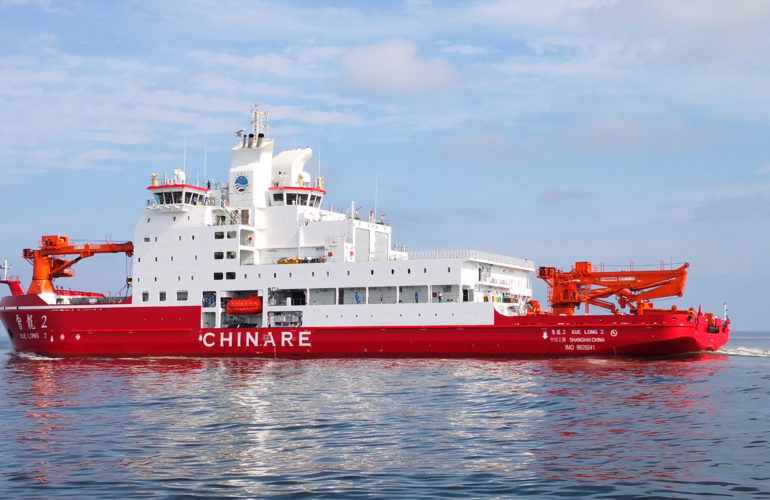
Why Russia Should be Worried, “ARCTIC PRC’s 13th Arctic expedition creating concerns for Russia” –The Watch

Xue Long 2 on sea trials. Photo by PRIC.

NORTHCOM’s online magazine, “The Watch,” gives us a balanced, non-alarmist, look at Chinese Arctic activity, but also tells us why maybe Russia should be worried.

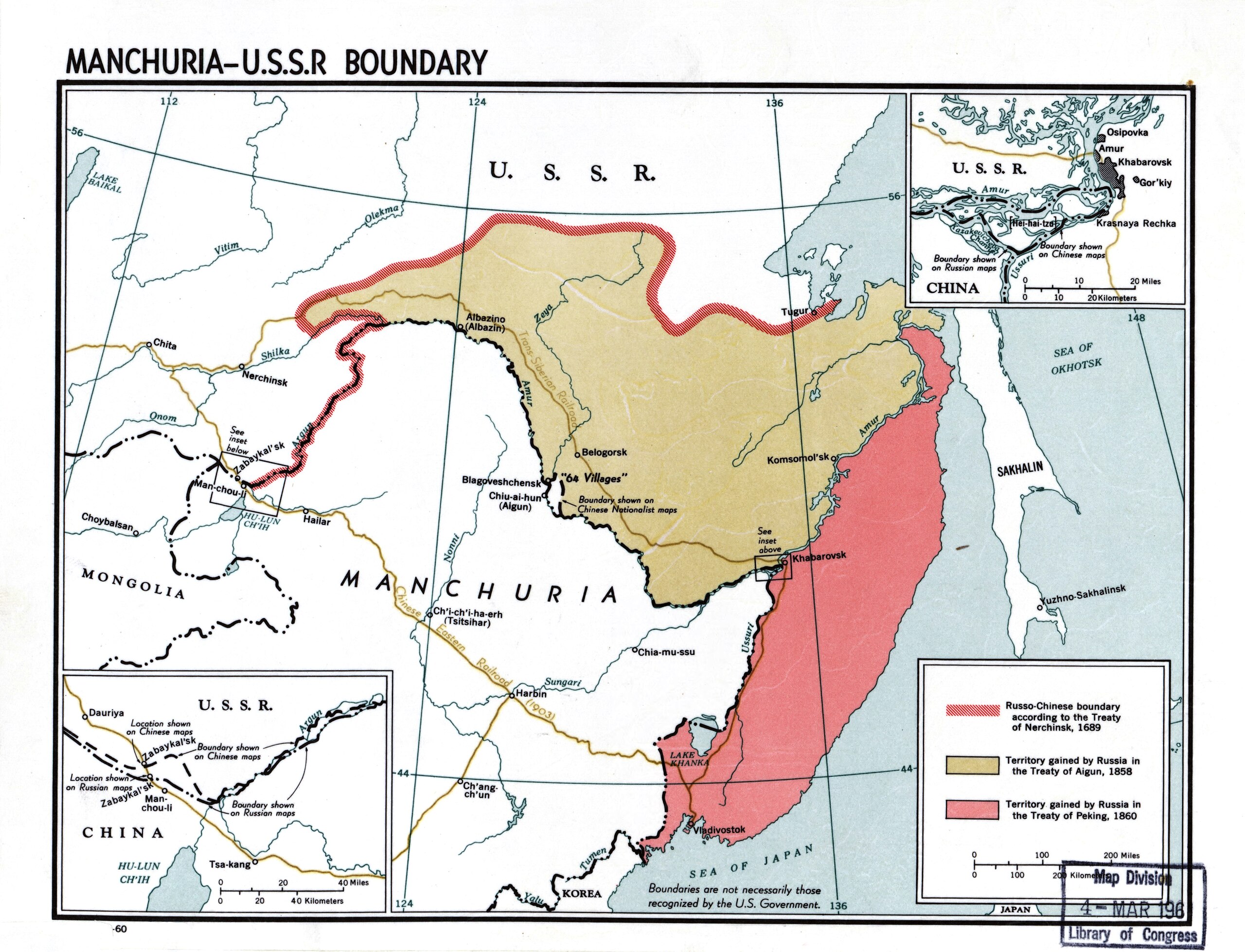
I have contended for a long time that sometime in the future, China will turn on Russia and recover those parts of China ceded to Russia as a result of unequal treaties (and here) in the 19th Century, during what China calls the Century of Humiliation, and while they are at it, maybe a bit more. They have neither forgotten nor forgiven.  

Library of Congress Geography and Map Division Washington, D.C. 20540-4650 USA
DIGITAL ID g7822m ct002999 http://hdl.loc.gov/loc.gmd/g7822m.ct002999

China and Russia have a long history of conflict (here, here, here and here), There was a border conflict between China and Russia (then the Soviet Union) in 1969, when China was clearly the weaker of the two, that lead to China opening to the West and Nixon’s trip to China.

Russia and China’s current partnership has mostly benefited China. China benefited from technology transfers and reverse engineered Soviet and Russian weapon systems.

Now China is clearly stronger than Russia in just about everything except nuclear weapons, and they are now rapidly growing their nuclear capability.

If China should decide retaking Taiwan, which has 215,000 active military and 2,310,000 reservists, a tech savvy population of about 24 million, and is protected by the 100-mile-wide Taiwan Strait and has potential help from powerful allies, may be too risky, they may decide recovery of Outer Manchuria is a good consolation prize.

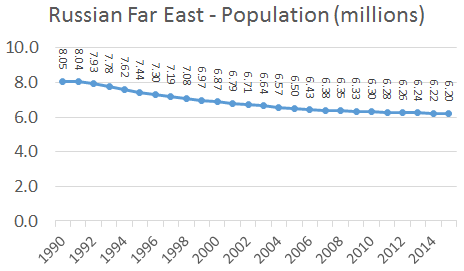
Population of the Russian Far East, 1990-2015 Data source: Fedstat. Author: Underlying lk. (About four million of these live in former Chinese territory.)

The Russian population in the Far East is small and declining. Russian infrastructure connecting industrialized European Russia with the FarEast is weak. Most of the Russian military is in Europe, and their weakness has been exposed in Ukraine.

If China attempted to retake land formerly part of China, they would want to cut Russia’s East/West logistics links. Taking out the few railroad links using airpower would be relatively easy. Air links can’t carry much in the way of heavy equipment. Most Russian supplies and material reinforcements would have to come by sea. Even if the Chinese did not interdict Russian traffic on the Norther Sea Route as suggested in the linked post, China’s Navy and Air Force could dominate Russian access to the Sea of Japan, including the primary Russian Pacific Fleet base in Vladivostok. Chinese submarines and their rapidly expanding force of aircraft carriers could probably cut off access to the Sea of Okhotsk and Petropavlovsk.

From a Chinese point of view recovery would be justified and perhaps far less costly than an amphibious invasion of Taiwan.

If the Russians can be made to see the righting on the wall, they might even be willing to sell the territory back to their friend at wholesale.

“US Coast Guard cutter provides presence during Russian military exercise in Bering Sea ” –D17

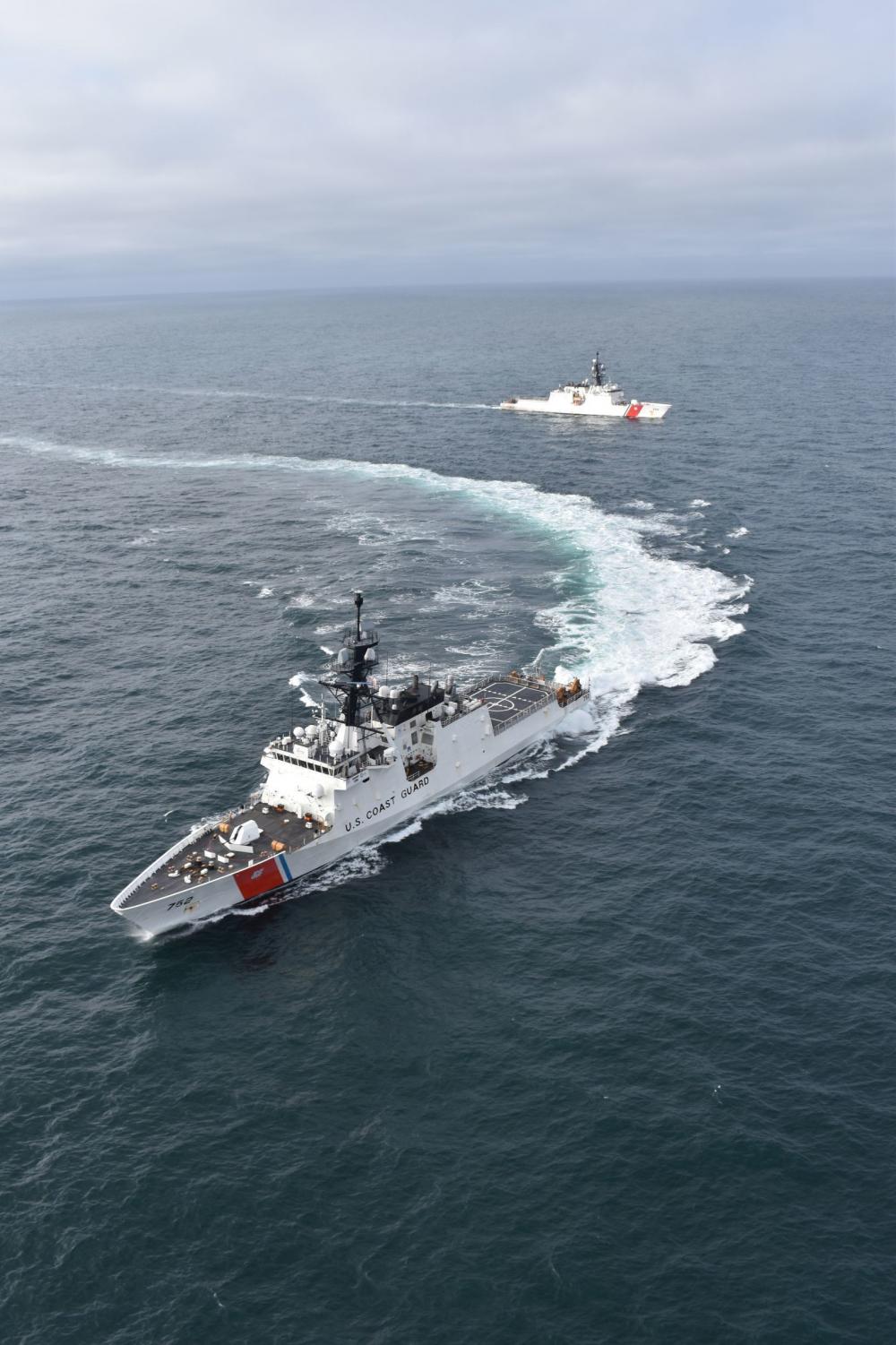
U.S. Coast Guard Cutters Stratton (WMSL 752) and Kimball (WMSL 756) steam in formation while patrolling the U.S.-Russian Maritime Boundary Line (MBL), in the Bering Sea, Sept. 26, 2022. This marked the first time two national security cutters jointly patrolled the MBL above the Arctic Circle. (U.S. Coast Guard courtesy photo).

Below is a District 17 (Alaska) News Release

Sept. 18, 2023

US Coast Guard cutter provides presence during Russian military exercise in Bering Sea

D17 Public Affairs

JUNEAU, Alaska – The crew of Coast Guard Cutter Kimball (WMSL 756), in coordination with U.S. Northern Command, provided U.S. presence during a Russian military exercise in the Bering Sea, Friday.

The Kimball patrolled in the vicinity of U.S. fishing vessels conducting their work in international waters within the U.S. exclusive economic zone (EEZ) during ongoing Russian military operations, which included the launch of a missile, approximately 300 miles southwest of St. Lawrence Island.

“Though military operations and exercises in international waters are lawful,” said Rear Adm. Megan Dean, Seventeenth Coast Guard District commander, “we will continue to ensure there are no disruptions to U.S. interests or commerce in the maritime environment around Alaska.”

On Sept. 10, an urgent warning of navigational dangers advisory message, known as a HYDROPAC, was released through the National Geospatial Agency regarding Russian military operations in the Bering Sea. The area of the HYDROPAC includes a portion of the U.S. EEZ southwest of St. Lawrence Island along the U.S./Russia Maritime Boundary Line and remains in effect through Sept. 24.

The Coast Guard notified vessels and the commercial fishing industry operating in the vicinity of the HYDROPAC, and made notifications to federal, state and tribal governments about the exercise. The Coast Guard continues to provide notifications throughout the maritime and fishing industry by all available means.

The Kimball, a 418-foot legend-class national security cutter homeported in Honolulu, Hawaii, is currently operating under the Seventeenth District’s Operation Frontier Sentinel.

Operation Frontier Sentinel is a Seventeenth Coast Guard District operation designed to meet presence with presence and ensure there are no disruptions to U.S. interests in the Alaskan maritime environment. The Coast Guard routinely patrols international waters under the service’s statutory authorities to ensure maritime safety and security of the U.S. maritime industry, to protect U.S. sovereign rights and to promote international rules-based order. Coast Guard presence ensures due regard for all lawful uses of the seas.

“Russia and China Sent Large Naval Patrol Near Alaska” –Wall Street Journal

The Wall Street Journal reports,

“Eleven Russian and Chinese ships steamed close to the Aleutian Islands, according to U.S. officials. The ships, which never entered U.S. territorial waters and have since left, were shadowed by four U.S. destroyers and P-8 Poseidon aircraft.”

The Russians and Chinese have been doing these joint deployments into the Bering Sea for at least a few years, and normally it has been the Coast Guard that followed them. This time the Navy sent a capable force, in addition to P-8 Maritime Patrol Aircraft they sent USS John S. McCain (DDG-56), the USS Benfold (DDG-65), the USS John Finn (DDG-113) and the USS Chung-Hoon (DDG-93).

Previous reports: 

Coast Guard Cutter Kimball encounters Russia and People’s Republic of China military naval presence in Bering Sea” –D17, Sept. 2022

“Chinese Warships Sailing Near Alaska’s Aleutian Islands Shadowed By U.S. Coast Guard” –Small Wars Journal, Sept. 2021

Chinese Navy Operating Off Alaska, Sept. 2015

http://www.state.gov/e/oes/ocns/opa/arc/uschair/258202.htm . This map of the Arctic was created by State Department geographers as part of the U.S. Chairmanship of the Arctic Council.

Why are they there?:

Russia is easy to understand. This is very close to their territory and their Pacific Fleet base in Petropavlovsk, but why the Chinese?

Russia is China’s top crude oil source, and much of that oil comes from Russia’s Arctic. In any conflict China’s energy sources are likely to be a target and the Bering Strait is the choke point on the most direct route from the Russian Arctic to Chia.

I would note that China’s excursions into the Bering Sea all seem to be toward the end of summer, which is about as nice as it gets in the Aleutians.