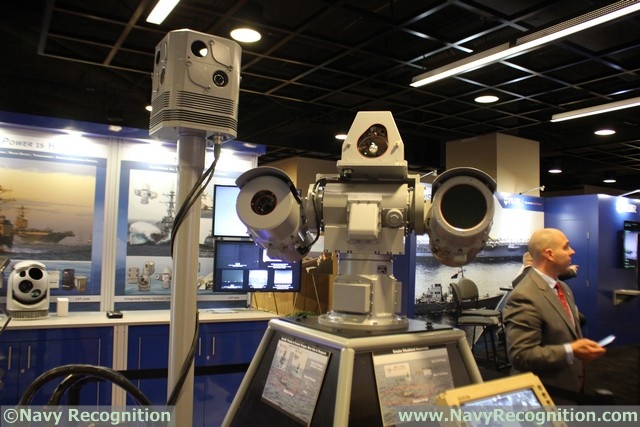
It appears the Navy has a new AI aided sensor system going into low-rate production called the “Shipboard Panoramic Electro-Optic/Infrared (SPEIR) program.” It looks like it may ultimately go on every Navy surface combatant, and that it may be scalable to make it applicable to units as small as patrol boats.
The DOD daily digest bulletin for 26 March reported,
NAVY
L3 Technologies Inc., Systems Company, Camden, New Jersey, is awarded a $205,899,580 cost-plus-incentive-fee, cost-reimbursement, firm-fixed-price, cost-plus-fixed-fee, and fixed-price incentive (firm target) contract for engineering, manufacturing, and development; engineering support labor; low rate initial production systems, and spares for the Shipboard Panoramic Electro-Optic/Infrared (SPEIR) program. This contract includes options which, if exercised, would bring the cumulative value of this contract to $593,050,756. Work will be performed in Mason, Ohio (54%); Northampton, Massachusetts (16%); Bothell, Washington (12%); Hamilton, Ontario (7%); Austin, Texas (7%); Tulsa, Oklahoma (2%); Norfolk, Virginia (1%); and various locations across the U.S., each less than 1% (1%), and is expected to be completed by November 2025. If all options are exercised, work will continue through March 2031. Fiscal 2021 research, development, test, and evaluation (Navy) funds in the amount of $11,000,000 will be obligated at time of award and will expire at the end of the current fiscal year. This contract was competitively procured via the Federal Business Opportunities website, with one offer received. The Naval Sea Systems Command, Washington, D.C., is the contracting activity (N00024-22-C-5514).
This 2017 report from Military Aerospace Electronics seems to provide insight into the program’s objectives and challenges.
This 2015 report seems to have been an earlier version with the same program, under the name CESARS, which in turn combined two earlier programs, the Shipboard Panoramic EO/IR Cueing and Surveillance System (SPECSS); and Multispectral EO/IR Countermeasures for Advanced Threats (MEIRCAT). The objectives included target acquisition, tracking, classification, identification, 3-D ranging, threat assessment, countermeasures execution, and countermeasures effectiveness monitoring against threats including cruise missiles (particularly optically guide cruise missiles that are not active emitters), small surface vessels, and Unmanned Air Systems. It would of course, also detect ships and conventional aircraft.
A major advantage of this type system is that it can provide situational awareness while allowing the ship to maintain strict EMCON (emissions control) minimizing active emissions that might be picked up by an adversary.
The good news for the Coast Guard is that, from the 2017 report,
This project also seeks to identify a family of imaging systems that could handle the situational-awareness needs of surface vessels ranging in size from a patrol craft, a frigate, a destroyer, and an aircraft carrier.
On small units, this system might provide some of the situational awareness capability provided by multi-mode radar and/or ESM on larger units, that is otherwise not available on these units.


 Chuck Hill's CG Blog