“Marines Commemorate 80th Anniversary of the Battle of Guadalcanal” –Seapower

Guadalcanal, Solomon Islands, edited by M.Minderhoud

The Navy League’s Magazine “Seapower” reports on a ceremony to commemorate the 80th anniversary of the start of the Guadalcanal campaign, held in Honiara, Solomon Islands. Quite properly Vice Admiral Andrew Tiongson, Commander, U.S. Coast Guard Pacific Area, was there representing the Coast Guard.

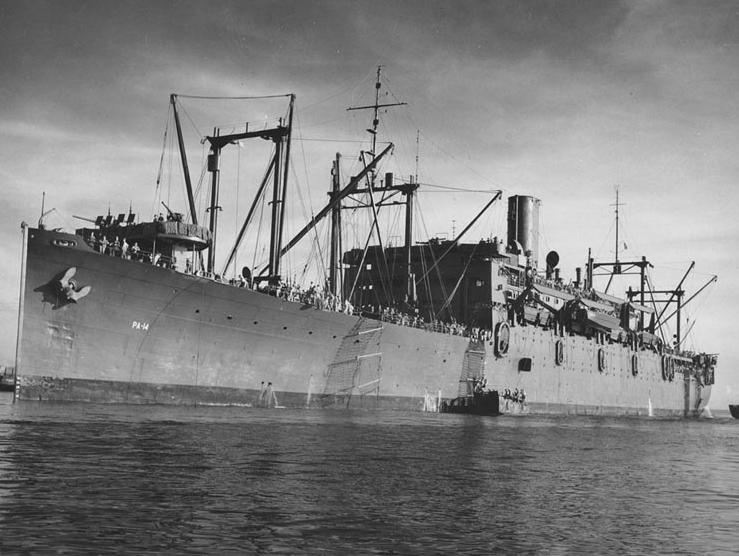
USS Hunter Liggett (APA-14) c1944.jpg

USS Hunter Liggett (APA-14) c. 1943-44

The Coast Guard manned transport USS Hunter Liggett was flagship of Task Force 62.1 which transported the 1st Marine Division, with Maj. Gen. Alexander A. Vandegrift, USMC, Commander ground forces, embarked. The story of Douglas Munro is well know, but there were other Coast Guard heros there as well. Ultimately the Coast Guard would suffer its largest single loss of personnel in the waters of Guadalcanal, when the Coast Guard manned ammunition ship USS Serpens (AK-97) exploded on January 29, 1945, while anchored off Laguna Beach.

Some stories:

The Long Blue Line: Tulagi’s Coxswains–the services 1st Silver Star recipients

The Long Blue Line: The “Green Hell” of Guadalcanal 80 years ago!

NOB Cactus, Guadalcanal, 1942

Gold Dust Twins: The Two Coast Guardsmen Who Saved Chesty Puller’s Marines on Guadalcanal

(U.S. Coast Guard)

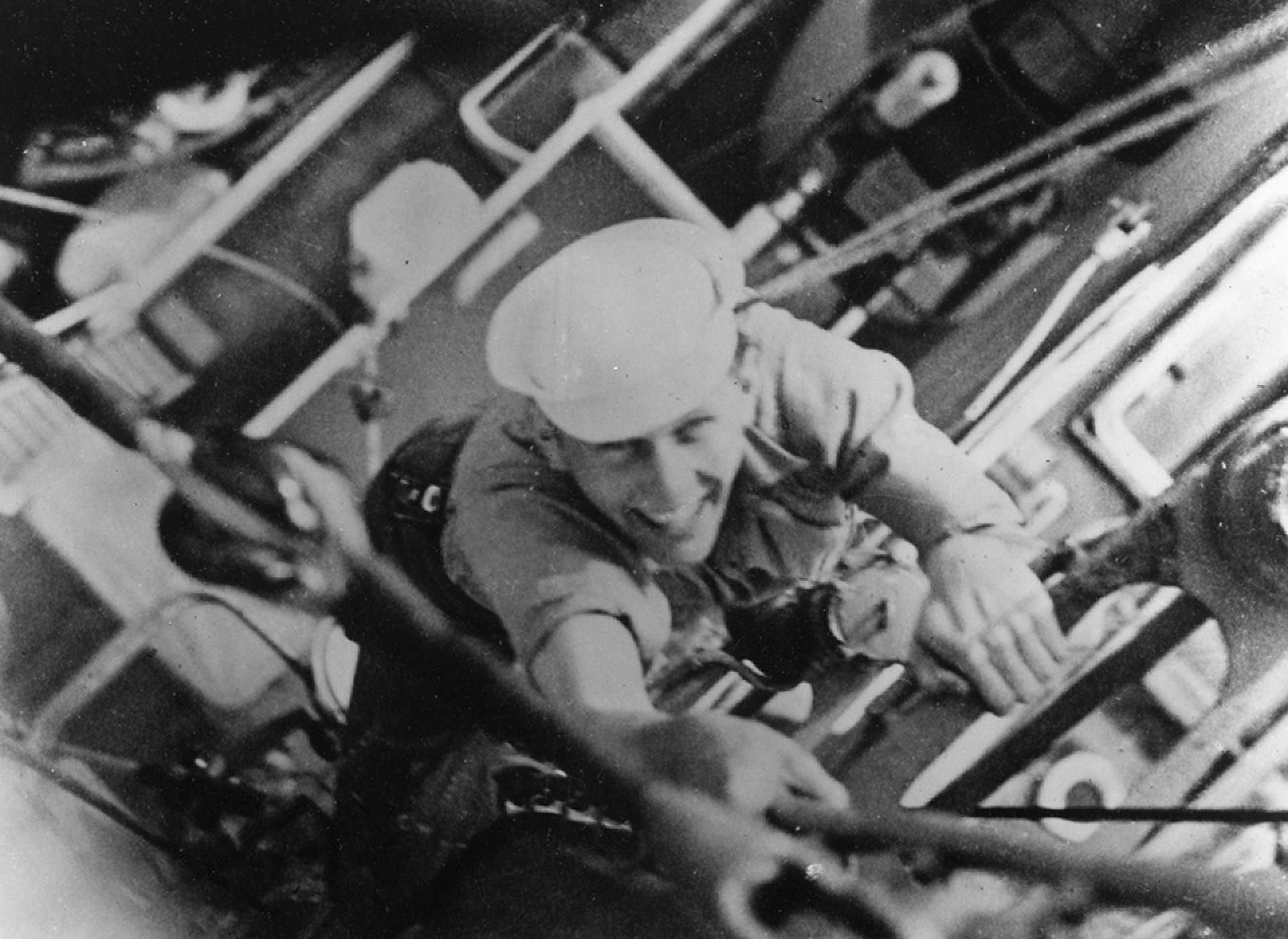
“The Marines were being driven back to the beach and many did not have radios to request assistance. A single “HELP” spelled out in T-shirts on the ridge near the beach sent a loud and clear signal to those looking on.”

“This man is the only US Coast Guard recipient of the Medal of Honor”

Joseph Toahty, Pawnee Warrior Of Guadalcanal

Loss of USS Serpens (AK-97), Jan. 29, 1945

What Ever Happened to the “Six Bitters?”

Port side view of USS Cumberland as a receiving ship, US Naval Academy, Annapolis, MD, 1938 with former USCG 75 foot patrol boats in the foreground.

Just a small footnote in Coast Guard histroy I stumbled across. Apparently, 51 Coast Guard prohibition era 75 foot “six bitter” patrol boats were sold to the Navy in 1933/34 and at least a few of them ended up at the Naval Academy as training ships for midshipmen.

The link above “U.S.C.G. Patrol Craft Built before WWII (Six-Bitters, WPC, WSC)” “…lists the 317 patrol craft built or acquired by the U.S. Coast Guard from its organization in 1915 through the start of WWII.” I have added the link to my Heritage page.

Steel Cut for DDG Honoring Coast Guard Hero

A graphic illustration of the future Arleigh-Burke class guided-missile destroyer USS Quentin Walsh (DDG 132). (U.S. Navy photo illustration by Mass Communication Specialist 1st Class Paul L. Archer/Released)

Dmitry Shulgin reports,

The U.S. Navy and General Dynamics (GD) Bath Iron Works (BIW) marked the start of fabrication for the future USS Quentin Walsh (DDG-132) with a ceremony at BIW’s Structural Fabrication Facility in East Brunswick, Maine, November 16.

This earlier post tells the story of this Coast Guard Hero.

“Coast Guard veteran turns 100, reflects on ‘scary days’ and ‘unbelievable sights’ of D-Day invasion” –D8 Press Release

A great personal story.

Coast Guard Cutter 16, an 83-foot wooden patrol boat assigned to Coast Guard Rescue Flotilla One, sits out of the water in Poole, England, in 1944. On D-Day, the crew of CGC-16 saved the lives of 126 Allied troops, more lives than any other vessel present that day. (U.S. Coast Guard photo)

 Feature Release U.S. Coast Guard 8th District Public Affairs Detachment Texas

Coast Guard veteran turns 100, reflects on ‘scary days’ and ‘unbelievable sights’ of D-Day invasion

Official headshot of Michael J. Swierc, who enlisted in the Coast Guard on Aug. 11, 1942, and trained as a motor machinist’s mate before deploying overseas for the first wave of the D-Day invasion. Swierc, who turned 100 years old on Nov. 6, 2021, received the Bronze Star Medal for helping save 126 Allied troops from drowning in the English Channel on June 6, 1944. (U.S. Coast Guard photo, courtesy Pam Manka)

Story by Petty Officer 1st Class Corinne Zilnicki

Nearly 80 years have passed since Mike Swierc vaulted over the side of a ship hundreds of yards off Utah Beach during the first wave of the D-Day invasion. But for Swierc, a 100-year-old Coast Guard veteran, the memories of those fateful days and nights have not faded from his mind.

“The night of the invasion was unbelievable,” said Swierc. “There was a continuous flash of lightning in the sky and we could hear the bombs. It was nonstop fire.”

Facing off against 28 German heavy artillery batteries and multiple 88 mm machine guns was not exactly what Swierc had expected upon enlisting in the Coast Guard. He and his younger brother had preemptively joined the service in 1942 hoping to protect domestic waterways and scour eastern U.S. coastlines for enemy submarines.

Instead, the farmer’s son found himself weaving through the frigid waters of the English Channel more than 5,000 miles from his hometown of Falls City, Texas.

A natural and seasoned mechanic, Swierc had spent the first 22 months of his Coast Guard service swept up in a whirlwind of basic training and diesel engine schools before deploying overseas for the Normandy invasion.

The 31-day journey from Bayonne, New Jersey, to Ireland was fraught with difficulty. Swierc passed the days aboard his transport ship peeling potatoes, scrubbing dishes and wincing at the sound of the wind lashing against the bulkhead.

“Somehow, I never got seasick,” Swierc marveled. “But we faced the most terrible storm when we crossed the Atlantic.”

The 500 destroyers, escort ships, battleships and aircraft carriers in Swierc’s convoy kept their bows pointed doggedly into the fierce wind and arrived overseas on schedule. Upon reaching Ireland, the Coast Guardsmen joined U.S. Navy sailors in joint training sessions, honing their skills in small-boat handling, ship-to-shore movement, beach landings and general maintenance. As D-Day loomed closer, Coast Guard, Navy, and British Royal Navy personnel prepared their ships for the channel crossing.

Swierc’s cutter, an 83-foot, wooden patrol boat called Coast Guard Cutter 16, was assigned to Rescue Flotilla One, a collection of 60 ships that had been hastily summoned only a few weeks prior. Although the wooden cutters of “the matchbox fleet” were initially designed to hunt submarines, their crews were now charged primarily with rescuing Allied soldiers during the invasion.

“The name of the game was search and rescue,” Swierc said. “I think we did our fair share.”

At around 4 a.m. on June 6, 1944, the Allied assault force departed from the rendezvous point and headed for the coast of France. Heavy seas battered the boats and soaked the men, many of whom were desperately seasick. Bullets and shellfire roared to life overhead and pummeled the water all around the convoy as it approached Utah Beach.

“We didn’t really have time to be scared,” explained Swierc. “We got in there and got after it.”

As soon as CGC-16 arrived off the beachhead, Swierc and his crew dove into action and began plucking survivors from the water around the USS PC-1261, the first ship sunk on D-Day. The submarine chaser had led the first wave of landing craft toward Utah Beach and was obliterated when an artillery shell slammed into its starboard side, instantly killing nearly half the crew.

With shellfire peppering the water around them and the explosions of nearby mines rattling the deck beneath their feet, the Coast Guard crew calmly began extracting shipwreck survivors from the oil-slicked waves.

Upon spotting two injured Allied soldiers in the water, Mike Swierc leaped off the cutter, swam 40 yards through enemy gunfire and fastened a rescue line around the men.

“The one guy said, ‘Don’t worry about me, just get my buddy,’” recalled Swierc. “But I looked at his buddy, and he was bleeding with his head in the water. He had already passed away.”

Unflinchingly, the CGC-16’s head mechanic swam back through the 54-degree water as crew members aboard the cutter reeled in the two soldiers. This was only one of many daring plunges Swierc took into the water that day.

“We were out there swimming our hearts out,” said Swierc. “That water was icy cold but you just didn’t pay attention to it, you just swam.”

With 90 rescued troops safely aboard, the CGC-16 crew sped away from the PC-1261 wreckage site and delivered the survivors to the USS Joseph T. Dickman, a nearby transport ship-turned-hospital platform.

Immediately after handing over the last survivor, the CGC-16’s skipper, Coast Guard Lt. j. g. R. V. McPhail, maneuvered the cutter back into the line of fire to recover more wounded soldiers and sailors from another damaged landing craft. The vessel had struck a mine and was listing on its side, threatening to trap more than 30 stranded crew members underwater. Swierc and his shipmates tossed lines to the men and hoisted them aboard only seconds before the landing craft completely capsized, narrowly avoiding crushing CGC-16 in its rapid descent.

Undeterred, the CGC-16 crew rushed to rescue survivors from a third landing craft decimated by artillery shells less than a mile offshore, nosing past mines and through unceasing shellfire to reach the men.

“The whole deck was completely covered with survivors, most of them traumatically injured,” Swierc said. “It was a sad situation, but we were sent there to do it, and we did it the best we knew how.”

Despite having little formal medical training, Swierc found himself administering first aid to those sprawled across the decks of his ship. Hands that had spent countless hours picking cotton and repairing tractors now steadily injected morphine into the veins of wounded Allied soldiers and marked each man’s forehead with an “X” to record the dosage. After dulling the survivors’ pain, Swierc and his shipmates secured them in baskets and passed them to personnel aboard the Dickman.

All told, the crew of CGC-16 rescued 126 men on June 6, more than any other ship present that day. Along with his shipmates, Swierc earned both the Navy and Marine Corps and Bronze Star Medals for his gallantry and lifesaving actions.

Although his award citation lauds his “cool courage” and “devotion to duty,” Swierc said he was merely doing what he was supposed to do.

The achievements of Swierc and the CGC-16 crew aligned with the overall efforts of Coast Guard Rescue Flotilla One, which saved more than 400 men on D-Day alone and rescued 1,438 Allied troops before the end of June.

Even when the D-Day invasion ended and Allied forces gained a firm foothold in France, Swierc’s commitment and loyalty did not waiver. Along with most of his fellow CGC-16 crewmen, he eagerly volunteered to deploy to the Pacific theatre.

However, the war ended before he got the chance to make the journey.

In September of 1945, the head mechanic of the CGC-16 boarded a transport ship and headed back across the Atlantic with a souvenir tucked in his bag: a set of wrenches from his cutter, which along with 58 other ships of the matchbox fleet had been sunk, burned or cut up for scrap.

Although he was proud to have served his country, Swierc was eager to return to Falls City and reunite with his family. As though flipping back to a page in a familiar book, Swierc resumed helping his father on the farm, picking cotton and shucking corn with the same hands that had pulled wounded, waterlogged soldiers out of the English Channel.

Shortly after returning home from the war, Swierc began working at his brother’s grocery store, where he soon met and inadvertently annoyed his future wife. Despite a rocky start, the two eventually went on their first date at a local cafe, got married in 1948 and had eight children. Swierc, who turned 100 years old on Nov. 6, 2021, and is now surrounded by 44 grandchildren and six great-grandchildren, described his life since D-Day as “rich in love.”

“It’s my family’s love that keeps me going,” he explained with a chuckle and a smile. “This is just the first hundred years of my life. Now I’m going to start on my second hundred.”

Allied troops storm Utah Beach under heavy German artillery and machine gun fire in Normandy, France, June 6, 1944. More than 23,000 men of the U.S. 4th Infantry Division landed on Utah Beach, the westernmost of the assault beaches. (U.S. Coast Guard photo)

Members from Coast Guard Sector/Air Station Corpus Christi attend a birthday celebration for Michael J. Swierc, a Coast Guard veteran who turned 100 years old, Nov. 6, 2021, in Falls City, Texas. Swierc was presented with a hand written letter from the Commandant, as well as a Coast Guard ensign signed by members of Sector/Air Station Corpus Christi and a unit ball cover. (U.S. Coast Guard photo, courtesy Sector/Air Station Corpus Christi)

A socket wrench set originally kept on board Coast Guard Cutter 16, an 83-foot wooden patrol boat whose crew saved the lives of 126 Allied troops on June 6, 1944. Michael J. Swierc, 100-year-old Coast Guard veteran and head mechanic aboard the cutter, kept the set of tools as a souvenir from his service during WWII. (U.S. Coast Guard photo, courtesy Pam Manka)


Cat 4 Hurricane, No Problem, Bollinger Delivers USCGC John Scheuerman Ahead of Schedule

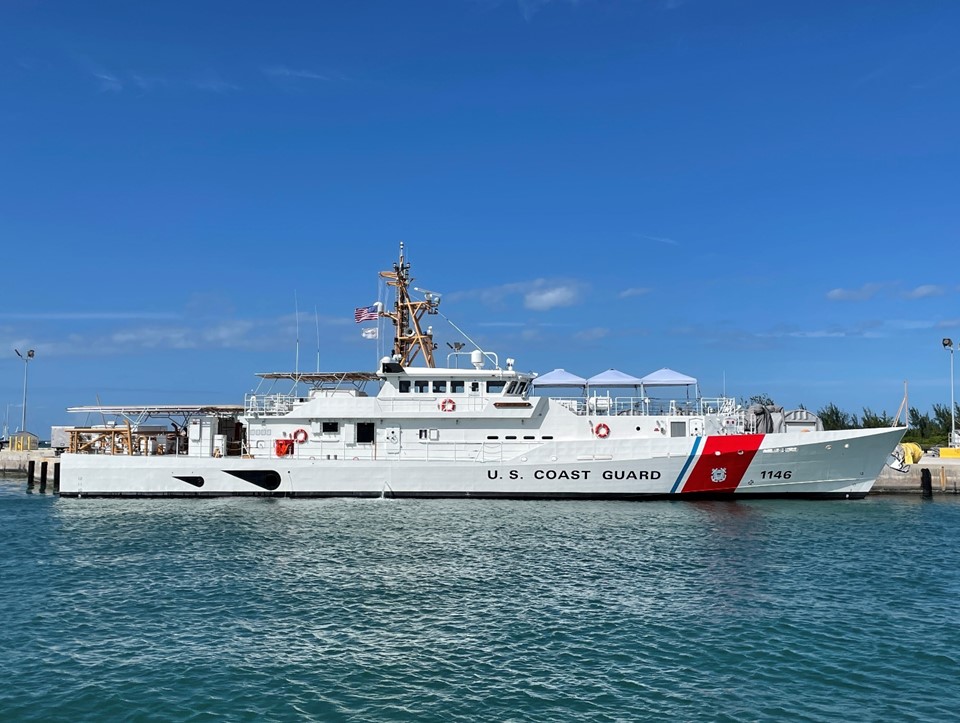
USCGC John Scheuerman in Key West, Florida.

Below is a lightly edited Bollinger news release. The battle in which John Scheuerman lost his life, was the Invasion of Solerno. If you read the link I provided, you can see that the Luftwaffe response was so intense, it caused the naval task force commander shift his flag to a less conspicuous ship, USS Biscayne, a ship that would later serve as USCGC Dexter.


BOLLINGER SHIPYARDS DELIVERS 46th FAST RESPONSE CUTTER AHEAD OF SCHEDULE DESPITE DIRECT HIT FROM HURRICANE IDA 

LOCKPORT, La., – (October 21, 2021) – Bollinger Shipyards LLC (“Bollinger”) has delivered the newest Sentinel-class Fast Response Cutter (“FRC”), the USCGC John Scheuerman, to the U.S. Coast Guard in Key West, Florida nearly one week ahead of schedule despite a three week shutdown due to the significant damage sustained to Bollinger’s facilities during Hurricane Ida. The storm made landfall in late August near Port Fourchon, Louisiana as a powerful Category 4 storm. Bollinger’s facilities in Port Fourchon, Lockport, Houma and Larose suffered significant damage as a result of Hurricane Ida, which tied with last year’s Hurricane Laura and the Last Island Hurricane of 1856 as the strongest on record in Louisiana.

“While every delivery is meaningful, being able to deliver this vessel nearly a week early despite everything our crew has faced over the past month is nothing short of remarkable,” said Bollinger President & CEO Ben Bordelon. “We had folks who lost everything in that storm. Our yard where we build the FRCs took a beating and was shuttered for three weeks while we rebuilt. This vessel and this delivery is a win our folks really needed and it reflects the resilience, commitment and tenacity of the 650 skilled men and women that built it.”

On September 24th, following an extensive multi‐week recovery and rebuilding effort, Bollinger welcomed employees back to all 11 of its facilities across Louisiana. Bollinger’s Lockport facility is home to the FRC program, which directly supports 650 jobs. The USCGC John Scheuerman departed Lockport on Monday, October 11th for Bollinger’s Fourchon facility where it performed a shakedown excercise prior to dry docking for final inspection in preparation of its delivery. The Cutter departed Fourchon for Key West, FL on Sunday, October 17th. The USCGC John Scheuerman is the 169th vessel Bollinger has delivered to the U.S. Coast Guard over a 35-year period and the 46th FRC delivered under the current program. The USCGC John Scheuerman is the fifth of six FRCs to be home-ported in Manama, Bahrain, which will replace the aging 110’ Island Class Patrol Boats, built by Bollinger Shipyards 30 years ago, supporting the Patrol Forces Southwest Asia (PATFORSWA), the U.S. Coast Guard’s largest overseas presence outside the United States.

U.S. Coast Guard Commandant Adm. Karl Schultz has previously lauded the “enhanced seakeeping capabilities” of the PATFORSWA-bound FRCs, saying the ships are going to be “game changing” in their new theater of operations. Last week, at the commissioning ceremony for the USCGC Emlen Tunnell—another Bahrain-based FRC—Adm. Schultz noted that these ships will “conduct maritime security operations, theater cooperation efforts, and strengthen partner nations’ maritime capabilities to promote security and stability in the region, as well as thwart the increasingly aggressive and dangerous maritime activities of the Iranian Revolutionary Guard Corps.” He went on to say that these FRCs are “a perfect complement to the capabilities of both the Navy and Marine Corps. United, we bring a range of maritime capabilities to employ across the cooperation-competition-lethality continuum.”

PATFORSWA is composed of six cutters, shoreside support personnel, and the Maritime Engagement Team. The unit’s mission is to train, organize, equip, support and deploy combat-ready Coast Guard Forces in support of U.S. Central Command and national security objectives. PATFORSWA works with Naval Forces Central Command in furthering their goals to conduct persistent maritime operations to forward U.S. interests, deter and counter disruptive countries, defeat violent extremism and strengthen partner nations’ maritime capabilities in order to promote a secure maritime environment.

Each FRC is named for an enlisted Coast Guard hero who distinguished themselves in the line of duty. John Scheuerman, Seaman First Class, United States Coast Guard Reserve was posthumously presented the Silver Star Medal for service as set forth in the following citation:  “For conspicuous gallantry and intrepidity in action while serving on board the U.S.S. LCI (L) 319 during the amphibious invasion of Italy, September 9, 1943.  Observing an enemy fighter plane diving in for a strafing attack as his vessel approached the assault beaches in the Gulf of Salerno, SCHEUERMAN unhesitatingly manned his battle station at an exposed antiaircraft gun and, with cool courage and aggressive determination, exerted every effort to direct accurate gunfire against the hostile aircraft.  Although mortally wounded before he could deliver effective fire, he remained steadfast at his post in the face of imminent death, thereby contributing materially to the protection of his ship against further attack.  SCHEUERMAN’s fearless action, great personal valor and selfless devotion to duty under extremely perilous conditions were in keeping with the highest traditions of the United States Naval Service.” Scheuerman also posthumously received the Purple Heart Medal.

After 79 Years, Finding a Final Resting Place at the Coast Guard Academy

Lt. Crotty

We seem to be half masting the flag a lot lately, but this one has greater than the usual significance. Please read his story using the link below. Earlier post here.

united states coast guard

R 141500Z OCT 21
FM COMDT COGARD WASHINGTON DC
TO ALCOAST
BT
UNCLAS
ALCOAST 380/21
SSIC 5060
SUBJ: HALF MASTING OF NATIONAL ENSIGN
A. U.S. Coast Guard Regulations 1992, COMDTINST M5000.3B
B. COMDT COGARD WASHINGTON DC 290809 OCT 19/ALCOAST 335/19
1. By order of the Commandant and IAW REF (A), the National
Ensign shall be flown at half mast from sunrise until sunset
on Friday, 15 October 2021, in honor of LT Thomas James Eugene
“Jimmy” Crotty, an American and Coast Guard hero.
2. The National Ensign shall be flown at half mast on all
Coast Guard buildings, grounds, and vessels not underway.
3. As announced in REF (B), LT Thomas James Eugene “Jimmy”
Crotty, USCG, died as a prisoner of war of the Japanese at
the Cabanatuan Prisoner of War Camp on 19 July 1942. He was
buried in a common grave along with all those who died that
day. On 10 September 2019, as part of an exhaustive effort
by DoD to bring every service member home, LT Crotty was
positively identified from the remains exhumed in early 2018.
LT Crotty was returned home with honors on 01 November 2019
to Buffalo, NY.
4. LT Crotty will have his final inurnment on Friday,
15 October 2021, at the United States Coast Guard Academy
Columbarium in New London, CT, at 1400.
5. LT Crotty’s biography and additional information can be
found at:
(Copy and Paste URL Below into Browser)

https://compass.coastguard.blog/2019/09/18/the-long-blue-line
-lt-crotty-and-the-battle-for-corregidor/

6. RADM Eric C. Jones, Assistant Commandant for Human Resources
(CG-1), sends.
7. Internet release is authorized.

“Coast Guard, NOAA to hold event to announce the discovery of U.S. Revenue Cutter Bear and arrival of U.S. Coast Guard Icebreaker in Boston” –D1

Appearing very different from its last Greenland visit in 1884, the USS Bear returned in 1944. Unlike in 1884, the Bear relied on a Coast Guard crew during World War II. As part of the Greenland Patrol, it cruised Greenland’s waters and, in October 1941, brought home the German trawler Buskø, the first enemy vessel captured by the U.S. in WWII. (Coast Guard photo)

An interesting news release from CCGD1 below. While looking for an appropriate photo, I found an earlier article, “Hunting for Bear, the Search for the Coast Guard’s Most Iconic Vessel,” by MARK A. SNELL, PH.D., U.S. Coast Guard Auxiliary, beginning on page 56 of the Spring 2019 issue of Proceedings of the Marine Safety and Security Council. This is the way it ends.

A few years ago, an aspiring author posted an ode about the loss of the Bear on a website known as “Ghost Stories for Lovers.” Her thoughts on the final moments of the iconic ship are an apt denouement both for the sinking of the Bear and the conclusion of this article:

“I imagine her exhaustion. I imagine the familiar rush of waves lapping against her parched skin, reawakening every memory of every youthful adventure with such
a flood of overwhelming intensity that the strength of the wind and the salt and the biting northern air that she once drank now aches. Her arthritic timbers swell and throb as they move through the rough ocean. The towline grows taut, too taut, as she struggles to keep pace with the smaller boat. Did she welcome the final gale that snapped it, I wonder, that final push of force that plunged her mast deep into her hull, into her heart, releasing nearly a century’s worth of man’s insatiable hope from her shattered bones and back into the sea from which he crawled?

“She didn’t take anyone down with her. The two sailors who were with her when it happened shivered and gaped from the rails of the tugboat that rescued them as she slipped further into the black water. Slowly. Silently. As if she were never there…”

united states coast guard

News Release

U.S. Coast Guard 1st District Northeast

Media Availability: Coast Guard, NOAA to hold event to announce the discovery of U.S. Revenue Cutter Bear and arrival of U.S. Coast Guard Icebreaker in Boston

Editors’ Note: Media interested in attending are requested to RSVP at 617-223-8515 or D1PublicAffairs@USCG.mil by 9:30 a.m., Oct. 13, 2021 and should arrive no later than 2:45 p.m. and must follow proper CDC guidelines for COVID-19.

BOSTON—The Coast Guard is scheduled to hold an event to discuss the discovery of the wreckage of the U.S. Revenue Cutter Bear and the arrival of the USCGC Healy (WAGB  20) following its recent transit of the Arctic’s Northwest Passage.

WHO: Vice Adm. Steven Poulin, Coast Guard Atlantic Area commander, Capt. Kenneth Boda, USCGC Healy commanding officer, Coast Guard historians and representatives from the National Oceanic and Atmospheric Administration (NOAA).

WHAT: The Coast Guard is announcing the findings of the wreckage of the U.S. Revenue Cutter Bear, a vessel of historical significance to the Arctic, and discussing the arrival of the USCGC Healy, one of the Service’s polar icebreakers.

WHEN: Thursday, Oct. 14, 2021, at 3:00 p.m.

WHERE: Boston Cruise Ship Terminal, 1 Black Falcon Ave. Boston, MA 02210

The USRC Bear was built in Scotland in 1874 as a steamer ship and purchased by the U.S. government in 1884 for service in the U.S. Navy as part of the rescue fleet for the Greely Expedition to the Arctic, which gave world-wide acclaim as the vessel that rescued the few survivors of that disastrous expedition. In 1885, the Bear was transferred from the Treasury Department for service in the Arctic as a Revenue Cutter and for 41 years it patrolled the Arctic performing search and rescue, law enforcement operations, conducting censuses of people and ships, recording geological and astronomical information, recording tides and escort whaling ships. Between 1886-1895, the captain of Bear was “Hell Roaring Mike” Healy. The USCGC Healy was commissioned in 1999 and named in his honor. During World War II, the Bear served during the Greenland Patrols and participated in the capture of a German spy vessel, the trawler Buskoe. It was decommissioned in 1944 and was lost at sea while being towed in 1963.

The U.S. Coast Guard Cutter Healy crew, following in the Bear’s tradition of Arctic service, recently completed a transit of the Arctic Northwest Passage. Healy is one of the Coast Guard’s polar-capable icebreakers and operates as a multi-mission vessel to protect American interests in the Arctic region.

For nearly two decades, NOAA Ocean Exploration, the NOAA Office of National Marine Sanctuaries’ Maritime Heritage Program, the U.S. Coast Guard Research and Development center, and a number of academic research partners have been engaged in a search for the final resting place of U.S. Revenue Cutter Bear.

For more information, please visit NOAA’s Ocean Exploration website.