
This Sunday is Fathers’ Day. For many it seems, the military is a family affair. Many of today’s coasties came from military families. For my generation, many of our parents went through World War II in uniform.
Capt. Bob Gravino, USCG (ret.) is the scribe for my Academy class Alumni Bulletin class notes. He had been told the stories of fathers and other family members who had military experience in WWII and was concerned that those stories would be lost, so he has tried to recover them. I suggested we post them here.
It seems men of that generation seldom talked about their experiences. My father-in-law was an aircraft mechanic and tail gunner on B-25s as part of General Kenney’s Fifth Air Force in the SW Pacific. Of French Canadian parents, he spoke fluent French, so of course the Army did not send him to Europe. He had been shot down and spent a day in a raft in the Pacific before being rescued, but my wife had never heard that until I drew him out.
Here are some of my classmates’ stories. If you would like to add your own remembrances, please put them in the comments.
From George D. Bond, II
My father was Army and Gayle’s Navy (his wife-Chuck). Both in the Pacific Theater.

WOJG James T. Doherty (Sr.), 1946

The war ended abruptly with a couple of bombs. Hornet was assigned “Magic Carpet” duty and crossed the Pacific several times returning men and material from forward deployment. My dad claimed this was the most important thing he did during the war. Magic Carpet ended in February of 1946. Shortly thereafter my father was advised that his enlistment, which had been extended “For the Duration” was ended and he had to reenlist or be demobilized. Under the influence of my mother, he elected not to reenlist and left the Navy.
The next brother, Roy, has a much shorter story. He was also rejected by the Navy for being under weight and so enlisted in the Army in late January 1942. He was assigned to Basic Training (even he did not remember where) but did not go because his Basic Battery showed him to be a candidate for a special program. He was assigned directly to Signals Intelligence Schools where he learned first radio electronics, and then wire recorders, and then Morse code (to 60 wpm) and finally rudimentary Japanese. As he described it, an excellent shot his whole life, he never officially touched a gun in the Army. On finishing school he was ordered, with the highest priority, to Oahu via San Francisco. He was put on an express train to SF and, on arrival, was given priority transport to Angel Island for transport to Hawaii. And then, in a way only the military can really do, they lost track of him, and despite the fact that he appeared every Monday at the transport desk with his orders, and the fact that at least two ships left for Hawaii each week, he spent 4 months on Angel Island with no duties. It was during this time that he got to spend a day with Marvin in SF so it was a mixed bag. He then went to Oahu and spent the rest of the war listening in on Japanese communications and recording them both by hand and on wire recorders. Interestingly, he claimed that when his number came up for Magic Carpet he missed the cutoff for being assigned to Hornet to ride home (with his brother) by less than 100.
The last brother, Earl, was too young to enlist at the beginning of the war. He finally enlisted in the Marines after VE day. By the time he had finished his training the war was over. Except his war was not over. At some point (he was pretty vague and mumbled about still “Secret”) his company was deployed to China as part of an advisory team to the Nationalist Government Army which was engaged in a losing fight against the Peoples Liberation Army. He was also pretty vague about what he did in China or even when he left. He was not vague about some bits. His company suffered heavy casualties. He counted himself as lucky to not be one of them. It was the ugliest thing he had ever done and beyond the ugliest thing he could have imagined. He liked the Chinese peasants in the ranks (farm boys a lot like himself he would say), but had no use for their ruling class (officers and politicians). They had a reckless disregard for human life, except their own. The only thing he had a lower regard for was the Chinese Communist Party who shared the reckless disregard for life but added, in his view, a casual cruelty to what they did. Noting that promotion was almost non-existent, that a wider war was probably coming, and that he had seen all the war he needed in his lifetime, he left the Corps just in time to avoid the Korean Police Action.
I don’t know why, but these stories in no way deterred my brother and I from seeking commissions in the sea services of the United States.
Bob Gravino:
My father was in the US Army during WWll and served in the invasions of North Africa and Sicily, and then fought up the Italian peninsula to Rome. He died at age 64, and never spoke about his time in the service. My mother would talk about him waking up in the middle of the night screaming, which went on for five or more years after they were married in 1945.
Robert Henry:

1st Lt. Harold F. Henry, lower left.
Dad flew out of North Africa and Italy in 1944 with the 15th AAF. He participated in numerous missions including Ploesti, Budapest,, Bucharest and Vienna, and earned two Distinguish Flying Crosses. He never talked about his war time experiences and we only found out about his achievements after he passed away. I can only imagine what he went thru along with the rest of his generation to give us the freedom we now take for granted.

Mike Moore:

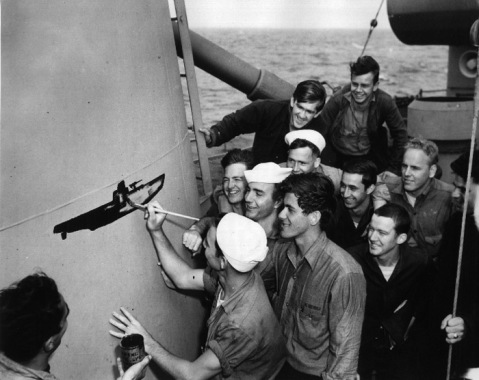
Photo: William Pavlik, gun captain of this twin 40mm. As a GM2 he would go AWOL to marry Aldia, Gary’s mother. For that he was busted to GM3.
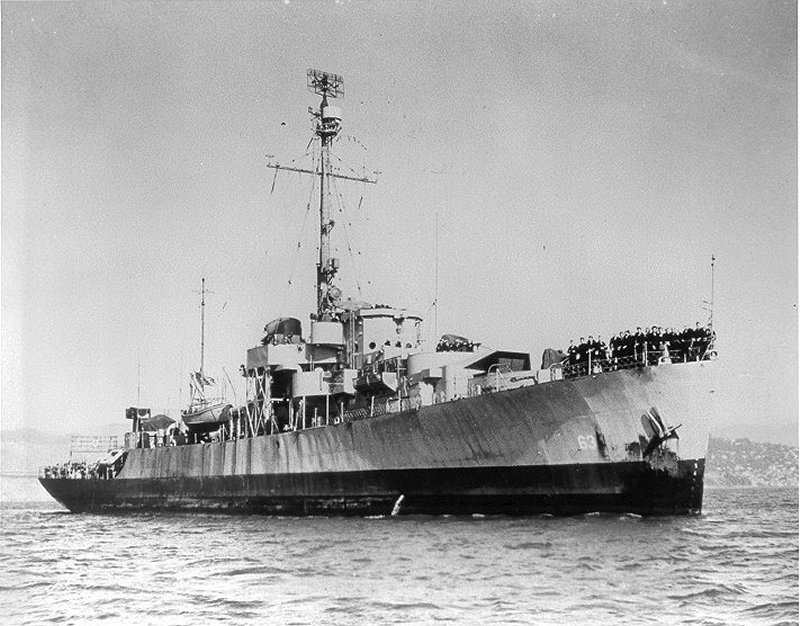
My dad was on a completely CG crewed USN DE, the USS Lowe (DE-325), that did convoy escorts between NYC and ports in the Med. Had one confirmed sub kill and two probables.

USS Lowe (DE-325) in its later guise as USCGC Lowe (WDE-425). Maybe we could name an Offshore Patrol Cutter after her to commemorate the 351 Coast Guard manned Navy vessels and craft of World War II.–Chuck
When I was young what I heard about WWII from Dad was during conversations with his brothers, my uncles. One who served on subs in the Pacific theatre.
LTjg Daniel H. White: Dan had attended two years at Yale University before enlisting in the Coast Guard. He was stationed in Seattle where he met Mom. Dan went through Coast Guard OCS at the Academy’s Splinter Village (wooden barracks and buildings where Munro Hall and parking lots are now) and recalled the old Cadet Auditorium, Cadet Recreation Hall and the old Field House (Alumni Center area) on our Fourth Class Parent’s Weekend. He attended diesel power school at Penn State before picking up LST-763 in New Orleans and trans packing to the Pacific Theater. His LST saw action during the D-Day landings on Iwo Jima and Okinawa. The story I’ve been told is that a roommate he had for the D-Day landing on Iwo Jima was photo-journalist Joe Rosenthal. An uncle was a navy officer who served in Europe and another uncle who survived the attack on Pearl Harbor serving on one of the battleships.








 Chuck Hill's CG Blog