This Day in Coast Guard History, February 5

Based on the Coast Guard Historian’s timeline, https://www.history.uscg.mil/research/chronology/
With inspiration from Mike Kelso

February 5

1882  The schooner Mary L. Vankirk, bound for Philadelphian from South Creek, Pamlico Sound, North Carolina, carrying a crew of five men, encountered heavy weather.  She lost sails and sprung a leak and before long she became water-logged and almost unmanageable.  In this condition, it was determined to run to leeward and seek refuge in Hatteras Inlet.  Matters, however, became worse and it was decided to beach the vessel.  She was discovered heading for the land by the crew of Station No. 18, Sixth District (Chicamicomico, North Carolina).  The surfboat was run out, but the life-saving crew returned to the station for the breeches-buoy apparatus. The latter arrived abreast of the schooner at 8:15, fifteen minutes after she struck the bar about half a mile north of the station.  The schooner was so close that the keeper was able to wade out into the water and cast a heaving-line to those huddled in the rigging.  As quickly as possible, the men in the rigging hauled off the whip-line.  The breeches-buoy was soon rigged and went spinning out to the vessel.  All five men were safely landed.

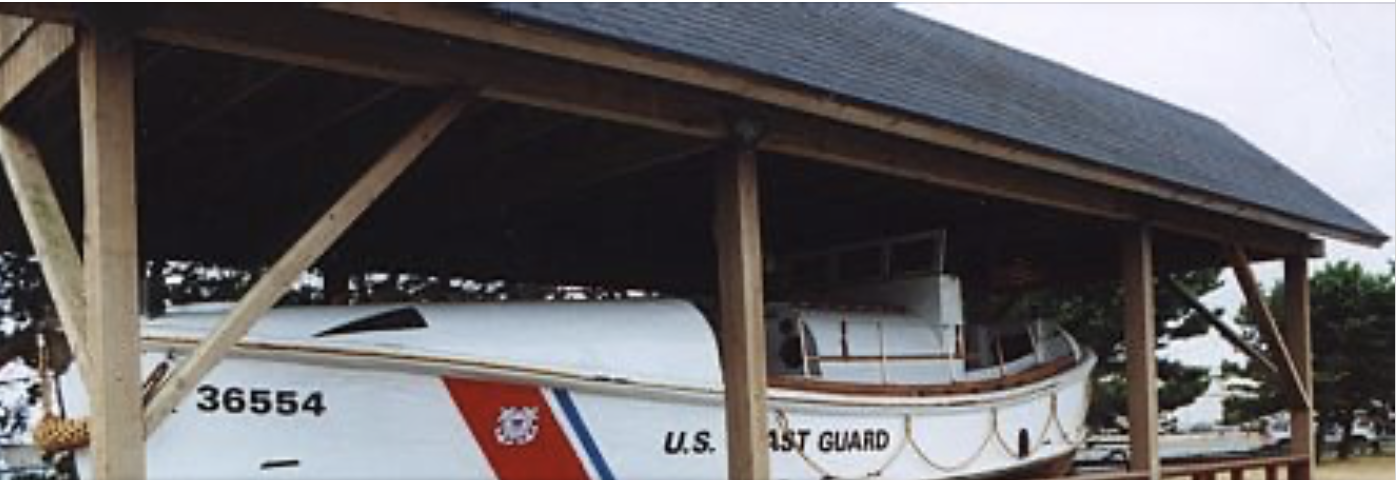
The 36 foot Coast Guard lifeboat serves as a memorial to the men who died on it in a rescue mission. The four Coast Guardsmen honored gave their lives while following in the brave traditions of the United States Coast Guard’s search and rescue mission. (photo courtesy of westportwa.com)

1946  Four Coast Guardsmen from Willapa Harbor Lifeboat Station perished in the line of duty while searching for two crab fishermen feared lost in Williapa Bay.  The men were: BMC Joseph W. Miller, USCG; MM 1/c Geloyd J. Simmons, USCG; Coxswain James R. Graves, USCG; S 1/c Howard W. Hampton, USCG.

“The 36 foot Motor Lifeboat from the Station Willapa Bay washed ashore near Ocean City with no one on board. The boat and its four man crew had joined the Westport station’s 52 foot Invincible in a search for two Westport crab boats believed lost in a storm the previous day. The 36 footer was last seen by the Invincible’s crew at approximately 1 a.m. on the 5th during a brief rendezvous somewhere south of Grayland.
“Bodies of three of the four Coast Guardsmen were later recovered along the beach north of Grays Harbor, but exactly what happened aboard the boat or to the fourth crewman remains a mystery. Ironically, the fishermen identified as the subjects of this search and feared lost at sea were found safe in Willapa Harbor, where they had remained throughout the storm.

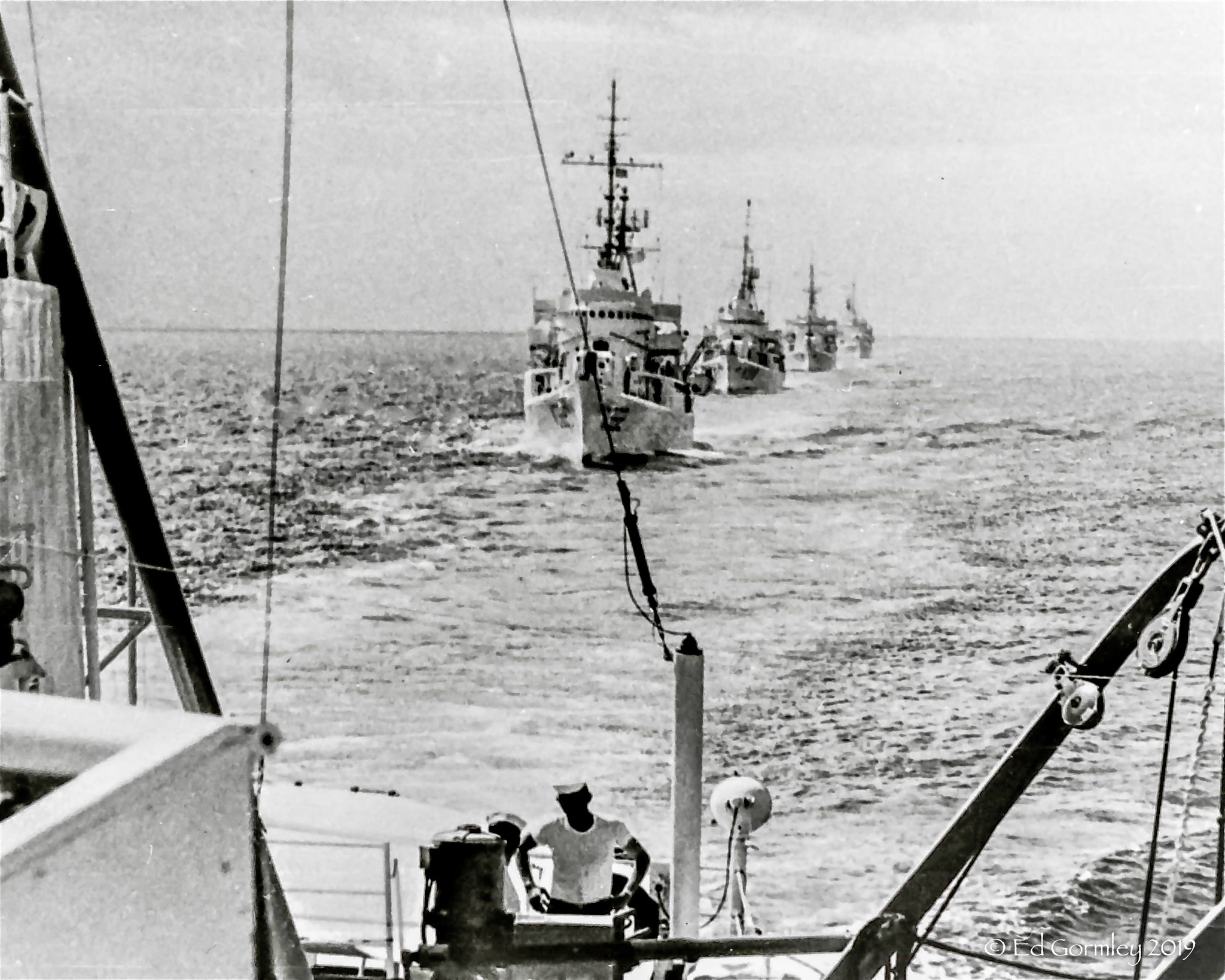
CG Squadron 3 enroute Subic Bay, 1967, Vietnam War

1973  The position of Senior Coast Guard Officer-Vietnam (SCGOV) was disestablished.

1975  The Coast Guard commissioned the Houston-Galveston Vessel Traffic System, the third VTS to be “implemented by the Coast Guard on a major waterway of the U.S.”

This Day in Coast Guard History, February 2

Based on the Coast Guard Historian’s timeline, https://www.history.uscg.mil/research/chronology/
With inspiration from Mike Kelso

February 2

1944  Coast Guardsmen participated in the landings at Saidor, New Guinea.

Elevated view of the loaded deck of a LST (Landing Ship, Tank) on the way from Goodenough Island to Saidor, New Guinea (present day Papua New Guinea). On the deck are many soldiers, jeeps, trucks, artillery and supplies. Tanks were probably in the hold of the ship. Another warship is in the distance. Robert Doyle wrote a caption for this image although it was not published at that time: “Packed with vehicles and soldiers, landing ship heads north for assault on Saidor, New Guinea, by task force consisting mainly of elements of Thirty-second Division. Landing was made at Saidor Jan. 2.”

US Coast Guard cutter Munro transits the Taiwan Strait with US Navy destroyer USS Kidd, US Navy

2014  The Coast Guard and Navy completed a joint mission in the Central and South Pacific under an agreement between the services to enforce fisheries laws and enhance regional security January 7 to February 2, 2014.  The partnership supported the Oceania Maritime Security Initiative, a Secretary of Defense program, which leverages Department of Defense assets transiting the region to increase the Coast Guard’s maritime domain awareness, ultimately supporting its maritime law enforcement operations in Oceania.  As part of Operation Persistent Presence and in conjunction with NOAA, a Coast Guard law enforcement team embarked the Arleigh Burke-class guided missile destroyer USS Kidd in San Diego to conduct law enforcement boardings while the vessel was in transit.  The Coast Guard-Navy team, including the two embarked MH-60R helicopters from Helicopter Maritime Strike Squadron 78, conducted 46 external visual inspections, and 13 boardings with internal inspections of fishing vessels across two separate jurisdictional areas in the Marshall Islands and Nauru exclusive economic zones.

This Day in Coast Guard History, February 1

Based on the Coast Guard Historian’s timeline, https://www.history.uscg.mil/research/chronology/
With inspiration from Mike Kelso

February 1

1871  Using his administrative authority, Secretary of the Treasury George S. Boutwell re-established a Revenue Marine Bureau within the Department and assigned Sumner I.  Kimball as the civilian Chief.  (He was 36 at the time.) Kimball’s duties included administering both the revenue cutters, which were then under the control of the local Collectors, and the life-saving stations.

Sumner Increase Kimball, organizer of the United States Life-Saving Service and the General Superintendent of the Life-Saving Service from 1878–1915.1913, American magazine, Volume 150

1938  The Lighthouse Service Radio Laboratory was moved from the shops of the lighthouse depot in Detroit, Michigan, “to the Lazaretto Lighthouse Depot in Baltimore, Md., where a building had been constructed providing more adequately for this important branch of the work of the Service.”

1942  Enlistees after this date were restricted to enlistment in the Coast Guard Reserve. This was done to prevent having too many regulars in the service at the end of World War II.

1944  Coast Guardsmen participated in the invasion of Namur Island, Kwajalein Atoll.

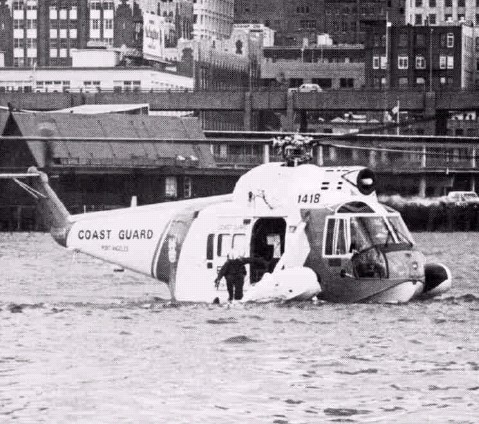
File:HH-52A PortAngelesWA NAN6-79.jpg

U.S. Coast Guard HH-52A floating in Seattle in 1979

1963  The Coast Guard’s “newest” helicopter, the Sikorsky HH-52, performed its first rescue.  On February1, 1963, the F/V Enterprize sank after colliding with ice off Hyannis, Massachusetts.  The two crewman of the vessel abandoned and sought safety on the ice.  After a 63-mile flight, 56 of which were over water at night, the aircraft commander, LT R. A. Johannsen, landed the HH-52A (CG-1352) on the ice and made the rescue.

This Day in Coast Guard History, January 31

Based on the Coast Guard Historian’s timeline, https://www.history.uscg.mil/research/chronology/
With inspiration from Mike Kelso

January 31

USCGC Itasca as HMS Gorlsston, a sister ship of HMS Culver (former USCGC Mendota), one of ten Lake Class cutters transferred to the Royal Navy under Lend Lease.

1942 HMS Culver (ex-CGC Mendota – one of the “Lake” Class cutters transferred to the Royal Navy in 1941 under the Lend-Lease program) was torpedoed and sunk with only 13 survivors.

An older woman polishes the mirror, known as a Fresnel lens, behind a light bulb

Salter polishes the Fresnel lens at Turkey Point Light, 1945

1948 Mrs. Fannie M. Salter, keeper of the Turkey Point Lighthouse in upper Chesapeake Bay since 1925 and the last woman keeper of a lighthouse in the United States, retired from active service.  The first woman had been hired as a lighthouse keeper 150 years before.  Salter’s retirement temporarily closed the tradition of women serving as keepers at lighthouses.

1968 Coast Guard SPAR Chief Storekeeper Mary Ashley Rose retired “after a career of more than 20 years of service in the Coast Guard.  Chief Rose is the first enlisted woman to retire from active duty in the Coast Guard.”

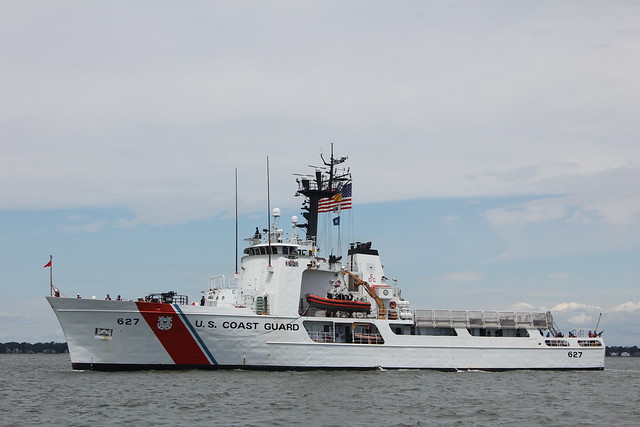
USCGC Vigorous

1975 CGC Vigorous (WMEC-627) became the first cutter to make a seizure of a foreign-flag fishing vessel on the high seas when she seized the Italian fishing vessel Tontini Pesca Cuarto for illegally taking lobster.  All of the other fishery seizures prior to this were of vessels that had violated territorial seas (TS) or Contiguous Fishing Zone (CFZ).  At the time, Vigorous was under the command of CDR Paul Welling, USCG.  The arresting officer was ENS S.T. Fuger, Jr., USCG.

2000 Alaska Airlines Flight 261 crashed off the coast of California near the Channel Islands, killing all 88 on board.  Coast Guard Channel Island Station crewmen responded to the tragedy.

2004 The crews of a 47-foot MLB from Station Chincoteague and a rescue helicopter from Air Station Elizabeth City combined to rescue five men after their vessel began taking on water 25 miles east of Chincoteague.

USCGC Alexander Hamilton (WPG-34) Lost January 30, 1942

Today is the 83rd anniversary of the sinking of USCGC Alexander Hamilton (WPG-34), January 30, 1942. She was the Coast Guard’s first loss of World War II and the first US warship sunk in the Atlantic after the US entered the War.

USCGC Hamilton (WMSL-753)’s web site has the story of her sinking which I have reproduced below.

There is a “Booklet of General Plans” as originally built here, and contract plans here.

U-132, which torpedoed Alexander Hamilton, also sank ten other ships but was “Sunk on 4 November 1942 in the North Atlantic south-east of Cape Farewell, in approx. position 55.38N, 39.52W, when the British ammunition ship Hatimura blew up in a huge explosion. U-132 had torpedoed this ship earlier and was probably waiting nearby for her to sink when caught in the lethal radius of the explosion. 47 dead (all hands lost). (FDS/NHB, January 1985).”

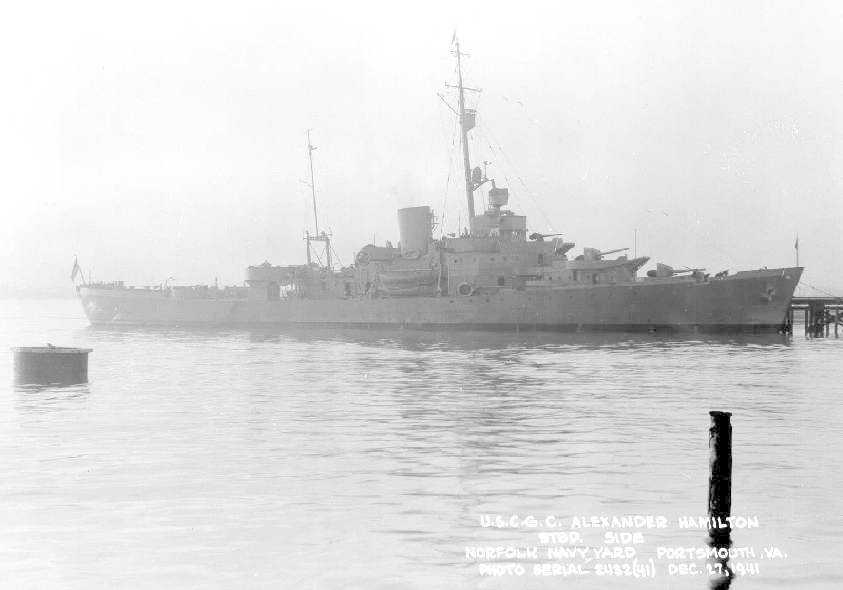
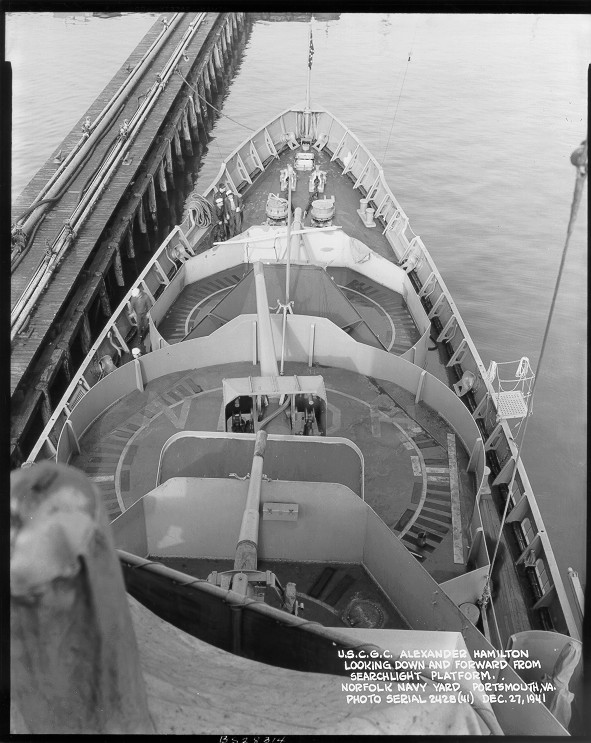
Found some photos of Cutter Alexander Hamilton on Facebook that were taken only five weeks before she was sunk. She is much better armed then when she was built, with three 5″/51s and three 3″/50s, but does not have some of the equipment seen on other ships of her class in pictures taken in 1942/43, no radar, no High Frequency Direction Finder (HF/DF), a Y-gun in the photo immediately but no K-Gun depth charge launchers.
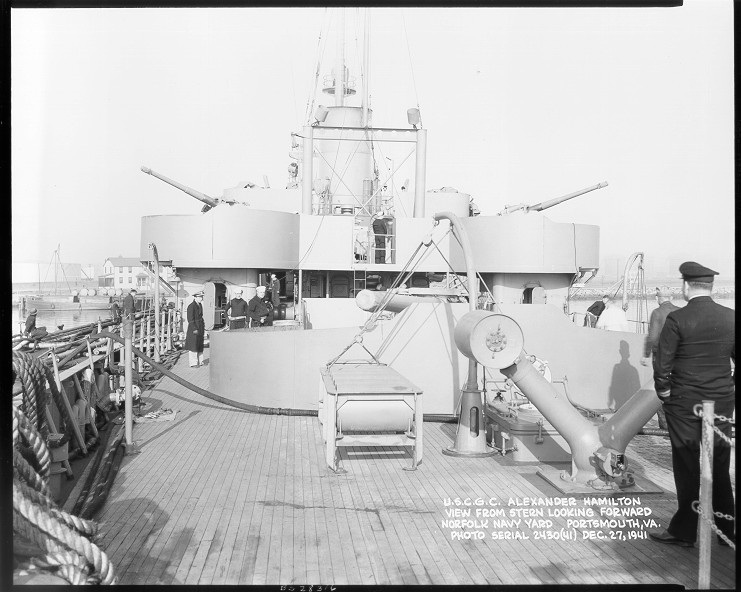
U.S.C.G.C. Alexander Hamilton view from stern looking forward, Norfolk Navy Yard Portsmouth, VA. Photo Serial 2430(41) Dec. 27, 1941.

U.S.C.G.C Alexander Hamilton STBD. Side Norfolk Navy Yard Portsmouth, VA Photo Serial 8482(41) Dec 27, 1941″


THE FIRST LOSS; THE SINKING OF THE ALEXANDER HAMILTON
by Dr. Robert M. Browning Jr.

When the United States entered World War II, the Coast Guard had already demonstrated its value in this country’s national defense.  For over a year the Coast Guard, with its large cutters and experienced seamen, had protected American interest in the North Atlantic.  They had maintained patrols in Greenland and took a prominent role in the protection of America’s seaborne commerce in this area.  The 327 foot cutters in particular were well-suited for convoy duty in the North Atlantic. Because of their long-range and good sea-keeping qualities along with their speed and armament, the Navy Department put the entire class into naval service before the war began.  The Alexander Hamilton, participating with the ocean escorts in the icy North Atlantic, became the Coast Guard’s first loss of the war.

The Alexander Hamilton was one of the newest ships in the service.  Built at the New York Navy Yard, this twin-screw, geared-steam-turbine-propelled cutter was commissioned in March 1937.  The Alexander Hamilton was initially stationed in Oakland, California and performed patrols to the Bering Sea. All the vessels in the class carried their full names when commissioned, but these were shortened in 1937 to their surnames only.  The Navy requested that the Hamilton use its full name so as not to be confused with the Navy’s U.S.S. Hamilton.  In January 1942, the cutter resumed its full name once again.

When war began in Europe the cutter was ordered to Norfolk Virginia to perform Neutrality Patrol duties. The Alexander Hamilton also operated with the Grand Banks Patrol and made ten cruises on weather observation patrol. On 27 December, just three weeks after Pearl Harbor, the Alexander Hamilton reported for special naval duty in the North Atlantic. Mixed groups of U.S. Navy, Coast Guard and Royal Canadian Navy escorts had begun to escort fast and slow convoys between rendezvous points off the coast of Newfoundland and mid-ocean meeting points (MOMP). At this point British escort groups protected the merchantmen eastward. The 327 foot Campbell was the first cutter to perform this duty, followed by the Ingham and on January 15th 1942, the Alexander Hamilton.

After helping to screen convoy HX 170 to the MOMP, the Alexander Hamilton was tasked to tow the disabled storeship Yukon to Iceland. A destroyer, USS Gwinn, steamed ahead to act as an escort. The British rescue tug Frisky arrived later to take over the tow. At about 1:00 pm, the Alexander Hamilton handed off the tow to Frisky and steamed ahead to screen the other ships.

Unknown to all the allied ships, the German submarine U-132 had detected these ships at a vulnerable moment and maneuvered to a favorable position to attack.  Instead of singling out the crippled and near motionless 12,546 ton storeship Yukon, the U-132 fired a spread of torpedoes at the Alexander Hamilton.  The cutter had meanwhile worked up to 15 knots and passed the Yukon as the torpedoes sped past the storeship.  One torpedo passed ahead of the Yukon and struck the Alexander Hamilton on the starboard side between the fireroom and the engine room.(Right: crew of the Alexander Hamilton abandons ship after being torpedoed.)
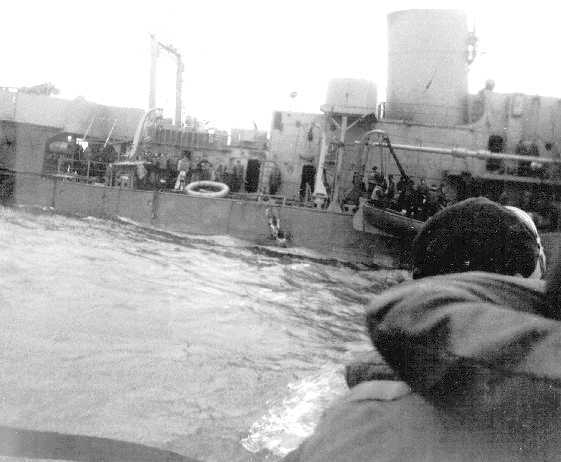
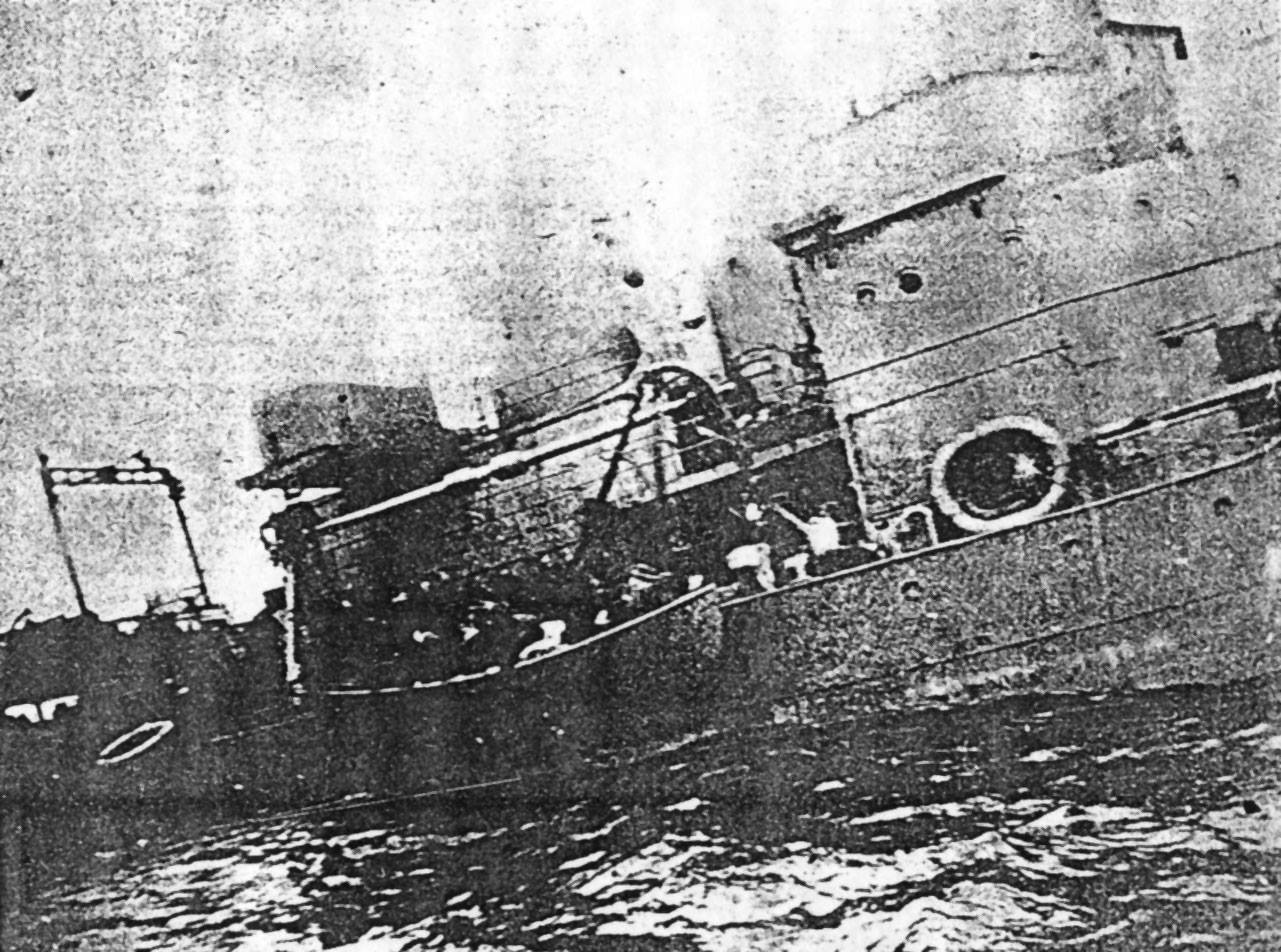
Crew of the Alexander Hamilton abandons ship after being torpedoed.

The Alexander Hamilton was fatally wounded.  The explosion wrecked both the engine room and the fire room, initially killing seven men and burning and injuring many others.  The cutter immediately lost way and settled 4 feet in the water but was counter-flooded to trim the vessel. Afraid that the submarine might fire another torpedo, the crew began to abandon ship.  Thirty minutes after the attack, four boats began transferring the injured and some of the crew to the Gwin.  Three Icelandic fishing trawlers, responding to the distress signals, also came to help remove the “Hamiltons”.  The torpedo claimed 26 lives, including 6 who later died of burns. While attempting to rescue the damaged cutter, as many as 14 destroyers from the nearby base at Hvalfjordur searched unsuccessfully for the U-132.

The cutter remained afloat.  That evening the British tug Restive tried for two hours to take the Alexander Hamilton in tow.  The Frisky returned from Reykjavik after towing the Yukon and joined the ex-Coast Guard tug Redwing and the Restive in the attempt to save the cutter.

Darkness and rough seas, however, prevented salvage throughout the night.  Just after 10:00 am on the morning of 30 January, the weather moderated enough for the Frisky to take the Alexander Hamilton in tow. The cutter’s list had increased to nearly 20 degrees as seas broke over the starboard side aft while the bow rode out of the water.  The Frisky towed the Alexander Hamilton about 18 miles when the cutter suddenly capsized and floated bottom up.  The life of the gallant cutter ended at 7:57 pm when gunfire from the U.S.S. Ericksson sent it to its final resting place in forty fathoms of water, 28 miles off the coast of Iceland.

This Day in Coast Guard History, January 30

Based on the Coast Guard Historian’s timeline, https://www.history.uscg.mil/research/chronology/
With inspiration from Mike Kelso

January 30

Model of the revenue cutter Jefferson Davis. On display at Coast Guard Museum/Northwest, Seattle, Washington. Sister ship of McClelland.

1861 Treasury Secretary John A. Dix ordered LT S. B. Caldwell, the second in command of the cutter McClelland, “to arrest Capt. Breshwood [the cutter’s commanding officer and a Confederate sympathizer] assume command of cutter and if anyone attempts to haul down the flag, shoot him on the spot.”  The message was not delivered by the telegraph office.  Breshwood turned McClelland over to the State of Louisiana, where the cutter ended up in Confederate service.  The northern papers reported the story though and the Secretary’s order became a rallying cry in support of the Union’s war effort.

1942 The capsized wreck of CGC Alexander Hamilton was sunk by the Navy after U-132 torpedoed the cutter off the coast of Iceland the previous day.  She was the first cutter sunk by enemy action during World War II.  Twenty-six of her crew perished in the attack.

“Convoy WS-12: A Vought SB2U Vindicator scout bomber from USS Ranger (CV-4) flies anti-submarine patrol over the convoy, while it was en route to Cape Town, South Africa, 27 November 1941. The convoy appears to be making a formation turn from column to line abreast. Two-stack transports in the first row are USS West Point (AP-23) — left –; USS Mount Vernon (AP-22) and Coast Guard manned USS Wakefield (AP-21). Heavy cruisers, on the right side of the first row and middle of the second, are USS Vincennes (CA-44) and USS Quincy (CA-39). Single-stack transports in the second row are Coast Guard manned transports USS Leonard Wood (AP-25) and USS Joseph T. Dickman (AP-26).”

1942 USS Wakefield, the former passenger liner SS Manhattan converted to a troop transport and manned by a Coast Guard crew, transported British troops to Singapore.  Having disembarked the troops, she was bombed by Japanese aircraft while still tied up.  Five of her Coast Guard crew were killed and nine were wounded.  After temporary repairs, Wakefield evacuated 500 women and children to Bombay before the port fell to the Japanese

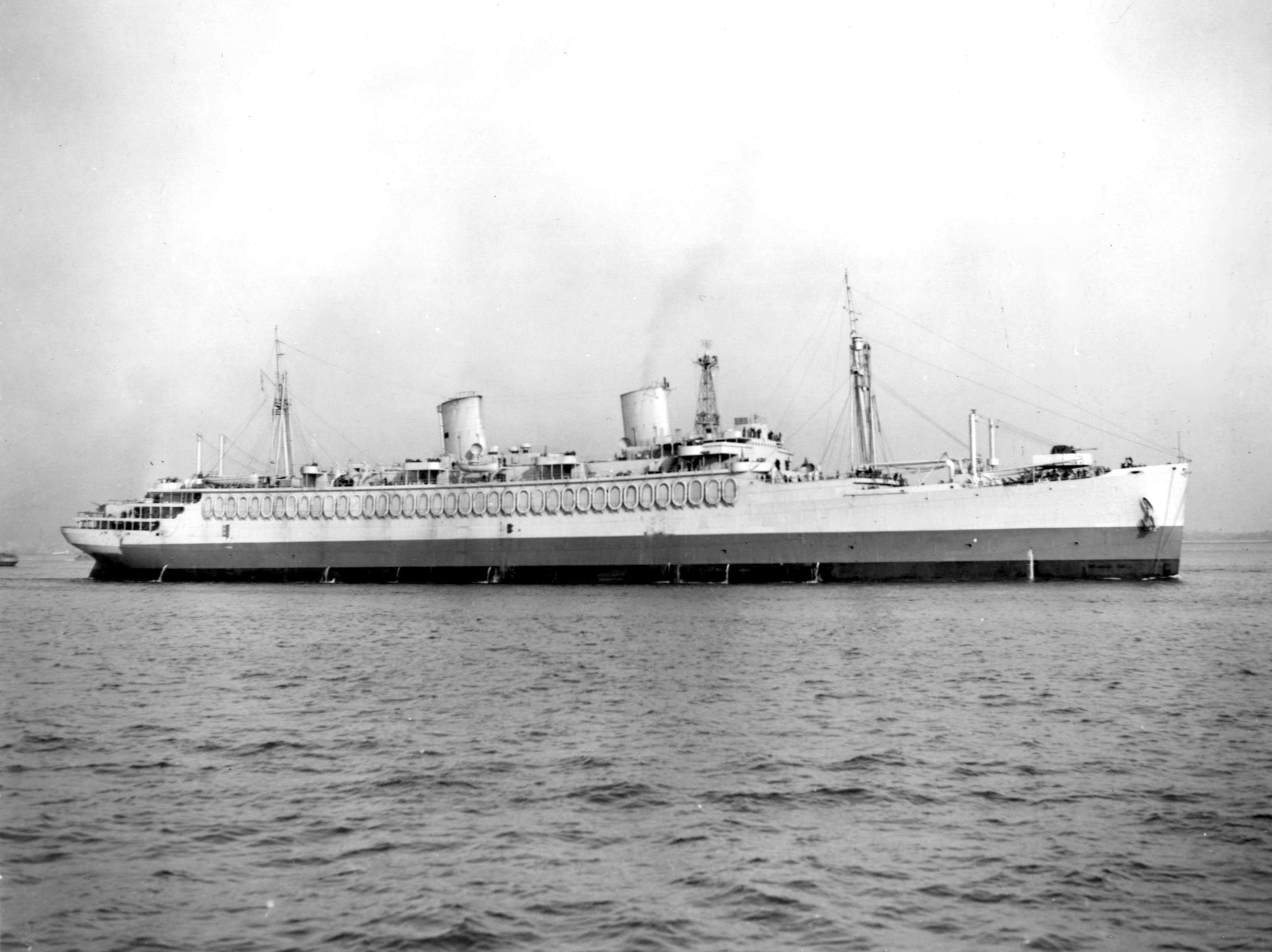
The U.S. Navy troop transport USS Wakefield (AP-21) off the Boston Naval Shipyard, Massachusetts (USA), in March 1944. Wakefield had been completely rebuilt at Boston after a large onboard fire in September 1942.

1979 There was an explosion at the Coast Guard Marine Safety Detachment office at Ponce Playa, Port Ponce, Puerto Rico.  The OVPR (Organizacion De Voluntarios Por La Revelucion Puerto Riquena) claimed responsibility.  The terrorist attack caused no casualties and little damage to the facility.

1982 Coast Guard 8th District units responded to the flooding of the Calcasieu River near Lake Charles, Louisiana.  Up river Coast Guard boats searched daily for stranded people and domestic animals.  Downriver COTP Port Arthur and Marine Safety Detachment Lake Charles wrestled with the problem of strong currents and four run-away barges that destroyed one bridge and threatened two others.

This Day in Coast Guard History, January 29

Based on the Coast Guard Historian’s timeline, https://www.history.uscg.mil/research/chronology/
With inspiration from Mike Kelso

January 29

1919 Ratification of the 18th Amendment to the U.S. Constitution occurred on this date.  The amendment prohibited the manufacture, sale, and transportation of alcoholic beverages.  Its enforcement was authorized by the National Prohibition Enforcement Act, otherwise known as the Volstead Act that was passed on October 28, 1919.  The Coast Guard was tasked with the prevention of the maritime importation of illegal alcohol.  This led to the largest increase in the size and responsibilities of the service to date.

USCGC Bibb

1938 CGC Bibb reported for duty in connection with the U.S. Navy exercises held off Culebra, Puerto Rico.

The U.S.S. Serpens Monument is dedicated to those who lost their lives when the U.S.S. Serpens was destroyed. The 14,250-ton ammunition ship exploded off Lunga Baech, Guadacanal, British Solomon Islands on the night of Jan. 29, 1945 and was the largest single disaster suffered by the U.S. Coast Guard in World War II. (U.S. Army photo by Rachel Larue/released)

1945 The Coast Guard-manned attack cargo vessel USS Serpens exploded off Guadalcanal due to unknown causes.  Only two men aboard survived.  This was the single greatest Coast Guard loss of life in history.

USCGC CASCO 1961

1963 CGC Casco inaugurated the expanded Ocean Station Vessel Oceanographic Program when it departed for Ocean Station Echo on this date.  Casco was outfitted for oceanographic research by the addition of a laboratory space, hydrographic winch, and other instruments.  As the first Coast Guard Ocean Station Vessel to be so outfitted, Casco’s mission represented “a significant step on the Coast Guard’s participation in the National Oceanographic effort.”

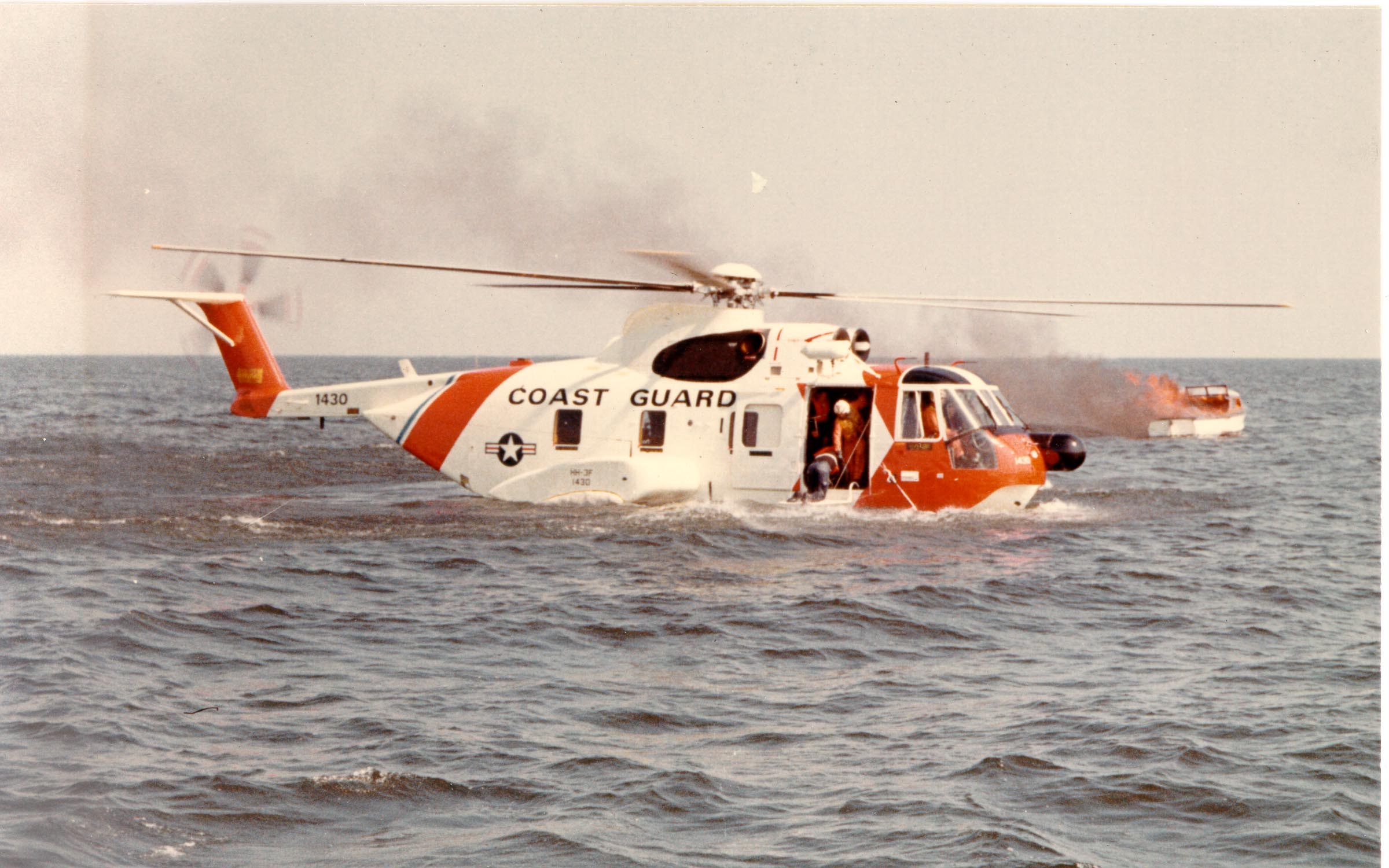
USCG HH-3F Pelican on the water, demonstrating its amphibious capability. This was also the first HH-3F delivered to the Coast Guard.

1980 Local authorities in the Tijuana, Mexico area requested Coast Guard assistance in evacuating flood victims stranded by the rising waters of the San Miguel River.  Two HH-3F helicopters from Air Station San Diego transported 180 persons to safety during the two-day operation.

This Day in Coast Guard History, January 28

Based on the Coast Guard Historian’s timeline, https://www.history.uscg.mil/research/chronology/
With inspiration from Mike Kelso

1885 Keeper Marcus Hanna of the Cape Elizabeth Light Station saved two men from the wrecked schooner Australia.  For this rescue Hanna was awarded the Gold Lifesaving Medal.  He was also awarded the Medal of Honor for his actions at Port Hudson in 1863.  He is the only person to have ever received both awards.

1915 President Woodrow Wilson signed into law the “Act to Create the Coast Guard,” an act passed by Congress on January 20, 1915 that combined the Life-Saving Service and Revenue Cutter Service to form the Coast Guard (38 Stat. L., 800).  The Coast Guard, however, still considers the date of the founding of the Revenue Cutter Service, August 4, 1790, as its official birthday, even though the Lighthouse Service, absorbed in 1939, is even older than that, dating to August 7, 1789.  Under the new law the Coast Guard officially became “part of the regular military establishment of the United States.”

The U.S. Coast Guard buoy tender USCGC Blackthorn (WLB-391), in the 1972. US Coast Guard photo.

1980 CGC Blackthorn sank in Tampa Bay after colliding with the tanker Capricorn.   Twenty-three Coast Guard personnel were killed in the tragedy.

The STS-51L crewmembers are: in the back row from left to right: Mission Specialist, Ellison S. Onizuka, Teacher in Space Participant Sharon Christa McAuliffe, Payload Specialist, Greg Jarvis and Mission Specialist, Judy Resnik. In the front row from left to right: Pilot Mike Smith, Commander, Dick Scobee and Mission Specialist, Ron McNair. 15 November 1985

1986 NASA’s space shuttle Challenger exploded after lift-off, killing the entire crew. Coast Guard units, including the cutters Dallas, Dauntless, Harriet Lane, Bear, Tampa, Cherokee, Sweetgum, and Point Roberts conducted the initial search and rescue operations and later assisted in the recovery of much of the shuttle’s wreckage.  Other units included personnel from Station Port Canaveral, air stations Miami, Clearwater, and Savannah, as well as Coast Guard reservists and Auxiliarists. Dallas served as the on-scene commander for what was a joint Coast Guard, NASA, Navy, and Air Force search and recovery operation.

2003 DOD submitted a request for Coast Guard forces in support of Operation Enduring Freedom.  The Commandant, ADM Thomas Collins, approved that request and ordered the deployment of eight 110-foot patrol boats, crews, and support units.  The cutters were CGCs: WrangellAdakAquidneckBaranofGrand IsleBainbridge IslandPea Island, and Knight Island.


This Day in Coast Guard History, January 26

Based on the Coast Guard Historian’s timeline, https://www.history.uscg.mil/research/chronology/
With inspiration from Mike Kelso

January 26

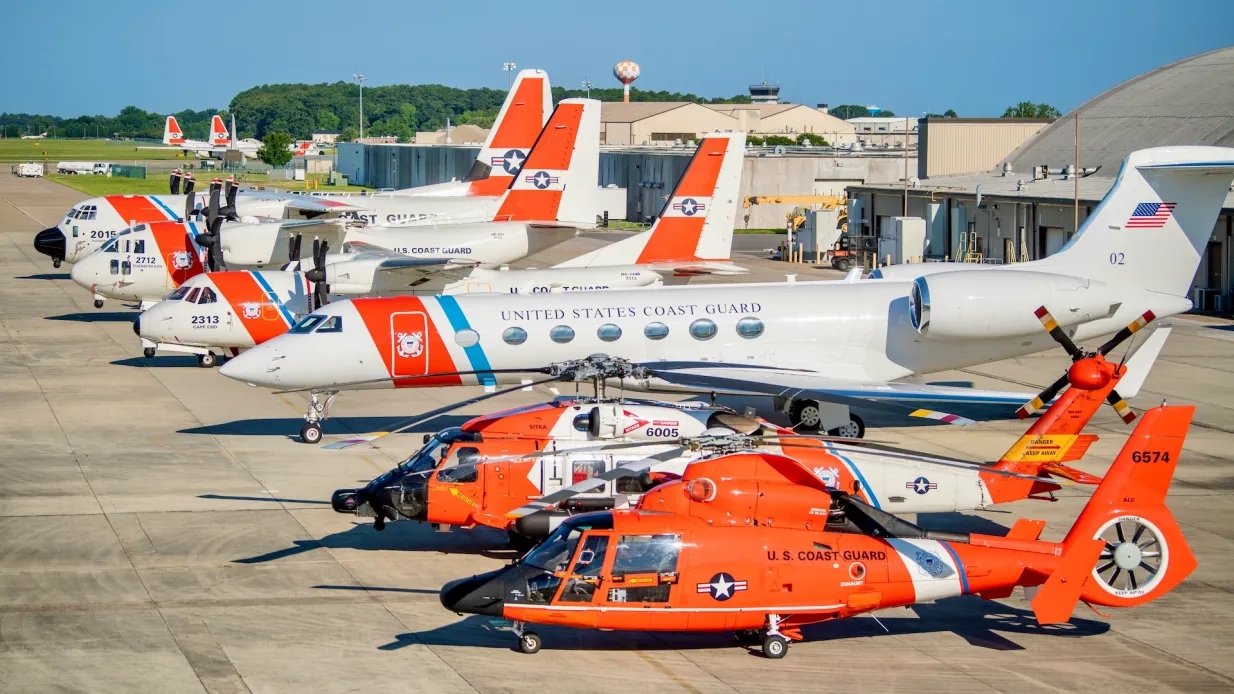
Every Coast Guard Aircraft Type Pictured Together In Rare ‘Family Photo’. Pictured: HC-130J, C-27J, HC-144, C-37B, MH-60T, MH-65E.

1939 Ground was broken for the construction of an air station at Elizabeth City, North Carolina.  With the support of Congressman Lindsay Warren and a favorable vote by local county and city officials regarding a bond issue, the land was secured for the new facility which was constructed by the WPA.

1953 Coast Guard forces assisted civilian authorities in evacuating 191 persons from the Coxuille Valley, Oregon flood area.

Coast Guard Cutter Healy (WAGB 20) and crew conduct formation steaming exercises with Candian Coast Guard Ship Sir Wilfrid Laurier and crew in the Beaufort Sea, July 28, 2023. The crew conducted a passenger exchange with the Sir Wilfrid Laurier off the coast of Utqiagvik, Alaska. (U.S. Coast Guard photo by Petty Officer 1st Class Michael Underwood)

1963 The modern Canadian Coast Guard was founded on this date.  Their official motto is Saluti Primum, Auxilio Semper (Safety First, Service Always).

1991 Upon receiving a request from the Saudi government, the Bush Administration determined that the Coast Guard would head an interagency team to assist the Saudi government in an oil spill assessment and plan for a clean-up operation after an intentional Iraqi oil spill.

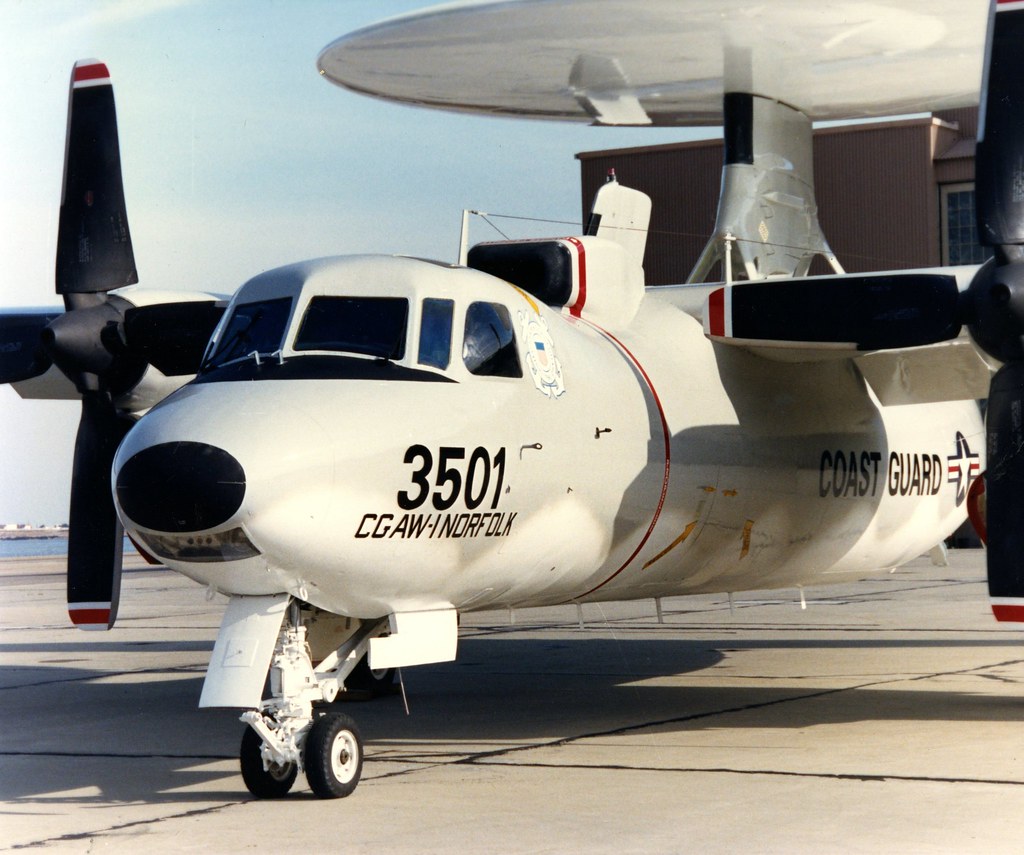
1990 Coast Guard Air Station St. Augustine, home of CGAW-1, was formally commissioned.  The Navy loaned E2Cs to the Coast Guard for use in the efforts by CGAW-1 to track drug shipments by radar.  One E2C, #3501, crashed during a landing at Roosevelt Roads, Puerto Rico, on August 24, 1990 and all four crewmen on board were killed.  CGAW-1 was disbanded soon thereafter and the remaining E2Cs were returned to the Navy.

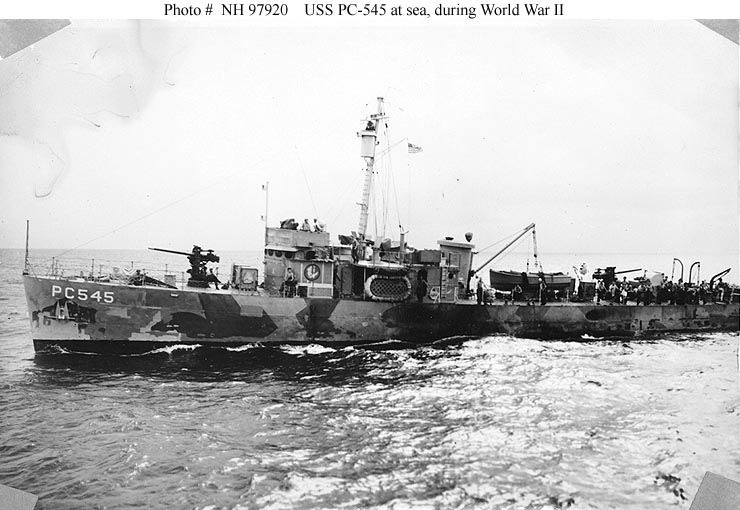
Lt. John F. String, Jr., USCGR, CO USS PC-545, Silver Star Recipient

PC545
Photo: USS PC-545, Commanded by Lt. String, At sea during World War II. Probably photographed in 1942-43, while wearing rather weathered pattern camouflage. Donation of Phil Wagner, 2001. U.S. Naval Historical Center Photograph.

The “This Day in Coast Guard History” for January 22 included this simple statement,

1944  Coast Guardsmen participated in Operation Shingle – the landings at Anzio-Nettuno, Italy.  Coast Guard units involved were USS PC-545 and LSTs 16, 326, 327, and 381.

The Coast Guard manned only four of these PCs during WWII. I remembered one had performed extremely well. This is the story.

STRING, John F. Jr., LT, USCGR, WWII, Anzio invasion, Silver Star, for conspicuous gallantry in action while serving as commanding officer of the USS PC 545 off Anzio, Italy on March 18, 1944. When an enemy motor torpedo boat was sighted at night. Lt. String immediately ordered the attack. With an expert display of seaman ship, he so skillfully maneuvered the ship that the first shots scored hits on the enemy craft before it was able to maneuver into position to effectively use its torpedoes and the resulting fire caused it to disintegrate in an explosion. This successful action against the enemy contributed materially to the protection of shipping in the Anzio area and to the successful maintenance of forces ashore.

This is a brief summary of USS PC-545 career while Coast Guard manned from NAVSOURCE.

  • Laid down 31 March 1942 by the Defoe Shipbuilding Corp., Bay City, MI
  • Launched 8 May 1942
  • Commissioned USS PC-545, 27 June 1942 with a Coast Guard crew
  • PC-545 participated in the following campaigns: Sicilian occupation, 9 – 15 July, 28 July – 17 August 1943 Salerno landings, 9 – 12 September 1943 Anzio Netturno advanced landings, 28 January – February 1944 and the Invasion of Southern France, 15 August – September 1944
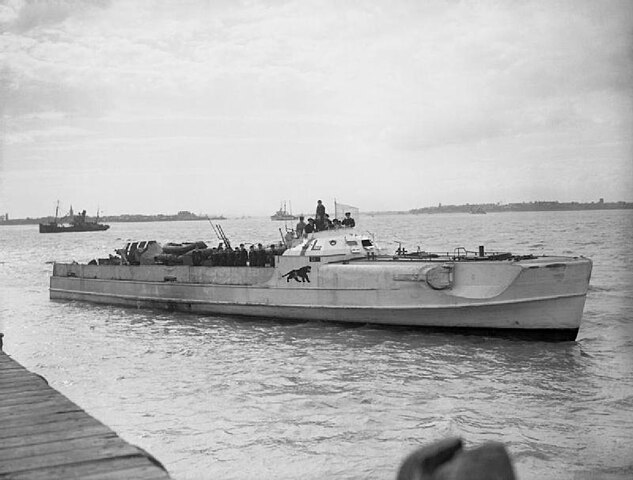
  • Sank a German E-boat 19 March 1944 west of Anzio, Italy
  • Decommissioned 17 October 1944, transferred to France at Toulon, France and named Goumier (W 91). Her Coast Guard crew was removed the same day.

Typical E-Boat. The German Schnellboot (“E-boat”) S 204 flying a white flag of surrender at the coastal forces base HMS Beehive, Felixstowe, Suffolk (UK), on 13 May 1945. The two German E-Boats S 204 and S 205 from the 4th Schnellboot-Flotilla were escorted in by ten British MTBs. On board of S 205 was Rear Admiral Erich Breuning, who had been in charge of E-Boat operations and who signed the instrument of surrender. Note the black panther painted on the side of S 204 which had on board KKpt Kurt Fimmen (CO 4th Schnellboot-Flotilla) and KptLt Bernd Rebensburg (Ia Op/Operations-Officer of the Staff of Führer der Schnellboote/FdS). Lt. J.E. Russell, Royal Navy official photographer