“Coast Guard Cutter Polar Star Returns to Seattle after 308 days” –USCG News

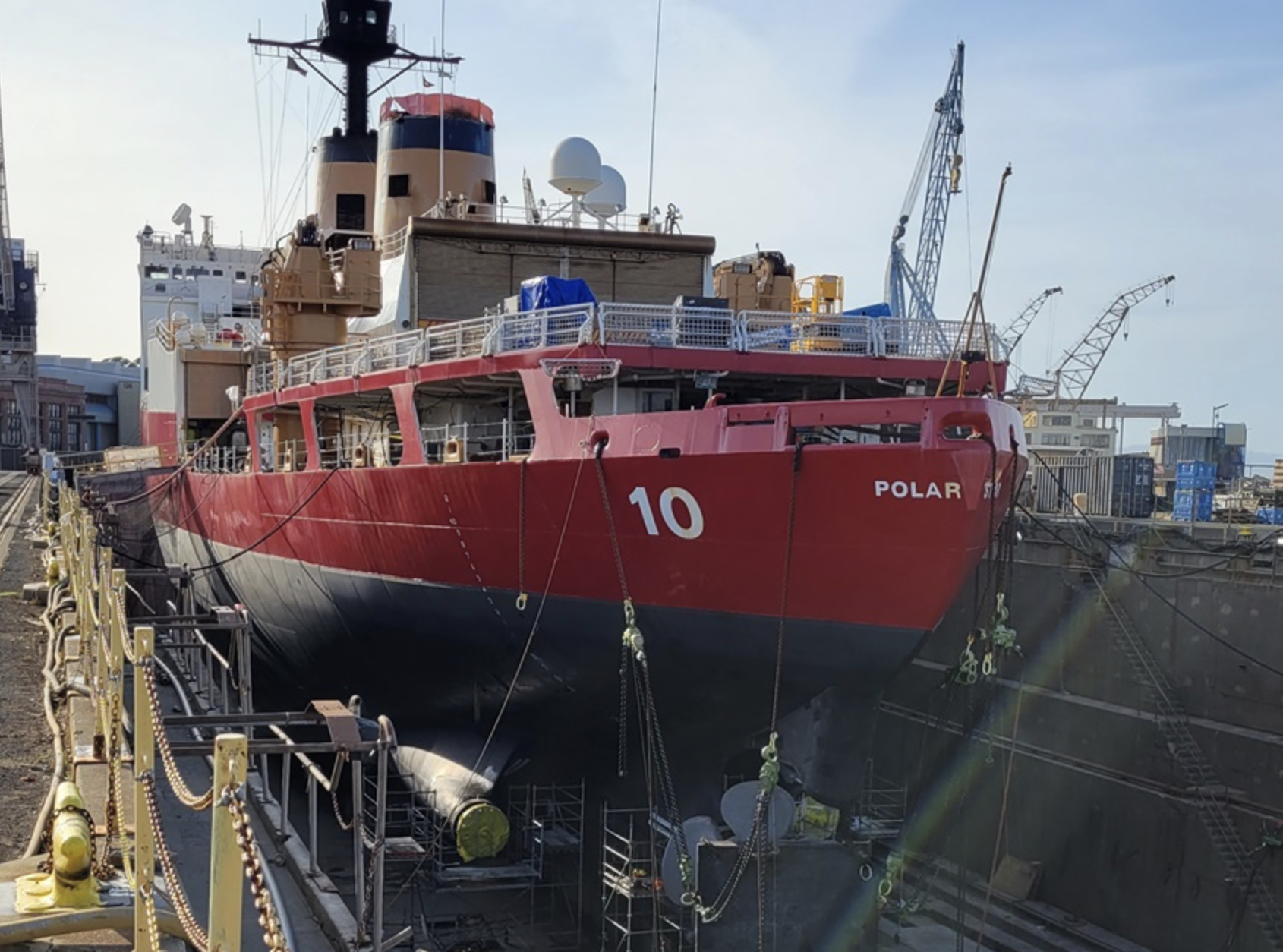
The rudder of the USCGC Polar Star (WAGB 10) is being removed while in a Vallejo, Calif., dry dock, April 1, 2025. The maintenance work completed over the past five years recapitalized integral systems, including propulsion, communication, and machinery control systems. (U.S. Coast Guard photo by Seaman Nestor Molina)

Below is a Coast Guard News Release.

The Coast Guard did a Service Life Extension Program on a 49 year old ship because its replacement is still not ready. Let that sink in for a while.

In addition to the work listed in the release, they removed the centerline shaft for servicing and inspection, exchanged all three propellers, and renewed both forward and aft main deck surfaces.

The ship has not seen its homeport for ten months and the intention is to do the same sort of five year phased SLEP on USCGC Healy, meaning she will have similar long periods away from homeport. At least she is at an age where SLEP is appropriate.

Ships should be home-ported in places they can be worked on.

50 year old ships should be the exception not the rule.


Sept. 25, 2025

Coast Guard Cutter Polar Star Returns to Seattle after 308 days

SEATTLE — After 308 days away from its Seattle home port, the 49-year-old U.S. Coast Guard Cutter Polar Star (WAGB 10) and crew returned home Tuesday. 

Upon completing Operation Deep Freeze (ODF) 2025, Polar Star returned directly to Mare Island Dry Dock in Vallejo, Calif., to complete the final year of a five-year Service Life Extension Program (SLEP).

Polar Star’s SLEP completion comes at a time when the Polar Regions are becoming more consequential, and the demand for U.S. Coast Guard presence, leadership, and vigilance continues to grow.

The maintenance work completed over the past five years recapitalized integral systems, including propulsion, communication, and machinery control systems. These efforts are designed to extend the cutter’s service life as the Coast Guard begins construction of its first Polar Security Cutter. Until PSCs becomes operational, Polar Star will remain the only U.S. icebreaker capable of completing the annual breakout of McMurdo Sound, Antarctica in support of the U.S. Antarctic program (USAP).

“Much has been asked of this ship over the past five decades,” said Capt. Jeff Rasnake, Polar Star’s commanding officer. “The completion of this extensive five-year maintenance and recapitalization project is a major milestone in enabling Polar Star’s operations into the future.”

Polar Star’s SLEP has been completed in five phases to maintain its operational capability to complete annual polar deployments. Phase Five, the last phase in its SLEP, began March 30, 2024, focusing on these projects:

  • Gyro repeater recapitalization to ensure that these critical pieces of navigation equipment are updated to modern standards, enabling safe navigation of the cutter.
  • Ancillary pumps and motors recapitalization through the replacement of critical main propulsion and auxiliary systems with modern supportable units.
  • Heating, ventilation, and air conditioning systems refurbishments; multiple zones were refurbished with ventilation trunks, fans, and heaters to improve air circulation and maintain a comfortable living environment for the ship’s crew during extended deployments.

The completion of Polar Star’s five-year SLEP underscores the importance of the annual ODF mission, the U.S. military support mission for the USAP, which facilitates the transport of personnel, equipment and supplies required to maintain the U.S.’s strategic presence in Antarctica. Having participated in a majority of these missions since they began in the 1950s, the U.S. Coast Guard will continue to support the U.S.’s continued presence on the Antarctic continent as part of the Joint Task Force – Support Forces Antarctica.

Work completed in Phase Five took 175 days and represented an additional $12.7 million investment in the U.S. Polar capability. While at Mare Island, Polar Star received support from both Coast Guard Base Seattle and Base Charleston’s Naval Engineering Departments to perform a center section overhaul on one of Polar Star’s nine main diesel engines. In parallel with this work, members from the Coast Guard Yard in Baltimore completed vital work on the ship’s sanitary systems.

Additional major work completed includes removing the centerline shaft for servicing and inspection, exchanging all three propellers, and renewing both forward and aft main deck surfaces.

“This is a tremendous ship, and it is in better shape today than it was ten years ago,” said Rasnake. “That’s a testament to the unrelenting efforts of the crew, the enduring support of our mission partners, and the renewed enthusiasm and investment in our nation’s polar icebreaking capabilities.”

Commissioned in 1976, Polar Star is 399 feet, weighing 13,500 tons with a 34-foot draft. Despite reaching nearly 50 years of age, Polar Star remains the world’s most powerful non-nuclear icebreaker with the ability to produce up to 75,000 shaft horsepower.

“Building a ‘Heavy’ Icebreaker in Helsinki” –Sixty Degrees North

Sixty Degrees North intends to follow the construction of Canada’s heavy icebreaker in Finland,

“I intend to closely follow and document construction of the Polar Class 2 ‘heavy’ Polar Icebreaker at Helsinki Shipyard in my continuing effort to correct the false belief that Finnish companies cannot build the types of icebreakers needed by the U.S. Coast Guard…

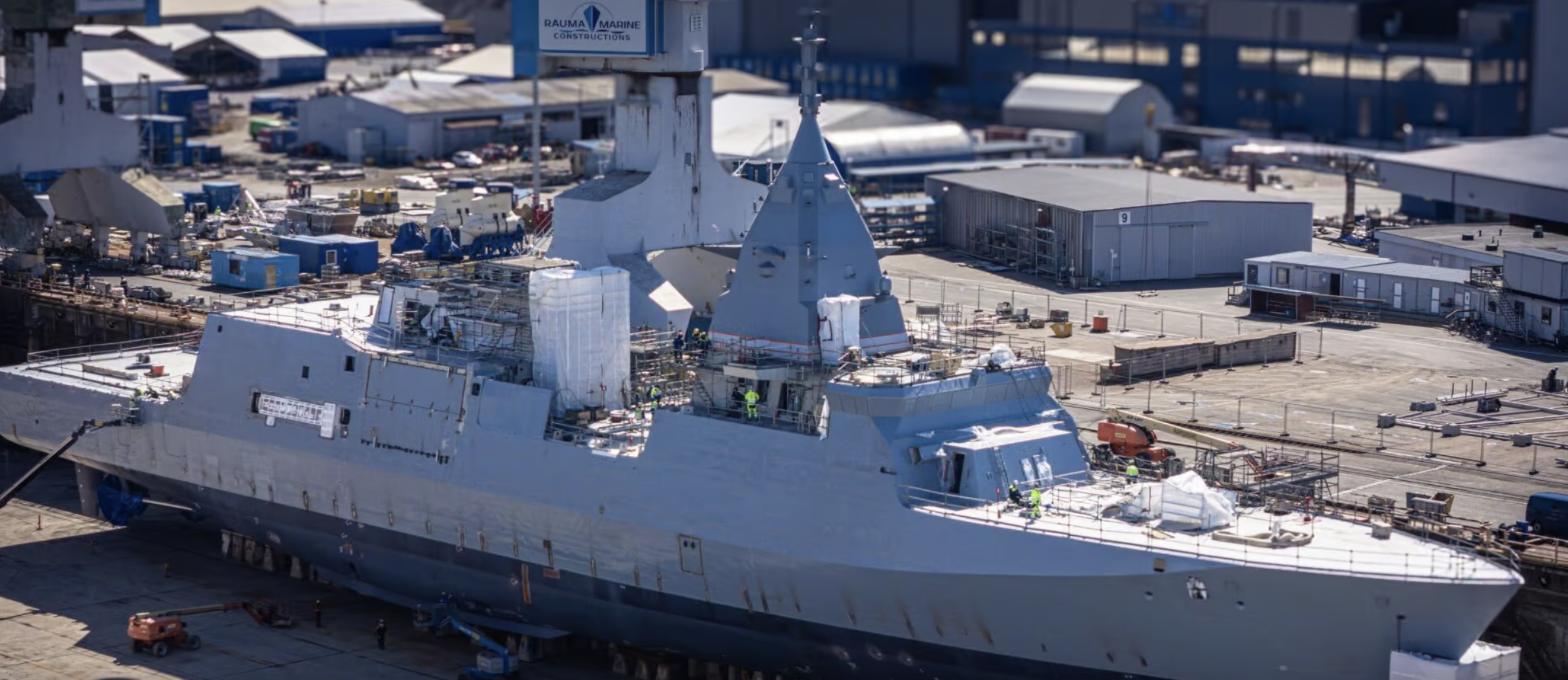
“You will also see me reporting on Rauma Marine Construction’s (RMC) progress building the Finnish Navy Corvettes...At the moment, they have three (of a planned four) Corvettes in simultaneous production.”

The corvette is also interesting combining significant anti-air, anti-surface, and anti-submarine capability with a hull designed to operate in ice, all in a hull 15% smaller than that of an OPC. I look forward to hearing more about it.

The first multi-purpose corvette built for the Finnish Navy’s Squadron 2020 project was launched at Rauma shipyard on Wednesday 21 May 2025.

“Davie Unveils $1B ‘American Icebreaker Factory’ in Texas to Build Arctic Security Cutters” –gCaptain

A rendering of Davie Defense’s “American Icebreaker Factory,” a planned $1 billion transformation of the historic Gulf Copper shipyard in Galveston, Texas. Image courtesy Davie

gCaptain reports,

Davie Defense Inc., the newest entrant to the American shipbuilding sector, has revealed detailed plans for a $1 billion overhaul of the historic Gulf Copper shipyard in Galveston, Texas, aiming to create the “American Icebreaker Factory”—a purpose-built facility for constructing U.S. Coast Guard’s Arctic Security Cutters.

The project plans, announced Wednesday, marks what the company describes as the largest single increase in U.S. shipbuilding capacity in decades.

Note, this is intended to build the medium “Arctic Security Cutter.”

“Helsinki Shipyard Begins Construction of Canadian Polar Icebreaker” –60 Degrees North

Canada’s Polar Max. I had the opportunity to attend the steel-cutting ceremony. Photo: Peter Rybski

60 Degrees North reports,

From an August 20th Davie press release:

In a historic milestone for the Canadian shipbuilding industry, Davie today officially began construction of the Polar Max icebreaker, a vessel that, once delivered by 2030, will redefine Canada’s Arctic capabilities.

Uniquely, Polar Max will be constructed through an innovative industrial collaboration between Canadian-controlled facilities in Helsinki, Finland and Lévis, Canada. Construction on the Polar Max hull will begin at Davie’s Helsinki Shipyard, which has built 100% of the complex medium to heavy icebreakers delivered from Finland over the past 25 years.

“The ICE Pact: One Year Later” –Sixty Degrees North

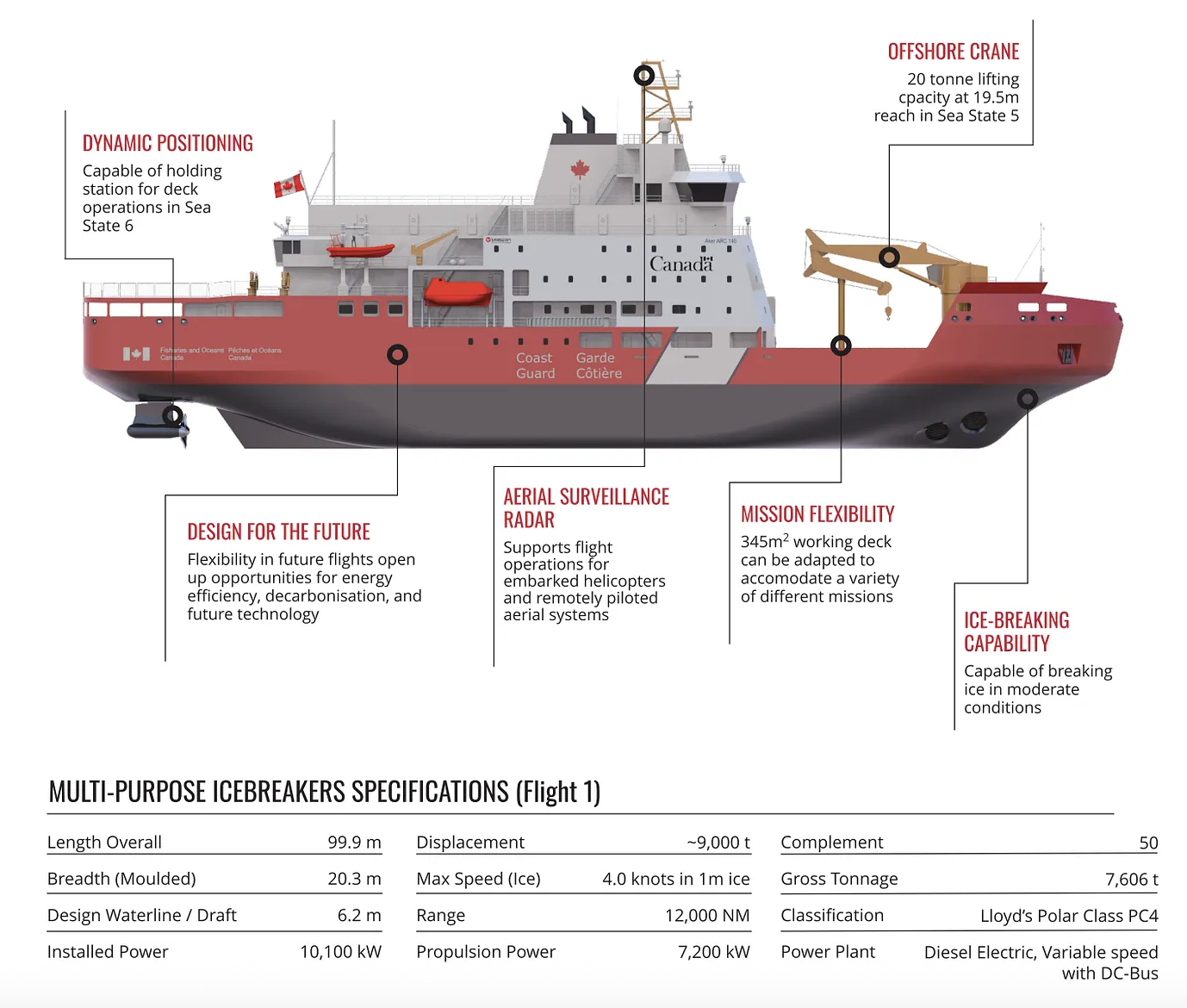
Canadian Coast Guard Multi-Purpose Icebreaker (MPI). Source: Seaspan
Note: The MPI image does not show the right propulsors; it will use Steerprop’s contra-rotating propulsors (CRP). Additionally according to Seaspan, the design could easily be upgraded to PC3. Confirmation from Seaspan and Aker Arctic. 

To get a realistic view of the potential of the ICE Pact, I recommend a review of the Sixty Degrees North’s review of the state of the agreement after the first year–useful, but perhaps less than we might have hoped.

“Coast Guard announces agreement to construct new polar security cutter shipyard facilities” –CG-9

I am trying to catch up on things, but while this is an August 4 release from the Acquisitions Directorate, I think it is an important step in integrating the PSC’s machinery and providing training.


Coast Guard announces agreement to construct new polar security cutter shipyard facilities

As part of continuing efforts to foster growth within the domestic shipbuilding industry and maintain momentum for acquisition priorities, the Coast Guard on July 23 formalized an agreement with Bollinger Mississippi Shipbuilding (BMS) to construct a production integration facility and land-based test facility at the shipyard in Pascagoula, Mississippi, in support of the Polar Security Cutter (PSC) Program.

This action represents a significant step in the Coast Guard’s continuing investment in the domestic shipbuilding sector and collaboration with industry partners to deliver critical assets to the nation. The construction of both facilities represents a significant capital investment partnership between the Coast Guard and BMS that will support streamlined production and integration of PSC mechanical and communication systems for a simplified installation process.

The Coast Guard modified the construction contract for the first PSC, originally awarded on March 25, 2025, to provide funding for the integration and test facilities via capital expenditure incentives. These incentives benefit the shipyard by providing access to funding for facility upgrades, workforce training and wage increases.

For more information: Polar Security Cutter Program page

“Finnish and Canadian Firms Team Up to Offer Arctic Security Cutters to U.S. Coast Guard” –SixtyDegreesNorth

Canadian CG MPV. Credit Aker Arctic.

Here we have a post from Peter Rybski (prybski@gmail.com) thought many of my readers might find interesting. It’s reprinted with his permission.

It suggests that a partnership of Canadian and Finnish shipyards may be in the lead to provide two Arctic Security Cutters using the design for the Canadian Coast Guard’s Multi-Purpose Vessel, a light icebreaker, and that follow on ships of this class would be built in the US.

This is not the first time Peter’s analysis has appeared here:

“Analyzing the Arctic Security Cutter Request for Information” –Sixty Degrees North

We have been following the Canadian Coast Guard’s Multi-purpose vessel program.

Canadian CG MPV. Credit Aker Arctic.

Note also that Canadian Shipbuilder Davie has announced an intention to acquire and modernize Gulf Copper & Manufacturing Corporation with facilities in Port Arthur and Galveston.

Aerial photo of Gulf Copper Dry Dock and Rig Repair in Galveston, Texas. In the dry dock is the former USS Texas, length 573 ft (175 m) (overall), beam 95 ft 2.5 in (29.020 m), displacement 27,000 tons, so big enough for a Polar Security Cutter. Shutterstock photo by Felix Mizioznikov.


Finnish and Canadian Firms Team Up to Offer Arctic Security Cutters to U.S. Coast Guard

According to the proposal, Seaspan’s Multi-Purpose Icebreaker design would be built in Finland by Rauma Marine Constructions (RMC), with Aker Arctic (who did the concept design) providing support.

I’m currently away from Finland, visiting family in the USA. Last week, while I was grilling hamburgers and hot dogs during a family Independence Day Barbecue, a regional Finnish newspaper (Satakunnan Kansa) ran a very interesting article:

RMC’s Nieminen returned from a sales trip to the USA: “Rauma Shipyard is Number One.”

RMC is part of a consortium that is offering two icebreakers to the U.S. Coast Guard, as well as extensive training.

(translation via google, with some corrections for clarification):

A satisfied man walked through Helsinki-Vantaa Airport on Thursday afternoon. RMC CEO Mika Nieminen returned from a sales trip to the USA, where he brought back some good news.

Nieminen was presenting the ship design of the consortium he represents to the US Coast Guard and the reception was excellent.

“Our ship design exceeded expectations and it is the design that the Coast Guard wants. The number one is the Rauma shipyard, which would also build it. The feedback was very positive.”

In addition to RMC, the consortium represented by Nieminen includes the Canadian shipbuilder Seaspan Shipyards and the Finnish ship design firm Aker Arctic Technology Oy.

The Canadian shipyard will start building medium-sized icebreakers based on the same model next year. Canada plans to build 16 icebreakers. This same ship model is now being offered to the US Coast Guard, but with RMC building the ships.

This is clearly referring to Seaspan’s Multi-Purpose Icebreaker (MPI) design, which I discussed in a recent article:

Analyzing the Arctic Security Cutter Request for Information

Analyzing the Arctic Security Cutter Request for Information

·
JUN 15

Canada’s Multi-Purpose Icebreaker (MPI, formerly known as the Multi-Purpose Vessel): Modern design that meets all of the listed requirements [for the U.S. Coast Guard’s Arctic Security Cutters]. The first flight of six vessels (of a planned sixteen) are scheduled to be built by Seaspan at their Vancouver shipyard….

Seaspan’s Vancouver Shipyard is at capacity through approximately 2029. While they will begin building MPIs for the Canadian Coast Guard, there is no room to build one for the U.S. Coast Guard in the relevant timeframe….

Building MPIs at RMC is an interesting idea, but I have no idea if that is actually under consideration.

It is more than just under consideration. According to the Satakunnan Kansa article, RMC would build the first two MPIs for the U.S. Coast Guard in Finland by 2028. The deal would also involve working with U.S. shipbuilders to ensure they had the training and skill to build subsequent vessels of the class in the USA. Cost information is not yet available.

Canadian Coast Guard Multi-Purpose Icebreaker (MPI). Source: Seaspan
Note: The MPI image does not show the right propulsors; it will use Steerprop’s contra-rotating propulsors (CRP). Additionally according to Seaspan, the design could easily be upgraded to PC3. Confirmation from Seaspan and Aker Arctic.

In April, Finnish newspaper Helsingin Sanomat published an article about negotiations between the U.S. Coast Guard and RMC to build a significant number of icebreakers, but the details were not subsequently confirmed. Before publishing this article, I reached out to RMC, Seaspan, and Aker Arctic for comments. As of press time, Aker Arctic and Seaspan responded, confirming many of the details in the article.

Arto Uuskallio, Head of Sales at Aker Arctic, commented via e-mail:

It’s natural that we are involved, since the MPI is an Aker Arctic concept, and it’s good to have a partner onboard who understands the possibilities and limitations of the ship concept. More detailed comments will likely come from the shipyards.

Dave Hargreaves, Seaspan’s Senior Vice President for Strategy, Business Development, and Communication, provided the following comments via e-mail:

We have consulted with many U.S. and non-U.S. shipyards regarding their readiness and aptitude to build the MPI design for the U.S. Coast Guard ASC program including Rauma Shipyard in Finland.

Rauma has a track record of delivering ice-capable vessels in less than 36 months — including recent programs. As a fully capable, end-to-end shipyard, Rauma is the lowest risk and best option to meet the 36-month requirement. Unlike other shipyards, Rauma has an active panel line and block fabrication facility that is ready to start production today — it does not require any further investment or ramp up in workforce to begin construction. This significantly lowers the risk of meeting the schedule requirement.

Together, with Rauma and Aker, Seaspan has developed a comprehensive plan detailing how we will work with a U.S. shipyard to transfer the design, knowledge, expertise and build plans to enable future ASC vessels to be built in the United States. This approach will deliver a comprehensive, U.S.-built ASC fleet for the U.S. Coast Guard while enhancing domestic icebreaker shipbuilding — avoiding the delays, costs and risks of long-term, high-investment alternatives.

I take his comment about schedule risk as a subtle dig at Davie/Helsinki Shipyard. I’ve been reading these press releases and comments long enough to see the back-and-forth, sometimes subtle, between Seaspan and Davie, and RMC and Helsinki Shipyard. I expect to read more of this, but am much more interested in tracking the progress of ongoing ship construction (such as the Canadian Polar Icebreakers being built by Seaspan and Davie) than in following their rhetorical barbs.

Helsinki Shipyard has an excellent track record of delivering icebreakers in less than thirty-six months, as I noted here.

Rauma Marine Constructions was unable to provide additional comments by publication time, but did say that more information would be coming out soon.

Thoughts and Comments

The Multi-Purpose Icebreaker is a solid design, and Rauma Marine Constructions is a capable shipyard with a solid track record. As my goal in writing about icebreakers has always been to assist the U.S. Coast Guard in getting the ships that it needs in a relevant timeline, I view the Seaspan/RMC/Aker consortium’s proposal as a positive development.

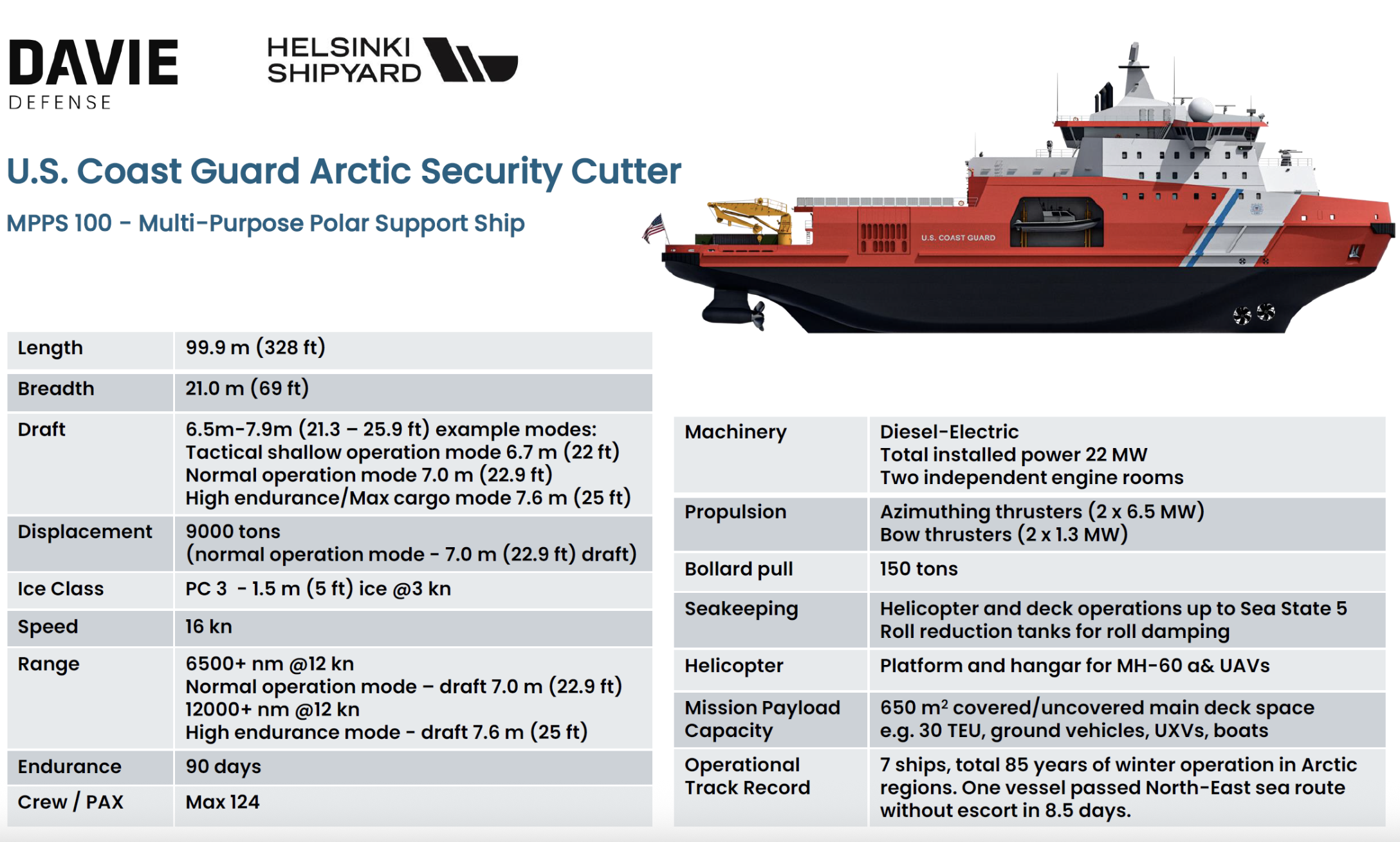
Davie does not comment on any of its ongoing negotiations, but it seems likely that it is offering its MPPS-100 to the U.S. Coast Guard to be built first in Helsinki Shipyard, and later (perhaps) in Texas.

The only announced player without any information about its proposed design is the United Shipbuilding Alliance created by Bollinger and Edison Chouest Offshore.

May the U.S. Coast Guard get the best ships for its needs in the shortest amount of time and at a good price! I’ll certainly be tracking all of these details closely.

Thanks for reading. Be sure to subscribe and share so that you never miss an update on this fast-moving and important topic.

Until next time-

All the Best,

PGR

Share

Leave a comment


“Analyzing the Arctic Security Cutter Request for Information” –Sixty Degrees North

Canadian CG MPV. Credit Aker Arctic.

An excellent article here from Sixty Degrees North.

Minor difference with the analysis above, authors states,

“Note that it is about 3,000 nautical miles from Seattle to northern Alaska, so the 6,000 nm range in the RFI is likely insufficient for meaningful operations in the Arctic.”

The 6500 nautical mile range listed in the RFI is probably adequate given the possibility of refueling in Alaska, although longer range is always a desirable attribute.

Note there has been considerable news lately that Canadian Shipbuilder Davie has announced an intention to acquire Gulf Copper & Manufacturing Corporation with facilities in Port Arthur and Galveston. It is always going to be difficult to sell the idea that US military vessels should be built outside the US.

“USCGC Storis departs on maiden voyage” –USCG News

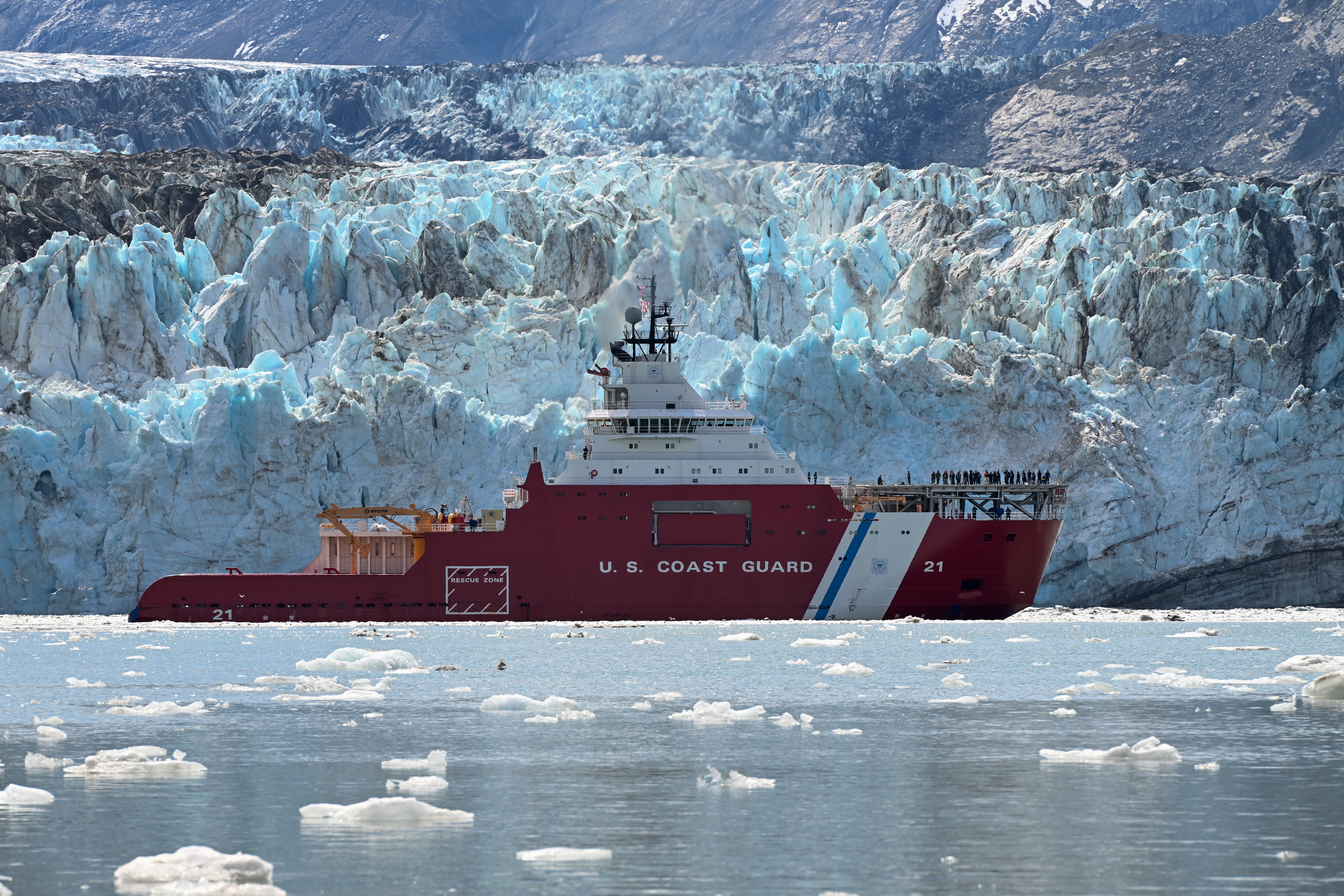
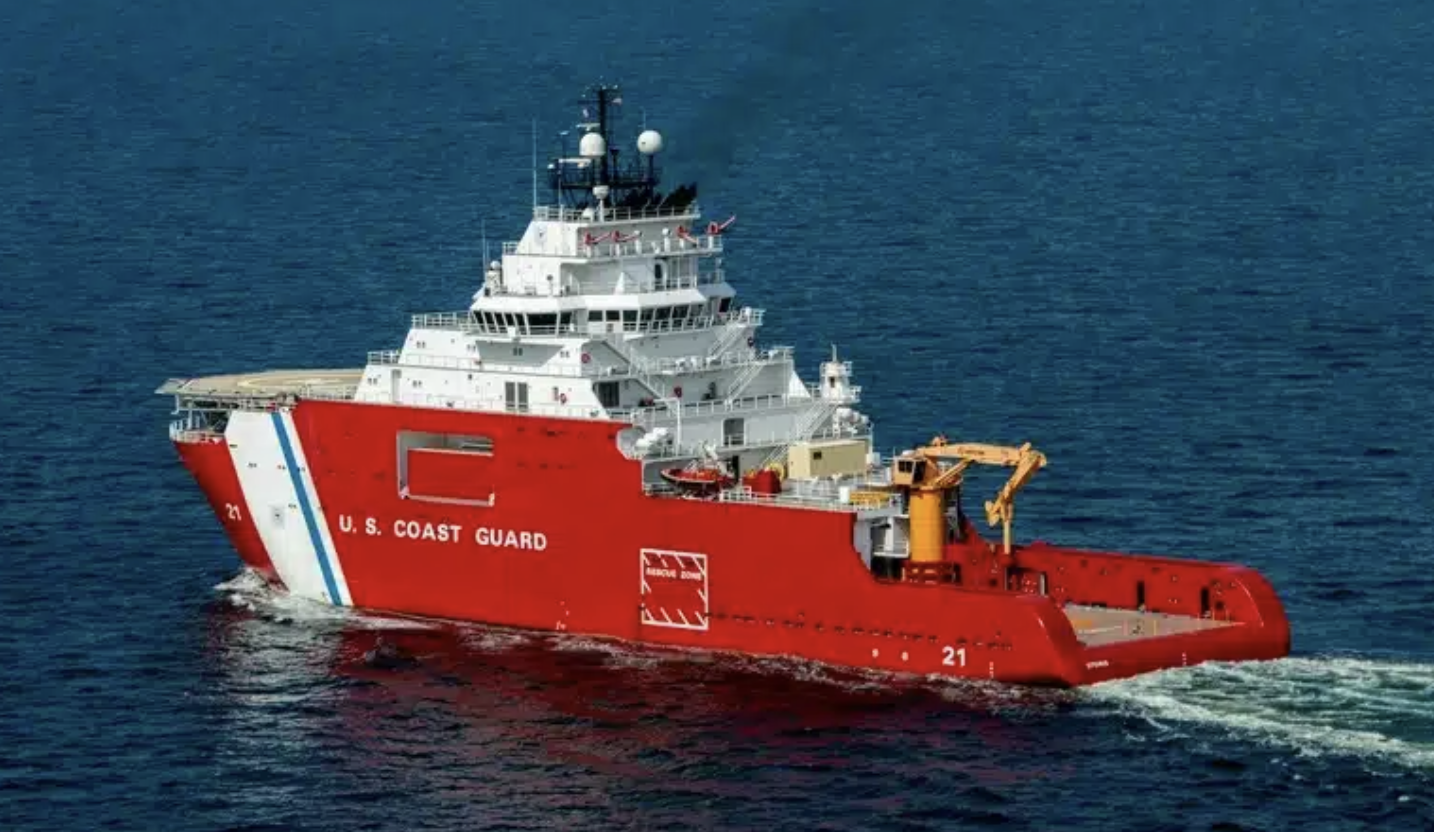
Pascagoula, MISS – The U.S. Coast Guard Cutter Storis is shown here from a top view while underway, June 3, 2025. The Storis is the Coast Guard’s first new polar icebreaker acquisition in 25 years and will expand U.S. operational presence in the Artic Ocean. Photos courtesy of Edison Chouest Offshore.

Below is a USCG news release. There are a couple of interesting details in this release.

First the statement that, “Storis is commanded by Capt. Keith M. Ropella who currently serves as chief of cutter forces at Coast Guard Headquarters in Washington D.C….” This seems to suggest that Captain Rosella is commanding a ship from his desk in CG HQ. I have heard of something similar, the CO of the CG Yard is nominally CO of the cutters that are stored at the Yard that are “in commission, special.”

Second, “The vessel is manned with a hybrid crew consisting of military cuttermen and civilian mariners.” I don’t know if the Coast Guard has ever done this, but this seems to similar to the way the Navy mans their Expeditionary Sea Base (ESB) ships. Will Storis normally be manned this way?

I have a complaint about this news release. The opening paragraph says, “The U.S. Coast Guard Cutter Storis (WAGB 21)…departed on its maiden voyage to safeguard U.S. sovereign interests in the Arctic and conduct Coast Guard missions.” It departed Pascagoula Mississippi; I don’t think it is going to the Arctic. I think it is in transit to Seattle.  Why didn’t they just say that? That would explain the unusual command and manning or is the Coast Guard going to depart from its usual operating procedures?


June 4, 2025

USCGC Storis departs on maiden voyage

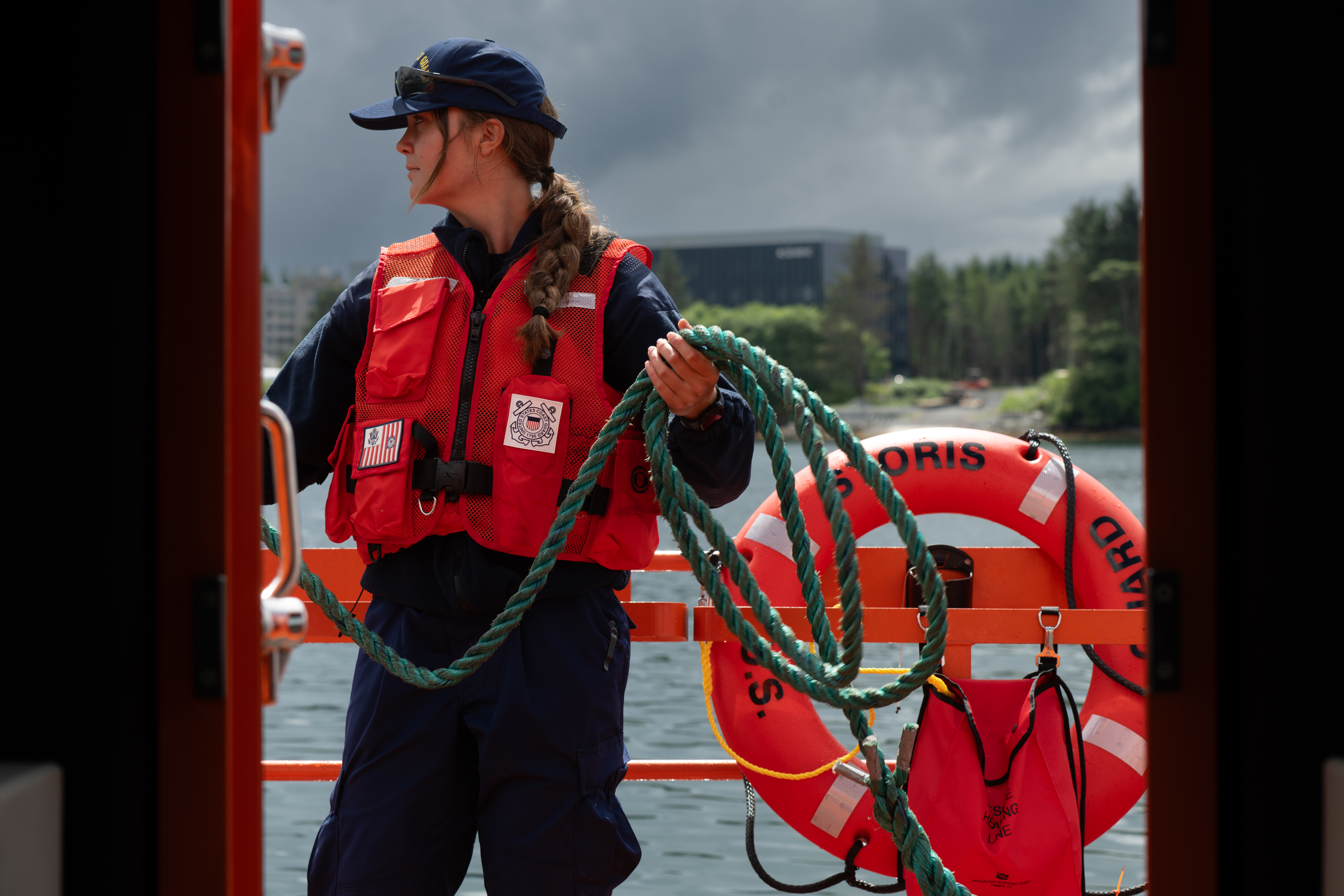
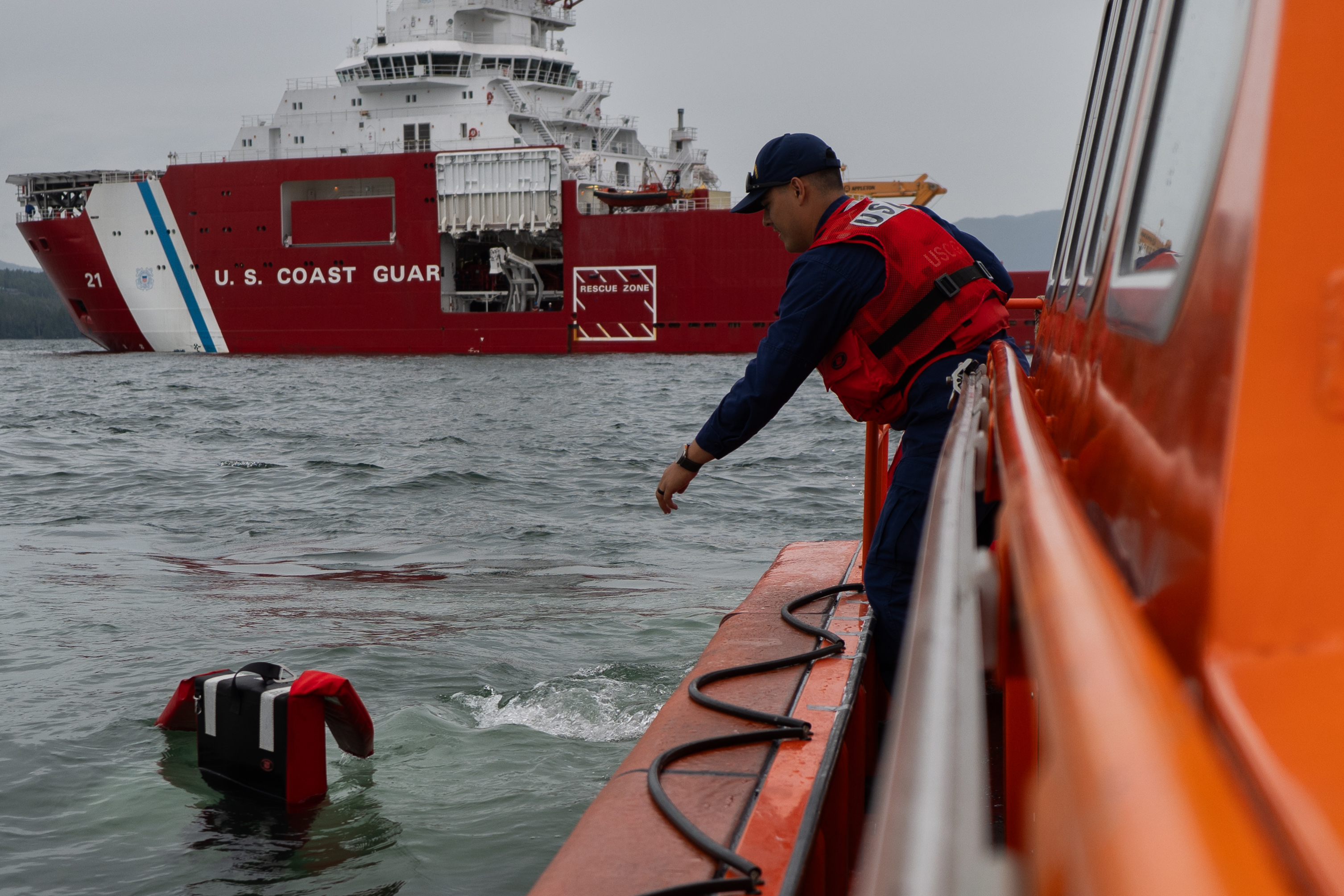
PASCAGOULA, Mississippi – The U.S. Coast Guard Cutter Storis (WAGB 21), the Coast Guard’s first polar icebreaker acquired in more than 25 years, departed on its maiden voyage to safeguard U.S. sovereign interests in the Arctic and conduct Coast Guard missions.

Storis’ departure marks an early milestone in the Service’s transformation through Force Design 2028 (FD2028), which includes reforming Coast Guard acquisitions to rapidly deploy capabilities to execute the Coast Guard’s missions.

The motor vessel Aiviq, acquired Dec. 20, 2024, from an Edison Chouest Offshore subsidiary, was renamed Storis following modifications to enhance communications and self-defense capabilities. The vessel will expand U.S. operational presence in the Arctic and support Coast Guard missions while the service awaits the delivery of the Polar Security Cutter (PSC) class. The Coast Guard will continue evaluating the cutter’s condition and requirements to achieve full operational capability.

Storis is commanded by Capt. Keith M. Ropella who currently serves as chief of cutter forces at Coast Guard Headquarters in Washington D.C., and previously commanded Coast Guard Cutter Polar Star (WAGB 10), from July 2022 to July 2024.

The vessel is manned with a hybrid crew consisting of military cuttermen and civilian mariners. This is the second vessel in Coast Guard history to bear the name Storis. The original Storis, known as the “Galloping Ghost of the Alaskan Coast,” had a storied history conducting 64 years of icebreaking operations in Alaska and the Arctic before being decommissioned in 2007.

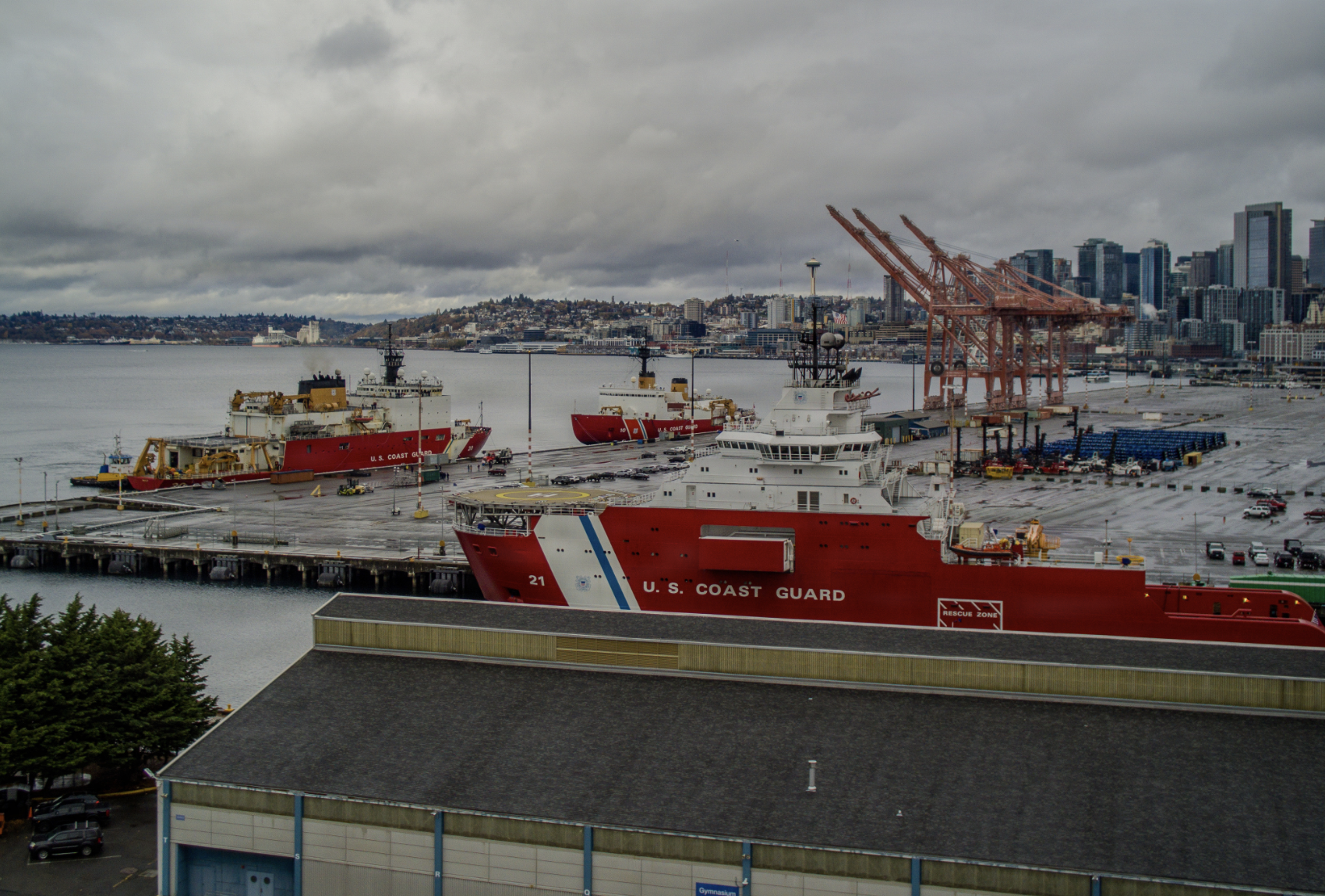
Storis will be commissioned this August in Juneau, Alaska, which will eventually be the vessel’s permanent homeport. Until the necessary shore infrastructure improvements are completed in Juneau, Storis will be temporarily berthed in Seattle, Washington, with the Service’s two other polar icebreakers.

The acquisition was made possible through the Don Young Coast Guard Authorization Act of 2022 and fiscal year 2024 appropriations. It does not affect the ongoing procurement of PSCs and is not part of the PSC program of record.

The Coast Guard operates the United States’ fleet of icebreakers to assure access to the polar regions to protect U.S. sovereignty. To fulfill this mission and meet operational needs in the polar regions, the Coast Guard requires a fleet of eight to nine polar icebreakers. In support of the President’s intent to acquire at least 40 new icebreakers, the Coast Guard is working to replace, modernize and grow its aging fleet of icebreakers, which currently includes 3 polar icebreakers, 21 domestic icebreakers and 16 ice-capable buoy tenders. As the United States’ third polar icebreaker, Storis will provide near-term operational presence and support national security as a bridging strategy until the full complement of PSCs is delivered.

Announced by Secretary of Homeland Security Kristi Noem on May 21, FD 2028 is a blueprint to transform the Coast Guard into a stronger, more ready and capable fighting force. This initiative will include campaigns focused on people, organization, contracting and acquisition, and technology. You can read more about FD 2028 here: Force Design 2028.

“Canada, Finland tout different paths of ‘icebreaker diplomacy’ with US” –Defense News

Coast Guard Cutter Healy (WAGB 20) and crew conduct formation steaming exercises with Candian Coast Guard Ship Sir Wilfrid Laurier and crew in the Beaufort Sea, July 28, 2023. The crew conducted a passenger exchange with the Sir Wilfrid Laurier off the coast of Utqiagvik, Alaska. (U.S. Coast Guard photo by Petty Officer 1st Class Michael Underwood)

Defense News reports,

Canadian and Finnish shipbuilders have made different offers to the United States for the production of icebreakers, which must weigh what it values more: speed or its sovereign shipyard industry.

It becomes a question of priorities with conflicting aims,

  • Get them fast?
  • Build in US yards to expand US shipbuilding capabilities?
  • Increase the USCG budget to pay for rapid acquisition?

It is unlikely, possibly impossible, the answer to all these questions will be yes.