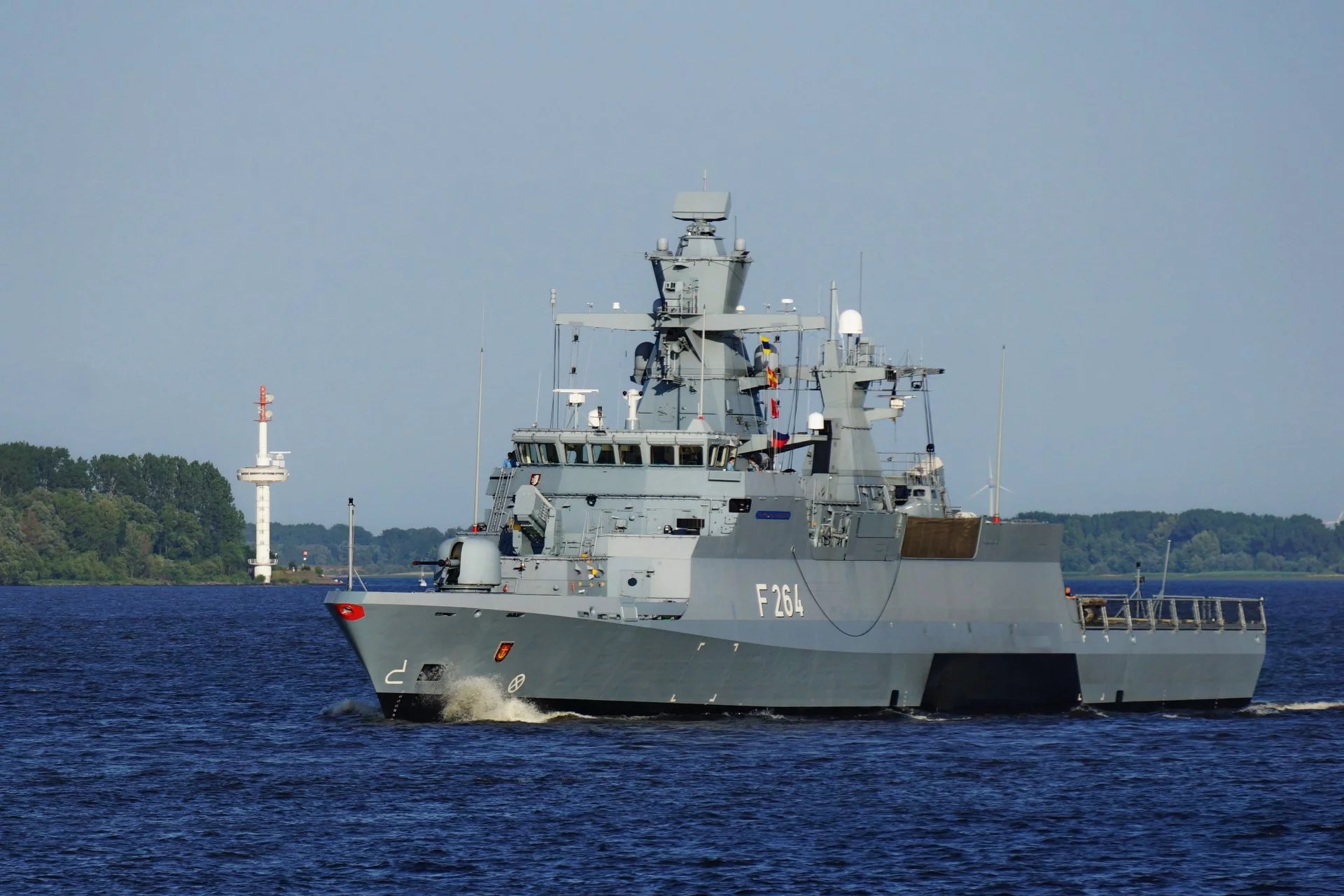
According to information published Die Zeit on October 17, 2024, the German Navy corvette Ludwigshafen am Rhein, deployed as part of the United Nations Interim Force in Lebanon (UNIFIL), successfully intercepted and neutralized an approaching drone near the Lebanese coast.
Unfortunately, the report does not specify which defensive system brought down the drone, but the corvette is relatively small, only a little larger than a WMEC270, and compared to the American DDGs that have been operating against kamikaze drones in the Red Sea, their options were limited. It has two 21 cell RAM (rolling airframe missile) launcher, a 76 mm gun similar to that found on the WMEC270s, two 27mm guns, and an Electronic Countermeasures System.
Most US successes against drones have involved air to air intercepts or the use of very expensive standard missiles, with some attributed to medium range ESSMs (Evolved Sea Sparrow Missiles). In one case a drone was brought down by a Phalanx CIWS (Close in Weapon System) like that mounted on the National Security Cutters, but that was a last ditch effort not a weapon of choice.
The Italian Navy, showing great confidence in their 76mm Strales system, shot down a kamikaze drone after forgoing an opportunity to engage it with surface to air missiles.
Wanted to pass this along. A little less than a half hour, but a good way to get up to speed on an emerging weapons technology. It also includes a lot of background on torpedoes.
I would only add that these are likely to be used as terrorist weapons as well as weapons of war.
H. I. Sutton is probably the leading unclassified source for information on unconventional naval warfare systems and has also been a great source on maritime drug smuggling technology. He has a website, “Covert Shores,” that is included on my “Recommended Blogs” page. He is also widely published in the popular press including by the US Naval Institute and in Naval News. He has also published several books.
The War Zone reports, “A French Navy helicopter used machine gun fire to shoot down a Houthi drone over the Red Sea today.”
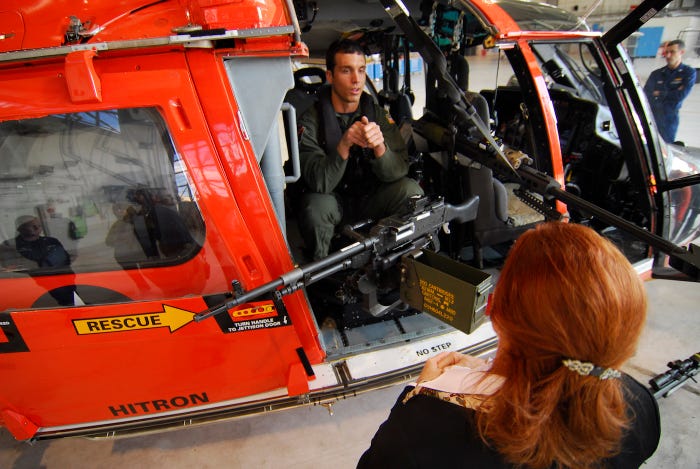
This is a potential Coast Guard capability, given its airborne use of force capability includes a door mounted rifle caliber machine gun, though I do not know if every Coast Guard Air Station has qualified gunners. The .50 caliber sniper rifle included in the package might even be more effective than the machine gun.
I am not suggesting the Coast Guard send helicopters to the Red Sea, but when the Coast Guard provides protection for vessels transiting to sea, it has generally been done with small boats with crew served rifle caliber machine guns. Ballistic Missile submarines have been an exception. They may be escorted by 82 foot patrol boats with .50 caliber machine guns in remote weapon stations. Perhaps the Coast Guard should consider providing an armed helicopter overwatch. An armed helicopter could be effective against hostile surface systems as well as air systems.
Petty Officer 2nd Class Anthony Phillips, a precision marksman at Helicopter Interdiction Tactical Squadron, displays the weaponry used by a HITRON during missions, February 23, 2010. US Coast Guard/Petty Officer 1st Class Bobby Nash
Below is a video taken by the French helicopter (an AS565 Panther, similar to the Coast Guard’s H-65s) as it shoots down the drone.
A US Navy helicopter demonstrated this capability over eight years ago. It is certainly less expensive than bringing down a drone with a missile. On the other hand, I would not want to be in a helicopter near a drone if the Navy decides to use a missile to destroy the drone.
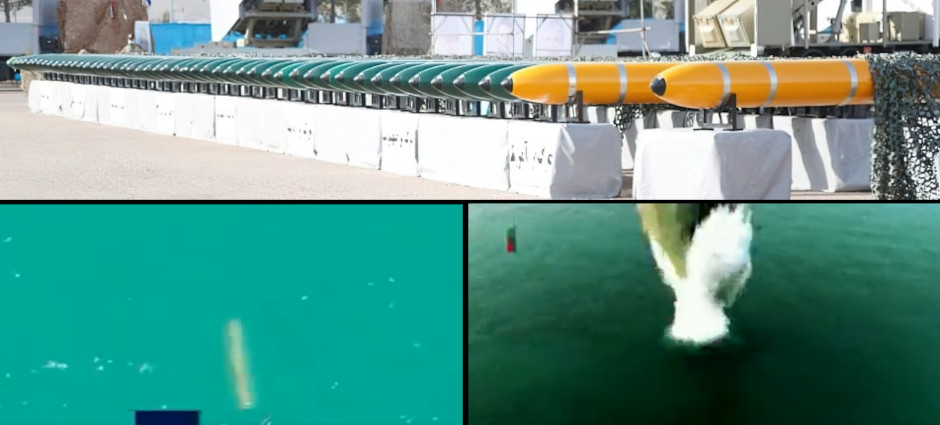
“US Coast Guard / CENTCOM released photo of weapons seized aboard an Iranian dhow…The seizure included UUV and USV components. The annotations, highlighting possible UUV parts, have been added.”
As reported earlier, on January 28,2023, USCGC Clarence Sutphin Jr. intercepted an arms shipment bound for Houthi controlled areas of Yemen. Somehow, I skipped over an aspect of the report.
The boarding team discovered over 200 packages that contained medium-range ballistic missile components, explosives, unmanned underwater/surface vehicle (UUV/USV) components, military-grade communication and network equipment, anti-tank guided missile launcher assemblies, and other military components. (emphasis added–Chuck)
H. I Sutton at “Covert Shores” amplifies on the story, identifying the likely UUV as a one-way attack system. An earlier post provides a bit more detail about the likely weapon.
It appears this weapon is slow, so it is more likely to be used against vessels that are anchored or moored. It might also be used against port infrastructure. It could be launched and/or controlled from any number of innocuous looking craft. Because the effects of an underwater explosion are amplified by the non-compressible nature of water, this weapon could cause very serious damage.
In addition to the Houthi, Iran and any of its client organizations may use this weapon.
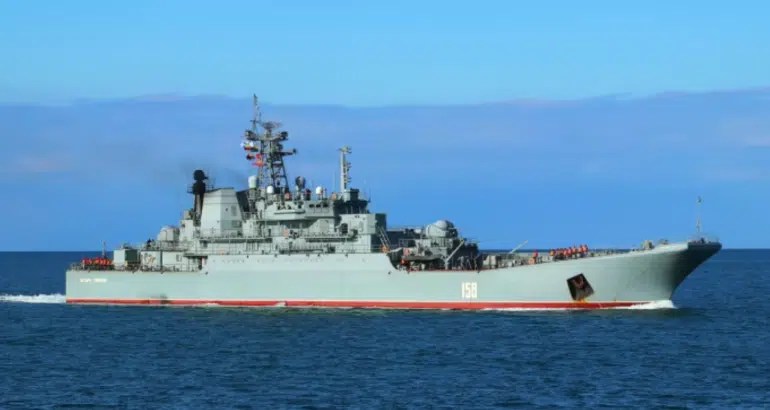
“Ukraine has claimed the destruction of another warship of the Russian Black Sea Fleet, the Ropucha class landing ship Cesar Kunikov (also written as Tsezar Kunikov) being the latest victim of explosives-laden naval drones off the coast of Crimea. Ukrainian officials claim that the landing ship was sunk in the overnight attack and available imagery shows the vessel capsized.”
I applaud what the Ukrainians are doing, but the Coast Guard needs to anticipate that we might someday be on the receiving end of this sort of attack. What are the Russians doing and could we do better?
So far, the Russian Black Sea Fleet has reportedly lost 24 surface units and a submarine to various forms of attack. But let’s look specifically at landing ships in the Black Sea which the Russians are using to transport supplies and reinforcements to Crimea.
Ropucha-I class landing ship Caesar Kunikov (Russian MoD photo)
Russia has been able to add some small combatants to the Black Sea Fleet using its River systems, but they are unable to add large ships, including landing ships because Turkey has closed access to the Black Sea by warships from the Mediterranean, so Russia cannot expect reinforcements. Apparently anticipating closure of the Dardanelles, the Russian Navy moved six additional landing ships into the Black Sea. Wikipedia reports,
In February 2022, prior to the full-scale Russian invasion of Ukraine, the landing ships Korolev, Minsk, Kaliningrad, Pyotr Morgunov, Georgy Pobedonosets, and Olenegorsky Gornyak from the Baltic Fleet and Northern fleets departed their bases and passed through the Dardanelles Strait for claimed Military exercise in the Black Sea.
In addition, a Ukrainian ship of this type was added to the Russian Black Sea Fleet when Russia occupied Crimea, but that ship is reportedly inactive. The Russians are apparently having difficulty maintaining these approximately 40 year old ships.
“According to Ukrainian Navy spokesperson Dmytro Pletenchuk, the Black Sea Fleet now has only fiveRopucha class ships remaining in service out of a previous total of 13 (additional units were transferred from the Baltic and Northern Fleets ahead of the full-scale invasion of Ukraine).” –This may refer to all types of LSTs, not just Rapucha class. They also lost a Tapir class LST.–Chuck
Ship Self-Defense:
Looking at this video, I could not help but think that the Ukrainians would have had a harder time if the Russian ship had enforced darken ship. At the very least the attackers might have had less time to coordinate their attack. The attacks are clearly made at night using electro optics, and a lighted target helps them. All that lighting also degrades the night vision of lookouts that might otherwise recognize that an attack is underway.
The Russian LST was well armed. The Rapucha class ship reported sunk, had two twin 57mm guns with a 200 round per minute rate of fire, so, theoretically, about four times the firepower provided by an NSC or OPC’s 57mm Mk110. You might think these would be effective against unmanned surface vessels, but I have yet to see any evidence in any of the videos of main gun systems being used against such attacks. They always seem to be pointed on the centerline.
It seems that in successful attacks, the target is late in recognizing it is under attack. I have to wonder if their weapons and sensors were manned and ready? Were lookouts posted? Were lookouts equipped with night vision devices?
Apparently, the attack occurred near the end of its voyage from Novorossiysk to Sevastopol. The ship was close enough to Sevastopol that smoke from wreck was visible on shore.
If you are intending to intercept a ship that may use evasive courses. The most logical place to intercept it would be near the known starting and ending points and in this case the ending point would have been an easier place to stage an ambush. It would also be the easiest place to provide protective units.
In an earlier attack, we saw the attacking USVs engaged by a helicopter. In this case, there seems to have been no overwatch.
Small boat escorts might help, even if all they did was provide eyes and ears away from the light and noise of the target vessel that could recognize the threat.
It would of course be critical that they escorting vessels not be fired upon by the targeted vessel, so recognition signal lights would probably be appropriate.
Pairs of boats ahead and on either side of the escorted vessel could alternately sprint and drift so as to minimize noise.
I would estimate escorting boats would want to patrol about 4,000 yards from the escorted vessel, but this is something that could be tested using watercraft with similar characteristics to the kamikaze USVs.
If armed with machine guns, escorting boats could attempt to engage the threats. If using tracer ammunition, even if unable to destroy the threat, they would be pointing out the threat to the target ship.
In many of these videos, it appears that the first hit which immobilizes the target occurs with USV in a pursuit curve coming up the stern of the vessel. An escorting boat in the wake of target vessel would be in a good position to prevent that first immobilizing hit.
“A dramatic new view released by the Ukrainian Defense Intelligence Directorate (GUR) shows several of its uncrewed surface vessels (USVs) strike and sink the Russian Tarantul-III class missile corvette Ivanovets. The attack took place Wednesday night local time on the Black Sea near Lake Donuzlav in western Crimea, the GUR said on its Telegram channel.
“A 128-second video posted on Twitter shows what appears to be a complex attack on the Ivanovets by what Lt. Gen. Kyrylo Budanov, commander of GUR, told us were Maritime Autonomous Guard Unmanned Robotic Apparatus (MAGURA V5) USVs operated by the GUR’s Group 13 drone unit.”
Tarantul-class corvette
The vessel in the video is a Tarantul class missile corvette. These vessels are powered by four engines totaling 32,000 HP making them very fast (42 knots). The hot gas turbine exhausts on either side of the transom glow brightly early in the video.
They have a pair of 30mm gatling guns on the aft superstructure with a clear field of fire aft.
This ship appears well equipped to defeat an unmanned surface vessel (USV) attack.
The Drive post analyses the attack, but I would point out that I don’t see as many splashes as I would have expected, if the 30mm guns were functioning. I don’t see muzzle flashes. What I did see appeared to be from heavy machine guns (12.7 or 14.5mm) rather than 30mm.
Many USVs were involved in this attack. The Ukrainians claimed six USVs hit the little corvette. Still other USVs filmed the ultimate explosion and sinking.
Perhaps the 30mm guns had run out of ammunition engaging other USVs by the time the drone in the first video recorded attack gets as close as seen in the video.
The report included this statement,
““The Ivanovets MRK sank while repelling a night attack by the Ukrainian Armed Forces on Sevastopol,” the Russian VoenkorKotenok Telegram channel wrote.”
The Russians have historically stationed a “guard ship” off their ports to prevent surprise attack. Ivanovets may have been stationed off Sevastopol specifically as a counter to a drone attack.
Shahed-136One Way Attack Uncrewed Air Vehicle (), Source: Covert Shores
Covert Shores makes some interesting observations and asks pointed questions particularly in regard to the terminal homing phase of how the low-cost slow cruise missiles make their attacks on moving targets.
Hitting fixed target in Ukraine is very different from hitting a moving target hundreds of miles off the coast. Even an oil tanker is very small in the vastness of the ocean. The mission would need target location intelligence, and the drone would need targeting during its attack phase. The former is the same for any anti-ship weapon and can be achieved by patrol aircraft, fishing boats. Or, as possibly the case in the Chem Pluto attack, by the target broadcasting its position via AIS (automated information system).
The final phase targeting is more interesting. We do not know, at least in the public sphere, how the drones targeted the tankers. Whether it was a human-in-the-loop camera, or some form of automation.
Do they have satellite communications? Target recognition software? Home on AIS?
Presumably we have recovered at least one of the failed drones and can answer the question, but there is an even simpler solution.
Forward observers in one or more of the many Dhows that traffic the area, who call in a UAV when they have a target, and who can take over control of the drone when it arrives on scene, steering it into the target. This would be a continuation of what we saw with the Houthi remote control explosive motorboats, which unlike the USVs we are seeing in the Russo-Ukraine War, had no satellite link and were apparently steered by a second vessel within line of sight of the target and the attacking USV. It is not unlikely the Iranians and Houthi have a network of such nondescript vessels.
The slow speed of the UAVs does present something of a challenge in getting to the right place at the right time, but that is mitigated by the predictability of shipping lanes and the consistent speed of merchant vessels.
While the Unmanned Surface Vessel was identified as a MARTAC T38 Devil Ray USV, the weapon was not identified. I think we can be pretty the “Lethal Miniature Aerial Missile System” was the AeroVironment Switchblade 300 launched from their Multipack Launcher (MPL).
I have suggested this weapon would be almost ideal for the Coast Guard, should they need to stop a terrorist attack using a small, fast, highly maneuverable boat.
As a counter such an attack, this weapon is far better than a 7.62mm or .50 caliber machine gun.
It has a range of up to 20km so it could engage a target far earlier than a machine gun and from outside the effective range of hostile small arms fire.
With a sprint speed of 100 mph (87 knots) it can cover the 2200 yards nominal effective range of the .50 caliber in about 45 seconds.
It has demonstrated a high probability of a first round hit on target.
It has a man in the loop function so it can be aborted if necessary.
There is little danger of collateral damage compared to firing multiple bursts from a crew served machine gun mounted on a bouncing highspeed boat.
Exercise Digital Talon Advances Unmanned Lethality at Sea
MANAMA, Bahrain –November 02, 2023
U.S. Naval Forces Central Command (NAVCENT) is advancing lethality and the combat capabilities of unmanned surface vehicles (USVs) during live weapons firing exercises in the international waters surrounding the Arabian Peninsula, Oct. 23.
The firing exercises were conducted as part of Exercise Digital Talon and constituted the first use of lethal munitions from USVs in the Middle East region.
During the exercise, NAVCENT’s Task Force 59, the Navy’s first Unmanned and Artificial Intelligence Task Force, demonstrated the ability of unmanned platforms to pair with traditionally crewed ships in “manned-unmanned teaming” to identify and target simulated hostile forces at sea. The hostile forces were represented through the use of a target boat. Then, using live munitions launched from another unmanned platform, NAVCENT forces engaged and destroyed the targets.
During multiple firing events, a MARTAC T38 Devil Ray USV, equipped with a Lethal Miniature Aerial Missile System, successfully scored direct hits each time. A human operator ashore at Task Force 59’s Robotics Operations Center made the engagement decisions.
Digital Talon was coordinated with and supported by Commander, Special Operations Forces Central Command.
This exercise is the second time in as many months the U.S. Navy has successfully demonstrated advanced unmanned capabilities in the region, according to Vice Adm. Brad Cooper, NAVCENT commander. In September, unmanned underwater surface and aerial vehicles were able to track Iranian Navy and Islamic Revolutionary Guard Corps Navy ships and small boats over several days during routine patrols in and around the Strait of Hormuz.
“We are focused on the operational application of new, cutting-edge unmanned systems and artificial intelligence technologies. Last month, we integrated 12 different unmanned platforms with manned ships for ‘manned-unmanned teaming’ operations to conduct enhanced maritime security operations in the waters surrounding the Arabian Peninsula,” he said. “During Digital Talon, we took a significant step forward and advanced our capability to the ‘next level’ beyond just maritime domain awareness, which has been a traditional focus with Task Force 59. We have proven these unmanned platforms can enhance fleet lethality. In doing so, we are strengthening regional maritime security and enhancing deterrence against malign activity.”
Looking ahead, Cooper said, he expects to see the progress expand in scale and impact, including future exercises expanding the arsenal of combat-capable unmanned systems.
“I’m excited about the direction we’re headed,” he said.
U.S. Naval Forces Central Command/U.S. 5th Fleet’s area of operations encompasses about 2.5 million square miles of water area and includes the Arabian Gulf, Red Sea, Gulf of Oman, Gulf of Aden, Arabian Sea and parts of the Indian Ocean. This expanse, comprising 21 nations, includes three critical choke points at the Strait of Hormuz, the Suez Canal and the Strait of Bab al Mandeb.
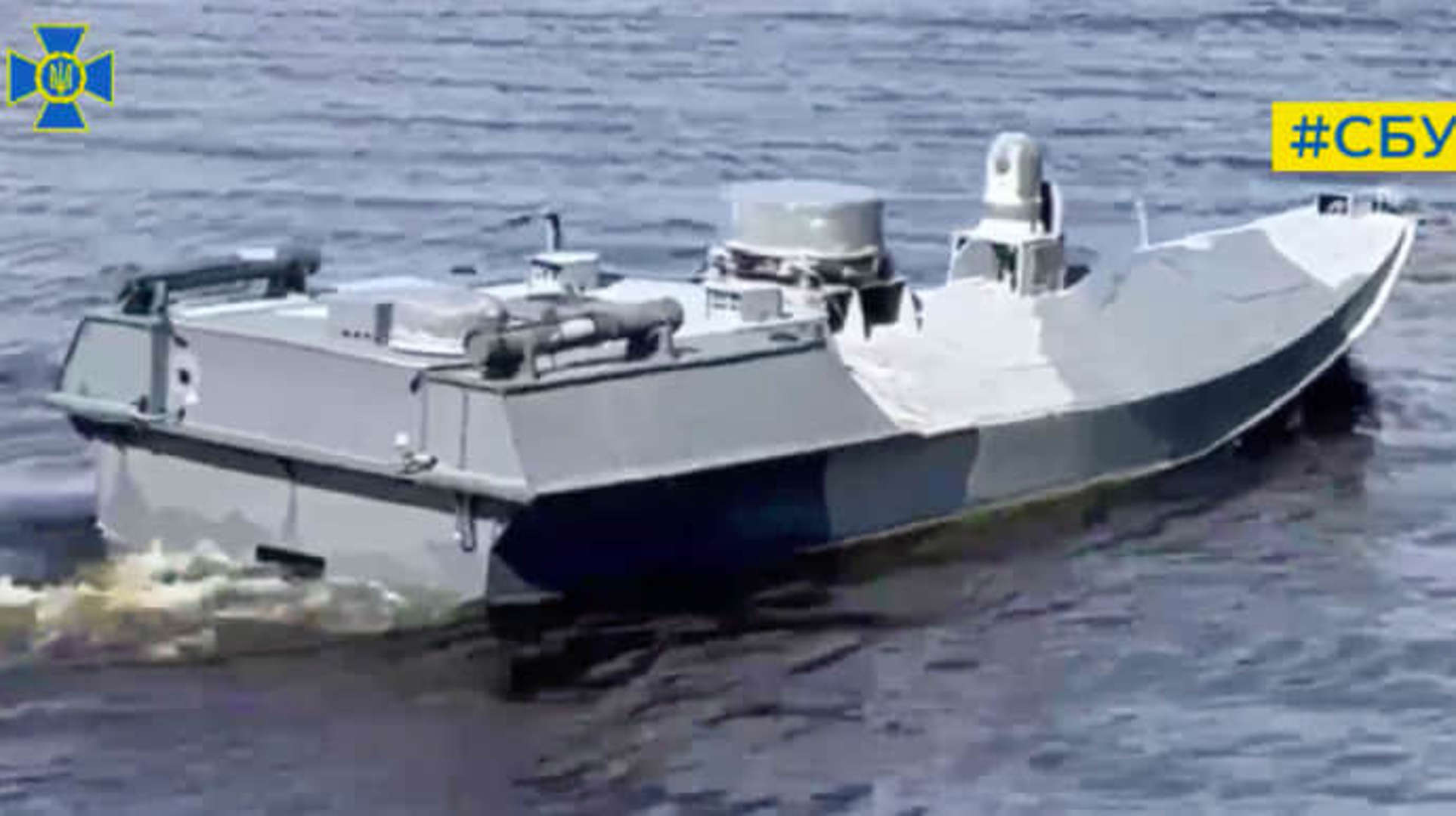
The Security Service of Ukraine, together with the Ukrainian Navy, has attacked the Buyan cruise missile carrier and the ship Pavel Derzhavin using experimental weapons on uncrewed surface vessels…both vessels were hit by Sea Baby drones with experimental weapons.
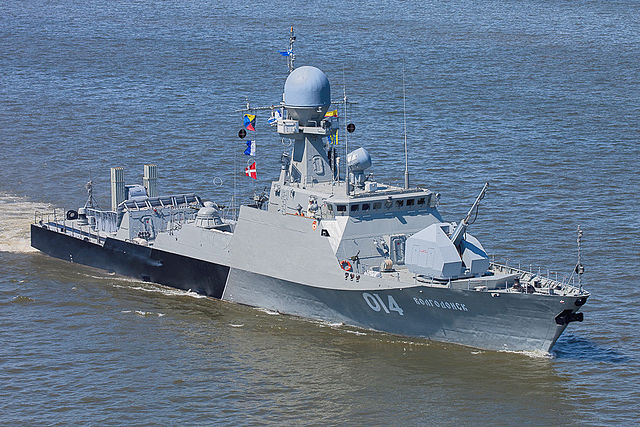
The Buyan cruise missile carrier or Buyan-M (that is the name of the class, not a specific ship) is a small, 949 ton full load, 75 meter (246′) corvette armed with up to eight cruise missiles similar in capability to the American Tomahawk.
Buyan-M class corvette, Volgodonsk in Astrakhan. Author Anton Blinov, via Wikipedia.
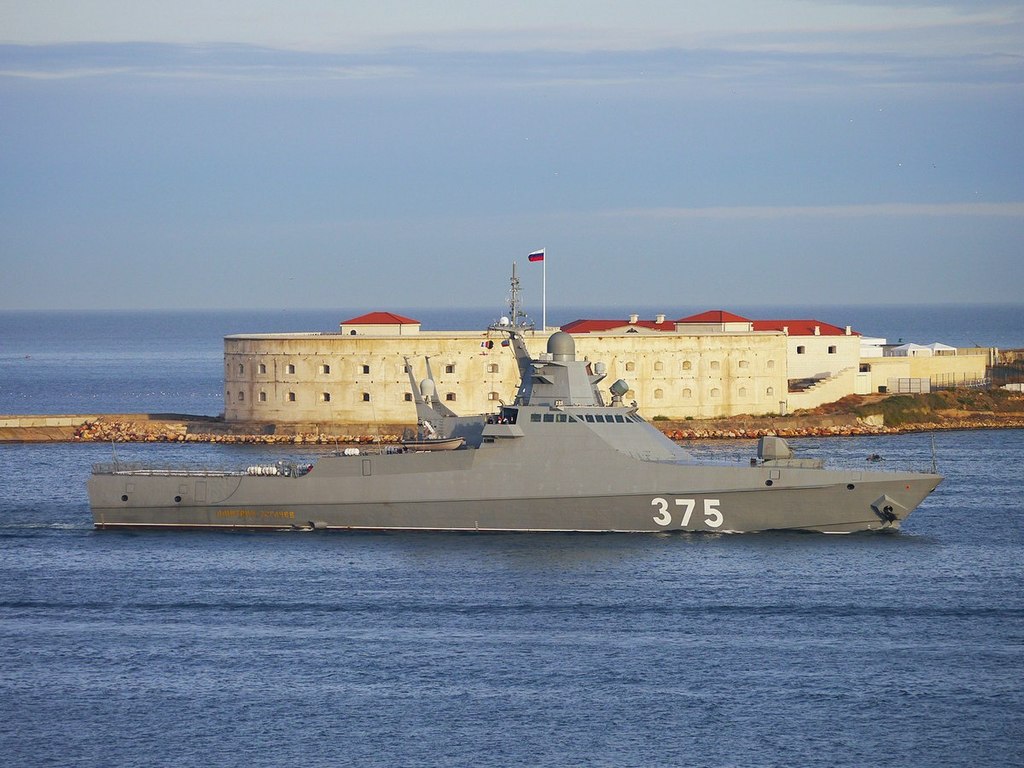
Pavel Derzhavin is a Project 22160 class patrol ship, a bit bigger than the Buyan-M at 94 meters (308 ft) in length, but not as heavily armed.
Russian Project 22160 Patrol Ship Dmitriy Rogachyov in Sevastopol, 12 April 2019. Photo from Ministry of Defence of the Russian Federation.
I found the reference to “Sea Baby drones with experimental weapons” interesting, not that the Sea Baby drone was experimental, so I presume the warhead was experimental. Various reports seem to indicate the explosion was extremely loud and created a great deal of smoke. This could have been the result of secondary explosions.
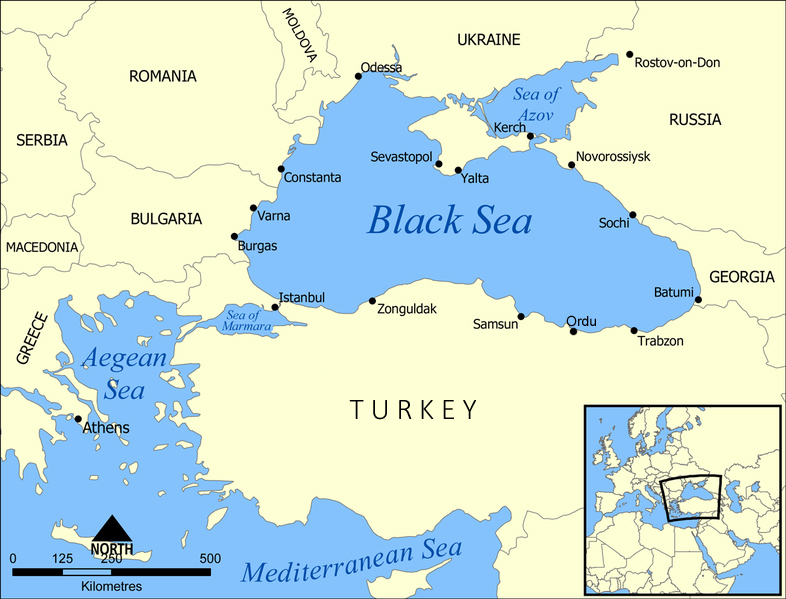
A map showing the location of the Black Sea and some of the large or prominent ports around it. The Sea of Azov and Sea of Marmara are also labelled. Created by User:NormanEinstein, Wikipedia
Russia has dispersed its naval forces in the Black Sea between the southeastern coast of Crimea and Novorossiysk in fear of Ukrainian surface drone strikes, Southern Command spokesperson Natalia Humeniuk said on Aug. 18.
Well, the US Navy is all a twitter about “Distributed Maritime Operations” (DMO) so is this a good idea for the Russian Black Sea Fleet? Like most such questions, it depends.
It depends on how good Ukrainian intelligence is. The supposed advantage for the Russian Fleet would be that their ships are harder to find, but is this case? Not only does Ukraine have access to some Western intelligence sources, but they seem to have good independent intelligence. All their successful USV attacks seem to have been against valid targets though there are many more potential targets that were not directly supporting the Russian military. When Russian ships are in port, the Ukrainians are going to know it.
Convoying has been a feature of Naval Warfare for over a thousand years because it is a defensive tactic that takes the choice of where and when to concentrate out of the hands of the offense. Spreading out the potential targets requires diluting the defense. That leaves the choice of where and when to concentrate effort in the hands of the Ukrainians.
To be successful, the defense has to detect all of the incoming USVs at a distance from their target and have sufficient numbers of countermeasures systems, in the right place, to engage all incoming USVs as they are detected.
The Ukrainian USVs don’t seem to be too hard to defeat once they are detected. Most of the successful countermeasures seem to have used machineguns, but you need one or more within effective range to engage every attacking USV.
On August 4, Ukraine’s maritime authorities issued a “war risk area warning” to all international mariners headed for six Russian Black Sea ports, including Novorossiysk and the smaller oil-exporting terminals of Tuapse and Taman. The warning is scheduled to go into effect on August 23 and continue “until further notice” (Interfax-Ukraine, August 5). And on August 8, Zelenskyy’s economic adviser Oleh Ustenko told US media that “everything the Russians are moving back and forth on the Black Sea are our valid military targets,” including oil tankers or terminals.
When you multiply the number of points you have to defend, you divide your defensive force. USVs are cheap and readily produced. Ukraine will not have trouble finding targets. Ukraine will attempt to overwhelm the defenses by creating situations where even if the defense is taking out say four out of five or six out of seven attacking drones, the Russians still loose, even if it is only one ship at a time.





 Chuck Hill's CG Blog