“U.S. Marine Corps And The New Long-Range Attack Munition” –Naval News

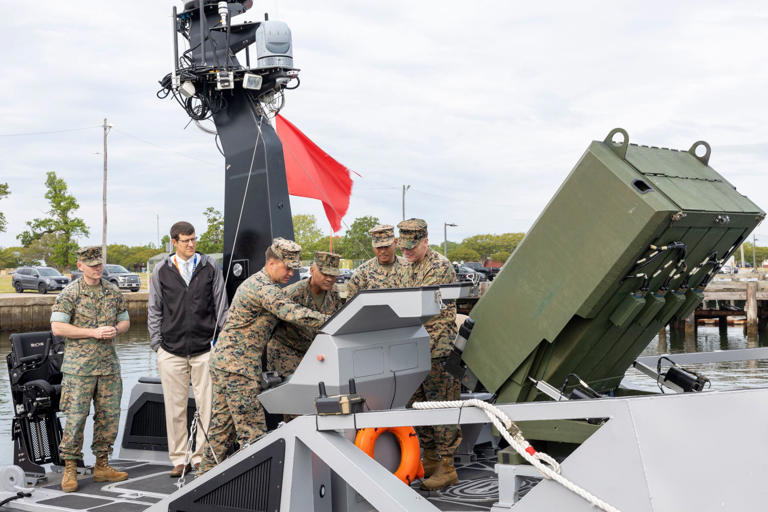
Not exactly the same, but you get the idea:   U.S. Marine Corps Lt. Gen. Brian W. Cavanaugh, the commanding general of Fleet Marine Force, Atlantic, Marine Forces Command, Marine Forces Northern Command, and Marines with 3d Marine Littoral Regiment, 3rd Marine Division, examine the manual controls to the Long Range Unmanned Surface Vessel, Joint Expeditionary Base Little Creek-Fort Story, Virginia, April 27, 2023. A LRUSV is an optionally manned vessel capable of extended travel and transporting loitering munitions that accurately track and destroy targets on sea or land. Metal Shark is designing, building, testing and implementing the LRUSV system under an other transaction authority aggrement with Marine Corps Systems Command to primarily serve as an intelligence, surveillance, and reconnaissance platform.
© Provided by The Drive

Naval News reports the Marines hope to develop a new long range loitering munition. It would take off vertically, be relatively inexpensive, be usable against both moving and fixed targets, on land or at sea, with a “minimum total payload weight capacity of 25 pounds (lbs) to include weapon seeker and warhead (but excludes fuel weight)” and have a range of about 150 nautical miles.

This might be something the Coast Guard could use. Single rounds should be effective against small, fast, highly maneuverable threats, while multiple hits might be effective against larger threats.  The relatively long range would mean it would not have to be widely distributed. A few, held as group assets, might be sufficient to deal with a terrorist threat.
“Our Best Look Yet at the Marines’ New Loitering Munition Toting Drone Boat” –MSN

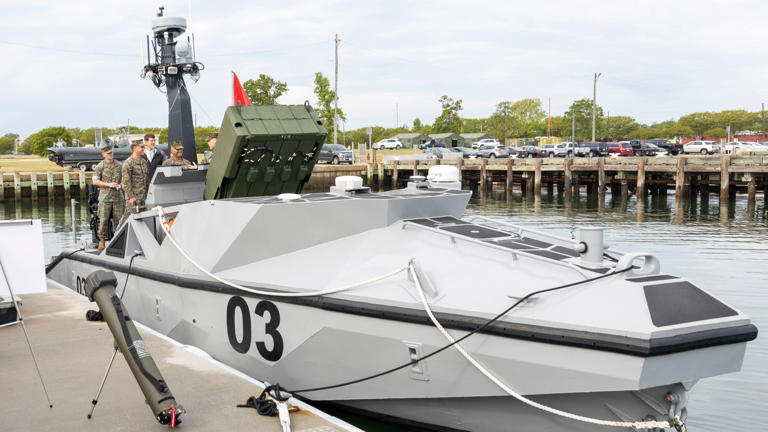
HERO 120 launcher on Long Range Unmanned Surface Vessel (LRUSV)

We talked about the HERO 120 loitering munition before. I noted it might be just what the Coast Guard needs to deal with the potential threat of small, fast, highly maneuverable craft.

While man portable single round launchers are probably all Coast Guard units might need (other than perhaps Bahrain based PATFORSWA Webber class cutters), we now have photos of an eight-cell launcher mounted on a Metal Shark optionally manned 40-foot, Long Range Unmanned Surface Vessel (LRUSV).

The Hero 120 is the largest offering in UVision’s “tactical” line of loitering munitions, weighing around 27 and a half pounds, including a 10-pound warhead. It uses an electric motor to drive a propeller at the rear and has a maximum endurance of around 60 minutes.

U.S. Marine Corps Lt. Gen. Brian W. Cavanaugh, the commanding general of Fleet Marine Force, Atlantic, Marine Forces Command, Marine Forces Northern Command, and Marines with 3d Marine Littoral Regiment, 3rd Marine Division, examine the manual controls to the Long Range Unmanned Surface Vessel, Joint Expeditionary Base Little Creek-Fort Story, Virginia, April 27, 2023. A LRUSV is an optionally manned vessel capable of extended travel and transporting loitering munitions that accurately track and destroy targets on sea or land. Metal Shark is designing, building, testing and implementing the LRUSV system under another transaction authority agreement with Marine Corps Systems Command to primarily serve as an intelligence, surveillance, and reconnaissance platform.
© Provided by The Drive

While it looks increasingly likely this system will become common in the Navy/Marine Corps inventory, it is perhaps important to remember that this eight-round launcher is not necessary to launch these. Loaded single round launchers are small enough to be man portable and would impose no heavy loads on the platform at launch. Certainly, some training would be required, but they could be stored in a group, station, or ship’s armory and be issued when needed.

Hero 120 Loitering Munition

The Navy/Marine Corps has a new weapon in their inventory, and it may be just what the Coast Guard needs to deal with the potential threat of small, fast, highly maneuverable craft. It is a loitering munition, a drone with a warhead, making it a kind of slow cruise missile with an ability to abort.

Hero 120 will be going on the Marine Corps Long Range Unmanned Surface Vessel (LRUSV) as well as Marine manned ground vehicles.

Weight (with canister): 18 kg (40 pounds)
Warhead: 4.5 kg (10 pounds)
Range: 60+ km (32.4 nautical miles)
Endurance: 60 min
Engine: Electrical
Launch method: Single/Multi-Canister

Range is to some extent apparently limited by line of sight, but this could be used from land or from virtually any patrol boat.

Take a look.

“U.S. 5th Fleet Reveals New Details on Iranian Drone Attack on Tanker” –USNI

Graphic illustration and images captured by a U.S. Navy explosive ordnance disposal team aboard M/T Pacific Zircon, Nov. 16, showing the location where an Iranian-made unmanned aerial vehicle (UAV) penetrated M/T Pacific Zircon’s outer hull during an attack Nov. 15. The one-way UAV attack tore a 30-inch-wide hole in the outer hull on the starboard side of the ship’s stern, just below the main deck. US Navy graphic

The US Naval Institute has a post providing addition detail about the November 15  drone attack on tanker Pacific Zircon.

The primary thrust of the post seems to be, to confirm that the drone was of Iranian origin, but then, that was almost assumed. They seem to have proven that, identifying it as a Shahed-136 design, a “loitering munition.”

For me the new information was where the tanker was targeted and the extent of the resulting damage.

When I first heard that this drone had hit the hull, I thought perhaps the Iranians had decided it was not to their advantage to kill crew members, as had happened in the July 30 attack on the tanker Mercer Street, but apparently that was not the case, since this strike was also on the stern where it is more likely to effect crewmembers.

As to the weapon’s effect, the Shahed–136 reportedly has a 30–50 kilograms (66–110 lb) warhead. referencing a 5th Fleet report, USNI notes,

On Nov. 15, a Shahed 136 explosive-tipped drone flew into the aft section of the merchant oil tanker M/T Pacific Zircon punching a hole through the hull, “while subsequently penetrating and damaging internal compartments. The UAV’s explosive impact also damaged a shipboard boiler, potable water tank and life raft,” reads the statement.

That they managed to damage engineroom equipment, which presumably required penetration of multiple internal bulkheads, after penetrating the hull, is more than I would have expected. The anti-armor, shaped charge version of the munition, which would result in a narrowly focused path of destruction, may have been used.

Another report from Business Insider vis Yahoo that includes more photos here.

“U.S. Blames Iran for Drone Attack on Tanker Near Oman” –USNI

Shahed 136 drones. Iranian military photo

US Naval Institute’s News Service reports,

U.S. Central Command and Israeli officials are blaming Iran for a Tuesday attack on an oil tanker linked to an Israeli billionaire off the coast of Oman.

Tanker Pacific Zircon was 150 miles off the coast of Oman when what U.S. officials said was an unmanned aerial vehicle hit the ship at about 3:30 p.m. local time, according to the shipping company.

Interestingly this second attack was on a ship linked to Idan Ofer, brother of the Israeli billionaire, Eyal Ofer, linked to the tanker, Mercer Street, attacked in a similar manner in July 2021.

The latest attack did not result in any injuries, unlike the earlier attack that resulted in the death of two crewmembers. Both attacks occured South of Oman in the Northern Indian Ocean.

“Loitering Munition Strikes Ukrainian Gunboat, A First In Naval Warfare” –Naval News

Naval News reports a Ukrainian Gyruza-M-class patrol boat

Gyurza-M-class gunboat. Photo: Ministry of Defense of Ukraine

has been hit by a Russian Lancet Loitering Munition.

ZALA Lancet, side view, Photo by Nickel nitride

The Ukrainian gunboat seems to have been pretty well armed.

We have talked about Loitering Munitions before:

These could be the answer to the Coast Guard’s need to be able to defeat small, highly manueverable, high speed surface threats.

They also extend the range at which non-state actors might be able to engage Coast Guard units.