“GAO says Coast Guard needs better ‘performance measures’ in Arctic” –Workboat

The USCGC Sycamore (WLB 209) crew participates in a navigation exercise with a HDMS Knud Rasmussen (P570), a Royal Danish Navy Knud Rasmussen-class patrol vessel and the FNS Fulmar (P740), a French Navy patrol vessel, off the coast of Southern Greenland, June 13, 2023. Deployed forces demonstrated U.S. Coast Guard capabilities to build partner capacity and expertise in search and rescue, navigation, and damage control. These efforts solidify key strategic relationships while achieving mutual Danish, Greenlandic, and U.S. goals in the North American Atlantic Arctic and Northwest Atlantic Ocean. (U.S. Coast Guard photo by Lt. Cmdr. Katherine Blue)

Workboat reports,

“The Coast Guard hasn’t fully tracked the time spent on its Arctic activities,” according to the GAO, which is the non-partisan auditing and accounting arm of Congress. “Complete information would help the Coast Guard better allocate its constrained resources and assess its progress toward achieving its Arctic strategic goals.”

It seems GAO is always critical, but that is sort of their job. Reports are a pain in the ass, but it does seem that the Coast Guard has been lax in both making reports and in using them to justify additional resources, and this does not just apply to the Arctic.

For instance, I have not seen reports like this in a very long time.

To compete for budget dollars, an agency should be able to show return on investment. Money spent on the Coast Guard is a good investment. We need to be able to document that.

Thanks to Paul for bringing this to my attention. 
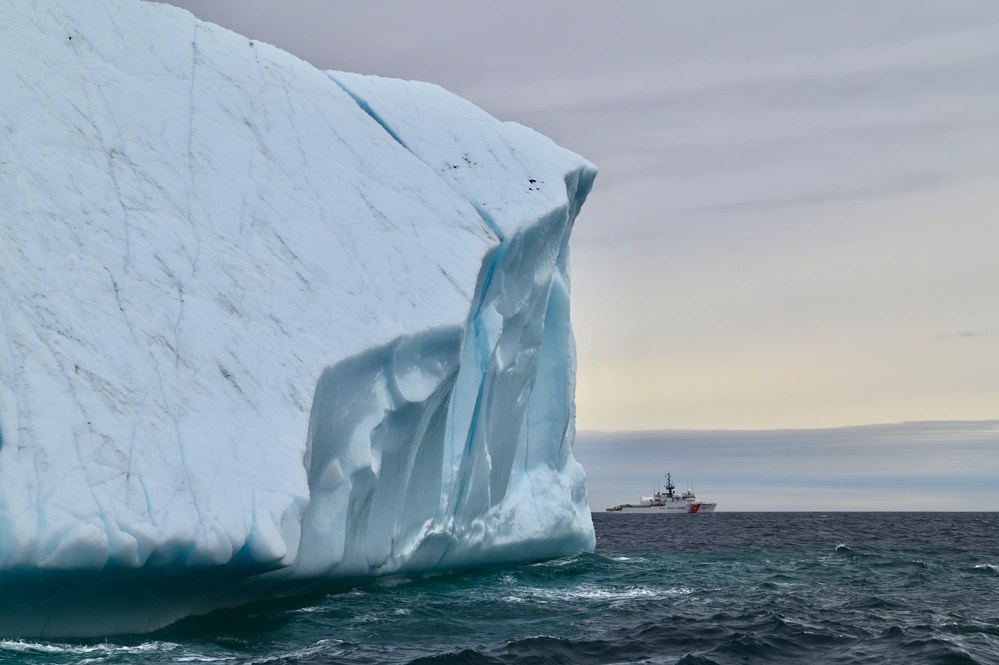
“USNI News Fleet and Marine Tracker: Aug. 28, 2023”

The U.S. Coast Guard Cutter Forward (WMEC 911) steams near an iceberg in the Atlantic Ocean, Aug. 22, 2023. Forward deployed in support of Op Nanook, an annual Canadian-led exercise that offers an opportunity to work with partners to advance shared maritime objectives. (U.S. Coast Guard photo by Petty Officer 3rd Class Mikaela McGee)

The US Naval Institute’s Fleet and Marine Tracker again reports three Navy ships are operating under 4th Fleet. This has been the case since the end of the UNITAS exercise. We will have to wait to see if this higher level of activity becomes a new norm.

As for Coast Guard activity, they note PATFORSWA in the Mid East, USCGC Healy (WAGB-20) in the Beaufort Sea, USCGC Forward (WMEC-911) participation in Operation Nanook, and, “Legend-class National Security Cutter USCGC Munro (WMSL-755) is in the South China Sea and is conducting joint training with the Malaysian Maritime Enforcement Agency (MMEA).”

There is good coverage of Coast Guard out of area operations. USNI is publishing what information they get from the Coast Guard, but apparently the Coast Guard does not provide anything comparable to the statistical information the Navy provides (as in the example below), so there is no information about routine Coast Guard operational tempo.

Ships Underway

Total Battle Force Deployed Underway
297
(USS 238, USNS 59)
100
(USS 67, USNS 33)
67
(39 Deployed, 28 Local)

Unfortunately, the Coast Guard frequently lacks visibility (particularly the larger cutters and fixed wing aircraft) because despite being an important component of the “National Fleet,” it is not included in the “Total Battle Force.” It could be argued that the battle force number is not very instructive because it includes everything from aircraft carriers to fleet tugs and research ships, but people, including people in Congress take the number seriously. They talk about it a lot.

The investment in high quality platforms that make the Coast Guard so effective in its peacetime missions is only fully justified by the fact that the Coast Guard serves as a naval auxiliary in wartime.

We cannot allow people to forget that the Coast Guard has wartime roles that justify additional investment in capabilities that might not be otherwise justified.

A revision to the statistical presentation, like the example above, that included Coast Guard major units, would demonstrate that Coast Guard units are underway at a relatively high rate. It would show that the government is getting what it paid for.

Coast Guard: Actions Needed to Improve Data Quality and Transparency for Reporting on Mission Performance and Capital Planning–GAO

The GAO has issued a report, “Coast Guard: Actions Needed to Improve Data Quality and Transparency for Reporting on Mission Performance and Capital Planning.” This was Testimony  before the Subcommittee on Coast Guard and Maritime Transportation, Committee on Transportation and Infrastructure, House of Representatives. You can find summary versions of the report here.

There are other issues, but what appears most significant to me is that apparently the Department is obstructing publication of information that the Coast Guard could easily provide.

GAO’s prior work also identified areas where the Coast Guard could improve the transparency of the data it uses for reporting on its mission performance as well its capital planning purposes. For example, in an October 2017 report on performance goals, GAO found the Coast Guard’s Annual Performance Report (APR) has not been released publicly since 2011. (emphasis applied–Chuck) Consequently, there has not been full visibility over performance across all of the Coast Guard’s missions. Coast Guard officials stated that a decision by Department of Homeland Security (DHS) leadership to limit the number of performance goals shared publicly had deterred the Coast Guard from public release of its APR (emphasis applied–Chuck). GAO recommended that APRs be available on the Coast Guard’s website; the Coast Guard plans to publicly release future APRs. In addition, previous GAO reports found that the Coast Guard’s annual 5-year capital investment plan, which projects acquisition funding needs for the upcoming 5 years, did not consistently reflect current total cost estimates or the effects of tradeoffs made as part of the annual budget cycle. GAO made recommendations to help the Coast Guard plan for future acquisitions and the difficult trade off decisions it will face given funding constraints. The Coast Guard agreed, but it is unclear when it will complete the 20-year plan.

From what I have heard, it also seems likely that the 20 year plan is also tied up at the Department level.

I did a series on published measures of effectiveness back in 2010 and the discussion it developed is still relevant to future reporting. Unfortunately the report the posts are based on is no longer accessible. You can find the posts here:

It is not as if these reports are optional.

The Government Performance and Results Act of 1993 (GPRA), as updated and expanded by the GPRA Modernization Act of 2010 (GPRAMA), requires agencies to establish annual performance goals with target levels of performance to measure progress towards those goals. See Pub. L. No. 111-352, 124 Stat. 3866 (2011) (amending Pub. L. No. 103-62, 107 Stat. 285 (1993)). Although GPRA and GPRAMA requirements apply to those goals reported by departments (e.g., DHS), they can also serve as performance management leading practices at other organizational levels, such as for component agencies (e.g., Coast Guard). In addition, GPRA requires executive agencies to prepare an annual performance report (APR) on program performance for the previous fiscal year, including a discussion of why any performance goals were not met and plans to meet those goals in the future. (emphasis applied–Chuck)

It sounds like the Coast Guard is doing more than enough performance measuring based on footnote 21 on page 11, to provide a comprehensive report.

To measure mission performance, the Coast Guard uses three types of performance goals and measures established by DHS for performance reporting by the Coast Guard and other DHS components: Strategic goals are used to reflect achievement of missions that are publicly reported in the DHS APR. As part of DHS’s APR, these goals are subject to GPRA and GPRAMA requirements. Management goals are used to gauge program results and tie to resource requests that are reported to Congress and publicly available through the DHS Congressional Budget Justification, along with the strategic goals. Operational measures are additional DHS component measures not reported by DHS, but used internally by components to inform management of operations and activities. The Coast Guard has at least 150 additional internal performance measures used to inform management of operations and activities based on our analysis of the Coast Guard’s Strategic Performance Directive and Operational Performance Assessment Report. (emphasis applied–Chuck)

I can’t help but believe, the Coast Guard, the nation, and even DHS would benefit from more transparency.