Piracy Update: Pirates 61 Captured, 14 Indicted, 5 Sentenced

The Indian Navy captured 61 pirates and freed 13 hostages in their third mothership take down of the year. The two previous operations were Jan. 28 and Feb 5. Sixty-one seems like a lot of pirates on a small ship.

A US court sentenced 5 pirates who had mistakenly attacked the frigate USS Nicholas to life plus 80 years. More here.

Fourteen of fifteen “suspected pirates” have been indicted in the case of the yacht Quest that resulted in the murder of 4 Americans.

And “As a last resort, the U.S. Coast Guard is drafting proposals to authorize merchant marines and private boat owners to use weapons against the pirates.”


Does This Mean the Chinese Will Create an American Style Coast Guard?

This is the second time I’ve seen reference to Chinese frustration with the fractured nature of their maritime law enforcement organization. As mentioned before, China currently has five different agencies that share “coast guard” duties. This has got to lead to some inefficiencies. Again we see the Chinese comparing their maritime law enforcement organization to that of the Japanese.

It will be interesting to see what the Chinese do about this perceived problem.


What Does It Take to Sink a Ship?

The Coast Guard spends much more time thinking about how to keep ships from sinking, than it does about how to sink them. But because the Coast Guard is tasked with maritime security and because of the potential for terrorists using a ship as a means of attack, the question has become relevant. It becomes important when you consider, is the Coast Guard adequately armed for its missions. I’ve mentioned several times that I don’t believe the 57 mm gun is adequate to stop a medium to large ship being used as a weapon. I’ll try to explain why I have reached that conclusion and offer some examples.

https://i0.wp.com/upload.wikimedia.org/wikipedia/commons/e/ea/BB61_USS_Iowa_BB61_broadside_USN.jpg

Stopping–keeping it from reaching the target–rather than sinking a ship is probably more the relevant criteria, but generally ships don’t sink rapidly, particularly if you are trying to do it with a gun, so almost inevitably it is necessary to do enough damage to ultimately sink the ship if you are going to stop it in a timely fashion. Many of the ships that I will talk about continued to fight on for over an hour after the first hits were registered. Think of sinking a close surrogate for stopping a ship before it reaches its objective.

There are of course many examples of ships either surviving grievous attacks or alternately ships sink after a single hit. What it takes to sink a ship is highly variable and at best probabilistic. Its highly dependent upon ship design and preparation, but the most important variable seems to be size.

World War II experience

Over a long period, I’ve made an informal study of this subject. The primary source I used was the US Navy Report of War Damage series available here. The same index also includes reports of individual ship damage and reports of damage to British warships. I would also recommend the “Destroyer Report: Gunfire, Bomb and Kamikaze Damage, 17Oct41-15Aug45” which includes annotated damage control plates. The amount of damage these little ships took and in some cases survived is truly amazing.

The US Navy Report of War Damage series briefly outlines all incidents of damage to US Navy Battleships, Carriers, Cruisers, Destroyers, and Destroyer Escorts as they were known at the time the document was published and includes diagrams of the location of hits. Continue reading

The Commmandant Answers–Future of WLR, WLI, WLIC, WTGB, WYTL

Shortly after the “State of the Coast Guard” address, the Commandant contacted us and offered to take some questions. Ryan Erickson, Bill Wells, and I took advantage of this generous offer and generated several–probably more than we should have. We may have overloaded the system, but the Commandant is being a good sport and says he will answer them all. Rather than try to answer them all at once, which would make for a very long post, they will come out individually or in small groups. This is the first:

Is there a plan for replacement or life extension for the old small
ships, including the WLR, WLI, WLIC, WTGB, WYTL?

The President’s Fiscal Year (FY) 2012 budget request includes funds for the completion
of engineering change work, materials purchasing and production for the first 140-foot
WTGB Ice Breaking Tug Service Life Extension Project (SLEP).  The goal is to add 15
years to the service life of the 140s.  We are not looking at a replacement project for the
140 fleet at this time.

In FY 2009, we were appropriated $5 million to begin the Inland River Tender
Recapitalization Project (formerly the Heartland Waterway Vessel Project), which is
planned to cover the WLR, WLIC & WLI classes.  Since that time, we have completed
the necessary mission analysis reports and drafted the mission needs statements.  The
U.S. Coast Guard and the U.S. Army Corps of Engineers Marine Design Center in
Philadelphia are collaborating on various Inland Fleet studies including some notional
designs.

There are currently no plans to replace the 65-foot WYTL Harbor Tugs.

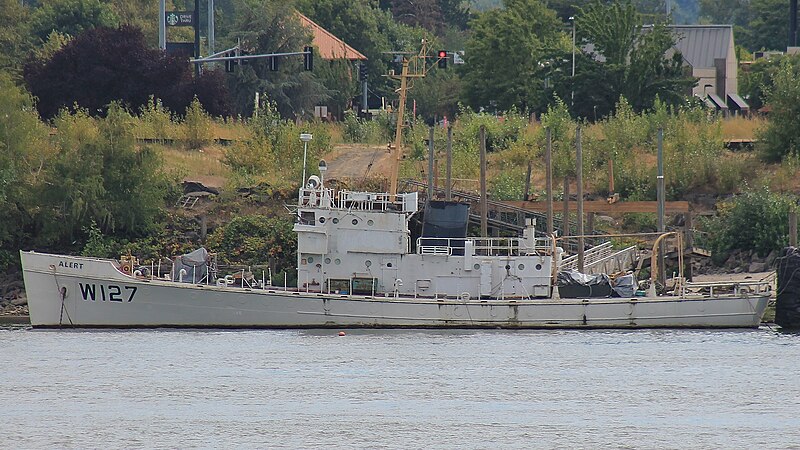
Old Cutter Alert WPC/WSC/WMEC-127

File:USCGC Alert August 2019.jpg

The Active-class cutter USCGC Alert (WMEC-127) moored on the Columbia River, by Hayden Island in Portland, Oregon. Seen on 14 August 2019. Photo from Wikipedia by Godsfriendchuck.

Ran across an effort to preserve a bit of our heritage. These volunteers’ mission to “…preserve, maintain and operate the old United States Coast Guard Cutter Alert, WSC-127 as a living museum. As one of the last warships representative of her era afloat we feel we have been given a chance to see to it that this fine old vessel continues to enlighten and inspire future generations.”She is now in North Portland Oregon.

As far as I can tell she is not open to the public yet. (Tried to e-mailed them but did not get a response.)

Anyone have a current status?

Coast Guard Dominates Helicopter Association International Awards

Aviation International News reports, “Helicopter crews and mechanics serving with the U.S. Coast Guard have been awarded four of the HAI’s (Helicopter Association International) eight “Salute To Excellence” awards to be presented this year tonight at Heli-Expo, including Humanitarian Service, Helicopter Maintenance, Pilot of the Year, and Law Enforcement.” Read the details are here.