“South Korea Bolsters Polar Capabilities Moving Ahead With Next-Generation Icebreaker” –gCaptain

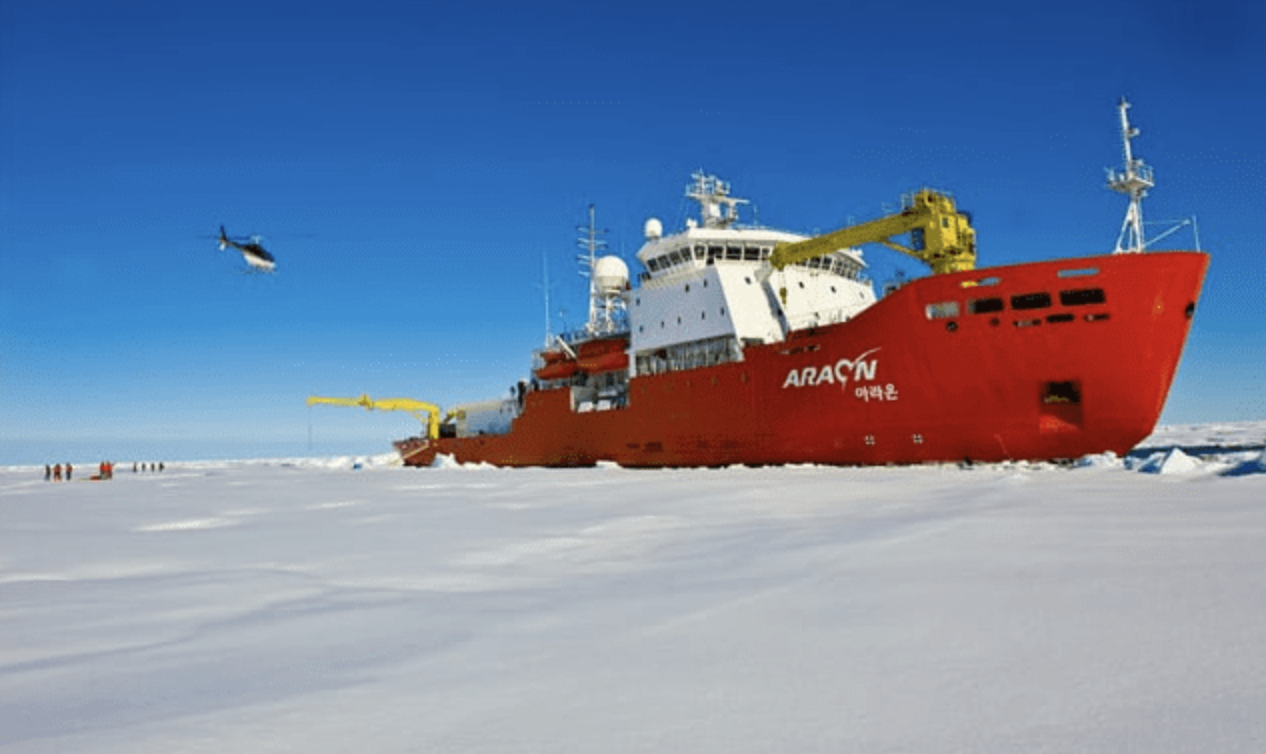
South Korea’s research icebreaker Araon, operated by the Korea Polar Research Institute. (Source: Korea Polar Research Institute)

gCaptain reports South Korea is building an icebreaker, “With a displacement of 16,560 tonnes the dual-fuel icebreaker – it can use both low-sulfur diesel and LNG – will be twice as large as the country’s existing icebreaker, Araon.”

But more interesting to me is that South Korea has been instrumental in operationalizing Russia’s Norther Sea Route.

All fifteen Arc7 ice-class LNG carriers for the Yamal LNG project were constructed by DSME (now Hanwha) with additional vessels and vessel elements for Arctic LNG 2 built by both Hanwha and SHI. Ice-capable oil tankers also originate at South Korean shipyards.

The country has also been a key anchor for expanded Arctic shipping with several container ship voyages via Russia’s Northern Sea Route originating or terminating at South Korean hubs, including Busan.

The Northern Sea Route certainly has the potential to facilitate trade between South Korea and Europe. The ships they have been building can traverse the Northern Sea Route without the aid of icebreakers.

“North American Arctic defense could shape outcome of Indo-Pacific conflict” –Indo-Pacific Defense Forum

A U.S. Army Green Beret observes an incoming CH-47 Chinook helicopter during Operation Polar Dagger in Wales, Alaska, in August 2024. IMAGE CREDIT: SPC. BRYON DAVIDSON/U.S. ARMY

The Indo-Pacific Defense Forum reported on a Special Operations Command North (SOCNORTH) exercise,

“To address growing concerns in the Arctic, SOCNORTH recently executed two phases of Operation Polar Dagger, an operational series that demonstrates rapidly deployable, joint SOF capabilities throughout the North American Arctic. It forms the basis of options to deter, disrupt and deny adversary activity in support of U.S. Northern Command’s (USNORTHCOM) layered defense of the U.S. homeland…

“In 2023 and 2024, SOCNORTH and the U.S. Navy partnered to deploy the amphibious transport dock ship USS John P. Murtha and the USS John L. Canley, an expeditionary sea base vessel that supports SOF operations and other maritime missions, to the Bering Sea and the Arctic Circle to support Operation Polar Dagger. USSOF is enhancing its navigation expertise in Arctic terrain and has demonstrated the ability to thrive in the region by executing long-range movements, maritime interdiction operations, rapid infiltration/exfiltration, air-to-ground integration, critical infrastructure defense, domain awareness, and medical evacuation validation, among other engagements.”

(I suspect what this means is that USS John P. Murtha participated in 2023 and USS John L. Canley participated in 2024. Both could not have participated both years.)

A lot of the post is an attempt to explain to an Indo-Pacific audience why a NORTHCOM exercise should be important to them.

Observations: 

It appears that Polar Daggar is a part of the larger NORTHCOM NOBLE DEFENDER exercise. This is apparently a regular annual exercise. NORTHCOM’s on-line magazine reported on the 2023 exercise.

“U.S. Army and Navy assets conduct an interdiction operation in the Bering Sea in July 2024.” Note how flat the seas are. That’s not normal. They did do this in July. You can’t count on seas like this. IMAGE CREDIT: SENIOR AIRMAN JOHNNY DIAZ/U.S. AIR FORCE

There is a serious problem here because there was apparently no Coast Guard participation in these exercises. The Navy’s Pacific Fleet almost never has surface ships anywhere near the Arctic. If you have an urgent need for a ship to do something in the Bering Sea, the Coast Guard is really the only option most of the time. SOCNORTH should be learning how they can exploit Coast Guard resources including ships, boats and aircraft. If you want maritime interdiction in the Bering Sea, if you want maritime domain awareness, who should NORTHCOM call? –the Coast Guard.

Want to fly a “Night Stalker” helicopter off of a ship? Want to launch ATACMS from the Chukchi Sea or maybe Tomahawk or SM-6 from a Mk70 launcher? You could put it on the flight deck of a cutter. 

Need follow-up logistics for paratroopers dropped into an isolated coastal location? Coast Guard.

A satellite image of Shemya Island. What is now called Eareckson Air Station, with its lengthy runway, is seen along the southern edge. Google Earth

Not enough Air Force transports available when you need to move troops to reinforce Shemya? Kodiak C-130Js can help with that.

Cutter might even put a landing party ashore to provide quick protection for a critical facility and stand offshore to provide some AAW protection with its 57mm.

East-Coast-based U.S. Naval Special Warfare Operators (SEALs) conduct an over the beach infiltration on Shemya Island, Alaska, Sept. 6, 2023, as part of Operation Polar Dagger. During the operation, special operations forces projected the ability of U.S. forces to defend critical infrastructure, enhanced all-domain awareness, demonstrated operational reach, and strengthened our understanding of activity in the Arctic. (U.S. Navy photo by Mass Communication Specialist 2nd Class Matthew Dickinson)

In 2023, Special Forces operating from USS John P. Murtha (LPD-26) did an infiltration exercise. A cutter could have done the same thing, and it probably would have been more realistic since an LPD is unlikely to be available.

Any surface or land action at the start of a conventional conflict against Russian and/or China that involves the Arctic is likely to be a surprise involving small units, probably involving covert actions from unconventional platforms, paratroopers, and small unit insertions. At least initially, it will be a “run what you brung” war. We will have to fight with what we have and effectively the Coast Guard is the surface navy for Alaska.

The “Center of Gravity” for the theater is likely to be the Bering Strait. As long as the US controls the strait, the Northern Sea Route will be useless for traffic between the Russian North coast and China or the Russian Pacific Coast.

The photo that leads off this post was taken at Wales, Alaska, population 145, 111 miles (179 km) northwest of Nome. The location is significant in that it is on the Eastern edge of the Bering Strait. It appears someone has recognized the significance of the location.

“US Coast Guard Icebreaker Sails in Proximity to Russia’s Northern Sea Route” –High North News

Nansen and Amundsen Basins Observational System (NABOS) moorings Healy is expected to visit. (Source: UAF)

High North News reports,

The US Coast Guard icebreaker Healy finds itself in unfamiliar waters as it becomes the first US government surface ship to venture into proximity of Russia’s Northern Sea Route (NSR) in the East Siberian Sea in several decades.

Russia claims the right to regulate traffic along the Northern Sea Route, a right the US does not recognize.

Healy is engaged in support of scientific research, but the Russians may view it as a challenge to their regulatory regime. The voyage, which originated in Seattle will end in Norway. Of course, Healy will then have to return to the US.

It is likely the US would like to do a Freedom of Navigation Operation through the Northern Sea route, but we have not had the facilities to do it with confidence.

Intentionally or not, Healy may be dipping a toe into the Northern Sea Route. So far, the Coast Guard is not saying.

Check out the article for a more complete discussion.

Thanks to Tups for bringing this to my attention.

“NPS Research on Coast Guard Icebreaker to Enhance Arctic Readiness” –Marine Link

During a seven-week Arctic transit aboard the U.S. Coast Guard icebreaker USCGC Healy (WAGB 20), Dr. Nita Shattuck from the Naval Postgraduate School (NPS) will study the impact of the extreme environment on crew performance and potential mitigations. Additional research includes assessment of an Amos01 3D printer installed by David Dausen from NPS’ Consortium for Advanced Manufacturing Research and Education (CAMRE), and specially instrumented to measure the impact of adverse Arctic sea conditions.

Marine Link reports the Naval Post Graduate School is doing some interesting studies on the working environment experienced by USCGC Healy’s crew.

To study the effects of these conditions on a ship’s crew at sea, Shattuck and her team will collect physiological data from the Healy’s crew members. Using innovative wearable technology, they will continuously monitor physiological processes such as sleep, heart rate, heart rate variability, respiration, oxygen saturation, and skin temperature. Study participants indicate that the rings are an improvement over wrist-worn wearables. The team will also use other sensors to monitor ambient light, noise levels, motion, and vibration aboard the ship.

The report also mentions that Healy will be going to Tromsø, Norway. How they get there will be interesting. Will they go the Northwest Passage through the Canadian EEZ or the Northern Sea Route through Russia’s EEZ?

“An Arctic presence grows more important for U.S. and its partners” –The Watch

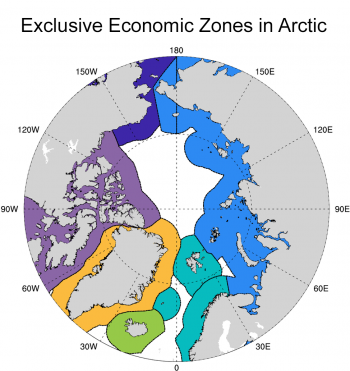
This map show the exclusive economic zones (EEZs) within the Arctic: Canada (purple), Greenland (orange), Iceland (green), Norway (turquoise), Russia (light blue), and USA (dark blue). As sea ice reduces there will be more opportunity for ice to drift from one EEZ to another, which has implications for the potential spread of pollutants.
Credit: DeRepentigny et al., 2020

NORTHCOM’s on-line magazine, The Watch, has a short post about the Arctic.

I would note that most of the discussion centers on the Atlantic side of the Arctic, whereas the Coast Guard concentration has primarily been on the Pacific side. We have seen some indications there may be Coast Guard Arctic capable assets on the Atlantic side in the future. Not too early to think about that.

The Coast Guard has had good relations with the Russians in the Arctic because of a common interest in fisheries, SAR, and environmental protection. That is all to the good. At some future date, the Coast Guard will probably do a Freedom of Navigation Exercise through the at least parts of the Northern Sea Route. Hopefully we can find ways to, perhaps, disagree amicably as we have with the Canadians in regard to the Northwest Passage.

“Military Planners Should Map Out Operations in Warming Arctic Waters, Expert Says” –USNI

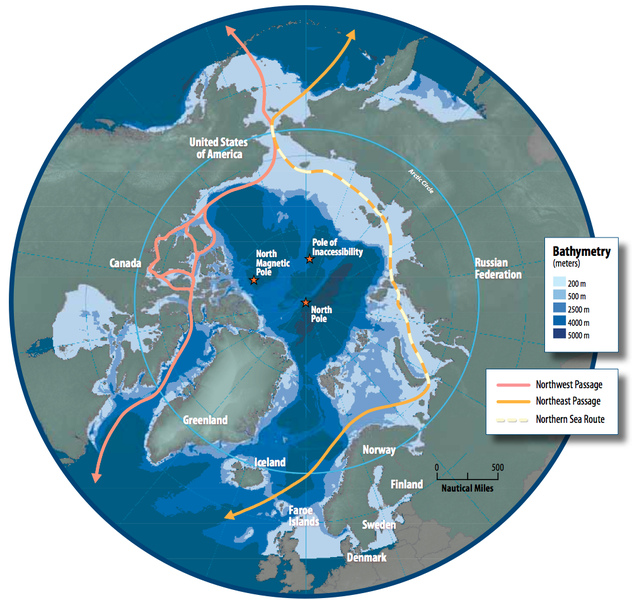
Map of the Arctic region showing shipping routes Northeast Passage, Northern Sea Route, and Northwest Passage, and bathymetry, Arctic Council, by Susie Harder

A reminder from the US Naval Institute of an issue that Russia and Canada share in opposition to the US–passage through Arctic Straits.

Let’s not forget that, when the US Navy wants to do “Freedom of Navigation” Exercises through the Northern Sea Route, there will be a Coast Guard icebreaker leading them.

“Rushing Navy Ships into the Arctic for a FONOP is Dangerous” –USNI

Map of the Arctic region showing shipping routes Northeast Passage, Northern Sea Route, and Northwest Passage, and bathymetry, Arctic Council, by Susie Harder

An interesting discussion of the Navy’s proposed Freedom of Navigation Operation (FONOP) in the Arctic which would presumably require Coast Guard assistance.

Within these stories are three different ideas: first, that the Navy is interested in expanding its physical presence in Alaska, through returning to Adak and/or a port on the Bering Strait ( Nome has been discussed for years); second, that Navy personnel need to regain operational familiarity with the Arctic environment; and third, that the Navy appears to be considering a freedom of navigation operation (FONOP) in the Arctic for summer 2019.

The first two ideas are unremarkable. Given the dearth of infrastructure and the challenging environment, both improved facilities and practical learning opportunities are required to ensure Navy vessels and aircraft operate safely and effectively.

The third idea—conducting a FONOP in the Arctic in just a few months—is a bombshell.

I seem to remember hearing that this had been discussed, and the Commandant had taken the position that the Coast Guard could not support the idea of a Freedom of Navigation Operation given the state of our icebreaker “fleet,” but apparently the idea is still alive, at least as of mid January.