“Mission success! Coast Guard exceeds 2024 recruitment target” –MyCG

Coast Guard Chief Petty Officer Jenna Coffey, a production recruiter at Recruiting Office D.C., talks about enlistment opportunities and incentives in Washington, D.C., September 19, 2024. (U.S. Coast Guard photo by Petty Officer 1st Class Zachary Hupp)

Below is a story from MyCG that discusses how the success was achieved, but in some respects, it is not as detailed as an earlier report from CBS. For instance, it does not mention that the maximum age for admission has been raised from 27 to 42, but taken together the two reports provides a good picture of how this success was achieved. Compared to what has been happening in other armed services, this is a remarkable turnaround. That is why it was national news.


Sept. 25, 2024

Mission success! Coast Guard exceeds 2024 recruitment target

By Zach Shapiro, MyCG Staff

For the first time since 2007, the Coast Guard has achieved all its recruiting missions for enlisted active duty, the Reserve, and Non-Academy Officer Candidate School (OCS) accessions. Thanks to Coast Guard Recruiting Command’s perseverance and coordination, the Coast Guard has accessed over 4,400 active duty members.

“This achievement would not have been possible without the efforts of our workforce and senior leadership’s investment in this endeavor,” said Capt. Ben Keffer, commanding officer of Coast Guard Recruiting Command (CGRC). Updated Coast Guard policies on the maximum recruiting age and tattoos, among others, have empowered recruiters to cast a wider net in their efforts.

Since 2022, the Coast Guard has opened new recruiting offices and added 95 new recruiting billets to process applicants. Today, the service has 72 traditional recruiting offices, 13 detached duty recruiting offices, 389 production recruiters, and four virtual recruiters. “I joke with my recruiters that I’ve still recruited zero people, but they’ve done over 4,400, so it’s a huge shout out to them, because the level of effort it takes to recruit people is no small feat,” Keffer emphasized.

The Coast Guard workforce and community has also had a hand in this success. Through programs like Scout Talent and Refer (STAR), which provides $1,000 for any Coast Guard member or employee who refers a recruit, and the bonus structures and incentives for new applicants, members and civilian employees play a critical role in spreading the word about the service.

“By exceeding this year’s recruiting mission, we are building a stronger Coast Guard, leaving the service better prepared for tomorrow’s challenges,” Keffer noted. “But the work isn’t over. We need your help to build this success into 2025 and beyond. We encourage Coast Guard members and employees to keep telling your friends about careers in the Coast Guard and to keep up their great work, which represents the Coast Guard well in our communities and nationwide.”

-USCG-

In the news: 
Resources: 

“Down 2,500 Recruits, Coast Guard Overhauls Talent Management” –USNI

The US Naval Institute News Service reports on how the Coast Guard is attempting to remedy its personnel shortage.

Recruiting had never been an issue for the Coast Guard, Vice Adm. Paul Thomas, deputy commandant for mission support, said at separate Sea Air Space panel. People would come to the service, and they met the necessary numbers with little effort. Now, the service has to revamp its approach.

The Commandant has asked people to think outside the box and it looks like we are beginning to see results. We can’t expect that every new idea will work, but at least the Coast Guard is trying new ideas.  

“Rebrand the Coast Guard Districts” –USNI

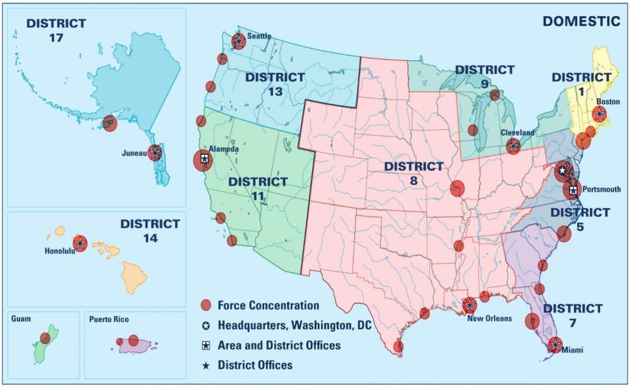
The February edition of US Naval Institute Proceedings has a one page, “No Body Asked Me, But,” article on page 18, by Cdr. Leah Cole, USCG, suggesting that the Coast Guard Districts be given geographic names rather than numbers.

I’ll just list the proposed names without linking them to the existing numbers because, you will find them obvious and intuitive.

  • Forces New England
  • Forces Mid-Atlantic
  • Forces South and Caribbean
  • Forces Heartland and Gulf Coast 
  • Forces California and Southwest Border
  • Forces Pacific Northwest
  • Forces Pacific Islands
  • Forces Alaska and Arctic

I think she pretty much nailed it, though I think Forces Southeast and Caribbean might be more descriptive for D7, and for D11, Forces Pacific Southwest.

Along with these, she would rebrand the Areas Forces Atlantic and Forces Indo-Pacific.  There is a potential glitch here, in that PATFORSWA, which frequently operates in the Indian Ocean, is currently under Atlantic Area. (Both the Combatant Commanders and the Navy’s Fleet structure have the Indian Ocean split up three ways.) Just Forces Pacific should suffice.

She goes on to suggest,

“As an additional step, the Coast Guard could time the renaming to align with a new recruiting initiative for both the active-duty and reserve force that offers candidates the opportunity to serve in their home regions or a region in which they would like to live and serve long-term. This could create a sense of purpose, build belonging, and also reduce barriers to accessions.”

She also suggests how district Reserve programs could be tuned for predicable surge operations–it’s a short read.

As I am sometimes told, this makes too much sense to actually happen, but it is definitely worthy of serious consideration.

“Commander Cole, a permanent cutterman, is executive officer of the USCGC Bertholf (WMSL-750). She is the 2023 recipient of the John G. Witherspoon Award for inspirational leadership.”

“‘Protect. Defend. Save’: Coast Guard Launches New Recruiting Initiatives to Attract Members” –Military.Com

(U.S. Coast Guard illustration)

Military.com has a post about the Coast Guard’s new recruiting initiative including the new logo above.

I really like the closing paragraphs,

To continue to provide a high level of operations, Fagan said, the service will need a 3% to 5% budget increase each year, which means, by 2033, the Coast Guard would be a “$20 billion a year organization.”

“I’m certain you will not find a better return on investment for the American people,” Fagan said.

Choice of words is important. Defend and perhaps protect, suggest to me, more emphasis on the Defense Readiness mission. Wonder if that was really the intention?

“Coast Guard launches new Lateral Entry initiative” –MyCG

Masked members of the cutter James crew and Commandant Adm. Karl L. Schultz (front, center), along with interagency partners, stand among interdicted narcotics at Port Everglades, Florida, on June 9. U.S. COAST GUARD / Petty Officer 3rd Class Brandon Murray

Just passing this along from MyCG. Note that one of the three ratings included in the program is culinary specialists (CS), reflecting the apparent cronic shortage in the rating. Presumably we are short electrician’s mates (EM), and health service technicians (HS) as well.


Coast Guard launches new Lateral Entry initiative

By Zach Shapiro, MyCG Writer, Nov. 17, 2022

The Coast Guard is launching a new Lateral Entry Beta Test initiative to fill key gaps in the workforce. As part of the Commandant’s intent to transform the total workforce, the Lateral Entry Working Group (LEWG) has developed a new, smooth, and streamlined process to recruit, train, and place candidates with matching skillsets and suitable military experience into critical roles in the service in fiscal year 2023 (FY23). The LEWG used the Maritime Operational Threat Response (MOTR) Protocols to develop the Lateral Entry Determination Calls (LEDC) Protocols to govern the process.

“The intent is to bring quality applicants into the Coast Guard at a grade commiserate with their existing skillsets,” said Command Master Chief Petty Officer Edward Lewis of Force Readiness Command (FORCECOM). This new process will create accountability, foster collaboration, and build a tailored training program that will help the Coast Guard meet the challenges of the next decade and beyond.

For Lewis and the Working Group, balancing the need for new recruits with preserving the age-old values of the Coast Guard is paramount. “Our fundamental goal is to protect the culture of the Coast Guard,” Lewis emphasized.  “However, we must seek new methods of accession, training, and managing, talent that preserve our competitive edge as an employer of choice.

The LEWG is focusing on filling key roles to strengthen the service. “We are trying to ensure that our workforce can meet missions. We’re looking hard at places where we are shorthanded,” Lewis added. “The recruiting effort is really going to be driven by critical ratings,” including culinary specialist (CS), electrician’s mate (EM), and health service technician (HS). Depending on the outcome of this pilot program, other ratings may be added to this priority list in the future.

The new lateral entry determination protocols will be evaluated regularly throughout FY23.

If you have any questions, please contact Russell Kirkham at Russell.A.Kirkham@uscg.mil or 202-795-6848.

Resources: