
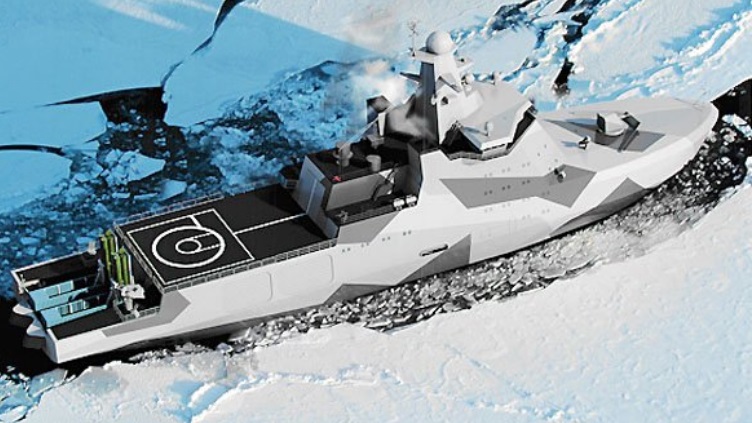
Concept image issued by the Russian Ministry of Defence of the Project 23550 ice-class patrol ships for the Russian Navy. Source: Russian MoD
Janes360 is reporting that the Russian Ministry of Defense has awarded contracts for two new ice class patrol vessels that are reportedly capable of operating in ice up to 1.5 meters thick (approx. 5 feet).
The class is described (in Russian) by the MoD as being “without analogues in the world”, and combining “the qualities of tug, ice-breaker, and patrol boat”.
To me it looks an awful lot like the Norwegian Coast Guard vessel Svalbard or Canada’s Arctic Offshore Patrol Ship that is based on the Svalbard’s design.
Jane’s notes, “A concept image released by the MoD showed the vessel armed with a medium-calibre main gun on the foredeck (likely an A-190 100 mm naval gun), a helicopter deck and hangar, and two aft payload bays each fitted with a containerised missile launch system (akin to the Club-K system offered for export) armed with four erectable launch tubes – presumably for either Club anti-ship or Kalibr-NK land-attack missiles. Although billed as patrol boats, this level of armament makes them better armed than many corvettes.”
If these are in fact containerized missile systems, then they may simply be optional equipment, added to the conceptual image to give the ship a bit more swagger, and we may never actually see this. If you are breaking ice for a vessel following close behind, you may not want missiles with their warheads and high energy fuel located near the stern where a collision with a vessel following too close might rupture a missile and start a fire.
It does suggest that a few spaces for containers could turn almost any ship into a potential missile platform.
![The Zelenodolsk Shipyard in the Volga area will lay down the third Project 22160 patrol ship Pavel Derzhavin on February 18, shipyard spokesman Andrei Spiridonov told TASS on Monday. "The shipyard will hold a solemn ceremony of laying down the Project 22160 patrol ship Pavel Derzhavin developed by the Severnoye Design Bureau in St. Petersburg [in northwest Russia]," the spokesman said.](https://i0.wp.com/www.navyrecognition.com/images/stories/news/2014/february/Project_22160_1.jpg)

 Chuck Hill's CG Blog