Sweden Selecting New Family of Weapons for Small Craft

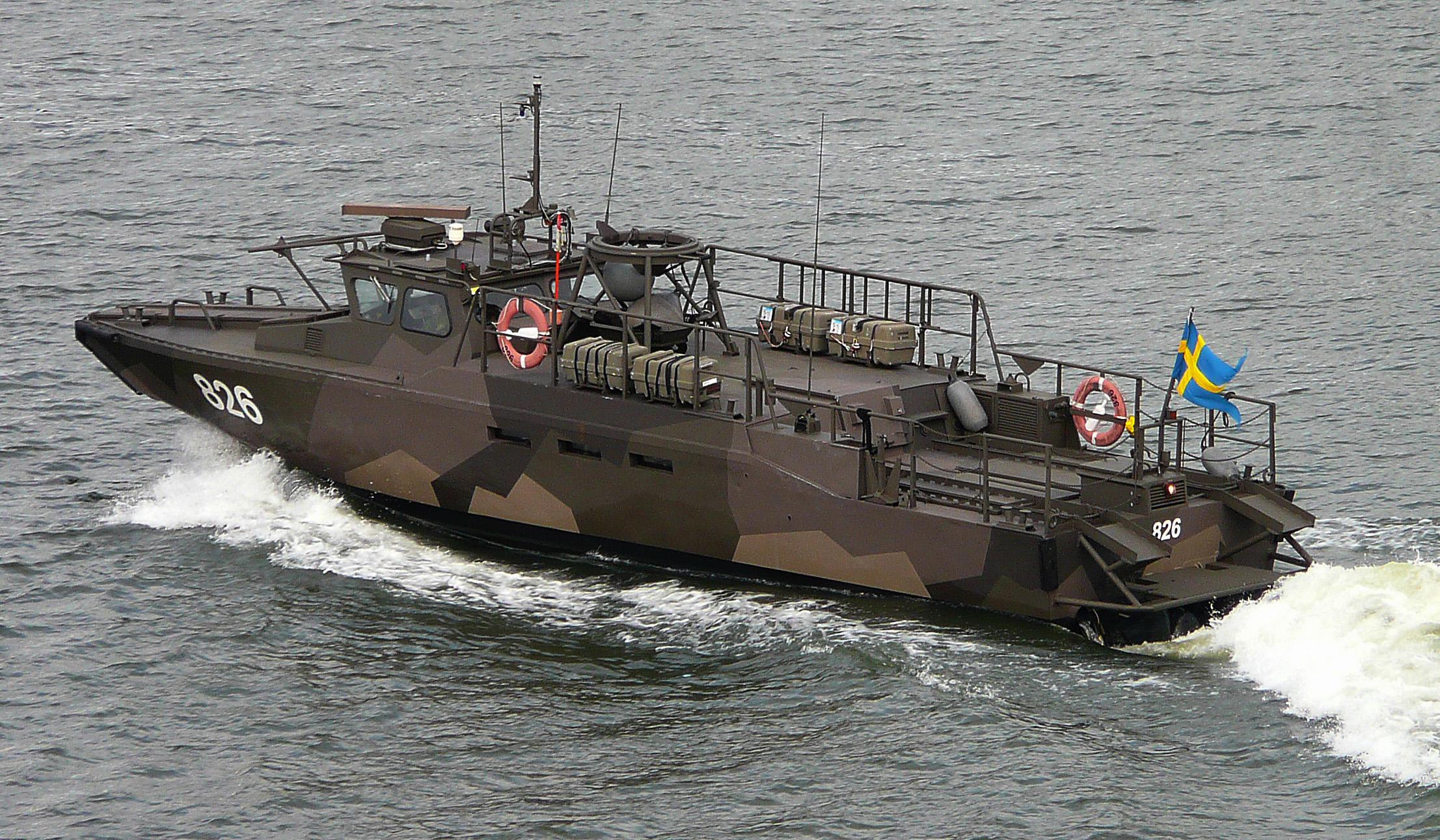
Swedish Combat Boat 90 (CB 90) in the port of Gothenburg. Photo by Arco Ardon

Naval News reports,

The Swedish modernization of their coastal troops is continuing, with the formal call for tenders for a new surface-to-surface anti-ship missile. The new weapon will receive the formal designation RBS 18, and unlike the current man-portable Hellfire-missile system used in the short-range anti-ship role by the Swedish marines will be mounted aboard the CB 90 combat boat.

Defense News reports,

“Sweden plans to acquire anti-aircraft guns for its fast-assault boats to counter drones and helicopters…”

Defense Industry Europe reports,

“FMV (Försvarets materielverk), the Swedish Defence Materiel Administration, announced the signing of a contract for the delivery of mortar-armed boats as part of the Amfbat 2030 programme.”

The Mortar equipped assault craft appears to be a resurrection of the previously cancelled Combat Boat 2010 program. The associated Patria 120mmAdvanced Mortar System could also be used in a direct fire mode.

The Amphibious Battalion operates between sea and land with the overall task of preventing enemy amphibious assaults. With the new maritime artillery, the fire controller on, for example, a Combat Boat 90 HSM can provide target data to the firing platform, enabling the firing of grenades at a high rate of fire while advancing, for indirect engagement of various types of ground targets. Image: FMV.

What we are seeing is a comprehensive overhaul of Sweden’s approach to littoral combat for their Amphibious Battalions (Amfibiebataljonen) of the Swedish Armed Forces from Stockholm and Gothenburg, assigned with defending the coastline, including numerous islands, against potential amphibious assaults.

While the mortars will be mounted on new construction boats, the new air defense and anti-ship missile systems will be mounted on existing CB90 (combat boat) assault craft.

The CB90 is a very popular product, used by at least nine different nations including the US, UK, and Ukraine. The Russian Navy even has what appears to be unlicensed copies of the craft. Mexico’s eight ship Oaxaca class Offshore Patrol Vessels carry a CB-90 HMN Patrol Interceptor in their well deck.

The CB90 displaces 23 tons and is 52 feet long with a 12.5 foot beam. 

If a weapon system fits on a CB90 it will certainly fit on any of the US Coast Guard’s patrol boats and larger cutters. 

In all probability the AAW weapon system will include a 30mm chain gun. Short range AAW missiles are possible. Perhaps the APKWS.

The anti-ship missile may be something entirely new. The closest to the description I know of, other than the MARTE MK2/N mentioned in the article, is the Spike NLOS.
“How Does Sweden and Finland Joining NATO Affect the U.S. Coast Guard?” –By Peter Ong

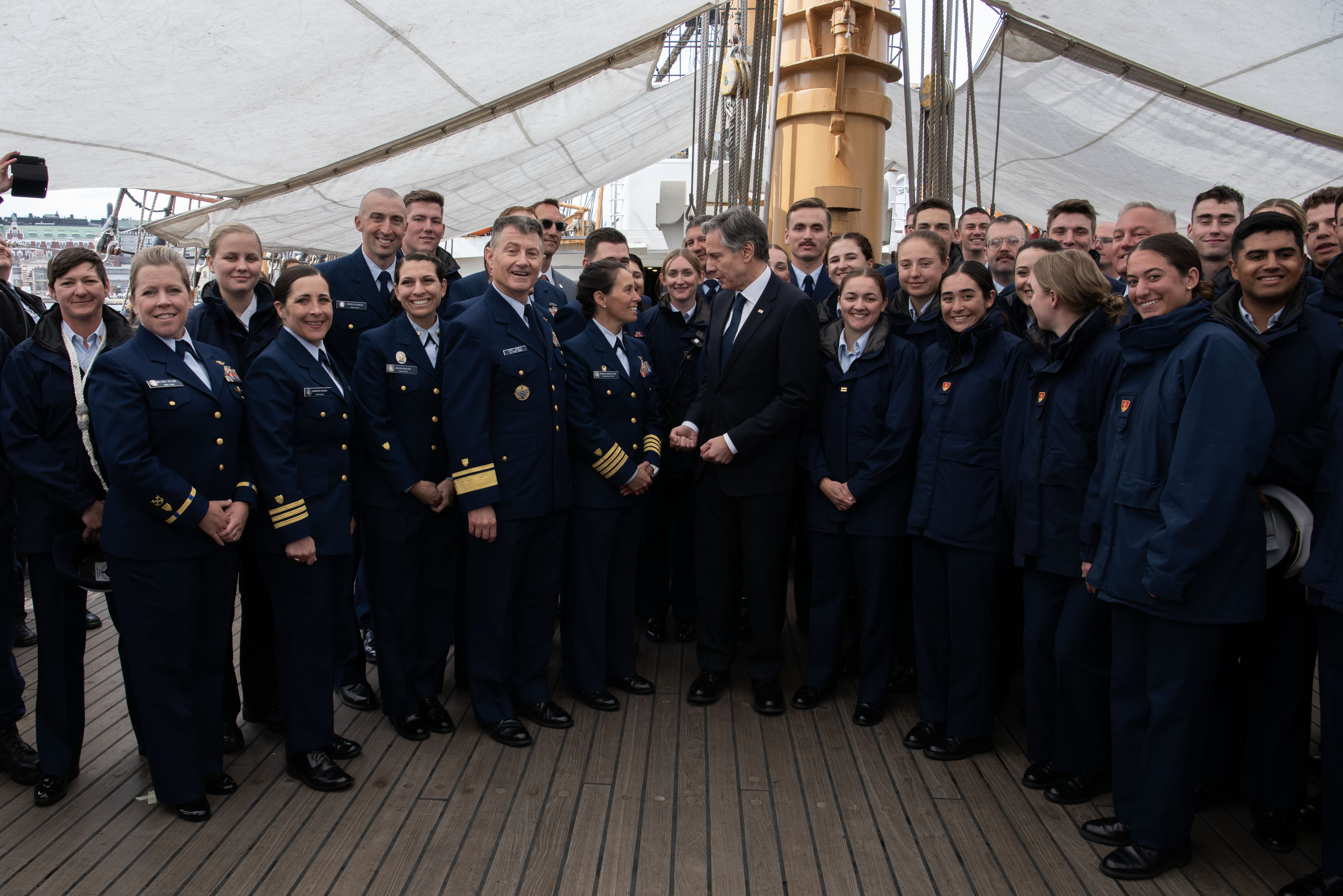
U.S. Secretary of State Antony Blinken, middle, takes a photo with the USCGC Eagle’s crew during a reception aboard the cutter, June 2, 2023, in Helsinki, Finland. Eagle is a tall ship used as a training platform for future Coast Guard Academy officers as well as a vessel utilized for establishing and maintaining domestic and international relationships. (U.S. Coast Guard photo by Petty Officer 3rd Class Carmen Caver)

Guest author Peter Ong provides a look at the continuing relationship between the Coast Guard and new NATO members Sweden and Finland. 

With the war in Ukraine affecting current economic and security situations in 2022-2024 Europe, the North Atlantic Treaty Organization (NATO) welcomed its two newest members, Finland and Sweden, both Arctic nations. Finland became a member of NATO on 4 April 2023. Sweden joined NATO on 7 March 2024.

NATO’s European members and when they joined the NATO alliance. Source: Wikipedia

I sent a media inquiry to the USCG’s Headquarters, Public Affairs Office, Washington D.C., asking how Sweden and Finland becoming NATO’s newest members might influence the U.S. Coast Guard in terms of icebreaking, cutter designs, exercises, training, enforcement, and maritime security.

The USCG replied, “From a regional perspective, this will increase cooperation and improve interoperability.  Information sharing, exercises, and operations will be much easier to coordinate with all the Nordics now in NATO.”


U.S. Coast Guard Petty Officer 1st Class Arthur Flaherty, a boatswain’s mate assigned to the USCGC Hamilton (WMSL 753), prepares to transfer Hamilton crewmembers onto the Swedish Coast Guard vessel Amfitrite in the Baltic Sea, Oct. 31, 2022. Hamilton was on deployment in the U.S. Naval Forces Europe area of operations. (U.S. Coast Guard photo by Petty Officer 3rd Class Alejandro Rivera)

The United States Coast Guard has a history of visiting and working with partner Baltic nations to improve relationships, training, interoperability, communications, intelligence, and coordination. Even before they entered NATO the US Coast Guard had a long-standing relationship with Sweden and Finland through the Arctic Coast Guard Forum.

U.S. Coast Guard Lt. Cmdr. Tanya Kuprak, engineering officer aboard USCGC Hamilton (WMSL 753), gives a tour of the engine room to Swedish Coast Guard members while underway in the Baltic Sea, Oct. 30, 2022. Hamilton was deployed with U.S. Naval Forces Europe and U.S. Sixth Fleet. (U.S. Coast Guard photo by Petty Officer 3rd Class Alejandro Rivera)

Recent interactions include:

United States’ relationship with Finland has benefitted in the area of model testing and consulting on the current Great Lakes icebreaker, Mackinaw, regarding its design and Azipod propulsion.