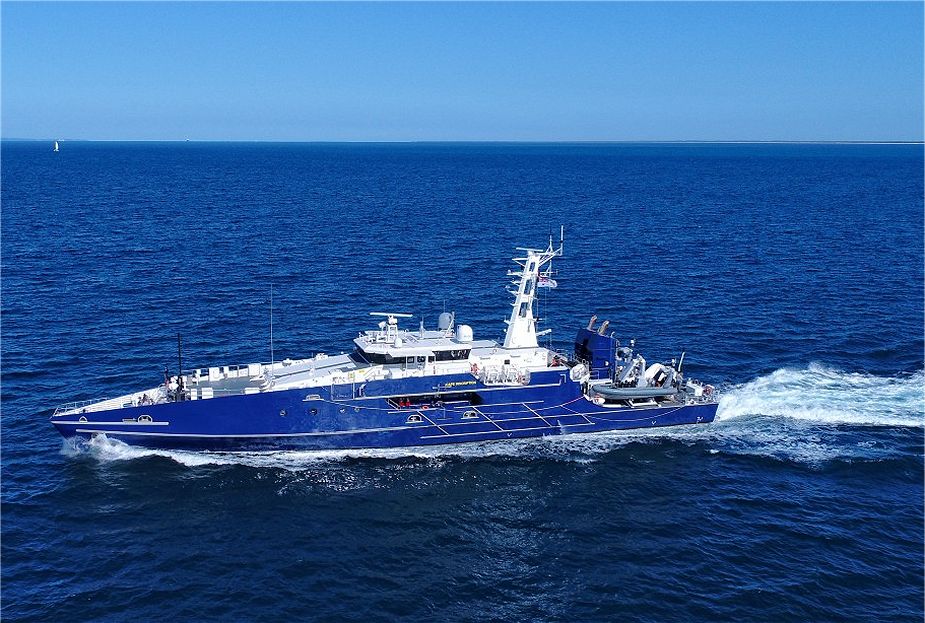
The six new Cape-class patrol boats will extend the fleet of ten ships currently operated by the Australian Border Force and Royal Australian Navy around Australia (Image: ADV Cape Inscription operating with the RAN)
Austal Limited is pleased to announce that Austal Australia has been awarded an A$324 million contract to design and construct six evolved Cape-class Patrol Boats (CCPBs) for the Royal Australian Navy.
These “Cape Class” patrol vessels are a bit unusual in size, slotting between typical “inshore” and “offshore” patrol vessels. We talked about this class when Trinidad and Tobago ordered two of them.
This is the information we had on the class earlier, compared to the Webber class.
Displacement about twice as large: 700 tons vice 353
Length: 57.8 m (190 ft) vice 46.8 m (154 ft)
Beam: 10.3 m (34 ft) vice 8.11 m (26.6 ft)
Draft: 3 m (9.8 ft) vice 2.9 m (9.5 ft)
HP, less: 6,772 vice 11,600
Speed, slower: 25 vice 28
Crew, smaller: 18 vice 24
Boats: two on davits vice one in stern ramp
Range: greater, 4000 vice 2500 nautical miles
Endurance: greater, 28 vice 5 days
These new ships will have some upgrades including accommodation for 32.
I was a little surprised by this procurement. Not too long ago, Australian Navy’s patrol force consisted of only thirteen 300 ton Armidale class patrol boats. These are being replaced by twelve 80 meter OPVs. None of these larger vessels have been completed so far. In the interim they leased two of these Cape Class. Now they are getting six more, improved versions. Presumably they will retain these even after the larger OPVs are completed, giving them 20 vessels.
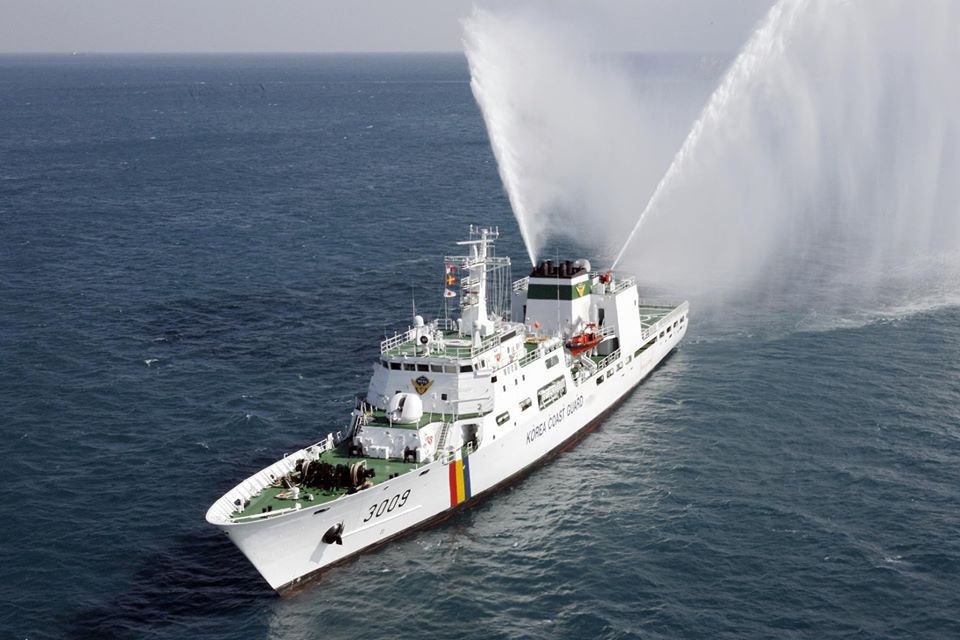
Naval News reports that the Korea Coast Guard will be receiving two new cutters. These are reported to displace 4,200 tons full load, meaning they are slightly smaller, but considerably longer than the 418 foot 4500 ton National Security Cutters and 360 foot Offshore Patrol Cutters of similar displacement.
There is no indication of the speed of the new cutters, but the earlier similar sized cutters, hull numbers 3009, 3010, and 3011 were reportedly capable of 28 knots. Armament seems be being standardized at a twin 40mm mount and 20mm Sea Vulcan Gatling Guns, both locally produced.
The Korean Coast Guard currently has 36 cutters of more than 1500 tons full load, including two of 6,500 tons full load, only one of the 36 is over 26 years old. Their Exclusive Economic Zone is less than 2.7% that of the US, but it is complicated by the proximity of North Korea, China, Russia, and Japan.
We have talked about TRAPS several times before, here, here, and here, but the video above is the clearest representation of how I works I have see so far. You can see the active element coming off the reel at time 23 to 25 seconds on this very short video.
It this works anything like it is claimed to (and the Canadian Navy has tested it), this could be a relatively easy route to reintroducing an ASW capability into the Coast Guard. It could also help detect low profile semi-submersible drug runners.
This December 2001 “battle,” described as a six hour firefight, between a small North Korea (NK) vessel and four Japanese Coast Guard cutters was unusual, but it is interesting for what it can tell us about the difficulties of dealing with a vessel that refuses to stop, as would probably be the case with a terrorist attack.
The incident happened outside Japanese territorial waters but inside their EEZ.
The NK vessel appeared to be a trawler, but this was no trawler. It was reportedly capable of 33 knots.
The Japanese went through the usual procedures trying to get the vessel to stop, flags, loud hailer, warning shots. When these were ignored, at least initially the Japanese apparently chose an aim point forward in the vessel where it was unlikely to hit crew members. Over 1000 shots were fired.
As appears to be standard procedure with the Japanese Coast Guard, it was not a single cutter, but a team of cutters that responded. In this case four. Japan Coast Guard aircraft were on scene, but apparently they had no airborne use of force capability.
Generally in the video, it appears that the cutters remained abaft the beam of the target vessel, minimizing the pursued vessels opportunity to ram a cutter and also insuring that friendly vessels were not in the line of fire.
Tsurugi class cutter PS202 Hotaka. From Wikipedia commons.
The Japanese cutters seen in the video appear to be Tsurugi class “high speed special patrol ships” specifically designed to intercept high speed North Korean vessels engaged in espionage or smuggling. They are longer but lighter than the Webber class, 50 meters (164 feet) in length with a 220 ton full load displacement and three diesels totaling
After the North Korean vessel was disabled the cutters came close aboard (about time 6:30). The wisdom of this was questionable since the vessel had been firing at the cutters. In fact the nearby cutter was fired upon. Subsequently apparently the crew of the NK vessel detonated scuttling charges, which had they been larger, might have damaged a nearby cutter.
15 survivors were seen after the sinking, but the cutters were told to ignore them as there was fear they would respond to rescue attempts with suicidal violence. The Japan CG cutter crews were relatively small. All members of the N. Korean crew were lost. Only three bodies were recovered.
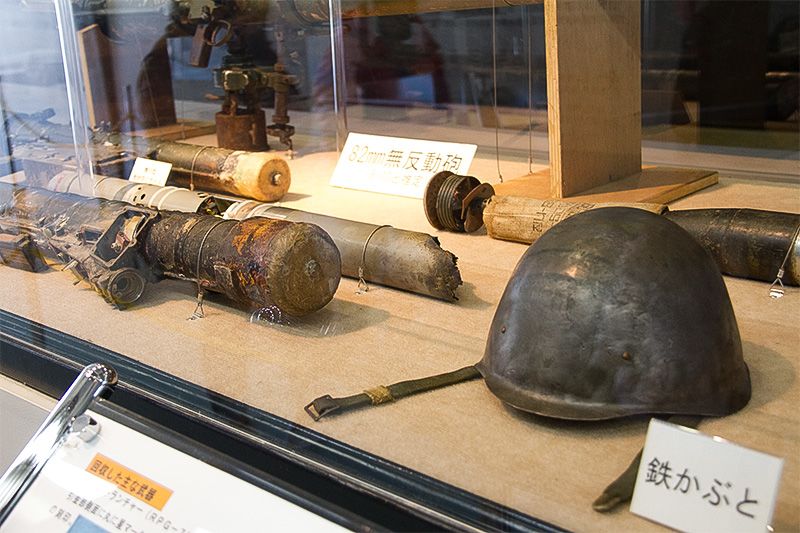
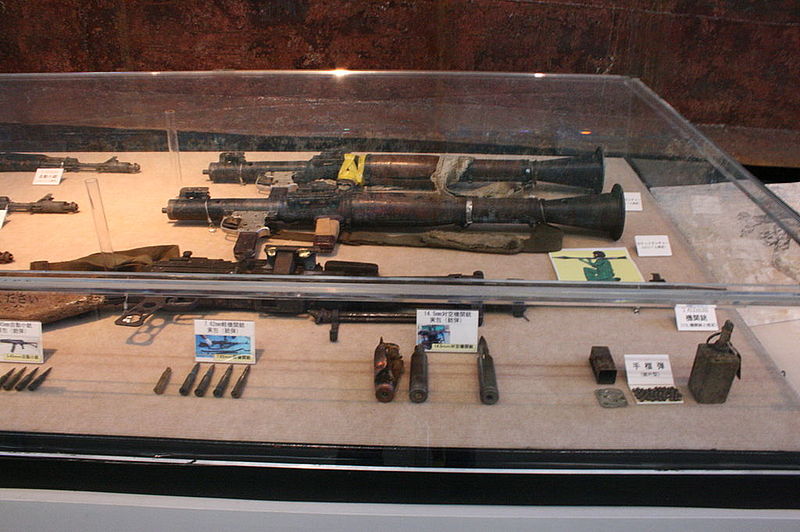
The North Korean vessel was small, 29.7 meters (97.4 feet) in length, but still the weapons used against it were found wanting. Due to the presence of heavy weapons like RPGs, recoilless rifles, and MANPADs on N. Korea spy vessels, the Japanese concluded that the 20mm Gatling gun was not adequate for their purposes and now expect to include vessels with 40mm guns in any similar future operation.
As I have noted before, I believe all Coast Guard vessels, WPB and larger, should be armed to forcibly stop any vessel regardless of size and have an effective range of at least 4,000 yards, so as to be outside the effective range of most potential improvised vessel weapon systems.
The North Korean vessel was subsequently raised to allow investigation of the incident. The vessel and some of its contents are on display at the Japan Coast Guard museum in Yokohama (see below).
ZPU-2 14.5mm anti-aircraft gun found on the North Korean spy trawler sunk by the Japanese Coast Guard in 2001. Transferred from ja.Wikipedia; ja:Image:North-Korea spy-vessel 2.jpg, Author: Bakkai at Japanese Wikipedia
Weapons including RPGs and automatic weapons found when the North Korean vessel was raised. Author: Nomansland511 (a.k.a. nattou)
There is not a lot new here if you have been following this website, but it is a good summary.
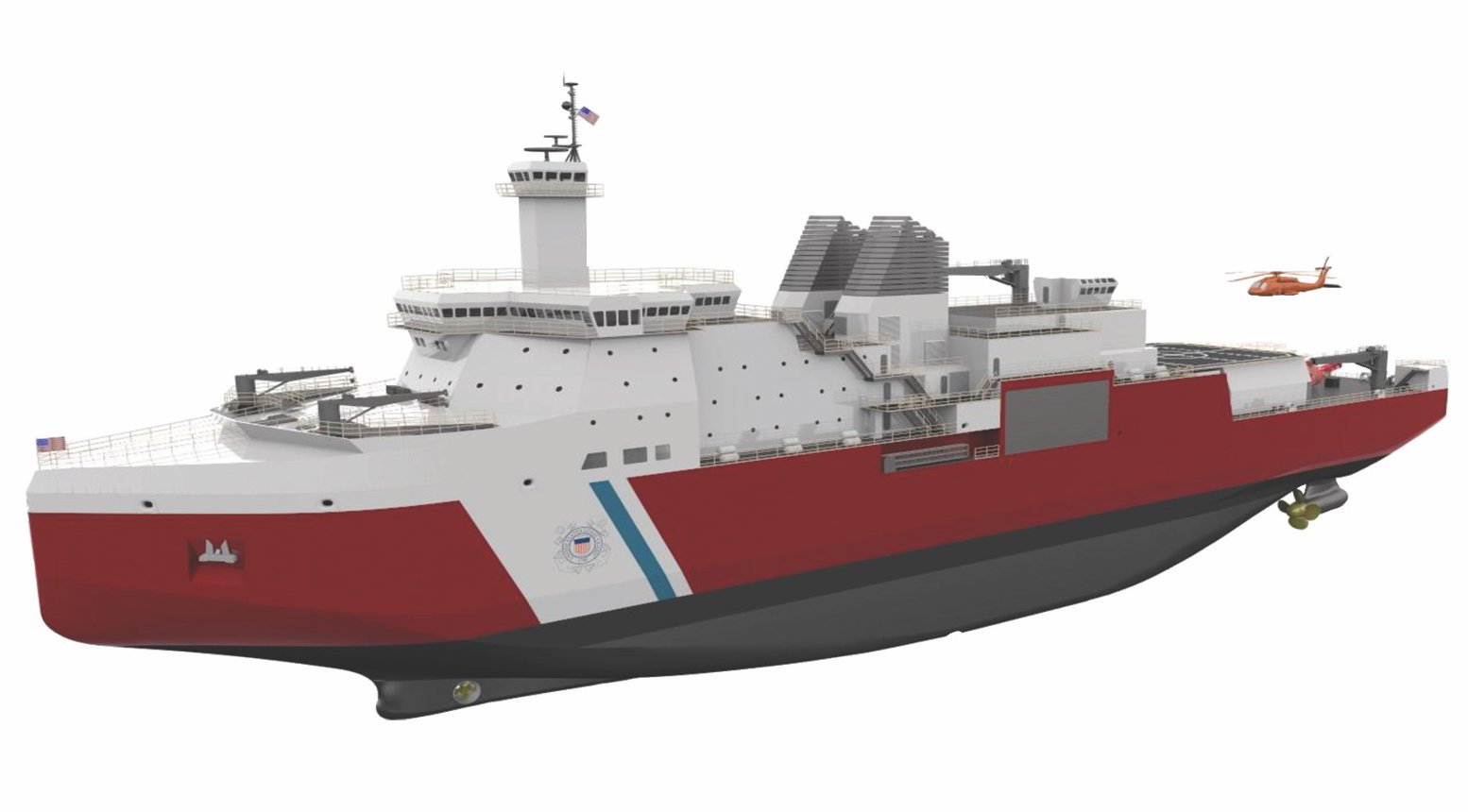
While it is true that, “The design of the PSC is based on that of the German polar research and supply icebreaker Polarstern II,” we now know that while Polarstern II was supposed to have been the parent design for the PSC, that project was cancelled and no contract for its construction was ever awarded.
Looking at the current plan for three heavy and three medium icebreakers, he suggests that the Coast Guard,
“…consider the alternative of three heavy polar icebreakers utilizing the current design and then have three other heavy polar icebreakers constructed on the same hull and propulsion design, but with greater emphasis on oceanographic and atmospheric research in polar waters. Utilizing the same hull and propulsion design will save time and money in the construction phase.”
Since the price has come down and should continue to do so with each successive ship, building more ships of basically the same configuration makes sense. There are already plans to provide space for science and research.
Presumably, at least the first two PSCs, and perhaps all three, will be assigned primarily to work in the Antarctic. The second class will probably work primarily in the Arctic. Operating frequently in the US EEZ, enforcing US laws and regulations, it makes sense to arm them more like other large cutters, like the NSC or OPC. In view of the apparent improvements being made to projectiles for the 57mm Mk110, a good fit might be two of these, one forward and one aft, to provide 360 defensive coverage. Using two of these weapons rather than one of 57mm and a second different weapon like the Phalanx, would minimize requirements for training and spares.
If things become confrontational in Antarctica, asI expect they will, these more heavily armed icebreakers could be used there as well.
Now for something completely different, to lighten the mood. In prep for my Academy class’ 50th graduation anniversary, a classmate, Bob Pokress, wrote new lyrics for Bruno Mars “Uptown Funk” and had it professionally recorded, to be used as the class marched onto the field. He also produce a couple of videos. First the one below staring some now old Coasties before they went to their first assignment. More recently the one above. Looking at the video below, you’ll see that the composition of the class of 1969 was very different from the population of today’s Academy classes.
The Gauntlet has been thrown down. Other Coast Guard unit videos out there that might equal or top this one?
Orthographic map of Venezuela centered on Caracas Controlled territory in dark green. Claimed territory in light green. From Wikipedia, Author: Addicted04
“President Donald Trump announced Wednesday that Navy ships are being moved toward Venezuela as his administration beefs up counter-narcotics operations in the Caribbean following a U.S. drug indictment against Nicolás Maduro.”
Most of the narcotics trafficking seems to be in the Eastern Pacific rather than the Caribbean. Venezuela’s coasts are on the Caribbean and the Atlantic. Apparently not all the effort will off Venezuela,
“The mission involves sending additional Navy warships, surveillance aircraft and special forces teams to nearly double the U.S. counter-narcotics capacity in the Western Hemisphere, with forces operating both in the Caribbean and eastern Pacific. Esper said the mission would be supported by 22 partner nations.”
Maritime-Executive and FleetMon report a curious case in the Caribbean. Looks like, perhaps the Venezuelan Navy attempted an act of piracy against an ice strengthened cruise ship, RCGS Resolute with 35 crewmen aboard, and lost a ship as a result. Warning shots were fired and the Venezuelan vessel attempted to shoulder the cruise ships.
Also this is the second Navantia built warship to sink as a result of collision. The Venezuelan patrol vessel, NAIGUATA, was commissioned in 2011 and is about the size of a Coast Guard 270 foot WMEC, 1720 tons full load, 79.9 m (262 ft) in length. Navantia is also teamed with Bath Ironworks in the US Navy’s FFG(X) Competition.
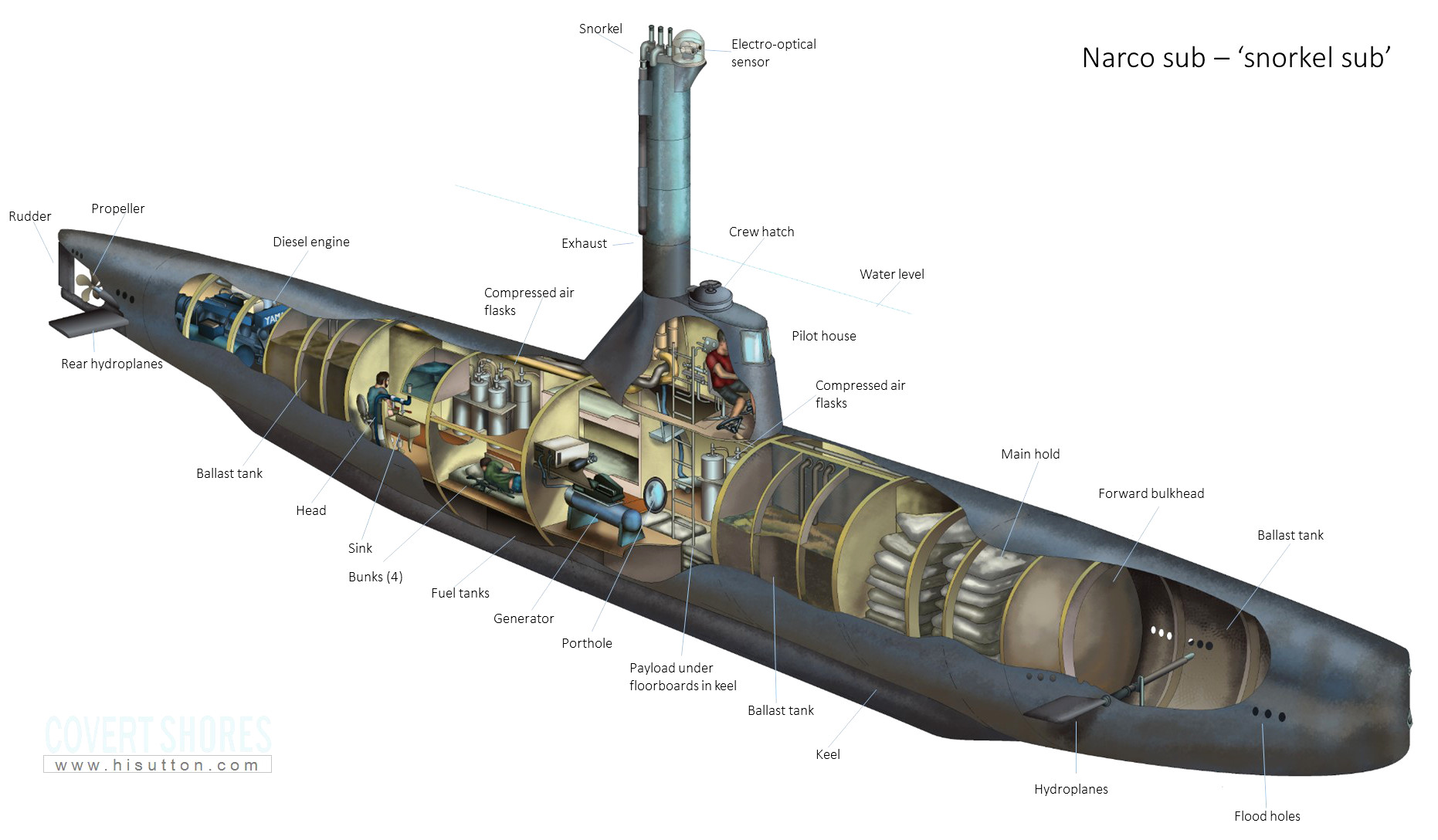
H. I. Sutton’s Covert Shores has a short guide to the various types of “drug sub” smuggling vessels. He lists five types and provides photos and/or diagrams of each.








 Chuck Hill's CG Blog